Owner/operator: Nevada Geothermal Power Inc.
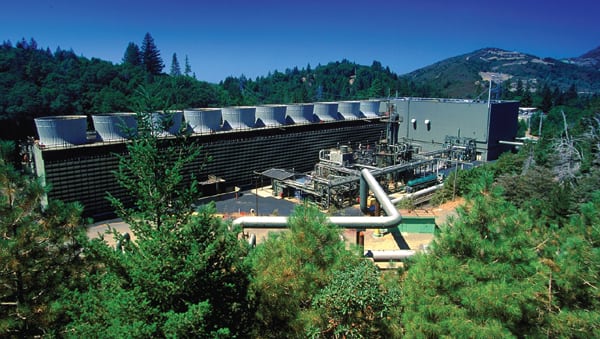
Completed in 2009 and partially funded under the American Reinvestment and Recovery Act, the 50-MW Blue Mountain Faulkner 1 Geothermal Power Plant is harnessing large amounts of renewable energy by tapping into an underground geothermal reservoir in northern Nevada. This subterranean source of heat allows the binary plant to generate pollution-free baseload electricity.
Hot rocks are hot business in the electric power sector these days. Currently, the U.S. has approximately 2,998.5 MW of geothermal energy capacity installed, which is 30.42% of the world’s total. Proposed and planned U.S. geothermal plants now total approximately 7,800 MW—more than double the geothermal generating capacity that’s already online. Currently identified geothermal resources in the U.S. could provide more than 20,000 MW of power to our nation, and it is estimated that undiscovered resources could provide five times that amount.
There are three general types of geothermal plants:
- Dry steam. Dry steam systems work by tapping into the naturally occurring pockets of steam or hot water that rise from deep underground, bringing with them the energy stored by rocks far below Earth’s surface. The steam or hot water is then used to drive turbines and produce electricity. The best known dry steam projects are the Geysers plants in northern California.
- Flash steam. Flash steam plants flash high-pressure hot fluids to vapor at lower pressures and then use that vapor to make power.
- Binary. Binary plants recover energy from hot fluids to heat a secondary fluid that is used to produce electricity.
One of the great advantages of geothermal energy is that it can be produced with minimal environmental impacts. Another benefit is that geothermal energy can provide continuous baseload electric power generation, unlike other renewable resources, such as wind and solar energy, which are variable.
One example of the new wave in geothermal power generation is the recently completed 50-MW Blue Mountain Faulkner 1 Geothermal Power Plant. To help finance its project, in November 2009, Nevada Geothermal Power Inc. (NGP) applied for and received a $57.9 million cash grant from the U.S. Department of the Treasury in lieu of tax credits for its geothermal power plant. This cash grant was funded by the American Reinvestment and Recovery Act. The total construction cost for the Blue Mountain power plant was $180 million, and debt financing was handled by Trust Company of the West.
“Geothermal power plants cost less to construct than most other renewable energy power plants, which leads to much more robust project economics, particularly due to government incentives,” explained Brian Fairbank, NGP president and CEO.
Plant Profile
NGP’s Blue Mountain facility is a state-of-the-art binary cycle geothermal plant supplied to NGP by Ormat Technologies Inc. It uses a closed-loop heat exchange system in which hot geothermal fluid is used to heat a secondary fluid that has a lower boiling point. Isobutane, the secondary fluid used at the NGP plant, is vaporized and used to run a turbine and generate electricity (Figure 1).
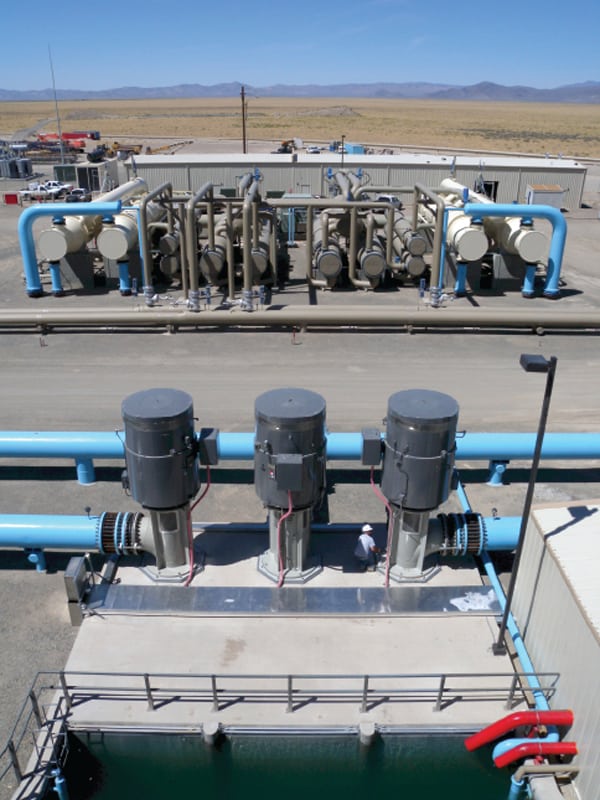 |
| 1. Geothermal energy at work. The view from the cooling tower of the energy converters at NGP’s Blue Mountain Faulkner Geothermal Power Plant in northern Nevada. Courtesy: Nevada Geothermal Power Inc. |
ThermaSource and Ensign were the well drilling contractors at the plant. JFMPE was the piping contractor, and GeoThermEx Inc. handled the reservoir engineering.
Fifteen full-time NGP staff members operate, service, and maintain the power plant, which runs continuously, every day of the week.
NGP’s Blue Mountain power plant started generating electricity in October 2009. Currently, the plant is operating at a net output of 37 MW and is selling power to NV Energy, which distributes power to much of Nevada and a corner of California, under a 20-year power purchase agreement.
At Blue Mountain, thermal water, which has an average temperature of >150C (300F), is supplied by five production wells and six injection wells. However, drilling is not complete and, at press time, a three-well program was scheduled to commence in late 2010.
Similar to many other newly commissioned power plants, the Blue Mountain power plant faced some challenges in its early days of operation. For example, in January, the facility experienced an electrical outage, which was repaired by the engineering, procurement, and construction contractor, Ormat. The plant was restarted in late February. A settlement has been reached, and NGP has been compensated for all losses incurred from the outage.
“We are pleased with the performance of the Faulkner 1 Power Plant at Blue Mountain and the transition of the company from developer to a significant power producer,” Fairbank said. “Revenue from power sales increased steadily from start-up through each of the last quarters.”
Another early challenge NGP faced was related to grid interconnectivity and accessing transmission lines, Fairbank explained. In the end, NGP built a 21-mile, 120-kV, wood pole transmission line, rated to carry up to 120 MW of power, from its Blue Mountain plant to the transmission grid connection at Mill City, Nevada.
Strong Geothermal Resources
The western U.S. has a remarkable variety of world-class geothermal resources, including the Geysers, a field in northern California, which is the world’s largest electricity-producing geothermal system. The Blue Mountain geothermal resource in northern Nevada has in abundance the necessary elements to produce electricity. According to Fairbank, those are:
- A heat source, traditionally found in volcanically active areas, although the current industry focus is largely on deeply buried hot granites.
- Permeable rock—either fractured granites or sedimentary rocks such as sandstones.
- Water to transport the heat to the surface for power generation.
The Plant’s Permitting Process
The permitting process involved a number of different entities. “As with most rural or remote areas in Nevada, the lands are checkerboarded federal and private ownership,” Fairbank explained. “The Blue Mountain project is on both private and federal lands and thus entails a federal, U.S. Bureau of Land Management (BLM) permitting component. The BLM reviews projects under the National Environmental Policy Act and issues permits for utilization and commercial operation. Permitting this power facility entailed local (Humboldt County) permits and, as with most states, there is federal and state duplication of permitting the drilling of geothermal wells on federal lands.”
On private lands, only the state agency issues drilling permits, Fairbanks said. In addition, Nevada’s Division of Minerals and Division of Environmental Protection coordinates its permits so that one drilling permit approves the casing and cementing program, as well as injection and surface discharge facilities. Changes to these permits are addressed through sundry notices.
Completion of a project such as the Blue Mountain plant requires that well over a hundred leases, easements, water rights, exploration and development drilling permits, environmental and land surveys, and plan approvals be obtained. The transmission and sale of power also requires oversight by the Nevada Public Utilities Commission, the Federal Energy Regulatory Commission, and the PUC Utility Environmental Protection Act.
Community Reaction to the Geothermal Plant
Residents of the city of Winnemucca in Humboldt County, Nev., appear to be pleased with having the Blue Mountain Faulkner 1 Geothermal Power Plant as their new neighbor.
“These are the types of operations that should receive funding, as they provide for eventual cost saving through renewable energy that benefits everyone,” Di An Putnam, Winnemucca’s mayor, said in a press release in February. “There is also an immediate economic benefit to the area.”
The plant will help Nevada meet its renewable energy portfolio standard requirements while creating new green jobs to help with its operation. Additionally, it helps to supply the area with clean, domestic renewable energy while reducing reliance on fossil fuels and associated carbon emissions.
“Nevada Geothermal Power has been a great addition to [Winnemucca’s] industrial makeup,” Putnam said. “They have provided diversity to our job base, which is a key element in our community’s growth. Even more so, they have put our area on the green energy map.”
Looking Ahead
Fairbank said that NGP estimates that the long-term production potential for the Blue Mountain plant’s wells at this site is “20 years plus.”
“By expanding the Blue Mountain Faulkner 1 Geothermal Power Plant, NGP plans to increase out to 71 MW net (89 MW gross) by the end of 2011,” he said. “In addition, NGP anticipates that they will place both the Crump Geyser and the Pumpernickel geothermal power plants online by the end of 2013.”
— Angela Neville, JD, is senior editor of POWER magazine.