The U.S. Energy Information Administration’s (EIA) extended forecast of electricity consumption requirements—as shaped by demographic trends, migration patterns, and population growth—suggests a 40% increase from current levels by 2030. To put this in perspective, that’s the equivalent of approximately 292 GW of new generating capacity. Considering the availability of fossil fuels, nearly half of the world’s electricity will need to come from nuclear, wind, and solar sources in order to reduce annual global carbon dioxide emissions by 2050. Today, carbon-free fuels account for only a third of global power generation.
Revitalizing nuclear power
As part of President Bush’s Advanced Energy Initiative, in February 2006 the secretary of energy announced the Global Nuclear Energy Partnership (GNEP, www.gnep.energy.gov), which revitalized interest in nuclear power and its fuel cycle by setting forth an aggressive strategy for managing and storing used nuclear fuel (UNF) in the U.S. and developing and deploying new nuclear reprocessing and recycling technologies, among others.
In spite of our high expectations for GNEP, there remain immediate challenges to nuclear power: what to do with the existing UNF currently in storage (an EIA survey found that there currently are more than 60,000 metric tons of UNF stored in the U.S.) and the uncertain future of the proposed high-level waste repository at Yucca Mountain.
The only current U.S. option for UNF is the once-through cycle, in which the UNF is sent to a geologic repository that must contain the radioactive by-products for hundreds of thousands of years. This approach is considered safe, provided suitable locations and space are available.
In June, the Department of Energy (DOE) submitted a license application to the U.S. Nuclear Regulatory Commission (NRC) for Yucca Mountain to begin accepting UNF and high-level waste in 2017. The proposed Yucca Mountain repository is limited to 70,000 metric tons of UNF and defense-related wastes. Although it is technically feasible to expand its capacity to 120,000 metric tons, projected increases in electricity generation from nuclear power could fill the extra space by 2030. Current legislation requires the secretary of energy to make a recommendation to Congress regarding the need for a second repository before January 1, 2010.
Until a suitable repository can be selected, every U.S. nuclear plant currently stores its UNF in pools. Regulations permit reracking of the UNF pool grid and fuel rod consolidation. Since the first dry-cask storage (DCS) installation to increase UNF storage capacity was licensed by the NRC in 1986, more than 30 commercial nuclear plants have relied on DCS in order to increase plant site UNF storage capacities. Some cask designs can be used for both storage and transportation (Figure 1).
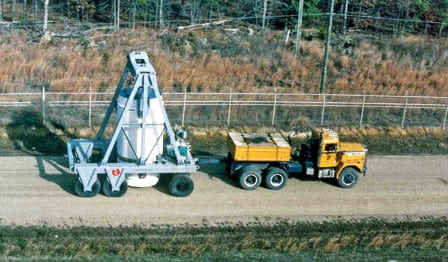
1. Sealed up tight. A typical dry cask storage container in transit to a plant’s cask storage facility. Courtesy: NRC
Reprocessing and recycling in the U.S.
The reprocessing of nuclear fuel first began in the U.S. in January 1943. The Bismuth Phosphate Precipitation Process was used for recovering macroscopic quantities of plutonium. The REDuction-OXidation (REDOX) process was the first successful solvent extraction process to recover both uranium and plutonium; it was further refined into the Plutonium and URanium EXtraction (PUREX) process, which has become the most common and fully commercialized liquid-liquid extraction process for the treatment of UNF.
In order to support a self-sufficient commercial nuclear power industry in the 1960s, the Atomic Energy Commission (AEC, circa 1946 to 1974)—the predecessor regulatory agency to the NRC (1974 to present) and the Department of Energy (circa 1977 to present)—encouraged the transfer of nuclear fuel reprocessing from the federal government to private industry. The three privately owned reprocessing plants constructed were the Western New York Nuclear Service Center (West Valley, N.Y.), Midwest Fuel Recovery Plant (Morris, Ill.), and the Barnwell Nuclear Fuel Plant (Barnwell, S.C.).
West Valley, N.Y.: The regulatory lesson. The West Valley facility started reprocessing UNF assemblies using the PUREX process in 1966, and by early 1972 it had reprocessed nearly 1,000 UNF assemblies. However, throughout 1973 and 1974, the AEC adopted increasingly rigorous safety criteria for nuclear facilities, mainly related to seismic issues. In September 1976, West Valley closed due to the economics of complying with heightened regulatory requirements applied retroactively.
Morris, Ill.: The technical lesson. The Midwest Fuel Recovery Plant (MFRP), completed in mid-1971, became a prototype for intermediate-size reprocessing plants to be built near existing nuclear power plants in an effort to reduce transportation costs and public acceptance obstacles. In addition, the designers attempted to minimize the generation of radioactive liquid effluents by avoiding, to the maximum extent practicable, the use of solvent extraction. The facility utilized an Aquafluor process that featured only one stage of solvent extraction and used remotely operated equipment. The waste was to be calcined, placed into containers, and stored in a pool awaiting shipment to a federal repository. During the design and construction phases, processes were demonstrated in the laboratory with bench-scale testing before being incorporated into the facility.
Unfortunately, equipment failures and technical problems prevented the plant from achieving full-scale operation. Its longest sustained run was 26 hours, and in March 1974 all operations were suspended. In July 1974, the MFRP was determined to be inoperable in its as-built configuration and to require a second decontamination solvent extraction cycle that would take a minimum of four years to complete. Finally, given the projected costs and the increasing regulatory scrutiny at West Valley, operations were terminated in August 1974. The MFRP closed without ever having reprocessed a single UNF assembly. It is currently used as an independent wet-pool storage installation.
Barnwell, S.C.: The political lesson. The Barnwell Nuclear Fuel Plant (BNFP) was the first large-scale commercial reprocessing facility in the U.S. consisting of:
- A fuel-receiving and storage station.
- A separations facility to chemically process UNF assemblies into liquid uranium, liquid plutonium, and liquid high-level waste (HLW) using advanced PUREX technology.
- A uranium hexafluoride facility to convert the liquid uranium into uranium hexafluoride.
- A plutonium conversion facility to convert the liquid plutonium to an oxide.
- A waste solidification facility to solidify the liquid HLW and store it prior to shipment to a federal repository.
The BNFP separations and uranium hexafluoride facilities were finished and undergoing preoperational testing when the NRC terminated all licensing actions on December 23, 1977, as part of U.S. policy to defer indefinitely the reprocessing of commercial UNF in response to proliferation concerns.
The “decision” to defer
During the 1976 presidential election campaign, critics raised concerns over the acquisition of plutonium from civilian nuclear power programs, the proliferation of nuclear weapons, and controls over exporting nuclear technology. In response to these concerns, and just prior to the 1976 election, President Ford announced a major decision by the U.S. government calling for a temporary halt to reprocessing that was aimed at stopping the proliferation of nuclear weapons capability.
In 1977, the Carter Administration extended the moratorium into a long-term policy to defer indefinitely the commercial reprocessing and recycling of plutonium produced in U.S. nuclear power plants. As a result of this decision, approximately 97% of the recoverable uranium and plutonium from UNF became nonrecoverable waste products.
Although the goal in principle was desirable, it ultimately eliminated all U.S. commercial reprocessing. In spite of the U.S. position, reprocessing continued elsewhere in the world, causing the U.S. to lose much of its influence in international nonproliferation efforts.
In October 1981, President Reagan lifted the indefinite ban on U.S. commercial reprocessing activities. However, even overlooking the negative history of the West Valley, Morris, and Barnwell plants, the availability of low-cost uranium, numerous plant cancellations, and premature shutdowns eliminated any interest in and financial incentives to reprocess UNF. By 1993, President Clinton had reaffirmed the U.S. deferral policy that discouraged reprocessing and research.
Reprocessing around the world
As in the U.S., reprocessing programs were started elsewhere in the world in order to support defense and nuclear energy programs. Currently, reprocessing and recycling is conducted in France, the United Kingdom, Japan, Russia, India, and China; Germany and Belgium have conducted pilot activities. Several facilities provide reprocessing and recycling services across national boundaries. Those facilities use an optimized PUREX process that separates uranium and plutonium and encapsulates the remaining transuranics (such as americium, neptunium, and curium) and fission products into a vitrified waste form.
For example, in France, the mission of the AREVA La Hague plant, which entered service in 1966, is to reprocess UNF. Reprocessing consists of separating and conditioning the various components of the UNF for recycling. Approximately 97% of the used fuel is recyclable when it leaves the reactor—96% as uranium and 1% as plutonium—while 3% is nonreusable waste materials and fission products. Therefore, natural uranium resources can be conserved, and the volume and toxicity of the final waste materials can be significantly reduced by treatment and conditioning specific to each type of waste.
The AREVA La Hague plant has a commercial reprocessing capacity of 1,700 metric tons of UNF per year, equivalent to annual UNF discharges from 90 to 100 light water reactors (Figure 2). For more than 20 years, AREVA La Hague reprocessing agreements have been in effect with the French nuclear program, Japanese power companies, and 29 European power companies, which are located in Germany, Belgium, Switzerland, and the Netherlands. From 1990 to 2007, the La Hague site has reprocessed approximately 23,600 metric tons of UNF for the recovery and recycling of uranium and plutonium for new fuel. The waste products consisting of transuranics and fission products are then vitrified for long-term storage. The volume of material requiring repository disposal is reduced by a factor of six compared with directly disposing of UNF.
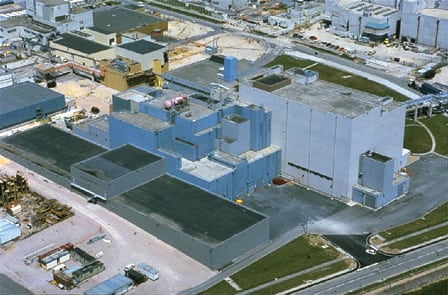
2. Missing in the U.S. AREVA operates a state-of-the-art used nuclear fuel reprocessing center in La Hague, France, that accepts fuel from nuclear plants across the European Union and Japan. Courtesy: AREVA
According to Dr. Alan Hanson, executive vice president, technology and used fuel management for AREVA (Bethesda, Md.), the economics of recycling can vary. “It is clearly economical to recycle aluminum because of the huge energy costs required to make aluminum, but it may be marginally economical to recycle paper. Nevertheless, it is the right thing to do. In the case of recycling used fuel, you can eliminate the need for 25% to 30% of new uranium. In addition, by reprocessing, we convert the waste form, primarily comprised fission products and transuranics, into highly stable vitrified glass that we believe is a better durable waste form than the fuel assembly itself.”
The COEX process
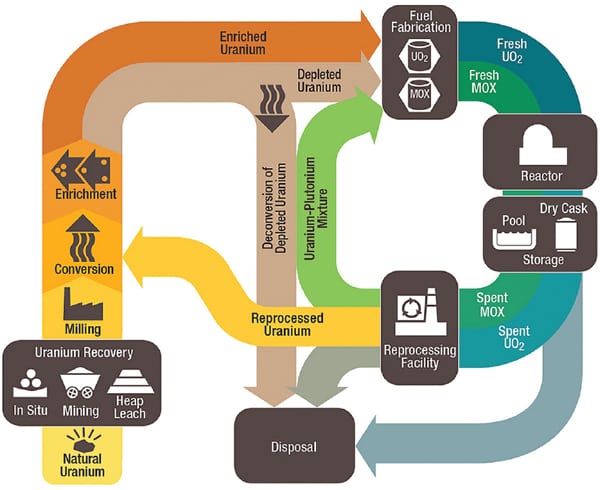
Under GNEP, various reprocessing and recycling options have been proposed for separating UNF constituents into several product streams. Hanson stated that AREVA has proposed a recycling strategy based on a new integrated co-extraction (COEX) process (Figure 3).
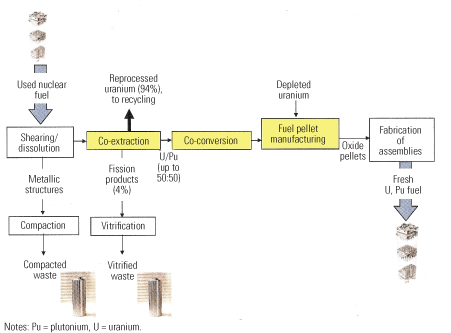
3. Once is not enough. In the AREVA COEX recycling process the used nuclear fuel is separated into three major streams: uranium-plutonium, uranium, and fission products and minor actinides. The COEX process does not separate out pure plutonium, which reduces the risk of its being used to build nuclear weapons. Source: AREVA
Whereas the PUREX process was originally designed to purify plutonium for weapons purposes, the COEX process does not separate pure plutonium at any point in the recycling plant. COEX consists of two colocated processes: the treatment process and the mixed oxide (MOX) fuel fabrication process. One additional attraction of MOX fuel is that it provides a way to dispose of surplus weapons-grade plutonium in the current U.S. fleet of conventional light-water reactors (LWRs).
In the COEX treatment process, UNF is separated into three major streams:
- Uranium-plutonium, extracted together and then turned into MOX fuel.
- Uranium, which is sent to external facilities for purification, conversion and reenrichment, and fabrication of additional recycled fuel.
- Fission products and minor actinides, which are vitrified into glass logs, stored on site as HLW, and eventually disposed of in a licensed repository.
In the COEX process, the uranium-plutonium mix is turned into MOX fuel for use in LWRs. Hanson commented that “The uranium-plutonium output stream is precipitated and co-precipitated and never, either as a product or in the piping in the facility, is pure plutonium. In that regard, COEX meets the nonproliferation requirements of GNEP by not producing pure separated plutonium, and the output product is one step further away from being usable for weapons purposes.”
The next generation of reprocessing and recycling plants in France that will ultimately replace the La Hague facility will use the COEX process.
Here in the U.S., AREVA announced in May 2008 that Shaw AREVA MOX Services LLC and the DOE had signed an agreement implementing construction of the Mixed Oxide (MOX) Fuel Fabrication Facility at the Savannah River Site in Aiken, South Carolina. The facility will remove impurities from surplus weapons-grade plutonium and mix it with uranium oxide to form MOX fuel pellets for reactor fuel assemblies. The assemblies then will be used in commercial nuclear power reactors. The facility’s design is based on AREVA’s La Hague and Melox fuel treatment facilities in France. From a physical protection perspective, the self-protecting, highly radioactive nature of the used MOX fuel will prevent direct handling of the assemblies, which will deter diversion of the residual plutonium.
U.S. missed the UNF boat
The closed fuel cycle option that involves reprocessing and recycling UNF has gradually gained recognition thanks to more than 40 years of demonstrated operational experience in France and a higher level of reliable economic data from actual operations. The Boston Consulting Group conducted an independent study funded by AREVA to review the economics associated with the closing stages of the once-through and recycling strategies. Proprietary data was obtained from AREVA, which reflected more than 20 years of nuclear materials reprocessing and recycling experience.
The study compared the long-term cost of recycling UNF against the possible cost of a repository handling the same UNF in a once-through strategy. In one scenario, the overall discounted cost of recycling UNF was on the order of $520/kg. This result was comparable to the cost of a once-through strategy, estimated at $500/kg, especially considering uncertainties, such as the price of uranium and repository costs.
Examining another possible scenario, the consulting group considered a new integrated recycling plant scheduled to open in 2020 that would use the COEX process, handle 2,500 metric tons per year of UNF, and be combined with a repository (such as Yucca Mountain) for storing HLW and legacy UNF. This scenario was projected to have a total net present cost of $48 billion to $53 billion. This result is equivalent to the net present cost of an exclusive once-through strategy with Yucca Mountain and an additional repository estimated at $47 billion to $50 billion.
Furthermore, the projected total undiscounted life-cycle cost for the recycling strategy would be approximately $113 billion, compared to approximately $124 billion to $130 billion for the once-through strategy. Given the intrinsic uncertainties used in the study, and the fact that almost 27 years have elapsed since President Reagan lifted the indefinite ban on U.S. commercial reprocessing activities, the economics of a recycling strategy are comparable to, if not better than, those of a once-through strategy.
International UNF reprocessing
Through international agreements and contracts, and following International Atomic Energy Agency (IAEA) regulations, it is very common for European companies to ship their UNF by rail to La Hague for reprocessing and recycling. For example, 235 metric tons of UNF from Italy’s nuclear power plants will be sent to France for reprocessing.
However, French nuclear law does not allow AREVA or any other entity to take waste and keep it in France. Although the recovered uranium and plutonium can be recycled for new fuel, the vitrified waste products are returned to the country of origin or another third party, as long as it is not in France. Therefore, Italy has to take back its vitrified waste products at some point in the future, but no later than 2025 (Figure 4). Other countries that ship their UNF to France for reprocessing must adhere to the same requirements.
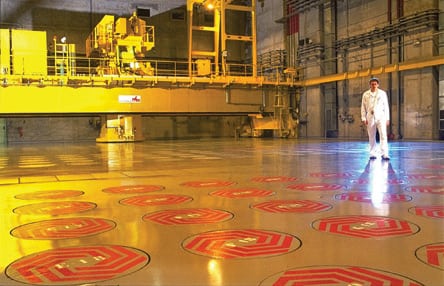
4. Under foot. The vitrified waste is kept in storage cells located below the floor at the La Hague facility. Courtesy: AREVA
Overseas shipments of another country’s UNF and shipments returning the vitrified waste for disposal must use specifically modified ships that adhere to the International Code for the Safe Carriage of Packaged Irradiated Nuclear Fuel, Plutonium and High-Level Radioactive Wastes on Board Ships (INF Code)
Hanson indicated that because processes are in place for a country to export its UNF and re-import its vitrified waste for disposal, this option could help the U.S. alleviate its UNF storage problem. However, international agreements would need to be developed between the NRC and France’s equivalent regulatory agency, the Nuclear Safety Authority (ASN).
“Furthermore, there is a well-utilized international program through the IAEA for transporting nuclear materials,” Hanson noted. “However, every nation that adopts these regulations tends to modify them in practice to meet their own needs. Because of that, there is a difference between the NRC’s and France’s regulations to certify nuclear transport casks. In practical purposes, there is no existing transport cask that has been licensed by both the NRC and the ASN. So there is no existing fleet of casks to move the fuel today between the United States and France. Possibly some of the existing fleet of transport casks could be adopted for this purpose, but there would need to be some up-front engineering and licensing considerations that must be worked out. Still, the biggest challenge in making this option economically justifiable is the cost of the marine transport of the used fuel and vitrified waste.”
Looking down the road
Until GNEP becomes a reality or the Yucca Mountain repository begins accepting UNF, nuclear-powered utilities are expected to continue using interim storage for the next 10 to 20 years. Furthermore, if history serves as a guide to the future, failing to follow through with a comprehensive program offered by GNEP will likely produce the same results witnessed in 1977. Since then, the indefinite deferral of reprocessing commercial UNF, and the absence of a viable alternative, has cost billions of dollars—many of them paid into the Nuclear Waste Fund—while producing few, if any, positive accomplishments. In addition, nuclear power plants have diverted resources for the storage of UNF to avoid plant closure while waiting for a licensed geologic repository to open.
If GNEP fails, expect these scenarios to be repeated again over the next 30 years, instead of the U.S. achieving energy independence, which would be a truly positive accomplishment.
—James M. Hylko (james.hylko@prs-llc.net) is an integrated safety management specialist for Paducah Remediation Services LLC and a POWER contributing editor.