In 1971, with passage of the Power Plant Siting Act, Maryland established the Power Plant Research Project (PPRP) and made the Department of Natural Resources responsible for its administration. The PPRP, which is funded by an environmental surcharge on all electricity consumed in the state, has two broad objectives: ensuring the availability of affordable electricity in Maryland in the future and protecting the state’s natural resources. To help reach those goals, the project expends most of its own resources on three activities: power plant licensing, long-range energy supply planning, and environmental assessments.
One of the more interesting PPRP programs under the environmental assessment umbrella is an ongoing evaluation of the use of coal combustion products/by-products (CCPs) as backfill to reduce or eliminate drainage of acids and harmful metals from abandoned coal mines into soil and water. The evaluation is part of a larger plan to manage CCPs produced by Maryland power plants in cost-effective yet "green" fashion.
Left unstabilized, CCPs are capable of leaching soluble metals into the environment and significantly contaminating ground and surface water. Stabilized and engineered to take advantage of their pozzolanic (cementitious) properties, CCP mixtures have proven to be an environmentally benign and affordable alternative to conventional cement grouts for use as roadbase, highway embankments, and mine fill.
Two birds, one stone
As engineering consultants to the PPRP, Environmental Resources Management (ERM) Inc. has conducted several studies and pilot projects to evaluate and demonstrate the beneficial reuse of CCPs for deep mine stabilization. There are several hundred abandoned underground mines in western Maryland and several thousand across the Mid-Atlantic Highlands (Figure 1).
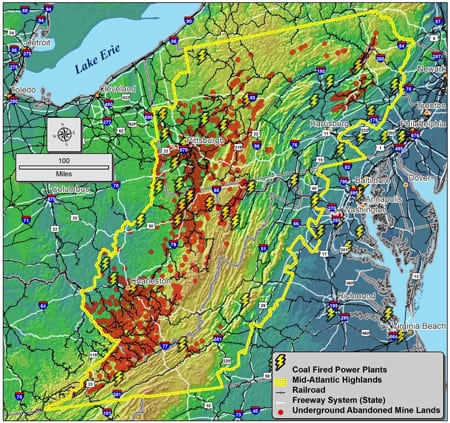
1. Back to the source. This map shows abandoned underground mine lands within the Mid-Atlantic Highlands. Railroads and interstate highways provide a readily accessible transportation network for moving coal combustion products/by-products (CCPs) to mine reclamation sites. Mines and power plants are typically located along rail and/or highway transportation corridors that are ideal for economical movement of massive volumes of CCP. Source: Environmental Resources Management Inc.
Stabilized CCP materials, in the form of grout, offer an attractive means of permanently restoring to productive use land and waterways that have been rendered uninhabitable by acid mine discharge (AMD). Typically, AMD-impacted streams are dosed with lime to raise their pH toward neutral—an unattractive solution because the dosing systems must be maintained in perpetuity. In contrast, permanent solutions such as mine void grouting and mine pavement sealing eliminate the source of AMD.
In Maryland and the Mid-Atlantic Highlands, the proximity of abandoned mines to coal-fired plants makes it cost-effective to transport massive volumes of engineered CCPs via the existing network of railroads and interstate highways. The voids in the Maryland mines alone have an estimated total volume of one billion cubic yards, or enough capacity to permanently (and beneficially) dispose of hundreds of years worth of CCPs generated in the state. At present, about 27 million tons of CCPs are produced annually in the Mid-Atlantic Highlands, with Maryland contributing approximately 2 million tons. The rule of thumb is that one ton of CCPs can be turned into one cubic yard of grout.
One major CCP is flyash, which is primarily a mixture of silicon dioxide, aluminum oxide, and iron oxide. In combination with an alkali activator and moisture, flyash becomes a cementitious material with excellent structural and engineering properties. Under PPRP direction, Atlanta-based Hemmings & Associates LLC has developed various CCP mix designs for grout and mine backfill that maintain long-term strength and cohesion suitable for a variety of mine stabilization requirements.
Because the chemistry and physics of abandoned mines are complex, CCP-based grout must be adaptable to a variety of underground conditions. It should be:
- Fluid enough to be pumpable, for optimal penetration of fissures and shafts.
- Strong enough to abate surface ground subsidence.
- Able to reduce acid formation.
CCP grouts also must be compatible with the often-acidic water in flooded underground mines (Figure 2). They should simultaneously be strong enough to provide control of subsidence and retain the physical and chemical integrity needed to resist dissolution and release of soluble metals. Optimizing the balance between a grout’s fluidity and cementitious properties is a key challenge in the engineering of a CCP for reuse.
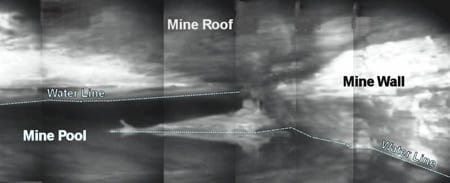
2. Down periscope. A panorama from a remote borehole camera shows the underground structures and conditions of the abandoned Frazee Mine in western Maryland. Mine pools often contain acidic water that could ultimately enter surface waterways through seepage or mine wall ruptures. Courtesy: Environmental Resources Management Inc.
Strength, stability, and savings
The effectiveness of mine void grouting with CCP-based material has been demonstrated by the PPRP’s Winding Ridge project in western Maryland. There, the Frazee Mine voids were filled with a 100% CCP grout in 1996. Over the past decade, drainage from the mine has become substantially less acidic and lower in concentration of harmful metals. The strength of the cured grout has proven equal to or greater than that of surrounding rock.
Experimental PPRP research also confirms the efficacy of mine void grouting. Results from initial weathering experiments indicate that no hazardous constituents leach at a detectable level from cured CCP grouts. Over the past year, an ongoing PPRP weathering experiment has subjected cured blocks of 100% CCP grout to a constant flow of acidic water with a pH ranging between 3.0 and 7.0, to simulate the flow of mine water over and/or through any grout fractures (Figure 3). To date, the experimental results indicate that there is no increase in dissolved constituents that would indicate weathering or chemical dissolution.
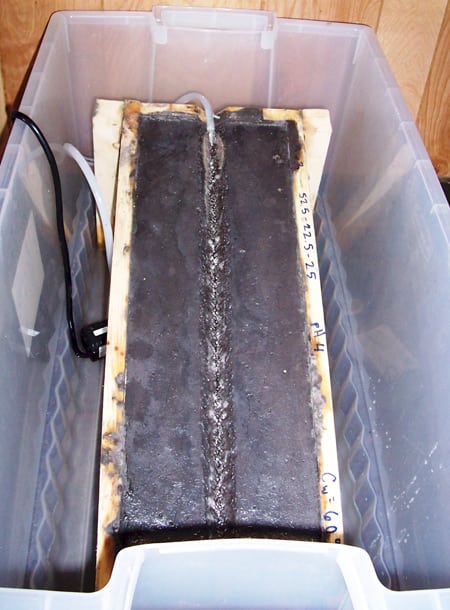
3. Weather report. Cured CCP grout blocks like this one—measuring 20 by 48 cm on a side and 15 cm thick—have been subjected to water with a pH ranging from 3.0 to 7.0 for more than one year, to simulate the long-term effects of acid mine discharge. Early results of the experiment, which is ongoing, indicate that the acidic water does not significantly dissolve the grout. Courtesy: Environmental Resources Management Inc.
Conventional mine void grouting techniques—for example, injecting Portland cement (conventional) grout as backfill (Figure 4)—often are expensive due to the cost of cement and associated material. Within the Mid-Atlantic Highlands, CCPs can be obtained at negligible cost from nearby power plants and used as a substitute for conventional grout. PPRP studies have demonstrated that a mine void can be filled with a CCP grout at 35% to 75% of the cost of doing so with conventional cement grout (Figure 5).
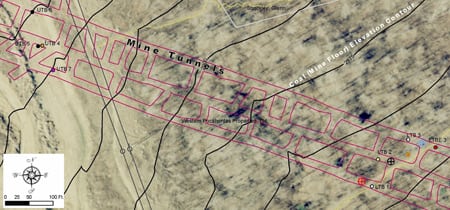
4. Down and grout. An aerial view of three tunnels at an abandoned mine complex in western Maryland. They were chosen to host a demonstration of CCP grouting and optimized borehole placement. The National Institute of Standards and Technology is currently simulating the chemical and physical properties of the tunnels in preparation for grout placement. Courtesy: Environmental Resources Management Inc.
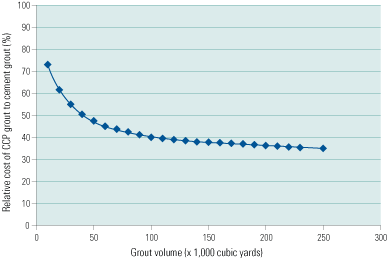
5. Economies of scale. CCP grout is inherently cheaper than conventional cement grout, and especially so for larger projects. The curve, which was developed for a typical mine void stabilization project in western Maryland, shows the volume dependence of the relative cost of CCP grout to cement grout. CCP and conventional cement grouting projects use the same equipment and are equally labor-intensive. Source: Environmental Resources Management Inc.
A common denominator of various initiatives to recycle CCPs is their favorable socio-economic impact. The low cost of CCP base material allows a larger share of a mine reclamation project’s budget to benefit the community by creating jobs. PPRP data indicate that labor accounts for about 55% of the total cost of a typical CCP grouting project (Figure 6).
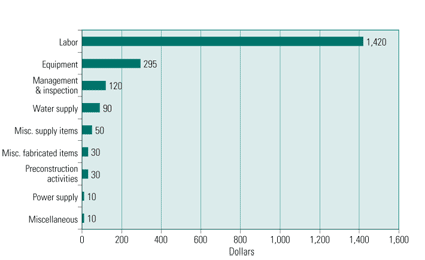
6. How to stuff a mine. These cost components are typical for a Maryland mine void grouting project, in this case, the injection of 150,000 cubic yards of CCP grout into voids below the Allegany (County) Business Center on the campus of Frostburg State University. Labor accounts for approximately 55% of the total project cost. Source: Environmental Resources Management Inc.
Tunnel vision
Stabilizing an abandoned mine requires a substantial investment in materials, equipment, and labor. About one-third of a typical project’s labor cost goes to drilling the boreholes needed to send the grout underground. On many projects, the strategy for borehole placement is "hit or miss" and hardly cost-effective—a grid of boreholes is drilled, and grout is injected only into those holes that find voids.
Using subsurface geophysical methods and exploratory boreholes to locate and characterize mine voids may adequately determine gross-scale mine geometry for drilling. However, those techniques do not enable accurate delineation of anticipated grout flow pathways through the existing network of mine tunnels. Drilling the boreholes to take advantage of those tunnels minimizes the number and cost of boreholes needed.
To that end, ERM Inc. has developed a model, based on known mine geometry, that can predict the spacing of flow paths for fluid grout through mine tunnel networks that will minimize drilling costs (Figure 7). Currently, the model is being refined to account for the effects of grout rheology (thickness and viscosity) and of debris and obstacles encountered by grout flowing along a mine floor.
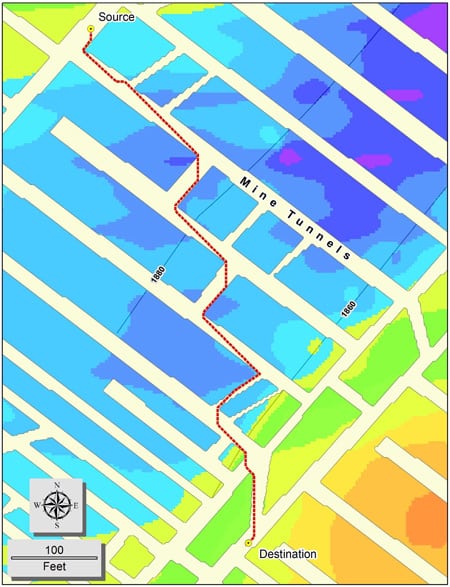
7. Least-cost path. In this two-dimensional view of a modeled grout path track through a mine tunnel network, the different colors reflect different mine floor slope classifications. The red dashed line was determined to be the optimal path for moving the grout from its aboveground source to its underground destination. Source: Environmental Resources Management Inc.
Basing borehole placement and grout path models on georeferenced mine maps can significantly lower the cost of drilling. For the past eight years, the PPRP has sponsored a program run by the Geospatial Research Group at Frostburg State University, in Allegany County, to accurately georeference historic mine maps in Maryland (Figure 8). In many cases, the maps exist only as paper documents.
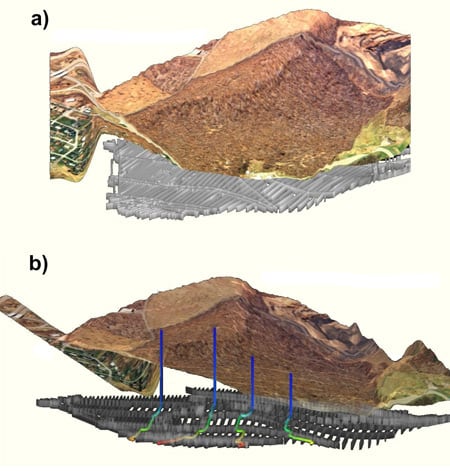
8. Eliminating sinkholes. Maryland would like to turn a parcel of land owned by Frostburg State University into a technology business incubator park. But first, mine voids below the parcel may have to be filled to keep the surface from subsiding. Shown are three-dimensional views from above of the surface and mine tunnel network looking north (a) and predicted grout flow paths looking northeast (b). Courtesy: Environmental Resources Management Inc.
Conventional recycling continues
Long used as an additive in the manufacture of concrete and cement products, flyash also can be used to stabilize material dredged from waterways. The PPRP also is involved in a project whose objective is to find a beneficial use for some 500,000 cubic yards of material expected to be dredged from Baltimore Harbor after 2010. By itself, dredged material (DM) has a very low compressive strength and is thus unsuitable for structural fill. But if the DM is stabilized with flyash and lime, the structural properties of the mixture will be more than adequate for that purpose.
The results of PPRP laboratory tests are promising. Blending DM with a 10% mixture of flyash and waste with a high lime content (for example, the dust from a lime or cement kiln) has produced a fill material with a compressive strength of several hundred psi. Because the material also meets environmental standards for soil, it has the potential for being engineered into a clean, low-cost, environmentally friendly solution to the problem of reclaiming surface mines such as quarries and sand and gravel pits.
Another PPRP program is responsible for the beneficial reuse by the state’s cement industry of over 600,000 tons per year of gypsum produced by power plant scrubbers in Maryland. Gypsum also can be used as an admixture to enhance the stabilization of CCPs. When mixed in the proper proportions with material of high lime content, gypsum significantly mitigates or eliminates leaching of both lime and hazardous metals from coal flyash. The compressive strength of the cured mix is more than adequate for use as surface mine fill, roadbase, or highway embankments.
Using rock ash in a stabilized fill material is hardly an innovation. The concrete of Romans’ famed aqueducts had just three ingredients: hydrated lime, pozzolan ash from a nearby volcano, and pieces of small rocks. CCPs behave similarly to the volcanic ash that the Romans put into their cement mixers. Based on the aqueducts’ longevity and the results of more recent studies, there is ample reason to believe that properly engineered CCP-based grouts and stabilized CCP products will be just as durable.
—Joseph F. Giacinto is a senior project manager at ERM Inc. He can be reached at 410-266-0006 or joseph.giacinto@erm.com. Leonard G. Rafalko is a principal of ERM and can be reached at leonard.rafalko@erm.com. Paul Petzrick is a project director with the Maryland Department of Natural Resources’ Power Plant Research Program; he can be reached at 410-260-8660 or ppetzrick@dnr.state.md.us.