Wind power is becoming a mainstream energy source that U.S. utilities are tapping into nationwide as a means of adding clean, domestically sourced energy to balance their generating portfolios. To identify where wind will take us, POWER’s senior editor talked to experts from diverse industry stakeholders about current and future developments.
From trends in regulations to technical innovations, wind energy is blowing in some new directions in the U.S. In order to assess the complexity of those changes, in October, POWER interviewed folks with a variety of viewpoints: representatives from the leading wind energy trade association, a U.S. wind energy technology manufacturer, a large consulting firm, and two national law firms.
Current wind speed
As of mid-August 2008, the U.S. had 20,152 MW of wind power generating capacity operating, Jeff Anthony, the American Wind Energy Association’s (AWEA) manager of utility programs and policy, told POWER. That accounts for about 1.5% of U.S. supply on an energy basis, but wind projects made up more than one-third of all the new generation capacity added in the U.S. in 2007, second only to natural gas.
According to Anthony, a good source for information on other generating technologies is the Electricity InfoCard kept by the U.S. Department of Energy’s (DOE’s) Energy Information Administration. It shows that about 50% of U.S. electricity is generated from coal, 20% from nuclear, about 20% from natural gas, 6% from hydropower, 3% from petroleum, and the remainder from renewables (Figure 1).

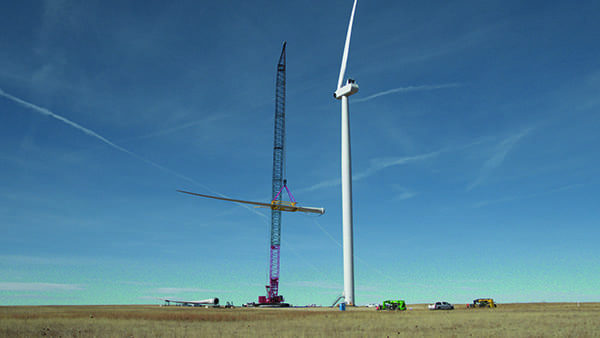
1. Turn, turn, turn. This 1.5-MW wind turbine is one of more than 9,000 GE Energy wind turbines in use around the world. Courtesy: GE Energy
"Wind power is already positioned as a mainstream energy resource in the U.S., with the industry experiencing 45% growth in 2007 and on track for a similar growth rate this year," he said. "At the end of the second quarter of 2008, 2,725 MW of new wind capacity had been installed. AWEA expects a total of about 7,500 MW to be installed before the end of the year."
Factors in the industry’s history-making growth, according to Anthony, include the following:
-
Wind technology has matured and steadily improved the performance and productivity of individual turbines.
-
Fuel prices have risen sharply over the past five years, making wind energy even more attractive as a resource.
-
Consumer demand for clean energy resources is growing, along with concerns about climate change, and utilities are looking to wind and other renewables as part of the energy solution in our carbon-constrained economy.
-
The domestic supply chain for wind is expanding, with new manufacturing capability and new manufacturing jobs adding value to the U.S. economy, while reducing transportation costs associated with wind components.
Cost comparisons
Edward C. Lowe, GE Energy’s general manager of renewable energy and gasification market development, shared his company’s views concerning wind energy’s ability to compete economically with other forms of energy that generate electricity.
"At approximately $0.08 per kilowatt-hour, wind is currently in the range of being cost competitive with traditional fuel sources — such as coal and natural gas," he said. "Due to technology advancements, the cost of electricity generated by wind power has decreased by about 80% over the last 20 years. Advancing wind technology will be the key to keeping this moving in the right direction."
When interviewed by POWER about this topic, Todd Bartholf, director of renewable energy at the U.S. engineering firm CH2M HILL, pointed to the many studies that have looked at costs. "We are using a conservative figure of $0.05 to $0.06 per kWh, given commodity price increases across the board over the past couple of years," he said. "Given the likelihood of some form of carbon tax within the next couple of years, we think that natural gas at a similar price point is the real benchmark going forward."
Anthony said that wind energy is already competitive on a cost basis with all forms of generation. And it is by far the lowest-cost zero-emissions power technology available today. Although older power plants, such as fully depreciated coal or nuclear power plants may produce electricity at cheaper prices than new wind energy projects, wind energy is already cost-competitive and provides a low-cost electricity source for many utilities that have already embraced this clean form of electricity generation.
"Costs for all sources of new generation are on the rise due to a number of factors," he said. "The cost of raw materials like copper and steel has risen dramatically, the cost of transporting materials and large equipment has increased (primarily due to the rise in oil prices), and labor costs have increased as demand for skilled workers is straining the labor force."
According to Anthony, a recent cost comparison published in June 2008 by the U.S. Federal Energy Regulatory Commission’s (FERC) Office of Enforcement shows the following estimates of current capital costs for various energy resources:
-
Wind: $1,500 to $2,500/kW
-
Nuclear: $4,500 to $7,500/kW
-
Conventional coal: $1,800 to $4,000/kW
-
Integrated gasification combined-cycle (IGCC) coal: $2,800 to $5,800/kW
-
Gas combined cycle: $800 to $1,500/kW
-
Gas combustion turbine: $500 to $1,000/kW
Power tool: Production tax credits
The federal production tax credit (PTC) is generally defined as a business credit that applies to electricity generated from wind and other renewable energy sources for sale at "wholesale," such as to a utility or other electricity supplier, that then sells the electricity to customers at "retail." In the case of wind, it applies to electricity produced during the first 10 years of a wind plant’s operation. The company that owns the wind plant subtracts the value of the credit from the business taxes that it would otherwise pay.
Benjamin Israel, an attorney with the Washington, D.C., law office of Bracewell & Giuliani LLP, told POWER that the PTC is critical for the continued development of wind resources in the U.S., as these credits help create a level playing field by allowing wind energy to be more cost-competitive with traditional fossil-fueled electricity production. "The PTC provides the foundation for the current boom in wind energy investment in the U.S.," he said.
Anthony agrees with Israel. With a stable PTC since 2005, the industry has experienced three years of record growth, he said. This has enabled the industry to build a solid foundation, which offers great potential for expanding the amount of wind being tapped in the U.S.
"Historically, when the PTC has been allowed to expire [Figure 2] before being extended (in 1999, 2001, and 2003), wind energy installations dropped by as much as 93% in the following year," he said. "Over the longer term, an array of stable and supportive policies are needed." (See the Commentary, p. 156, for international evidence of this dynamic.)

2. Gone with the wind. The number of wind turbines installed dropped quickly each time the U.S. production tax credit expired. Courtesy: American Wind Energy Association
Coming on the heels of Congress’s action in October to give a one-year extension to the renewable energy PTC for 2009, a flurry of announcements of new U.S. wind manufacturing facilities showed wind power’s potential to provide a critically important stimulus to the faltering U.S. economy, according to AWEA. If Congress had not acted in October, the PTC was scheduled to expire at the end of 2008. AWEA asserted that the plant announcements and openings in Arkansas, Minnesota, Indiana, and Iowa underscore wind power’s ability to generate jobs as well as electricity.
State wind power programs
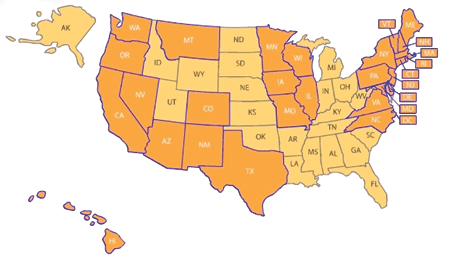
"Presently, 25 states and the District of Columbia have enacted mandatory renewable portfolio standards (RPSs) that require retail sellers of electricity to obtain from renewable energy resources a minimum percentage of the power they sell at retail," William D. Hewitt, an attorney with the law firm of Pierce Atwood LLP in Portland, Maine, said in an interview with POWER. "Retail sellers whose generation portfolios do not meet the RPS standard can purchase renewable energy credits (RECs) to bring their portfolio into compliance with the RPS mandates of the state where the retail sale is made."
According to Hewitt, RECs are an attribute of green energy, and they can generally be severed and sold independent of the energy. Thus, RECs provide a developer with a valuable revenue stream that, along with power sales and various federal, state, and local tax incentives, are helping to make wind competitive with traditional fossil generation.
Israel, the Washington-based energy attorney, also has strong views concerning the impact of state initiatives on the development of wind energy. He said that although the PTC provides the foundation for investment in wind energy in the U.S., the PTC does not dictate where wind farms will be developed. Rather, according to Israel, it is the RPSs that mandate that a certain amount of electric power should be generated by renewable energy resources and that shape the market for renewable energy in the country.
"While efforts to pass a national RPS have consistently failed in Congress, mandatory RPSs have been established in a patchwork manner in 25 states and the District of Columbia, with nonbinding RPSs in another four states," Israel said. "It is these state RPSs, combined with other state programs and incentives, which are leading and shaping the country’s development of renewable energy."
According to Israel, most utilities that purchase energy from wind farms have the right to claim all "green attributes" associated with those wind farms — including RECs. As a result, many wind projects are not able to separately market their RECs, making the REC market less liquid than it might otherwise be. However, this is not always the case.
"When wind farms do sell their RECs, they are often sold under the "Green-E Energy" certification program that assures the quality, quantity, and ownership of those RECs," he said. "It is the continued use of the Green-E certification program that keeps the REC market vibrant and potentially more liquid, further enabling the development of new wind farms."
Another interesting phenomenon associated with the segregation of RECs from power sales, according to Israel, is the ability of some wind farm owners to back-stop their power sales with a hedging device. The hedge gives the owner a guaranteed minimum energy sales price and allows the owner to separately sell, and receive compensation for, the RECs. Therefore, RECs can be sold to multiple purchasers whose needs for RECs may vary greatly from those of a regulated electric utility acquiring RECs through a traditional power purchase agreement.
According to GE’s Lowe, most, but not all, of the states with an RPS allow for REC trading, although in many cases the market is still small. The most developed REC market is in Texas, which has helped that state become the leader in wind power. A strong "solar REC" market is also emerging in New Jersey, helping it become the number two state in solar energy. In California, RECs are still "bundled" with power purchase agreements and cannot be traded separately, though this may change in the future.
Recent technical advances
Modern wind turbines stand 400 feet tall and capture premium wind resources higher above the ground than earlier models, according to AWEA’s Anthony. The average turbine installed in 2007 was rated at 1.6 MW of capacity — twice as powerful as turbines installed in 2005. The largest land-based turbines today are rated at 3 MW, and offshore projects use even larger machines with 5-MW turbines planned for installation within the next two years.
"Improved turbine design has led to a 70% reduction in capital costs since the early 1980s, according to Lawrence Berkeley National Laboratory (LBNL)," Anthony said. "Recently, however, the cost of raw materials and other factors have caused capital costs to go up as they have for all power technologies. LBNL also finds a 35% drop in operations and maintenance costs over the last 10 years. Also important is the continuing increase in wind turbine capacity factors: a 15% increase in capacity factor over the last 10 years, according to LBNL. State-of-the-art turbines achieve 36% capacity factors, compared with an average 22% capacity factor achieved by turbines operating commercially before 1998, and those factors continue to improve."
Lowe provided information about his company’s technical advances in the wind power arena. Since 2002, GE has invested over $750 million in promoting reliable and efficient wind technology, to improve performance and increase customer value. The company has continued to expand its wind energy operations, increasing its wind engineering team threefold and applying experience and expertise from its gas turbine, steam turbine, and controls business units, in addition to GE Aircraft Engines and GE Transportation, to advance its wind turbine technology.
"GE continues to improve performance and reliability of its 1.5-MW wind turbine through GE designed technology (pitch system, blades, and gearboxes), improved component robustness, and better diagnostic capabilities," he said. "The result is continuous improvement in overall fleet availability — from 96%+ for units commissioned in 2005 to 98%+ for units commissioned in 2007 — even as the 1.5-MW installed base has grown from only 1,000 units in 2002 to over 9,000 units today."
Future technical goals
CH2M HILL’s Bartholf pointed out that there are still a number of new design concepts that may work their way into the mainstream in the future, including a redundant generator, a self-erecting turbine, and a vertical axis. Other possible new technologies include electrical innovations, such as system load-shaping and mechanical advances in gearbox reliability.
According to Anthony, the DOE’s 20% Wind Energy by 2030 report finds that wind can meet the 20% goal using existing technology. The report, however, does note that continued capital cost reductions (10%) and capacity factor improvements (15%) over the next few decades will help make the use of wind power even more cost-effective. The DOE identifies several areas where continued research and development would help reduce costs and improve performance even more:
-
Improved reliability of towers, blades, power electronics, and gearboxes.
-
Developing lighter-weight drive trains, taller towers, and enhanced rotor technologies.
-
Developing new materials and more aerodynamic designs to further improve blade performance.
"GE’s wind product strategy is focused on creating more value for our customer in the areas of reliability, efficiency, and advanced logistics," Lowe said. "Since 2002, we have increased the reliability and capacity factor of our 1.5-MW wind turbine by 12 and 9 points, respectively. We are also using more robust materials, employing the more sophisticated electronics already being used in our other power generation products, and shaping turbine blades to better capture the wind."
Looking ahead, according to Lowe, GE is exploring the addition of carbon composite to turbine blades. Although it is more expensive than fiberglass, carbon is lighter — allowing the blade length to be increased by 16 feet. This would translate into a significant boost of energy and flexibility — allowing the blades to operate at higher wind speeds.
Additionally, the company is working on electronics controls to optimize performance and the sound level of entire wind farms. One of GE’s research teams is developing software for modeling how to best place turbines in a wind farm, while another is working on the electronic controls to get wind power fed into the grid most effectively.
Challenges to grid interconnectivity
"If you asked wind developers to identify the top challenges they face, access to transmission would be at or near the top of everyone’s list, said Hewitt, the Portland, Maine-based attorney. "This is particularly true in New England, where there has not been significant transmission built during the past 20 years. Unfortunately, the premium sites for locating wind projects in New England usually do not coincide with convenient access to the grid." (See the feature on p. 80 for more about this issue.)
He points out that although transmission utilities and merchant transmission companies are moving forward with new proposals to accommodate the increased need for transmission capacity throughout the U.S., wind developers are becoming increasingly more willing to assume the risk of building out their own transmission to get their power to market.
According to Lowe, transmission constraints are an emerging issue with his company’s customers. GE is engaged at the federal and regional levels in advocating for transmission policy reforms. Specifically, the company supports:
-
Proactive transmission planning initiatives such as ERCOT’s Competitive Renewable Energy Zone program, which is now being copied in Colorado and by the Western and Midwestern Governors’ Associations.
-
Interconnection queue reform to speed the processing of project applications, which is especially important in the Midwest.
-
FERC’s authority to intervene in and resolve interstate transmission planning disputes.
-
The development of a "Clean Energy Superhighway" that knits together the nation’s three interconnections (East, West, and ERCOT).
-
Support from grid planners to facilitate higher levels of wind penetration through the use of grid reliability and wind forecasting technology.
To help customers meet new and emerging standards for increased grid reliability, GE has developed several products offering improved methods of integrating wind power into electrical grids, Lowe said.
Not surprisingly, AWEA advocates a high-voltage transmission superhighway to carry electricity generated in rural, windy areas to urban load centers around the country. Regional transmission planning and cost-allocation policies are the most important components of future transmission policy and development.
According to Anthony, an upgraded and expanded transmission grid will lower energy costs for consumers. For example, the Midwest Independent System Operator (MISO) recently studied the costs of developing 16,000 MW of wind in the MISO system, along with 5,000 miles of new 765-kV transmission lines to deliver wind from the Dakotas to the New York City area. Although overall generation and transmission costs reached an estimated investment of $13 billion, if implemented, the project is projected to produce annual savings of $600 million over its costs.
Dealing with wind energy’s variability
During his interview, Anthony stressed that a major area of misunderstanding is the characterization of wind as an intermittent energy source for electrical generation.
"First of all, wind energy output is ‘variable,’ not ‘intermittent.’ This is an area where education is needed," he said. "The term ‘intermittent’ is not only inaccurate; it is also used in a negative, derogatory way by anti-wind activists. Intermittent implies that wind energy output can suddenly and inexplicably change; nothing could be further from the truth. In fact, wind energy output from a single wind turbine or a wind project containing hundreds of turbines is variable in that the output will change slowly over time and is very predictable, given that modern day wind forecasting techniques exist to allow system operators to anticipate changes in wind energy output in ‘day-ahead’ and ‘hour-ahead’ timeframes."
Conventional resources occasionally shut down with no notice, and these "forced outages" require operating reserves. In contrast, changes in wind energy output are not instantaneous, Anthony said. Because of the geographic diversity inherent with large numbers of wind turbine installations, it typically takes over an hour for even a rapid change in wind speeds to shut down a large amount of wind generation. Wind forecasting tools that warn system operators of upcoming wind output variations are becoming widely used and better integrated into system operations.
According to the DOE report 20% Wind Energy by 2030, factors that facilitate the integration of wind power into the electric system and further improve overall reliability and cost-effectiveness include the following:
-
Wind forecasting enhances system operation.
-
Flexible, dispatchable generators, such as natural gas plants, facilitate wind integration.
-
Aggregation and geographical spread of wind projects reduces variability; the more wind farms, the smoother the overall output can be.
-
Large balancing areas reduce impacts, for wind and for all technologies.
-
Changing load patterns, such as those enabled by a smart grid and plug-in electric vehicles, can complement wind power generation.
Going coastal: Offshore wind installations
"Any technical challenges unique to offshore installation can be solved," said Bartholf, "The real issue is cost. Recent figures show offshore projects at roughly double the cost for equivalent installed capacity on land. Currently, what major wind turbine manufacturers are involved with the design and manufacturing of these off-shore wind turbines? Most of the major ones."
The DOE’s 20% Wind Energy by 2030 calls for 54 GW of the overall 300 GW of wind operating in 2030 to come from offshore installations, Anthony emphasized. It is more expensive than onshore wind due to the need for more robust components to endure the challenging conditions of a salt-water environment. However, offshore wind energy offers all of the positive economic and environmental benefits of onshore development and, in many cases, additional positives, including these:
-
Offshore projects tend to generate more power than onshore projects due to higher wind speeds and more consistent winds.
-
There is less turbulence offshore, which reduces wear on components, and larger turbines can be used because transporting them is easier via water.
-
Offshore projects can be built in close proximity to demand centers (coastal cities), eliminating concerns about transmission line bottlenecks.
Even though GE does have experience in the offshore wind power arena (in 2004 it installed the first multi-megawatt offshore wind turbine at the Arklow Bank Offshore Wind Park in the Irish Sea, a 2005 POWER Top Plant), Lowe pointed out that the company is less enthusiastic than the DOE about the near-term future of this type of wind energy. "We believe that offshore wind is a limited opportunity in the near term," he said. "Offshore wind farms are two to four times more expensive to build than onshore facilities and maintenance costs are substantially higher. Based on the rich land-based wind resources that we have in the U.S., wind power can be generated from onshore wind farms for approximately $0.08 per kWh — versus $0.20+ per kWh for offshore farms."
Lowe further noted, however, that in areas with poor or limited onshore wind resources, the high premium for offshore wind power may be justified. Indeed, the only active offshore markets today — the United Kingdom and Germany — demonstrate significant offshore incentive "adders" beyond the policy support levels for onshore wind.
Protecting wildlife
"Virtually any tall man-made structure will pose a collision risk to birds, but the risk from wind turbines is very small when compared to buildings, communication towers, and transmission towers," Lowe said. "Today’s tubular tower design gives no reason for birds to be attracted [to them] for nesting," as they were to the older, scaffold design. "Wind turbines pose less risk than other man-made structures, and proper siting is the most important aspect to reduce risk to birds. Sites should be studied to determine the migratory and local avian patterns."
According to Lowe, GE recently helped launch the American Wind-Wildlife Institute — an industry-nongovernmental organization collaboration to proactively address siting and permitting issues to ensure that the development of wind projects proceeds in an environmentally sensitive manner.
Likewise, the wind energy industry and the National Wind Coordinating Collaborative, of which AWEA is a founding member, are dedicated to ensuring that wind is developed in a way that minimizes potential impacts to bird populations.
According to Anthony, after the initial discoveries in 2003 of bat deaths near wind farms in West Virginia, supporters of wind energy and bats reacted quickly and formed a new organization, the Bats & Wind Energy Cooperative (BWEC) later that same year. BWEC includes AWEA, Bat Conservation International, the U.S. Fish and Wildlife Service, and the DOE’s National Renewable Energy Laboratory. This initiative raises millions of dollars to fund studies designed to reduce bat mortality. BWEC is focused on finding good site screening tools and testing mitigation measures, including ultrasonic deterrent devices to warn bats away from turbines.
On the horizon
"In the short term future (during the next five years), wind will continue to provide both large-scale utility power in the form of wind farms that continue to increase in size and scale (multi-megawatt) as well as in more distributed fashion, such as single turbines for public facilities," Bartholf predicted. "I think we will also see a continuation of a recent trend to bundle multi-megawatt projects into multi-gigawatt projects in order to justify the cost of the new transmission infrastructure that will be required to transmit the new generation to the load centers most appropriate for this type and quantity of power."
According to Anthony, the domestic supply chain for wind energy components is expanding. "Over the last 18 months, at least 41 new manufacturing facilities have been announced, expanded or opened in the U.S. — many in states like Arkansas, Iowa, Michigan, Ohio, and North Carolina, which have suffered severe economic loses over the last several years in terms of manufacturing jobs," he said (Figure 3).
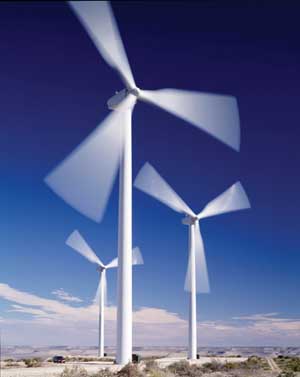
3. Getting a second wind. Wind energy is providing a boost to the beleaguered U.S. manufacturing sector. The average wind turbine installed in the U.S. in 2005 was made of about 30% American-made components. In contrast, turbines installed in 2008 contained nearly 50% domestic components. Courtesy: GE Energy
In addition, as the wind supply chain continues to expand, efficiencies in manufacturing and delivering wind turbine components will contribute to cost reductions, he commented. As the industry ramps up production, it will need experienced workers.
Wind energy will not attain its full potential in the U.S., according to Anthony, without a consistent, long-term federal policy that fosters investments in domestic renewable energy sources, just as federal policies have in the past and continue today to support conventional power technologies. There are several critical components to such a policy:
-
A federal renewable energy standard to support a long-term, consistent market for affordable, clean energy sources in our national portfolio.
-
National investment in transmission infrastructure and restructuring that provides an "interstate transmission superhighway" for transporting electricity from rural windy areas to urban areas where demand is greatest, and regional coordination/cost allocation policies to foster proactive planning for new energy resources.
-
Climate change policy that takes full advantage of wind power by financially recognizing its emission reduction contributions.
-
Improved siting regimes and coordination to minimize potential environmental impacts without unnecessarily delaying wind projects.