On January 8, 2007, a hydrogen explosion at the Muskingum River Power Plant’s 585-MW coal-fired supercritical Unit 5 caused one fatality, injuries to 10 other people, and significant damage to several buildings. The explosion occurred during a routine delivery of hydrogen when a hydrogen relief device failed, which allowed the contents of the hydrogen tank to escape and be ignited by an unknown source. This article covers the findings of the incident investigation and the actions the plant has taken to prevent a reoccurrence.
The explosion at Muskingum River Power Plant underscores the importance of implementing safe equipment design and construction as well as proper procedures for handling hydrogen in order to prevent the loss of life and property at power plants.
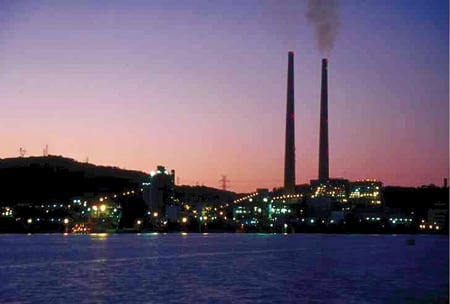
The plant, owned by Ohio Power Co., a subsidiary of American Electric Power Co. Inc. (AEP), is located on the west bank of the Muskingum River near Beverly, Ohio. The plant’s Unit 5 has been in service since 1968. Prior to this incident, the plant had a long history of strong safety compliance.
In March, POWER interviewed Kenny McCullough, director of safety and health in AEP’s generation division. He discussed the findings of the company’s investigation into the explosion and the actions the company has taken to ensure that hydrogen will be handled safely at the plant in the future (Figure 1).
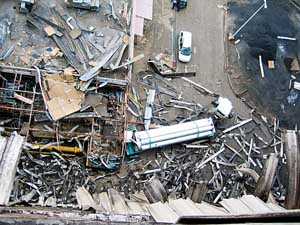
1. A somber scene. A hydrogen delivery truck is surrounded by debris from the explosion at Muskingum River Power Plant’s Unit 5. During delivery, a hydrogen relief device failed, permitting the contents of the hydrogen tank in question to relieve and be ignited by an unknown source. Courtesy: American Electric Power
Background to the Explosion
Hydrogen is used at the Muskingum River plant to cool the unit generators, McCullough explained. He described the standard operating procedures for the delivery of hydrogen to Unit 5.
"After checking in with the plant security, the vendor’s driver had sole responsibility for the task of unloading the hydrogen," he said. "The vendor delivered hydrogen approximately once or twice a week and had a blanket contract for hydrogen at the plant for many years." McCullough characterized the vendor as "a self-described ‘expert at designing, building and safely operating gaseous hydrogen plants,’ [that] provided its own procedures for unloading hydrogen."
Despite the routine use of hydrogen at the plant, plant personnel still had to use caution handling the substance because of its inherently hazardous properties (see sidebar). Hydrogen is the lightest element and is highly flammable.
The Explosion
McCullough explained what happened when the explosion occurred on January 8, 2007.
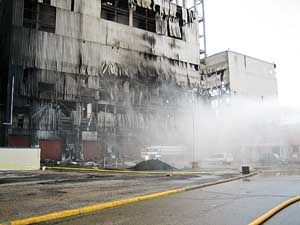
"A hydrogen relief device failed, permitting the contents of the hydrogen tank in question to be relieved and be ignited by an unknown source," he said. "The explosion fatally injured the vendor’s driver and also injured 10 others who had been working nearby. The explosion caused significant damage to the unit’s service building, turbine room, and steam generator building" (Figure 2).

2. Amid the wreckage. The building housing Muskingum River Power Plant’s Unit 5 was significantly damaged by the explosion that occurred when hydrogen, used to cool generating units at the plant, was being delivered. Courtesy: American Electric Power
McCullough noted that "Ohio Power Co. accident responders and first aid workers responded immediately to the scene to fight the fire and attend to the injured." Local fire department and emergency medical technicians also quickly responded to the incident and assisted with emergency response and evacuation actions (Figures 3 and 4).
3. Cooling things down. Water from fire hoses sprays on a hydrogen delivery truck and the surrounding area to keep the area cool after the explosion. Courtesy: American Electric Power

4. A prompt response. A fireman walks through debris near a hydrogen delivery truck after the explosion. The local fire department arrived quickly on the scene to assist the other emergency response teams in fighting the fire and aiding injured workers. Courtesy: American Electric Power
Investigation of the Incident
In the aftermath of the incident at the Muskingum River Power Plant, AEP personnel conducted their own examination into the cause of the explosion. Due to the fatality and the injuries sustained by workers at the facility, the U.S. Occupational Safety and Health Administration (OSHA) also conducted an investigation that included all parties involved in the incident.
"The investigation into this event showed that the relief device was a rupture disc that normally would have been built to relieve pressure to prevent catastrophic failure of the hydrogen tanks," McCullough said. "Normally, the device has a fusible bismuth plug that holds the coin-shaped disc in place until temperatures exceed 180 degrees. The device had been replaced by the hydrogen vendor several months prior, when the vendor was on-site to make repairs related to an apparent leak. The replacement relief device assembly did not have a fusible plug to support the disc."
When the rupture disc failed, the disc, or a piece of fusible plug left in the vent pipe during the replacement several months prior to the explosion, penetrated a bend in the piping, permitting the hydrogen to vent lower down in the area of the tanks as well as up the normal vent path, McCullough explained.
OSHA brought enforcement actions against the involved entities as a result of the findings from its investigation of the incident. Those actions initially consisted of 18 citations, nine each against the hydrogen vendor and Ohio Power Co. After an informal conference, the number of citations against each company was reduced to eight. Most of the citations were directed at the design and construction of the hydrogen system.
Reducing the Risk
After the incident, AEP took corrective actions to guard against future problems related to the handling of hydrogen at the plant.
"Muskingum River Power Plant employees and employees of plants owned by Ohio Power Co. and its sister corporations (AEP employees) took immediate action to prevent recurrence," McCullough said. "The remaining relief devices were verified as being the correct design and constructed with fusible plugs."
The hydrogen vendor was restricted to delivering only 2,100-psi hydrogen to the site (versus the typical 2,400 psi), and the vendors’ employees are now under observation by AEP employees using a defined procedure, the Job Hazard Analysis and Job Safety Assessment Checklist, McCullough explained.
AEP has made other changes in plant operations to further ensure that no more hazardous incidents occur at the facility. "In addition to the procedure changes, the hydrogen system was redesigned and rebuilt to eliminate the use of rupture disc – style relief devices," he said. "Now a relief valve system is used that will reset once pressures have been reduced. The cylinders have been moved away from spaces occupied by people, and the structure is protected from vehicle encroachment and ignition sources."
Key Safety Lessons
In September 2005, a working group with CIGRE (International Council on Large Electric Systems) estimated that there may be more than 40,000 hydrogen-cooled generators in service around the world. Despite the large number of systems that use pressurized hydrogen to cool generators, for the most part, few incidents or problems occur. However, given the inherently hazardous properties of hydrogen, plant staff working with this flammable material need to regularly review both the equipment and handling procedures to verify that there are no problems.
This case history is intended to be helpful to personnel who deal with hydrogen used to cool the generators at their power plants. Proper management, including safe equipment design and construction and correct procedures for handling hazardous materials, can ensure safe results in dealing with this useful substance.
—Angela Neville, JD, is POWER’s senior editor.