Three years ago, an article in POWER described how Cheng Power Systems, by modifying the combustors of several popular gas turbines, had used steam injection to lower the units’ NOx output to about 5 ppm—but some models had substantial CO levels without combustor modifications. Since then, the company has developed new combustor nozzles that recently proved capable of limiting a turbine’s emissions of both NOx and CO levels to even lower single-digit levels. Field test results for a naphtha-burning LM2500 are presented.
Gas turbine users have successfully used steam injection for power augmentation and NOx control for more than 30 years. A small amount of steam injected into the turbine’s combustion nozzles or compressor discharge plenum was all that was needed to meet early limits on emissions of the pollutant. A pleasant side effect was a noticeable increase in power output—assuming the turbine could handle the added mass flow.
Back in 1982, Dr. Dah Yu Cheng of Cheng Power Systems (CPS) saw the commercial possibilities of injecting steam into small and midsize turbines in industrial cogeneration plants that use a heat-recovery steam generator (HRSG) to produce process steam. The commercialization of the technology through his company—International Power Technology (San Jose, Calif.)—began with the 1984 installation of the “Cheng Cycle” on an Allison 501-KH turbine on the campus of San Jose State University in California (POWER, June 2003, p. 51). On that project, capacity rose from 3.25 MW to 5.6 MW, combustion efficiency increased from 28% to 40%, and NOx remained less than 21 ppm.
Further tests demonstrated that it was possible to significantly increase the output of a number of gas turbines of that era by increasing the nozzle steam/fuel mass ratio to 1.5. At the time, several gas turbines were being marketed with a steam injection option for boosting peaking power. Among them was the GE LM5000 steam-injected gas turbine (STIG), which promised an increase in capacity from a non-injected 33.5 MW to a fully injected 50 MW. When NOx reduction via steam injection hit a lower limit of 25 ppm, users turned to selective catalyst reduction (SCR) and CO catalysts to reach single-digit levels, which many localities were beginning to require.
Don’t confuse the Cheng Cycle with the standard STIG cycles available from original equipment manufacturers. STIG uses traditional, constant-pressure waste heat boiler technology. Operation of STIG cycles is limited to near full load, because low exhaust temperature at partial load would cause heat-transfer imbalances in the HRSG. But because the Cheng Cycle requires the use of a variable-pressure HRSG, its operating range extends from idle to full load.
How low can you go?
The technology development that has made possible even lower NOx levels—and now, CO levels as well—is the Cheng low-NOx (CLN) system. Simple to explain but difficult to implement, the CLN system precisely meters steam into the fuel gas under controlled conditions, unlike earlier systems that injected steam into the compressed air before it enters the combustor. With a properly designed set of combustor nozzles, the homogenous mixture of fuel and steam increases diffusion rates and improves the rate of combustion. The results are a lower peak flame temperature, more uniform temperature distribution, and a shorter combustion residence time—all of which combine to inhibit NOx formation.
The CLN system has been in continuous operation at the at the SRI Cheng Cycle Cogen plant for the past eight months. The NOx level has been maintained below 7 ppm. Rig tests of the Allison combustor shows the potential of reaching much lower NOx than that, if properly designed fuel nozzles and fuel manifolds can be installed. Potentially, there are eight more of the Allison 501-based Cheng Cycles in California, 15 in Australia, 18 in Europe, and hundreds in Japan that could adopt the same process. A partial Cheng Cycle (Cheng Boost) also is benefiting two GE 6B turbines in combined-heat-recovery service at a California refinery. But perhaps the most interesting installation of a partial CLN system is on a naphtha-burning LM2500 Cheng Cycle in Kauai, Hawaii, that went into service in 2002. More on that plant in a moment.
First, the rig results
Over the past 15 months, CPS has rig-tested the CLN technology on a Rolls Royce Avon 1535 and an LM2500 fired by natural gas. If the final test rig results look good, CPS will migrate the technology to these larger turbines. All of the tests were conducted on a CLN test rig at one of the Cheng California sites—a cogeneration plant that provides 5.6 MW and steam for powering, lighting, heating, and cooling the campus of SRI International, a nonprofit R&D firm based in Menlo Park.
So far, the test results have been very interesting, to say the least. The 15-MW-class Avon 1535 has never been known as a low-NOx or low-CO producer—that is, until CPS engineers got their hands on the engine’s combustion system. First they modified the combustion liner so that, even without steam injection, CO was reduced from over 125 ppm to 5 ppm. Then the real tests began. After installing the CLN fuel nozzle hardware and controls, NOx fell below 5 ppm (at 15% O2). The control mods entailed the retrofit of an autonomous digital controller to closely manage steam/fuel ratios under all operating conditions. Significantly, no flameouts were experienced during the testing.
The next set of rig tests focused on the workhorse of the midsize gas turbine market: the LM2500. The tests’ goal was to reach 5 ppm NOx with coincident CO less than 30 ppm. They were performed by a team of consultants and associates of CPS, including the cogeneration project teams at San Jose State University and professors of Norway Technical University.
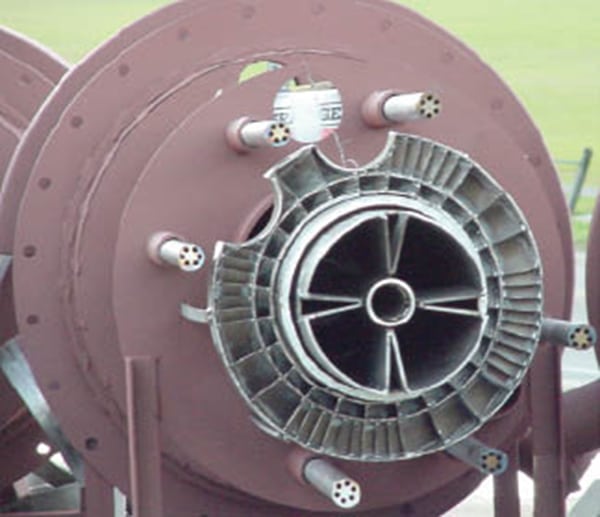
Rig testing of the LM2500’s combustion system followed the installation of a set of six specially designed, reduced pressure–drop CLN fuel nozzles in a segment of an annular combustor. The new nozzles’ tips can accommodate a high steam/fuel ratio without the need for extremely high steam or fuel pressure—a design criterion considered a must for implementation on a real engine. Two goals of the tests were no flameout and achieving as high a steam/fuel ratio as possible at conditions producing 5 ppm NOx or less. Another was to compare two different nozzle-tip configurations, both of which enlarge the steam and fuel flow areas within the confines of the current GE nozzle design. One was with four injection holes and the other was with six injection holes at the tip of the nozzle configuration.
One of the test results was expected: Both configurations were capable of achieving 5 ppm NOx with no flame instability. But another was a complete surprise: NOx levels below 2 ppm were reached with CO steady at 2 ppm and a stable flame observed across the entire CLN steam/fuel operating range up to 4:1 steam/fuel ratio (Figure 1). The combustion noise became quieter. At this high steam/fuel ratio, the equivalent heat rate reduction for constant power is about 28% and a reduction of 18% CO2.
|
1. Driving a big rig. Rig testing of a segment of an annular combustor of an LM2500 retrofit with Cheng low-NOx (CLN) nozzles demonstrated that emissions of the pollutant can be limited to 2 ppm, with comparable levels of CO. Courtesy: Cheng Power Systems
|

Aloha from the Garden Island
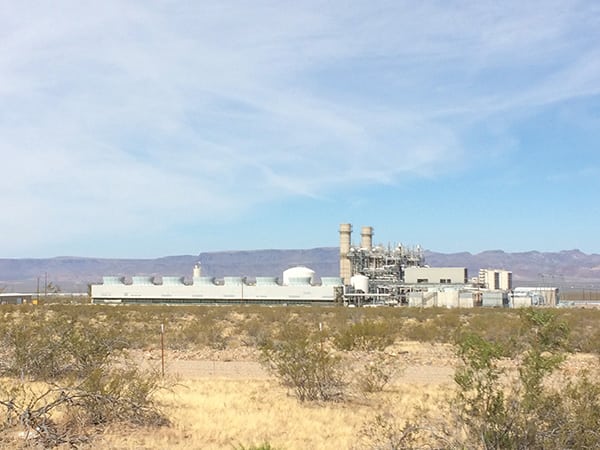
The test rig results at SRI shouldn’t have been that surprising in light of data taken from another Cheng Cycle installation 2,500 miles away. Kauai Island Utility Cooperative’s (KIUC) Kapaia Power Station (KPS) went commercial on September 2002 and is the newest power plant on the island (Figure 2). The facility was originally developed by a joint venture between CPS and CNG Int’l responding to an independent power bid offered by Citizen’s Utility. Due to the high efficiency of the Cheng Cycle, the joint venture was selected to be the final winner of the bid. The power island was jointly specified and guaranteed between CPS, Stewart Stevenson (now GE Energy) and GE Aero Products to provide a performance guarantee for project financing. Subsequently, Kauai Power Partners LP (an independent San Diego–based consulting group) was hired as consultants to administer environmental and site permits to build the plant. CNG Int’l has since merged with Dominion Resources Inc. (DRI). Due to the plant’s high reliability and high efficiency, in August 2003, KIUC exercised the option to buy the plant for $40.2 million. The purchase was a good deal for Kauai residents, because it eliminated the need to pay DRI for 26.4 MW over a 25-year power purchase contract.
|
2. Big power, little package. Kapaia Power Station, commissioned in September 2002, supplies over 50% of the power required by the island of Kauai. Courtesy: Cheng Power Systems/KPS
|
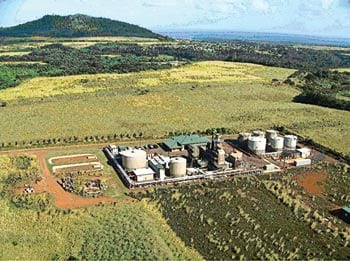
The heart of the KPS facility is a venerable GE LM2500-PH rated at 27.5 MW and operated in “Super STIG” configuration [Cheng]. For comparison purposes, the standard GE-designed LM2500 STIG can ingest up to 50,000 lb/hr of steam, whereas the Cheng version has been kicked up to a maximum of 72,000 lb/hr, limited only by the maximum allowable compressor discharge pressure of 282 psig.
The KPS, which supplies over 50% of the island’s electrical load, is designed to load-follow demand from 60% to 100% of turbine load. The unit is normally fueled by naphtha but occasionally by JP4 or JP5 jet fuel, depending on availability. Because the plant operates 24/7 (unusual for a simple-cycle gas turbine), it racks up a lot of operating hours in short order. Up to 75,000 lb/hr of injection steam at 382 psi/875F comes from a once-through steam generator from Innovative Steam Technologies (Cambridge, Ont.) that is designed to operate dry and be started hot if necessary. (Visit www.otsg.com for more information on this unique steam generator.)
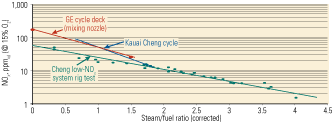
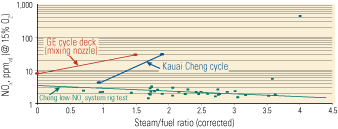
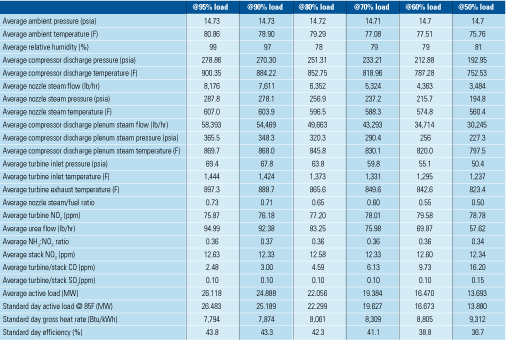
Plant emissions performance of the simple-cycle LM2500, the STIG version, and the Cheng Cycle version for NOx and CO are illustrated in Figures 3 and 4, respectively. As the tables show, heat rate exhibits an extremely flat profile over the operating load range and compares favorably with any 30-MW nominal combined-cycle design. This is an important point: With the available steam, NOx can be reduced to 12 ppm with nozzle steam—below the island’s NOx permit level for a liquid-fueled engine system of 15 ppm NOx without SCR. Because every kilowatt-hour is needed on Kauai, the engine runs in full available steam injection mode most of the time in order to maximize its operating efficiency. Without knowing the NOx reduction potential during the site permitting process, SCR was a required addition to the GE 1:1 steam/fuel coaxial nozzle system. The table provides a comprehensive look at the plant’s operating data.
|
3. Heading for zero. An LM2500 retrofit with the CLN system produced much less NOx than the unit with standard mixing nozzles. Source: Cheng Power Systems
|
|
4. CO levels lower, too. CO reduction also was remarkably reduced by the CLN nozzles in a test rig. The results were duplicated by tests at the Kapaia Power Station. Source: Cheng Power Systems/KPS
|
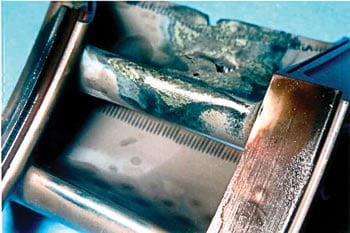
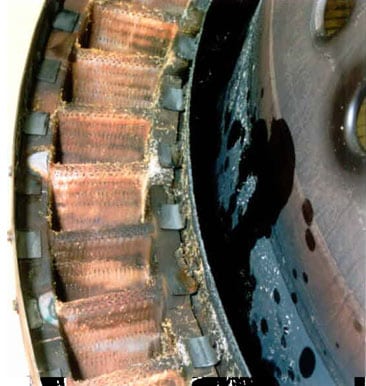
A hot section inspection of the Super STIG started at 12,500 hours as the standard GE liquid fuel hot section overhaul. The inspection was performed by Air New Zealand Engineering Services. Due to its excellent hot section condition, upon boroscoping the engine, the inspection continued every 15,000 hours. Finally, after 19,973 fired hours and 130 starts, KPS decided to do the first hot section overhaul. According to the module condition summary report, the first-stage high-pressure turbine (HPT) nozzle assembly was considered to be in “satisfactory/good” condition, with the potential for operating another 3,000 to 5,000 hours—as was the HPT rotor assembly (Figures 5 and 6). This is remarkable performance for an aeroderivative gas turbine operating for almost 20,000 hours on liquid fuel in a load-following mode.
|
Kapaia Power Station LM2500 performance test results. Source: Cheng Power Systems/KPS
|
|
5. Hot to trot. Burning of the forward outer concave surface of the first-stage high-pressure turbine nozzles. Courtesy: Cheng Power Systems/KPS
|
|
6. Burning blades. Note burning on the concave surface of the leading edge of the first-stage blading. Courtesy: Cheng Power Systems/KPS
|
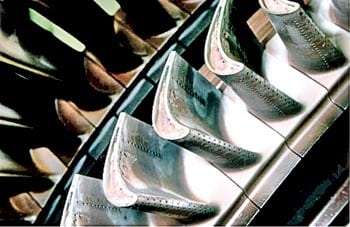
The condition of the second-stage HPT nozzle assembly wasn’t quite as good. The early stages of burn erosion and the loss of parent material appear to be the limiting factors for extending the engine’s hot section life (Figure 7). Following the inspection, repairs that began in February 2005 included installation of Chromalloy single-crystal nozzles, blades, and components on both stages of the HPT to improve its hot section life. After a year of operation, the proud owner of KPS reported in the most recent LM users conference that the expected hot section life would be 50,000 hrs. This is longer than most natural gas–fired units.
|
7. Too hot to handle. The leading edge of the second-stage high-pressure turbine nozzle also suffered significant burning damage. Courtesy: Cheng Power Systems/KPS
|