
Carbon control legislation made it out of a subcommittee of the U.S. Senate Committee on Environment and Public Works in late October, but no one is happy with it. The bill, S. 2191, America’s Climate Security Act of 2007, would direct the U.S. EPA to establish a program to decrease emissions of greenhouse gases (GHGs). Though it doesn’t stand a chance of moving beyond the Senate floor, it does highlight the most contentious issues facing any attempt to legislatively control CO2 emissions.
Besides providing financial aid to low- and middle-income taxpayers to help them adapt to new energy-efficiency rules, and funding a program to accelerate the development and deployment of innovative energy technologies, S. 2191 would:
- Require the three sectors that account for 75% of America’s CO2 emissions (electric utilities, industrial manufacturing, and oil refining) to lower their emissions to 2005 levels by 2012, to 1990 levels (about a 15% reduction) by 2020, and to 65% below 1990 levels by 2050.
- Create a cap-and-trade program for six GHGs, with the caps proportional to the gases’ global warming potential. Some 20% of the tradable emissions allowances would be given to existing carbon generators; the rest would be auctioned. Total credits available would then be ratcheted down over 24 years to meet the emissions-reduction goals.
If Congress is going to choose a cap-and-trade plan as its big gun in the fight against climate change, then it should recognize and acknowledge the “collateral damage” it will cause in terms of economic inequities both domestically and internationally.
Blowback
Responses to the bill, which is still being marked up, were predictable. The Los Angeles Times editorialized that because the cap-and-trade approach invites profiteering and cheating, the newspaper favors a carbon tax. The Natural Resources Defense Council likes cap-and-trade in concept but would like an accelerated timeline and fewer credits handed to existing power plants and factories. Lewis Hay, chairman of FPL Group (which owns two nuclear plants, part of only two coal-fired stations, and hundreds of wind turbines) also took issue with the initial distribution of credits. “Unfortunately, the . . . proposed [bill], if left unchanged, would reward the country’s biggest emitters of carbon dioxide with billions of dollars of free allowances.”
In effect, any carbon control mandate would redistribute wealth from those states (and their regulated utilities) with lower electric rates (primarily due to more coal-fired generation) to those with more nuclear, gas-fired, and renewable energy capacity. Is it fair to dole out some emissions credits to coal-fired utilities to soften the blow on their customers, whose rates will rise the most as a result of carbon caps? That’s something for the 110th (or 111th) Congress to determine. But, as the European Union learned the hard way, any cap-and-trade scheme will lose credibility and efficacy if the public decides that the initial allowances were oversupplied and badly distributed, via grandfathering rather than auctioning.
Doctrines without borders
Not only would U.S. carbon cap-and-trade legislation create domestic energy cost inequities, it would also have negligible practical impact on the international scene. By 2050, regardless of any carbon legislation Congress adopts, or how fast the ratchet handle is cranked, America’s CO2 emissions will likely be only a fraction of the world’s total—and the total is all that matters to the climate. “America’s Climate,” as the bill puts it, is inextricably part of the global climate.
Many say that only the U.S. can provide the political leadership and technology development needed to combat climate change. Perhaps, but I doubt that China and India are waiting for either. Having avoided signing on to the Kyoto Protocol, neither country will be likely to stunt its economic growth to comply with any future GHG-limiting global treaty.
Together, the U.S., the EU, China, and India currently account for 56% of worldwide CO2 emissions. To reduce worldwide atmospheric concentrations of CO2, the entire industrialized world must participate. If China and India don’t endorse and comply with the terms of the successor to the Kyoto Protocol, their carbon emissions will overwhelm those of the rest of the world for generations to come. In the meantime, the few who do adopt cap-and-trade schemes will bear a disproportionate burden of carbon costs.
Coal: Asia’s energy present and future
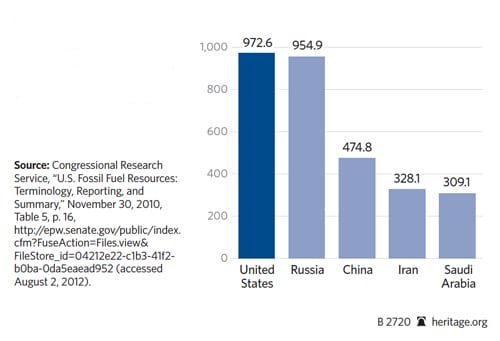
If China makes good on plans to add as many as 500 coal-fired plants over the next decade, they would account for half the world’s total in that category. Having just passed the U.S. in carbon emissions, China will surely increase its lead in coming years. And don’t forget India, which has 200 coal plants of its own in development. The U.S. has a paltry few dozen serious projects in the queue.
China’s economy is growing at a white-hot 10% a year, and it is being fueled by coal-fired electricity. Soon, it may also be driven by nuclear power, thanks to a building program that dwarfs ours—more than 30,000 MW of new reactors by 2020. Although the new nukes won’t produce any GHGs, their 30 GW of “clean” capacity will be overwhelmed by the “dirty” capacity of new Chinese coal plants growing at 8 GW a month over the past two years. China doesn’t have much choice. Use of natural gas is limited by its high price and the country’s undeveloped pipeline network. Big hydropower, represented by the Three Gorges Dam, is by all accounts an environmental disaster.
It’s time we realized that coal combustion will be increasing in China and India for decades to come. If we spend trillions over those same decades to reduce our CO2 emissions in ways that drive up power costs, the only guaranteed outcome is that China and India are going to eat more of our economic lunch.
—Dr. Robert Peltier, PE Editor-in-Chief