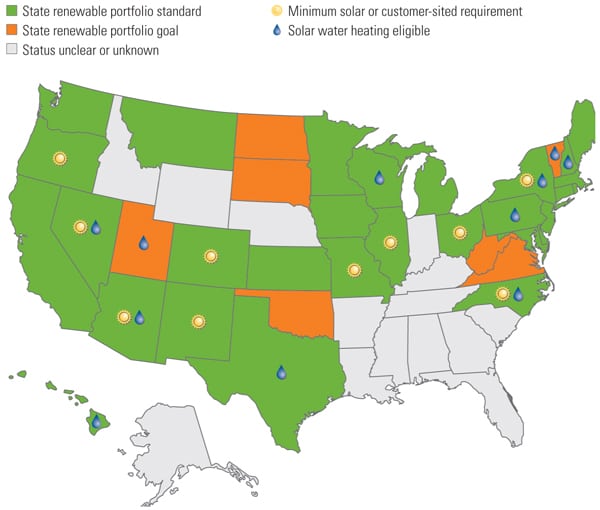

More than 20 states now require their investor-owned utilities to serve a certain percentage of their load with renewable energy by a date certain. Other states are considering following suit. Failure to meet its "renewable power" mandate can subject a utility to financial and other regulatory penalties.
If structured and supervised correctly, these initiatives should achieve their objective—accelerated development of renewable power. Unfortunately, one aspect of utilities’ implementation of the programs is actually retarding development: the passing through to renewable power producers of the regulatory risks associated with renewable power mandates. For example, Pacific Gas and Electric Co.’s 2006 renewable energy solicitation proposes that the supplier of renewable power accept the following indemnity: "Seller shall indemnify Buyer for all penalties assessed against Buyer by the [California Public Utilities Commission] pursuant to the [California] Renewable Portfolio Standard . . . to the extent caused by Seller’s failure to deliver the Product."
Who should bear the risk?
Contracts for the sale of both renewable and nonrenewable capacity impose financial penalties on suppliers for failing to meet their contractual obligations, particularly during peak periods. We do not take issue with these direct performance requirements. Like any other commercial party, the renewable supplier must deliver as agreed to or suffer the financial consequences. However, the effort by utilities to "flow through" any regulatory penalties assessed against them to renewable power suppliers:
- Deviates from accepted commercial practice.
- Contravenes the standard contract risk-allocation rule (that is, the party best able to manage a risk should assume the responsibility for that risk).
- Increases the cost and impedes the broader development of renewable power, undermining the overriding purpose of their renewable mandates.
The regulated utility’s obligation to satisfy its renewable mandate—which some utilities would portray as a garden variety contractual performance requirement readily assignable—remains fundamentally a regulatory requirement whose satisfaction is ultimately determined by policy-driven regulatory standards. Regulatory requirements, by definition, are designed for regulated utilities, which are in a unique position to respond to requirements and risks imposed by their regulator.
What should happen to a utility that fails to meet its renewable mandate through no fault of its own, as a result of a renewable power seller’s failure to perform? The utility should be able to present evidence of the failure to its regulator, to demonstrate how the generator’s failure prevented the utility from meeting its obligation, and to argue that—in this circumstance—the imposition of a financial or regulatory penalty would retard, rather than advance, the proliferation of renewable power.
Converting the utility’s regulatory responsibility to comply with the renewable mandate into a performance requirement forces a renewable power supplier to adjudicate its possible breach of a commercial term within the regulatory arena, which is ill-equipped to resolve commercial disputes. What’s more, addressing the utility’s non-compliance with a regulatory requirement via a one-off breach of contract determination diverts focus from the overriding regulatory objective: the advancement of renewable power.
All stick, no carrot
There also is no reason to impose this purely regulatory risk on renewable power producers. They, like all power producers, are already exposed to exacting commercial penalties for any performance shortfall. In contrast to utilities, nonregulated generators are not paid for capacity not made available and power not produced. Moreover, most power-purchase agreements impose stiff financial penalties for the failure to satisfy exacting "minimum" performance requirements (as high as 95% of capacity during peak periods). Additionally, certain performance deficiencies constitute events of default under power contracts and financing arrangements. Piling the utility’s regulatory risk on top of these penalties for the same performance deficiency is no way to incentivize renewable power producers to "try harder."
Finally, transferring this open-ended regulatory risk from utilities to renewable power suppliers will unnecessarily add to the price of renewable contracts by increasing the cost and decreasing the availability of financing. Ultimately, those two impacts will lead to higher retail electric rates, fewer renewable projects, and preservation of the fossil-fueled generation hegemony. Ironically, by increasing the business risks (and costs) of existing and prospective renewable power producers, utilities imperil their ability to comply with renewable mandates and thereby put themselves at greater risk of being penalized.
Drop the ball, pay the fine
At a minimum, regulators should bar utilities from passing on to suppliers the regulatory responsibilities associated with renewable mandates. Further, if a utility falls short of its mandate due to its failure to contract with reputable producers for sufficient supplies, the utility should bear full responsibility for these failures. But if a utility’s failure to meet the mandate was caused solely by a supplier’s contractual failure, the utility should not be penalized.
Meeting aggressive state renewable power mandates is challenging enough. The odds against success only increase if regulators allow utilities to add regulatory risk to the technological, permitting, financing, and performance risks already confronting renewable power producers.
—Christopher A. Hilen is Of Counsel to the Energy Practice Group of the national law firm Davis Wright Tremaine LLP. He can be reached at 415-276-6573 or chrishilen@dwt.com. Steven F. Greenwald leads Davis Wright Tremaine’s Energy Practice Group. He can be reached at 415-276-6528 or stevegreenwald@dwt.com.