Transformers, which are prone to leaking, are an excellent example of where using the right materials and techniques can quickly reduce cleanup costs and potential environmental damage from a fluid leak. Transformer leaks are most commonly caused by degrading cork gaskets or holes in the radiator fins or the steel tank. Often these leaks are slow drips, but occasionally a catastrophic leak will occur, spilling hundreds of gallons of mineral oil into the environment and causing the transformer to short-circuit, causing further health and safety concerns. These dangers, coupled with transformers’ isolated locations, make inspection, repair, and maintenance a major challenge.
Sealing Transformer Leaks
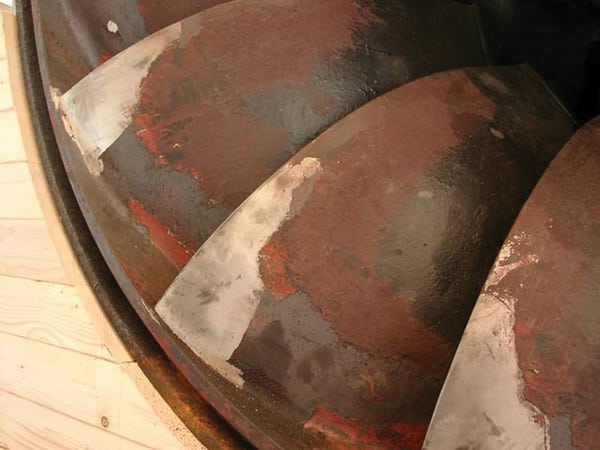
Radiator fins are a common area for oil leaks. Fins are made from thin metal to aid heat transfer. The downside of that thinness is that internal corrosion due to water ingress and separation or external environmental corrosion can quickly penetrate and spill the oil (Figure 4). Traditionally, the only solution for repairing this in-situ without severely compromising the fins’ ability to transfer heat and cool the transformer has been to weld the leak. This requires the transformer to be taken offline and drained before it can be welded, which can potentially inconvenience customers and is costly.

4. Transformers corrode and leak. Over time, the fins on a transformer can corrode and leak oil into the environment. Courtesy: Belzona Polymerics Ltd.
Preventing leaks is as important as sealing them, as the area most likely to be damaged is situated at the bottom of the transformer. Bonding thin metal plates to the affected areas is a highly effective method for repairing and protecting such fins without having a dramatic effect on their ability to transfer heat. If the bonding agent has good adhesion to the substrate, it will prevent further corrosion of the fin and seal any potential leaks. However, because the fins are very close together, it is almost impossible to get the surface clean and sufficiently abraded; most adhesives are unable to perform in this situation.
In one case, Belzona 1831 (Super UW-Metal) was used to bond preformed plates as thin as 1 mm (0.04 inch) to repair corroded fin areas. This is a straightforward repair easily undertaken by anyone on site.
Other areas where leakage is common include cork gaskets, such as those found around insulators or between flange faces, which over time will become porous and slowly leak. This is often a slow weeping rather than a catastrophic failure; however, over time, the weeping can cause a serious amount of oil loss.
In another example, the gasket between the lid and body of the 11-kV transformer had been leaking for some time (Figure 5). For this application the surface was prepared using an MBX Bristleblaster to clean and profile the surface. Belzona 1831 was applied to the prepared area (Figure 6) using the Belzona 9341 reinforcing sheet to add extra strength, as a gap was being bridged here. This repair was carried out quickly and without any other special equipment. In similar applications where leaking is more extreme, the bolts have also been sealed.
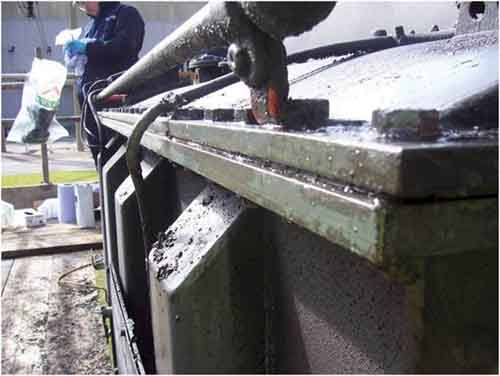
5. Seal an active leak. A leaking gasketed surface can also be repaired in place, without draining the oil from the tank. Courtesy: Belzona Polymerics Ltd.
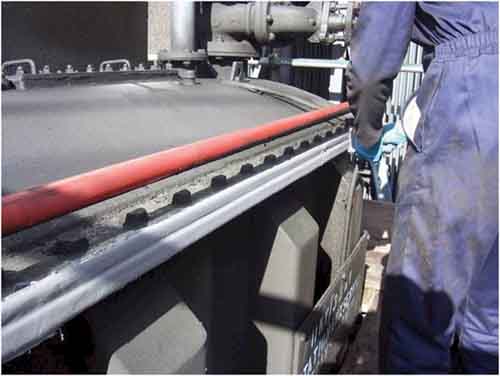
6. Prep and apply. After the surface was prepped, a reinforcing sheet to add strength was applied. Then a final coat was applied to the gap to stop the leak. Courtesy: Belzona Polymerics Ltd.
Where holes are sizeable and the oil is freely leaking, it is usually possible and necessary to temporarily stem the leak using a live leak-sealing product such as Belzona 1291. Belzona 1291 is an emergency leak sealant designed to make a quick, temporary repair by providing a moldable bung that cures quickly to become a rigid plug. Once the bulk of the leak is temporarily sealed, a permanent repair is made.
It’s All About Adhesion
All of these cases rely on the correct adhesive selection. Oil is an excellent release agent, preventing the vast majority of glues on the market from achieving effective long-term adhesion to steel.
Improvements in oil- and moisture-tolerant polymers changed our options. Belzona 1831 is able to penetrate through the oil and water and bond to even a mechanically abraded substrate, making repairs like these easy.
Surface preparation can be achieved in a number of ways using hand tools such as grinders. However, the best results have been found when using the MBX Bristleblaster, which will quickly and effectively clean the surface of the metal and produce an excellent and consistent profile for the product to bond to.
All of the repairs discussed were accomplished without draining the oil from the equipment by using cold-curing, 100% solids products that require no heat and do not shrink. Unlike welding, these products will not distort the substrates and will bond to all of the rigid materials found in this equipment. When cured, the polymer becomes an inert plastic, aiding disposal and recycling of the unit at the end of its life.
Material Also Seals Gas Leaks
Sulfur hexafluoride (SF6) leakage is also an environmental hazard and another application where this kind of product can provide an effective solution. SF6 is used as a gaseous dielectric medium for high-voltage electric equipment such as circuit breakers and switchgear, and it can be difficult to detect. Once detected, it is imperative that the leak be sealed very quickly, on site, without waiting for a specialist team. The same technology used for sealing transformer oil leaks can also be used to quickly and effectively seal SF6 leaks, as it will bond very well to steel and porcelain insulators (Figure 7).
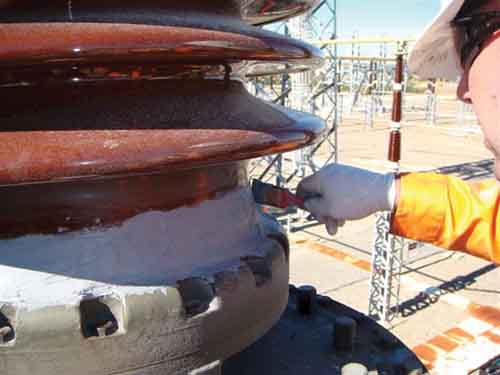
7. Stop gas leaks. The same sealant has been successfully used to stop SF6 leaks in switchgear. Courtesy: Belzona Polymerics Ltd.
Repairs like these can be completed in as little as one hour without special tools or equipment, and the repair will last for years in the most challenging of environments.
Since this system was launched in the UK, many electrical transfer equipment operators have implemented its use, and now it is being adopted by national electricity distribution companies in other European countries.
— Contributed by James Malcolm (jmalcolm@belzona.com), business development engineer, Belzona Polymerics Ltd.