ASSET MANAGEMENT
Replace pumps, cut repair bills
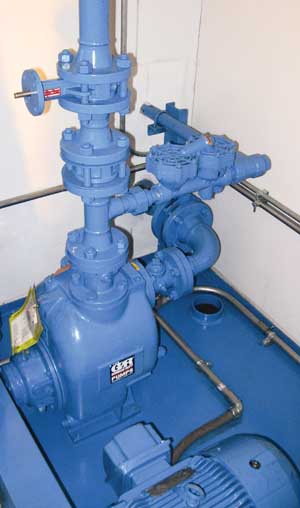
The original design of Progress Energy’s Lee Plant in Goldsboro, N.C., enlisted nine vertical sump pumps within the plant yard as drain pumps. In this type of design (Figure 1), the motor is at the top of a shaft that extends down to the bottom of the sump, where the pump itself is located. At the Lee plant, the vertical pumps remove all kinds of water: standing accumulations of rainfall, coal pile runoff, and water from storm drains from equipment washdowns. The pumps’ outputs are piped to a retention settlement basin whose sumps are below grade.
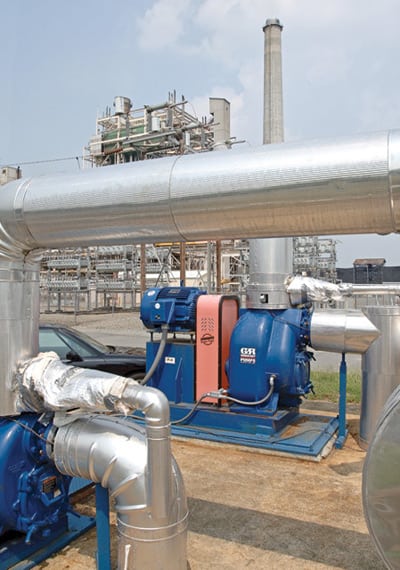
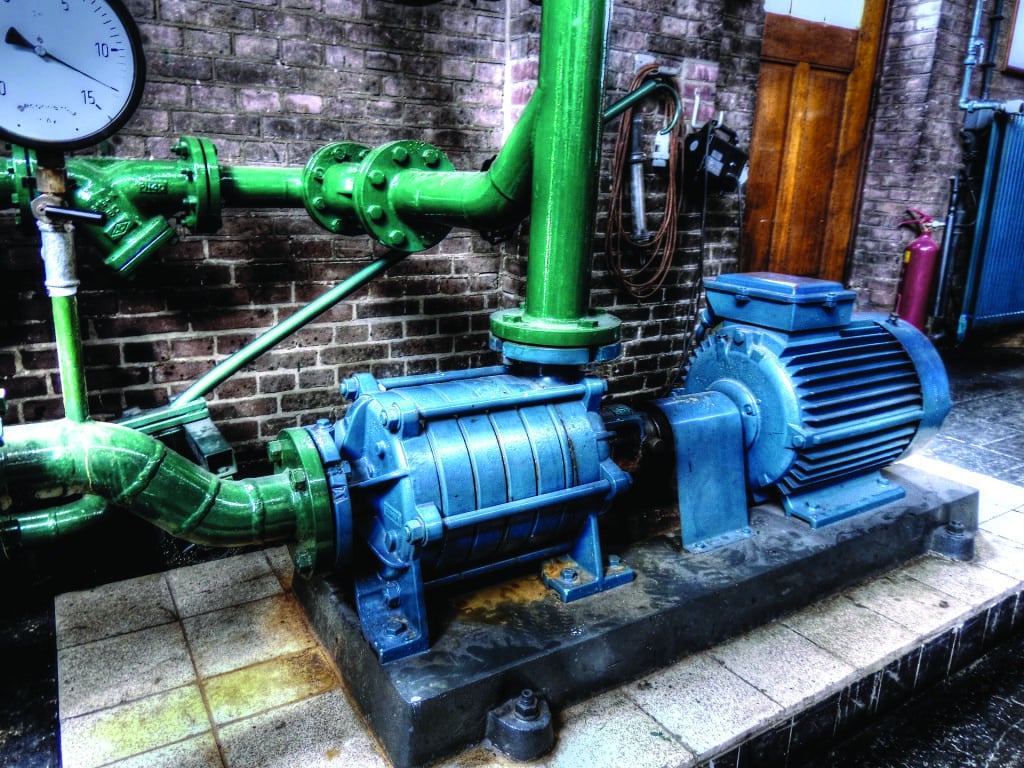
1. Problematic pumps. Vertical sump pumps played an important role at Progress Energy’s Lee Plant: keeping the plant yard properly drained. But as they aged, the pumps became less reliable and more expensive to maintain. Gorman-Rupp horizontal self-priming centrifugal pumps were selected as a replacement. Courtesy: Gorman-Rupp
As the pumps aged, their maintenance became more frequent and more expensive. Several years ago, their reliability had deteriorated to the point of compromising overall plant operations. "We were rebuilding those nine vertical line sump pumps on a regular basis," said Ed Davis, a senior work management specialist with Progress Energy. Replacing the pumps became a matter of "when," rather than "if."
Opportunity knocks
About four years ago, Davis consulted Bill Lynch of Tencarva Machinery Co. (www.tencarva.com), an employee-owned firm that specializes in rotating equipment and wastewater pumps for industries such as power generation.
After further discussions with Lynch at the plant, Davis decided to replace the vertical line sump pumps by horizontal, self-priming, centrifugal pumps. In addition to being more efficient, the centrifugal pumps are easier to maintain because they can be installed above ground level at the top of the pumping station, with only a suction line submerged below grade.
Ultimately, Davis specified Gorman-Rupp’s (www.gormanrupp.com) Super-T pumps in three sizes: 4, 6, and 8 inches. "When we compared the cost of the new pumps to the cost of maintaining the old ones, we felt the savings justified investing in new motor skids and controls as well," said Davis.
Before making a final decision to replace all nine vertical sump pumps, Progress bought two of the Gorman-Rupp centrifugal pumps on a trial basis and installed them over the course of 18 months. "To make sure we’d be making a sound investment, we wanted to spend time observing the pumps closely," Davis said. According to Tencarva’s Lynch, it took teams of two or three men about two weeks to make the switch, including piping and electrical modifications.
A thumbs-up trial
After seeing the centrifugal pumps work as advertised, Progress Energy ordered seven more. All nine vertical sump pumps have now been replaced, and seven of the new Super-T Series pumps (Figure 2) have assumed responsibility for keeping the plant yard drained. "Tencarva did an excellent job of matching the new equipment to our existing structure," said Davis. "The switch was completed easily and efficiently."
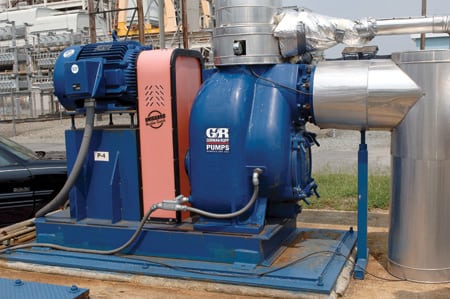
2. Prime numbers. Super-T centrifugal pumps can reprime automatically in a completely open system without the need for suction or discharge check valves. They can even do so when the pump casing is only partially filled with liquid and the suction line is dry. Courtesy: Gorman-Rupp
“Every 12 to 18 months, we had to rebuild a pump at each pump station,” said Davis. “We’ve operated the centrifugal pumps for three years now, and we have only had to perform normal preventive maintenance on them.”
According to Tencarva, Progress Energy has experienced only minor pump maintenance issues over the past three years. "With nine units, they [had to open] one of them up at least once a year, and that added up," said Lynch. "With the new pumps, the only problem was an air release valve that leaked and had to be replaced. The plant will soon need to replace three or four of the remaining pumps on its grounds. But the key is that when they wear out, the Lee plant doesn’t plan to rebuild them. They plan to match up the pump size and replace the vertical line sump pumps with self-priming centrifugal pumps. I think the pumps’ track record speaks for itself."
—Contributed by Tencarva and Gorman-Rupp
MECHANICAL
New bolts show their stress level
Critical bolted joints require precise tightening to establish the optimum clamp load. Though wielding a torque wrench can apply a "ballpark" pressure quickly, using a direct tension indicator (DTI) provides greater precision—because a DTI responds only to bolt tension, not to torque.
DTI SmartBolts were invented by Stress Indicators Inc. (www.smartbolts.com) to enable technicians and inspectors to apply the proper bolt tension with no need for torque wrenches, strain gages, wires, or electronic or ultrasonic equipment (Figure 3). There’s no need to touch or contact the fastener at all to verify its clamp load. The color of a visual indicator in the fastener itself can be correlated with the tension applied, both at the time of tightening and later.

3. Show and tell. According to extensive U.S. Air Force field testing, the tensions or clamp forces applied to a bolt by a given torque can vary by as much as 500%, depending on the bolt’s plating, lubrication, thread condition, nut and washer material—and 71 other variables. Courtesy: Stress Indicators Inc.
The indicator shows bright red when the fastener is loose and darkens to a deep black as the bolt is tightened. The operation is completely reversible—DTI SmartBolts can be tightened and loosened thousands of times with no degradation or loss of accuracy. The color-coding makes loose fasteners—even those in moving machinery—obvious at a distance. The standard tension accuracy is specified at ±10%.
The main limitation of DTI SmartBolts’ color-coding is the inability to show an over-tension condition. Once the design tension is achieved, the indicator will continue to show deep black if the fastener is tightened further. Another limitation is that the color change associated with a small (say, 10%) loss of tension may be difficult to resolve in real-world conditions.
Color-coding tension
Stress Indicators Inc. developed its new line of HR (high-resolution) SmartBolts to remove those limitations. They include a sensitive optical microindicator element in the middle of the bolt head (Figure 4). The indicator remains yellow as the fastener is elongated by its initial tightening. When 85% of design tension has been achieved, the indicator begins turning green; bright green signifies that 100% has been reached.
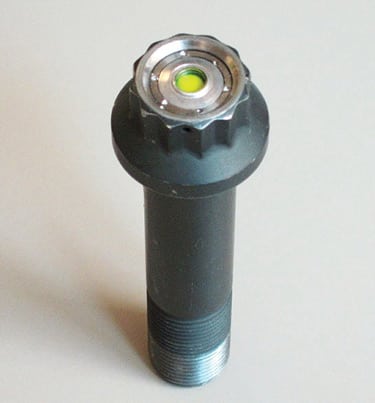
4. Military potential. HR SmartBolts have attracted the interest of the U.S. Army, which is now evaluating their possible use on Apache helicopters and other military applications. This ¾-inch bolt, made of MP35N alloy, has been proposed for fastening the Apache’s mast. Courtesy: Stress Indicators Inc.
If a bolt is tightened beyond design specs, its indicator darkens to nearly black. More importantly, should a bolt loosen by more than 10% to 15%, the indicator returns to bright yellow, signifying a problem. This improved color-coding scheme facilitates both remote, noncontact spotting of loose bolts and quick-look inspections ("grass green" means the bolt is doing its job).
More precise, too
HR SmartBolts indicate their tension via a direct measurement of their elongation. They are more accurate than DTI SmartBolts because the former are calibrated at design tension during assembly. The color of the microindicator responds to an elongation as small as 60 millionths of an inch, which corresponds to a change in tension of around 2% for high-strength bolts.
SmartBolts have been studied by EPRI, which concluded that their ability to show their tension at a distance could help reduce the radiation exposure of nuclear power plant inspectors and maintenance workers. Accordingly, radiation-resistant designs will soon be installed in actual nuclear plants for further evaluation.
—Contributed by Stress Indicators Inc.
WATER TREATMENT
Up a certain creek, without a filter
Just as recycling enables paper, plastic, and glass to be reused, filtration and purification systems allow reuse of something even more precious—water. Although most systems don’t turn sewage into drinking water (as they do on the International Space Station), "gray water" is increasingly used for irrigation, fire protection, and a variety of industrial applications. Like many utilities large and small, Florida’s Kissimmee Utility Authority (KUA) decided to use reclaimed wastewater to cool a new gas turbine plant built nearly a decade ago.
“We use [the treated effluent of our municipal sewage treatment plant] for cooling the plant for two reasons,” said Jay Butters, the plant’s O&M supervisor. It’s environmentally friendly to use water twice, and reclaimed water is a lot cheaper than potable water.”
However, as KUA learned the hard way, you indeed get what you pay for. The low-cost water repeatedly clogged the conventional filter that was installed, post-commissioning, in the line that brings the effluent of the sewage plant to the power plant.
Dirty water, disgusting job
Founded in 1901, KUA is Florida’s sixth-largest community-owned utility, with 170,000 customers. In 1998, with the Roy E. Hansel diesel plant nearing a century of service, KUA asked for and received approval to build a new, modern generator at the Cane Island Power Park, about 5 miles beyond Kissimmee’s city limits.
The prime mover of the new, 250-MW combined-cycle plant, which was constructed in short order, was a General Electric Frame 7FA turbine-generator capable of burning natural gas or fuel oil. The plant was designed to be cooled by water reclaimed from the City of Kissimmee’s sewage treatment plant.
To further purify the makeup, after starting up the gas turbine plant KUA installed a 1,000-micron filter in the line between it and the sewage plant. This filter caught most, but not all, of the many particulates in the effluent. Those it did catch ended up clogging the filter.
“That filter had to be cleaned three or four times a day, and the multiple cleanings took at least three hours for one man to finish,” Butters recalled. “Operators especially hated cleaning the filter because of what the job exposed them to: used toilet paper, biologicals in the water—even live bloodworms, which really raised concerns.”
Equally troubling was what the filters didn’t catch. Many of the smaller particulates that made it through the 1,000-micron screen ended up being deposited inside the plant’s plate and frame heat exchangers, which had be taken out of service quarterly for cleaning.
A zero-maintenance alternative
To eliminate the maintenance and health problems that the conventional filter was causing, KUA decided to replace it with a self-cleaning, stainless steel Tekleen filter from Automatic Filters Inc. (www.tekleen.com).
“We wanted to stop exposing operators to the wastewater and reduce labor requirements as well,” says Butters of the decision. Tekleen filters use a unique mechanism that does not interrupt the flow of filtered water during cleaning. The self-cleaning also uses a lot less water than normal back-flushing. Finally, standard, rather than optional, use of stainless steel makes the filters last longer.
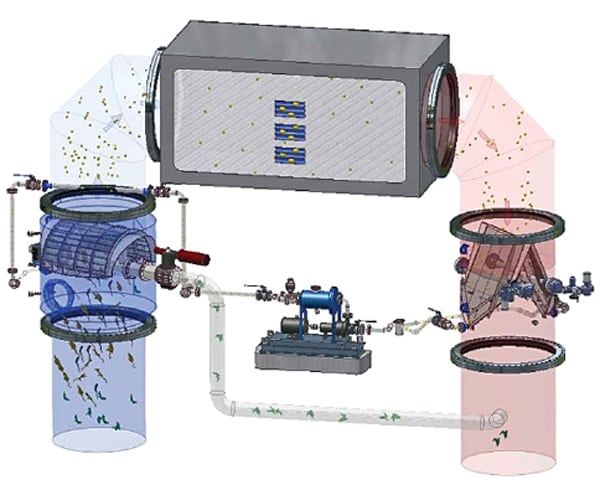
In the Tekleen design (Figure 5), dirty influent water is first cleaned by a coarse filter at one end that removes larger particles. This prefiltered water is then sent to the other end, where it passes through a final filter and then to the outlet. Over time, trapped particles clog the filter, reducing outlet flow and pressure. At the filter’s outlet is an adjustable differential-pressure switch that is typically set at 5 to 7 pounds. When the outlet pressure falls below the setpoint, the switch closes to open a small flush valve, initiating the self-cleaning procedure.

5. Can’t touch this. Replacing a filter that required manual cleaning several times a day with a self-cleaning Tekleen filter delivered several tangible health and economic benefits at a Kissimmee Utility Authority power plant. There’s no longer a need to repeatedly expose an operator to biological hazards in wastewater. Nor is there a need to clean clogged downstream heat exchangers quarterly, exposing maintenance workers to the same foul substances. By saving three man-hours daily and two man-days quarterly, the self-cleaning filter paid for itself within months. Courtesy: Automatic Filters Inc.
To clean itself, the Tekleen filter incorporates several small cleaning nozzles arrayed around a central shaft. Opening the flush valve lowers the water pressure within the cleaning assembly and activates a hydraulic motor and a piston. The motor and piston cause rapid rotation and axial movement of the nozzles, which remove all of the dirt on the inside surface of the filter within 5 to 10 seconds. Next, the flush valve closes and the piston and nozzles are returned to their starting positions. Other than small control voltages to actuate the differential-pressure switch and the flush valve, all self-cleaning motions are driven by water pressure.
Payback time
For its turbine-generator at Cane Island Power Park, KUA selected a 12-inch, 2,400-gallon/minute Tekleen filter with a 500-micron screen. The utility bought the filter in 2005 and installed it during the plant’s scheduled 2006 spring maintenance outage. It took a welder about four days to remove the old filter, install the new one, and connect its I/O lines to the plant instrumentation system.
Over the past 18 months, the new filter has performed exactly as expected. Because its 500-micron screen catches more, and smaller, particulates than the 1,000-micron filter it replaced, KUA no longer needs to shut down the plant’s cooling system quarterly to clean heat exchangers. And since the Tekleen filter is self-cleaning, an operator doesn’t have to waste several hours per shift attending to it.
“The self-cleaning filter is saving us a lot of man-hours and has eliminated some serious health concerns for our employees,” Butters said. “It easily paid for itself in just six months.”
—Contributed by Automatic Filters Inc.
PLANT SAFETY
Hang up those cables and hoses
During power plant overhauls, those myriad "temporary" cables and hoses snaking everywhere don’t just make it harder to complete the project on time and under budget. They also represent a potential hazard to personnel and sensitive equipment like workstations. A Dutch firm, Westmark BV (www.cablesafe.com), has developed an inexpensive hook (Figure 6) that gets cables and hoses off the ground, eliminating them as possible causes of damage to gear or injuries to workers.
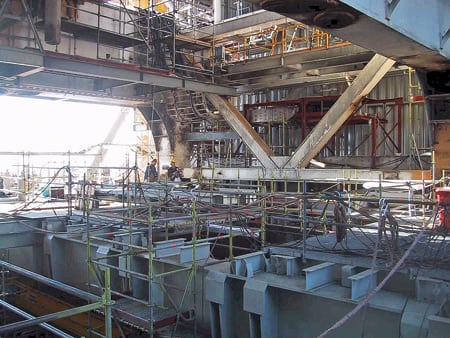
6. Mine or yours? To make it clear which contractors own which Cablesafe hooks, they can be ordered in different colors or even engraved with a name. Courtesy: Westmark BV
Cablesafe hooks earned their stripes at Dutch offshore oil and gas rigs and petrochemical plants by improving safety on decks, stairs, and scaffolding. Now, during a "turnaround" or shutdown of most plants owned by giants in both industries, contractors must use the hooks to suspend all their utility cables. Studies indicate that more than 20% of the accidents on overhaul projects are falls by workers who tripped on an electrical or welding cable or a fire or air hose.
These simple, S-shaped hooks are made of very strong, nonconductive, and inflammable reinforced polyester. They can be used again and again. During emergency situations, Cablesafe hooks help keep escape routes free of obstacles that can endanger the lives of plant personnel and firefighters.
Because the hooks are nonconductive, they eliminate the risk of inadvertently "frying" equipment or electrocuting workers. Based on experience, their use also reduces the number of temporary cables and hoses needed on a project and increases the longevity of those used by minimizing damage to them by sharp edges (Figure 7).

7. Safety first. Cablesafe hooks come in three sizes, and each clearly states its maximum load. At each end of the hook, there’s a hole large enough to accommodate a cable tie-wrap. Courtesy: Westmark BV
Westmark’s latest development is a fluorescent Cablesafe hook that glows in the dark. During the many power outages typical of overhaul projects, these hooks can serve as orientation points for personnel and help them escape safely from a potentially hazardous situation.
—Contributed by Westmark BV, represented in the U.S. by Intrepid Industries (www.intrepidindustries.com).