Ten years ago, any self-respecting U.S. utility executive might have been drawn and quartered for publicly promoting a nuclear power revival. How times have changed. Today, more than half of America’s nuclear plants have outsourced their operations to specialty firms, and the prospect of a nuclear renaissance in the U.S. (see Cover Story) is brighter than it has been since 1979—when the core of Three Mile Island Unit 2 partially melted down, pulling the plug on orders for new reactors.
The consolidation of nuclear plant operations will continue because it has raised the reliability and lowered the cost of service to end users. Firms such as Entergy Nuclear and Exelon Nuclear have become very adept at squeezing the last drop of performance and profit from nuclear assets, even graybeard plants. Over the past few years, the capacity factor of the U.S. nuclear fleet has hovered around 90%, with the production cost of most plants below 2 cents/kWh.
The efficiency gains of fleetwide operations also have simplified utility resource planning. Since 1990, gains in capacity factor alone have matched the cumulative capacity of at least a dozen typical-size plants, making their construction unnecessary. Separately, over 4,800 MW of reactor uprates—the equivalent of another four new units—have been approved by the U.S. Nuclear Regulatory Commission (NRC), and another 2,400 MW are pending.
Rich get richer
A realistic appraisal of near-term U.S. electricity demand growth indicates limited opportunities for profiting from nuclear power projects in this country. There are few utilities whose balance sheet can cover the $2 billion to $3 billion price tag of a new plant. And there are even fewer multinational engineering, procurement, and construction (EPC) firms with the talent and access to skilled labor necessary to build a single reactor—much less the dozen projects that have been announced in the U.S. alone.
I believe the new nuclear market will be carved up by the EPC firms and reactor vendors faster than Barry Bonds turns on a fat pitch. The early birds will catch the worms, and the late entrants will leave the table hungry. For the sake of argument, let’s assume that the market is 25 new projects over the next 15 years—worth perhaps $60 billion to $70 billion in the U.S. alone and possibly twice that worldwide. The early birds will bulk up and become even more formidable competitors. Come in second too many times and you’ll be out of business.
Order of battle
It’ll be interesting to see how the battle for the next generation of nukes unfolds in coming years. Who will emerge as the kings of the hill? The biggest challenge suppliers will face is whether there will be enough firm business to support five different reactor designs.
Every member of the world’s nuclear club is staking out turf in what promises to be the largest business opportunity of this era:
- China, which is planning to build 25 new reactors by 2020, has just selected Westinghouse’s 1,100-MW AP1000 for four new plants to be sited at Sanmen and Yangjiang. Westinghouse may be in line for perhaps 10 new projects in the U.S. as well.
- TXU has chosen MHI Nuclear Energy Systems’ 1,540-MW advanced pressurized-water reactor (APWR) for 2 to 6 GW of new capacity, also in the 2015–2020 time frame. The reactor is based on technology that MHI developed for a two-unit, 3,000-MW expansion of Japan Atomic Power Co.’s Tsuruga Power Station.
- Last June, NRG Energy filed a letter of intent with the NRC to add two GE ABWR (advanced boiling water reactor) units at the South Texas Project at a cost of $5.2 billion. Four of the units have been operating in Japan since 1996, two more are nearing completion in Taiwan, and construction has begun on a seventh unit in Japan.
- GE is also hawking its 1,550-MW "Economic Simplified" BWR, which the NRC says it may certify by the end of this year. Dominion and Entergy have expressed interest in the design for three sites.
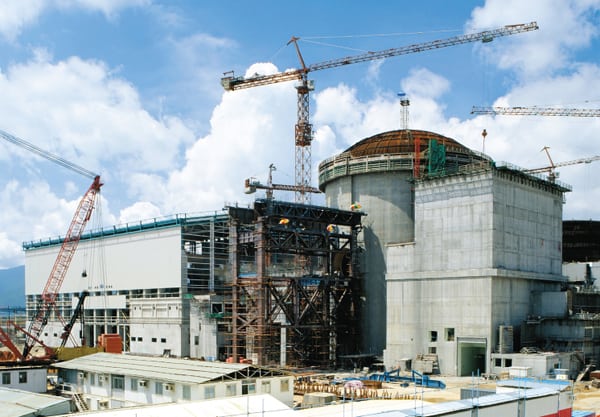
- Areva NP is marketing its 1,600-MW EPR (evolutionary pressurized water reactor) standardized design in the U.S. through Unistar Nuclear, its joint venture with Constellation Energy. The first EPR, now under construction at Olkiluoto 3 in Finland (this month’s cover photo), has an expected in-service date of late 2009.
A few good partners
Prospective nuclear plant owners will be looking not just for good reactor technology but also for business partners strong in all phases of the plant life cycle. EPCs lacking any of the following need not apply: time- and cost-efficient construction practices, the ability to ramp up construction capacity to match demand, access to long lead-time forgings for reactor vessels (now available only from two overseas suppliers), and a lean but solid supply chain that can service dozens of simultaneous projects across the globe.
It has been said that while amateur military strategists talk tactics, the professionals discuss logistics. In the looming battle for nuclear market share, the winners will be the suppliers with robust global supply chains.
–Dr. Robert Peltier, PE, Editor-in-Chief