
POWER
-
 Legal & Regulatory
Passing on regulatory risks undermines renewable mandates
More than 20 states now require their investor-owned utilities to serve a certain percentage of their load with renewable energy by a date certain. Other states are considering following suit. Failure to meet its "renewable power" mandate can subject a utility to financial and other regulatory penalties. If structured and supervised correctly, these initiatives […]
-
 News
NewsPOWER magazine’s Top Plants of 2006
On the following pages, we introduce the magazine’s 12 Top Plants of 2006. Among this year’s winners are two solar energy plants and another that marries fuel cells with heat and waste gas recovery. As those projects make clear, a plant doesn’t have to be big to earn kudos from us. What we typically like […]
-
 Gas
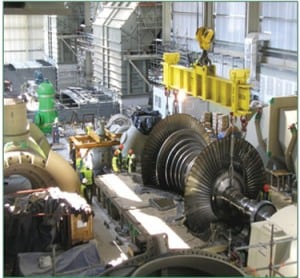
GasArcos de la Frontera Grupo III Combined-Cycle Plant, Cádiz, Spain
Iberdrola is rapidly making a name for itself on the world stage for building large, very efficient combined-cycle plants and for being the largest owner and operator of wind power plants. The utility’s most recent achievement was the successful commissioning of the Arcos de la Frontera Group III project, which marks the commercial debut of General Electric’s Frame 9FB gas turbine.
-
 Solar
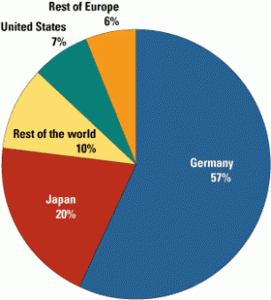
SolarBavaria Solarpark, Germany
The world’s largest solar electric system was dedicated in June 2005 in Mühlhausen, Germany. The 10-MW system comprises three separate but interconnected photovoltaic parks in different cities that use an innovative sun-tracking system to maximize their outputs. After one year of operation, all three parks are still going strong—as you’d expect, due to their dearth of moving parts.
-

Backroom deals
Richard Nixon was the master of the “big lie” in politics. Once, when his cronies expressed concern about some “liberal” statements he had made, he told them to “ignore what I say and watch what I do.” That insight into an elected representative’s true state of mind is as useful today as it was a […]
-
 O&M
O&MStandardizing PdM, fleetwide
The pressure on power producers to supply reliable electricity is unyielding. Forced outages, which usually are caused by unexpected component failure or systemic problems, can prove very costly to both bottom line and reputation. To reduce the frequency and duration of unscheduled outages, many gencos are implementing comprehensive predictive maintenance (PdM) programs. Such is the […]
-
 Business
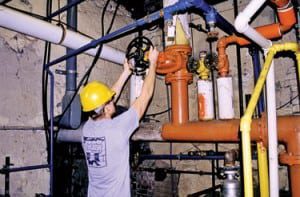
World-class teaching lab prepares next generation of plant operators
The Williamson Free School of Mechanical Trades near Philadelphia has been training power plant operations professionals for 112 years, and its graduates hold top positions at many major gencos, refineries, equipment suppliers, and design and construction companies. Testimonials indicate that it provides one of the best models for training tomorrow’s plant operators.
-
 Coal
CoalCoal: The cornerstone of America’s energy future
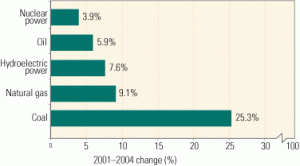
In April 2005, U.S. Secretary of Energy Samuel W. Bodman asked the National Coal Council to develop a “report identifying the challenges and opportunities of more fully exploring our domestic coal resources to meet the nation’s future energy needs.” The council has responded with eight specific recommendations for developing and implementing advanced coal processing and combustion technologies to satisfy our unquenchable thirst for energy.
-
 Coal
CoalGlobalization: The new millennium’s "invisible hand"
Participants in the CEO Roundtable at Electric Power 2006 raised a plethora of issues affecting decisions on future electric power generation. Representing a cross section of power producers, the industry leaders made clear that, although globalization has lost its luster in the power generation sector, its impact on the domestic industry remains profound. Ten years […]
-
 Coal
CoalSafety still Job No. 1 for PRB users
If coal is to be “America’s energy future” (see p. 42), the work of the Powder River Basin Coal Users’ Group (PRBCUG) will have a lot to do with making it so. Since 1999, the PRBCUG (see sidebar) has fostered the safe, efficient, and cost-effective use of the fuel as it watched its membership swell […]
-
 Synfuel
Combined Cycle Users’ Group completes another successful year
The third annual meeting of the Combined Cycle Users’ Group (CCUG) was held May 2–4 in Atlanta at Electric Power 2006, in cooperation with the ASME Power Division Combined Cycles Committee and other industry groups. The CCUG’s leadership (Figure 1) drives the group to address issues involving the major components of a combined-cycle plant and […]
-
 O&M
O&MImproving the reliability of turbine lube oil supply
Five years ago, San Onofre Nuclear Generating Station’s Unit 3 turbine experienced substantial damage after the supply of oil to its bearings failed. Because the turbine coasted down without oil after it tripped, its bearings, journals, and steam path needed extensive repairs. A follow-up investigation revealed lube oil system vulnerabilities that were subsequently corrected. The lessons learned might also improve your turbine-generators’ lube oil reliability, saving you many millions in lost revenues.
-
 O&M
O&MComputer-based hydro plant scheduling
Hydroelectric power plant managers face unique scheduling challenges. They have a finite amount of water in their reservoirs available for energy production, and they need to schedule generation according to market demand to maximize profits from their limited “fuel” supply. Hydro power plants are capable of producing products other than electricity. Among them are ancillary […]
-
Business
Gencos embrace benchmarking as strategic tool
Today’s utility business models re-emphasize utilities’ traditional mission—producing and delivering reliable, affordable power. Tracking how well that mission is executed is the raison d’être of modern plant performance benchmarking.
-
 O&M
O&MMonitor your fluid levels online
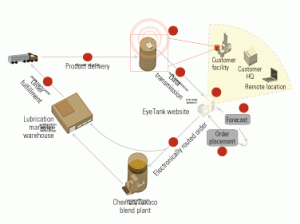
Although fluid monitoring technology has come of age in recent years, its level of sophistication varies widely across industries. Some users of bulk chemicals, fuels, and other fluids use state-of-the-art systems with bells and whistles like automated data gathering and transmission. At the other extreme, some tank farms still “stick the tanks.” Although 95% of large […]
-
 Wind
WindGreener than thou
U.S. wind power is on a roll, with wind farms sprouting like weeds. But in the near future, utilities may end up paying higher prices for wind capacity because state regulators are, in effect, imposing an artificial floor on national demand for generation fueled by renewable resources. At last count, at least 20 states had […]
-
 Gas
GasGlobal Monitor (May 2006)
Nuclear hot streak continues/Who’s winning in U.S. wind power?/ Canadian wind picking up too/ Brazilian port powers itself/ Biomass meets CHP in Sweden/ Power surfing from Scotland to Germany
-
 Water
WaterFocus on O&M (May 2006)
Desalination, Italian style; How to minimize DI operating costs; Advanced flow meter works with shorter pipe runs; Why tubing beats piping.
-
 Legal & Regulatory
State monitoring fails the cost/benefit test
Steven F. Greenwald and Christopher A. Hilen Utility regulators in California and other states have begun subjecting power plants to extensive oversight of their O&M activities. These oversight programs are a response to allegations that generators purposely shut operational plants down to drive electricity prices up during the 2000–2001 energy crisis. These state initiatives […]
-
 Water
WaterRecycling, reuse define future plant designs
The Valley of the Sun went off the water wagon on March 4, ending a record 136 consecutive days without measurable rainfall. That first 0.05-inch sip, followed by a 0.18-inch gulp the next day, only left residents yearning for more. But Mother Nature was only teasing, because the rest of March remained dry. On March […]
-
 Coal
CoalPreparation keyed Entergy’s responses to Katrina, Rita
With the 2006 hurricane season about to begin, climatologists are predicting that the Atlantic Ocean will spawn 17 “named” storms this summer and fall, with 9 categorized as hurricanes and 5 expected to be “intense.” Whether or not your plant lies in a vulnerable coastal area, you’d do well to learn a few lessons from Entergy’s unique experience last year.
-
 Coal
CoalCurbing the blue plume: SO3 formation and mitigation
Understanding why stack emissions become opaque leads to better choices of systems for controlling SO3 and other pollutants, based on current and future plant operating configurations.
-
 Coal
CoalHow accurate primary airflow measurements improve plant performance
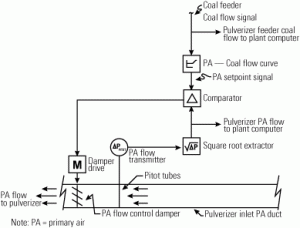
Primary airflow has a major impact on the efficiency, capacity, and cleanliness of pulverized coal–fired generation. Inaccurate measurements that underestimate primary airflow levels can lead to negative operational outcomes that include increased boiler gas temperatures, flyash loss-on-ignition, excessive NOx emissions, and higher-than-necessary fan power consumption. We remind you how to avoid those headaches.
-
 Gas
GasCheng Cycle flirts with 2 ppm NOx— and CO
Three years ago, an article in POWER described how Cheng Power Systems, by modifying the combustors of several popular gas turbines, had used steam injection to lower the units’ NOx output to about 5 ppm—but some models had substantial CO levels without combustor modifications. Since then, the company has developed new combustor nozzles that recently […]
-
 Coal
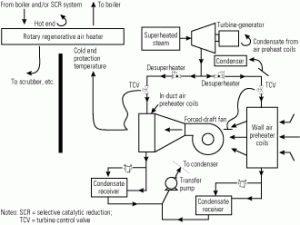
CoalDesigning and maintaining steam coil air preheaters for reliability and effectiveness
If engineered well and drained properly, a simple finned-tube heat exchanger can help maximize a fossil-fueled power plant’s combustion efficiency, capacity, and air pollution reduction. Use the guidelines in this article either to return a disabled steam coil air preheater to service or to improve the performance of a unit that may have been wasting […]
-
 Instrumentation & Controls
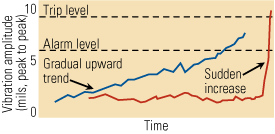
Solving plant vibration problems
Solving insidious vibration problems in rotating equipment may sometimes seem like a black art that requires the right incantation. But identifying the root cause of the vibration is actually a science. By using cutting-edge vibration measurement tools in concert with computer simulations, plant operators can arrive at a permanent, cost-effective solution to virtually any vibration […]
-
 Gas
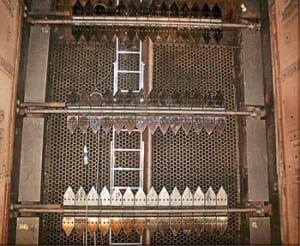
GasDesigning duct burners for variable GT loads
Duct burners use supplementary firing to increase the heat energy of a gas turbine’s exhaust, making it possible to increase the output of a downstream heat-recovery steam generator (HRSG). Early systems of the 1960s took a conventional approach to burner design. The exhaust of the turbine was directed into a windbox and then into a […]
-
 Instrumentation & Controls
Brain surgery breathes new life into aging plants
Age is wreaking havoc on the U.S. generation industry, especially the coal-fired sector. Industry conferences are replete with hand-wringing over the "brain drain," the lack of skilled personnel, the meager number of students pursuing engineering degrees, and the accelerated retirement of the older workers who make up the industry’s experience base. On top of this, […]
-
 Instrumentation & Controls
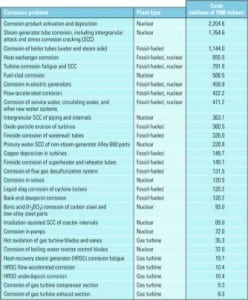
Designing steam cycles to avoid corrosion
U.S. power producers and owners of industrial steam systems each spend about $15.4 billion annually to combat corrosion in their plants. Scale and deposits are thought to be responsible for another $20 billion a year in reduced plant efficiency and lost generation capacity. Corrosion is the primary cause of every other forced outage, and the […]
-

Western coal rush
—Dr. Robert Peltier, PE Editor-in-Chief The hot hand in coal-fired power plant development is undoubtedly held by Nevada. In a departure from Sin City’s latest marketing slogan, "What happens in Vegas, stays in Vegas," most of the 5,500 MW to be generated by plants proposed for the state is destined for use elsewhere, principally […]