A South Korean power plant needed a coating that could survive corrosive condensates without sacrificing heat transfer—the industry’s usual workaround for that trade-off fell short. Seven years and one field inspection later, the alternative it chose has the data to back up the bet.
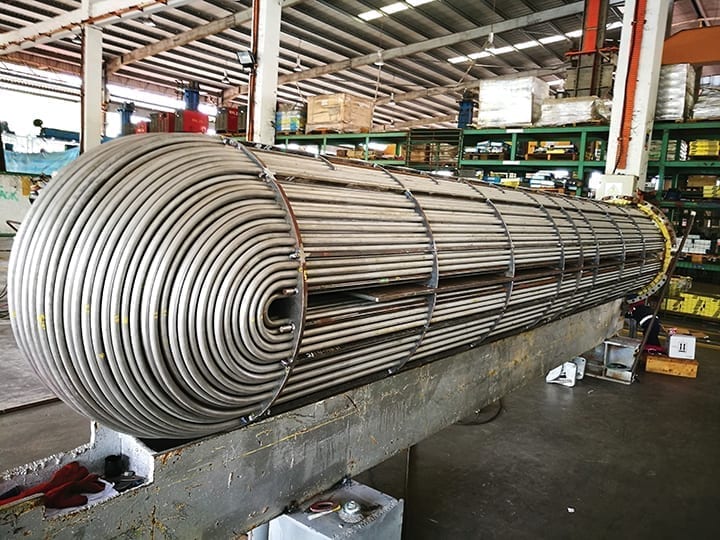
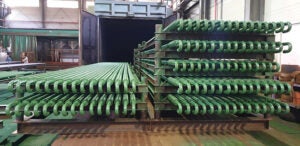
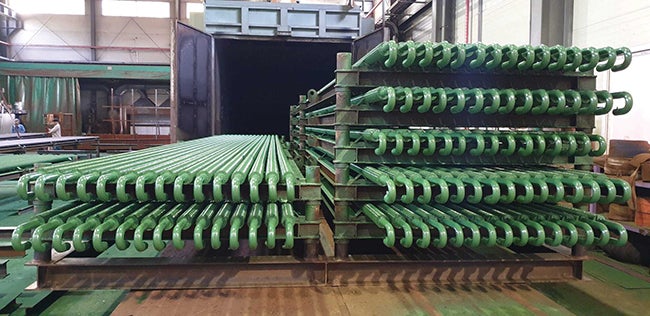
In high-temperature heat recovery systems, protective coatings are often expected to do two things that do not naturally coexist: resist aggressive chemical environments while maintaining efficient heat transfer. This tension becomes particularly acute in economizers handling exhaust gases and cooling water streams, where corrosion, fouling, and thermal stress act simultaneously on complex geometries. Säkaphen, a German manufacturer of protective coatings, may have found the right answer: phenolic-based chemistry (Figure 1).
 |
|
1. Heat exchanger tubes with a phenalic-based coating applied. Courtesy: Säkaphen |
Coating Market Limitations
Seven years ago, a South Korean power operator faced this exact challenge while protecting economizers in a series of new plants. The specifications were daunting. The units used gas-side heat recovery economizers, with cooling water circulating through spiral tubes to reduce exhaust gas temperatures.
“The service conditions combined elevated temperatures, fluctuating thermal loads, and exposure to chemically active condensates,” said Christoph Fischer-Zernin, commercial director at Säkaphen. “The geometry of the systems’ spiral tubes further complicated both coating application and long-term performance.”
The client had tried the obvious answer first: enamel powder coating, automatically applied with the spiral fin tubes being moved on a conveyor belt, was fast and economical. While efficient from a production standpoint, this delivered inconsistent coverage on spiral tube geometry, particularly the fin tips, leaving weak points in corrosion protection.
The operator sought an alternative approach based on liquid coatings, expecting better film continuity and penetration into complex surface geometry. The technical bar remained high: high temperature resistance, chemical durability, and minimal impact on heat transfer efficiency.
“The near-unanimous alternative recommendation was a hybrid system combining an enamel base layer with a PTFE [polytetrafluoroethylene] topcoat,” Fischer-Zernin explained. “While these systems offered chemical resistance, they introduced a significant drawback: reduced thermal conductivity.”
In heat recovery applications, even modest losses in thermal efficiency have significant consequences, making such solutions a poor fit despite their protective qualities. In addition, these were designed for straight tubes; with finned tubes, they would have meant reduced heat transfer surface areas and lower cooling capacity.
Opting for a Phenolic Product
Säkaphen, supported by its authorized applicator Säkaphen Korea, offered something different: a two-product solution built around phenolic chemistry.
 |
|
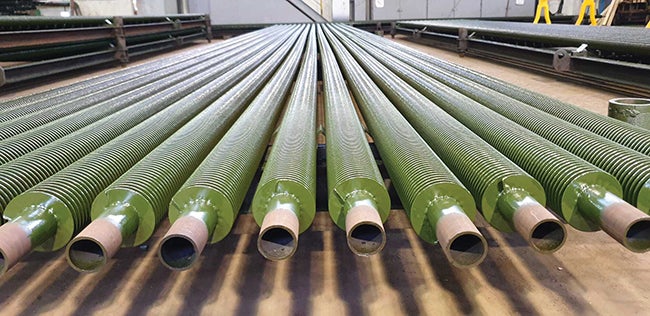
2. Spiral fin tubes with a phenalic-based coating applied. Courtesy: Säkaphen |
The primary lining was Si 14 E, a single-component phenolic-based thermosetting coating (Figure 2). Phenolic resins form dense, tightly cross-linked films with very low permeability, making them ideal in chemically aggressive service.
“This formulation,” Fischer-Zernin noted, “resists a broad spectrum of substances: acidic condensates, salts, hydrocarbons, and all water types. Equally important, it has strong hydrophobic properties, reducing fouling, scaling, and particulate adhesion, all of which can impair both corrosion resistance and heat transfer in economizer service.”
The coating handles temperature swings from –20C to +200C without cracking, and unlike PTFE, it does not meaningfully impede heat transfer.
 |
|
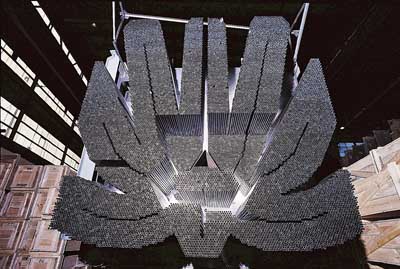
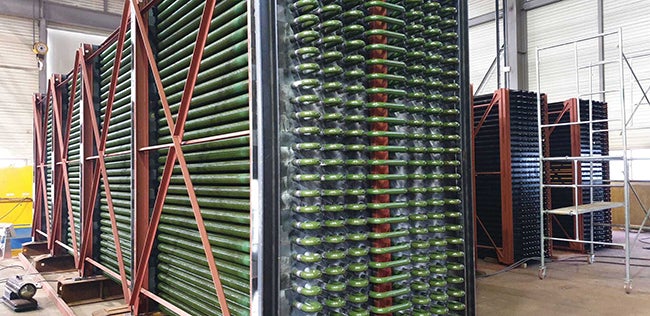
3. Coated economizer tubes after assembly of the bundle. Courtesy: Säkaphen |
The second product, HR 60 Extra G, is a two-pack epoxy formulated for direct-to-metal application. It served as a complementary repair and touch-up coating, fully compatible with Si 14 E, and was also specified to protect the welds joining the spiral tubes to form complete cooler assemblies (Figure 3). Before a gram was applied in South Korea, the system was tested as per the client’s requirements at Säkaphen’s headquarters in Gladbeck. It passed, and the first job went ahead.
Early Challenges in the Field
The first application of Si 14 E proceeded smoothly. At that point, however, construction reality intervened: minor surface damage and localized corrosion caused by the accidental omission of PTFE sleeves during tube installation and by prolonged outdoor storage were promptly addressed on-site with HR 60 Extra G. Its dual approval proved its value here: damaged and exposed areas were cleaned and recoated in the field without requiring any additional qualification or product substitution.
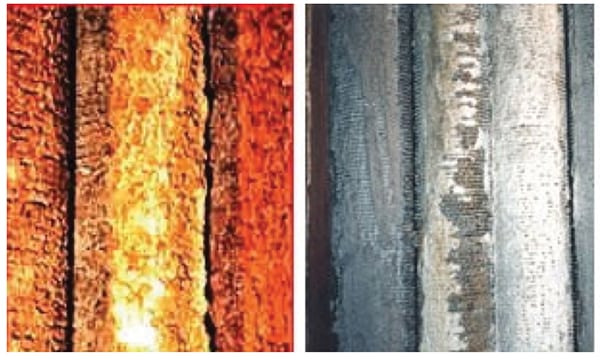
When a formal inspection was carried out in 2022, the results were telling. In the few areas where paint loss had exposed the base metal, the steel itself showed minimal corrosion. “This told us the coating had done its job up to the point of failure,” Fischer-Zernin said.
Once again, repair proved straightforward: affected sections were cleaned with sandpaper and wire brushing, then recoated with HR 60 Extra G by airless spray. The sections repaired during the original construction phase validated the method conclusively: those areas showed no subsequent corrosion at the 2022 inspection.
Seven Years Later
Over seven years, the system has held. Surfaces coated with Si 14 E show no significant degradation under operating conditions, and repaired areas perform comparably to the original applications.
“Säkaphen has already supplied several tons of baked phenolic material for this project,” Fischer-Zernin concluded. “This volume reflects not only the initial application but also ongoing maintenance supply, which was part of our original competitive brief. The plant operator reported satisfaction with the outcomes. Most importantly, we have demonstrated that phenolic-based coatings can deliver a balanced solution where both protection and thermal efficiency are critical.”
—Chiara Foppa Pedretti is the social media manager and content creator at Säkaphen.