
On April 24, 1996, the Federal Energy Regulatory Commission (FERC) issued Order 888, requiring all public utilities owning or operating interstate transmission facilities to file open-access, non-discriminatory transmission tariffs. Three years later, FERC followed with Order 2000, which encouraged—but critically did not mandate—the voluntary formation of Regional Transmission Organizations (RTOs). That distinction between “encouraged” and “required” became the hinge point for the most consequential structural divergence in the modern U.S. power industry.
The orders set the stage for a national experiment in electricity market design. Some regions embraced competitive wholesale markets administered by independent operators. Others rejected restructuring entirely. Nearly 30 years later, both camps have accumulated enough experience for a sober assessment of who made the better bet.
How the Regions Divided
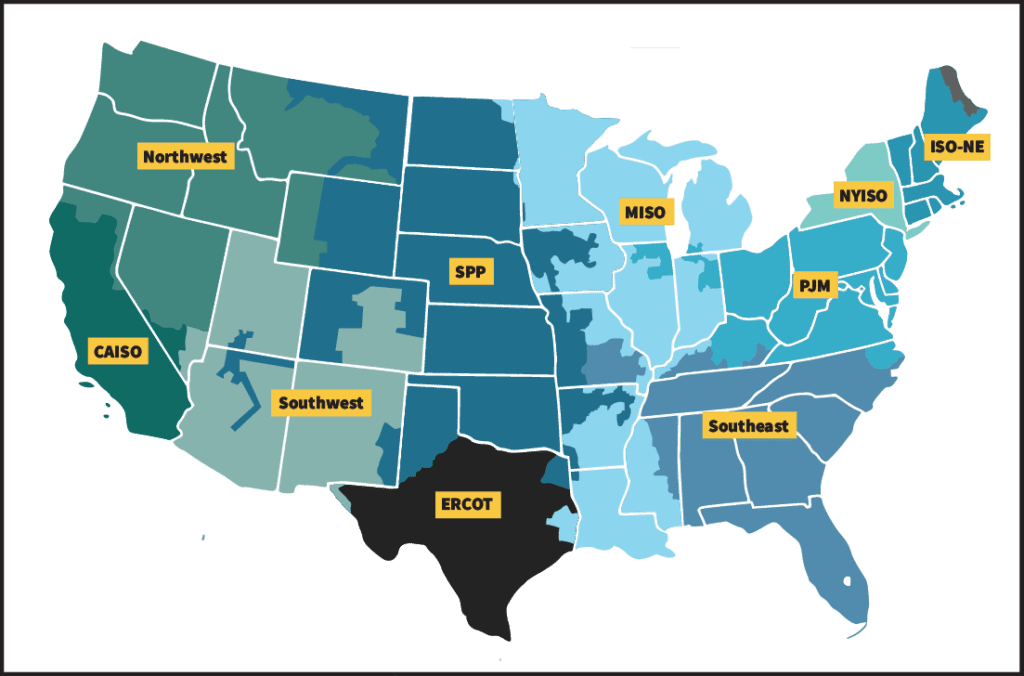
PJM Interconnection was the prototype. Tracing its roots to a tight power pool organized in the 1920s, PJM had decades of experience with centralized dispatch and cost-sharing among utilities. Its transition to a formal Independent System Operator (ISO) in 1997, and then to full RTO status in 2001, was evolutionary rather than revolutionary. PJM’s gradual, stakeholder-driven expansion—absorbing utilities across the Mid-Atlantic and Midwest including Allegheny Power, Commonwealth Edison, American Electric Power (AEP), and others—became the model for how to grow an organized market without destabilizing it.
The California Independent System Operator (CAISO), formed in 1998 under Assembly Bill 1890, became a cautionary tale. Frozen retail rates, mandatory generation divestiture, and a flawed market design created the conditions for the 2000–2001 energy crisis. CAISO survived, but California pulled back from full retail deregulation and never returned.
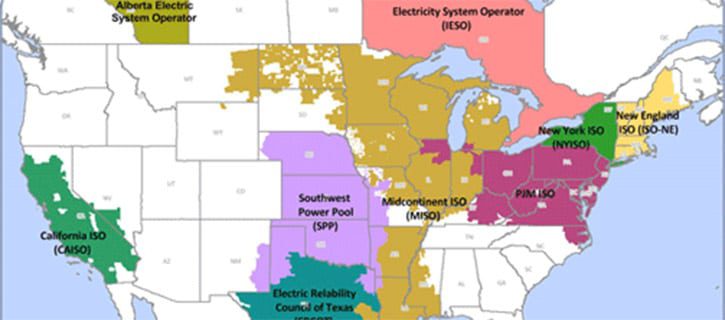
ISO New England (ISO-NE) and the New York ISO (NYISO) both emerged from existing tight power pools in the late 1990s. The Midcontinent ISO (MISO) had a harder birth, forming in 2001 but not launching its energy market until 2005, reflecting the contentious politics of a region combining vertically integrated utilities, municipals, and cooperatives. MISO’s integration of Entergy’s service territory in 2013 extended organized market benefits into part of the traditionally bilateral South. Southwest Power Pool launched its Integrated Marketplace in 2014.
The Electric Reliability Council of Texas (ERCOT) stands apart. Operating outside FERC jurisdiction because its grid is not synchronously interconnected with the rest of the country, ERCOT restructured under Senate Bill 7 in 1999, adopting an energy-only market with no capacity mechanism. The design delivered low wholesale prices and spurred massive wind and solar development, but its fragility was devastatingly exposed during Winter Storm Uri in February 2021.

In This Issue
Full issueThe Southeast is the most significant holdout. Utilities including Southern Company and Duke Energy successfully argued that their vertically integrated model delivered reliable, affordable power without the risks that California’s crisis had made vivid. FERC’s proposed Standard Market Design rule in 2002, which would have effectively mandated RTOs nationwide, died in large part because of opposition from the Southeast. Parts of the Mountain West and Pacific Northwest also stayed outside organized markets, though the Western Energy Imbalance Market launched by CAISO in 2014 and its successor, the Extended Day-Ahead Market, have gradually introduced competitive elements.
The Emerging Scorecard
The case for organized markets has strengthened considerably over the past decade. Multiple studies, including analyses by the Brattle Group, the RTOs themselves, and FERC, have quantified the savings from centralized dispatch, finding that RTOs reduce production costs by optimizing generation across wider footprints, improving transmission utilization, and enabling more efficient integration of variable renewable resources. PJM has estimated its market delivers $2.8 billion to $3.1 billion per year in customer benefits. A 2023 Brattle Group study for the South Carolina legislature found that the state’s customers could save as much as $362 million annually by joining PJM, or $187 million if a Southeast RTO were established.
The renewable energy transition has been a particularly compelling argument. Wind and solar developers have overwhelmingly favored RTO territories, where transparent market rules and locational marginal pricing reduce investment risk. The Southeast has been slower to integrate independent renewable generation in part because vertically integrated utilities control both the generation portfolio and transmission access.
But organized markets have real problems, too. Capacity market design has been an ongoing challenge in PJM, ISO-NE, and NYISO, with tension between state clean energy mandates and market-based capacity procurement. ERCOT’s energy-only design came under severe strain during Uri—ERCOT operators ordered controlled load shed, which is a deliberate grid management action to prevent system-wide failure. CAISO has wrestled with over-generation from solar and resource adequacy challenges during extreme heat events.
The bilateral Southeast model, meanwhile, has weakened but not collapsed. The rate advantage that Southern Company and others once enjoyed has narrowed as natural gas prices rose and coal fleets aged. Georgia Power’s Vogtle Units 3 and 4, years late and billions over budget, undermined the argument that the vertically integrated model produces efficient capital allocation. The Southeast Energy Exchange Market (SEEM), which launched in November 2022 with 23 member entities across 12 states, represents the first crack in the region’s resistance to organized trading. But critics have argued that SEEM’s limited bilateral platform, which cleared just 0.1% of regional annual demand in its first full year, is a far cry from a genuine organized market.
The data center boom is adding fresh urgency. Hyperscale operators want transparent pricing, rapid interconnection, and the ability to contract directly for clean energy—all things that organized markets facilitate more readily than the bilateral model. That pressure, combined with accumulating evidence of RTO cost savings, is pushing even the most resistant regions toward incremental market reforms. The question is no longer whether organized markets are better in principle, but how quickly they will come to the regions that have held out the longest.
—Aaron Larson is POWER’s executive editor.