The U.S. Environmental Protection Agency (EPA) has proposed new Clean Water Act section 316(b) regulations for once-through cooling water intake structures. Comments on the proposed rules closed in August, and a final rule is expected mid-2012. The EPA estimates that at least half of the power plants using once-through cooling will be required to implement a best technology available solution in coming years. That typically means barriers and screens, but you may want to consider other options.
The U.S. Environmental Protection Agency (EPA) recently proposed regulations, under section 316(b) of the Clean Water Act (CWA), designed to reduce the mortality of fish and other aquatic life entering cooling water intake structures of existing power plants. CWA 316(b) “requires that the location, design, construction, and capacity of cooling water intake structures for facilities having NPDES [National Pollutant Discharge Elimination System] permits reflect the best technology available (BTA) for minimizing adverse environmental impact.” An NPDES permit, which requires compliance with CWA 316(b), is required for any “point source” discharge into the “navigable waters” of the U.S. Most states are authorized to issue State Pollutant Discharge Elimination System permits.
The proposed rule covers “roughly 1,260 existing facilities that each withdraw at least 2 million gallons per day of cooling water,” according to the EPA. The agency estimates that this rule will affect about 670 power plants. Comments on the proposed rulemaking closed on August 18, 2011, and a final rule is expected in July 2012. The current rulemaking process will be interesting to watch. Twice, prior CWA 316(b) rulemakings (2004 and 2006) were successfully challenged in federal court and were remanded for corrections.
The proposed rule comes in three parts. First, existing facilities that withdraw at least 25% of their water from an adjacent water body used exclusively for cooling purposes and that have a design intake flow of greater than 2 million gallons per day would be subject to an upper limit on the number of fish killed by “impingement” against intake screens or other parts at the facility. Impingement occurs when fish and other organisms “are trapped against screens when water is drawn into [a] facility’s cooling system,” according to the EPA.
The owner of the facility will be required to select a technology to reduce those organism deaths, including reducing “its intake velocity to 0.5 feet per second.” Fish can swim away from the structure in water flowing at this velocity. This rule no longer allows restoration of a facility as a compliance alternative.
The second component of the new rule pertains to large users of once-through cooling water, at least 125 million gallons per day, which probably means all power plants using once-through cooling, whether it is ocean, river, or lake water. Those users must conduct studies that will determine site-specific technology alternatives, including conversion to the use of closed-cycle cooling (cooling towers), that will reduce aquatic organism mortality. The BTA option selected for use at a particular facility will be determined on a case-by-case basis.
The third and last requirement states that new units constructed at existing plants will be “required to reduce intake flow to a level similar to a closed cycle, recirculation system.” In essence, new units must use cooling towers to handle the additional load, or the equivalent.
The EPA requires BTA compliance within eight years of the new rule’s effective date. Also, the EPA estimates that more than half of the facilities affected by the rule already use technologies that will likely put them into compliance, although the EPA estimates covered all industrial plants, not just power plants. The rule does not apply to “new facilities,” defined as those plants that began construction after January 17, 2002.
Today’s Technology Options
Many plants continue to move forward and implement voluntary plans to meet the original guidelines set by the EPA’s 2004 Phase II Rule, specifically aimed at large power plants, which was suspended in July 2007. That rule required many existing facilities that were withdrawing their cooling water from rivers, oceans, and the Great Lakes to reduce their entrainment and impingement of aquatic organisms by an estimated 60% to 90%.
There are a number of technology options that can be used to comply with the Phase II Rule and BTA as defined by the pending rule. BTA is usually a combination of physical or nonphysical barriers: fine mesh intake traveling or passive screens, modification of existing screens for fish collection and return, special angled or louvered bar racks, or the addition of behavioral modification for fish guidance or deterrence.
Recent studies and field-testing of each option have produced positive results that are close to the desired levels previously set by the EPA. Each technology offers its own set of challenges and advantages. However, in our experience, deploying a combination of two or more technologies has proven to be the most effective approach to reaching a plant’s fish mortality reduction goals.
The use of physical barriers such as fish gates or rock barriers is the least desirable method because such barriers create an obstacle to waterway navigation and require frequent maintenance. Passive screens can be effective, but they have limited applications. The use of fine mesh screens will result in velocities greater than those set by the EPA, and high debris loading on the screen will reduce its effectiveness.
Impinged fish often come in a wide variety, often 50 to 100 species of juvenile and adult fish. Delicate pelagic (silver) fish such as shads, smelts, and herring are often the bulk of the impinged fish. These smaller, weaker swimming fish are unable to escape the intake current and are drawn in to the intake screen.
Technologies growing in favor are those that use behavioral modification, a system that uses stimuli such as electricity, sound, light, and air bubbles. The results obtained at several power stations and other water intakes over the past 10 years have proven such technologies to be effective in protecting many of the juvenile or mature fish species.
Multi-Purpose Fence
The bio-acoustic fish fence (BAFF) system is a novel approach to blocking fish from impinging on intake structures. The pneumatic nonphysical barrier system introduces sound and, in some cases, light into a bubble curtain. This wall of sound, light, and bubbles is very effective in guiding and deflecting fish.
Sound Fence. The BAFF system consists of series of sound projector arrays (SPA) connected to a source signal generator via a series of amplifiers by special underwater cables. The sound projectors are designed to transmit sound into water for varying water depths.
The difference in effectiveness of the BAFF is attributed to differences in specie sensitivity, principally the anatomy of the hearing mechanisms. Sound is detected in all species by the otolith organs of the inner ears. The hearing range of most fish falls within the audible range to humans, maximum sensitivity lying in the sub-3-kHz band down to infrasound (less than 20 Hz).
An acoustic fish deterrent (AFD) system exploits fish hearing sensitivity in the 20 Hz to 500 Hz range. Low-frequency sound (10 Hz to 3 kHz) is used for all species other than clupeids (small river fish like herring); for clupeids, either low-frequency sound or ultrasound (a frequency above the limit of human hearing, about 20 kHz) has been used with good results.
The sensitivity of fish to sound frequency can be depicted on an audiogram that describes the detectable sound pressure threshold to different frequencies (Figure 1). A well-designed BAFF is a deterrent for up to about 80% for many teleost species (ray-finned bony fish possessing a developed swim bladder) and for up to 90% to 100% for the most sensitive species, such as herring.
 |
| 1. Fish hearing test results. The reference for the figure is a relative “loudness” value of 1.0, which translates into ±0 dB as the baseline. Because the scale is logarithmic, at –10 dB, the relative loudness is reduced to 0.5 of the baseline; at –20 dB, 0.25 and so on. A sound level measurement of 1 pascal is equivalent to a sound pressure level (SPL) of 94 dB, the volume level we actually hear. This graph allows us to estimate the SPL hearing threshold of various fish species for different frequencies. For example, cod can detect very low sound levels in the 100 Hz to 250 Hz frequency range. Source: A.D. Hawkins, “The Hearing Abilities of Fish,” Hearing and Sound Communication in Fishes, 109-33 (Springer-Verlag, 1981). |
The AFD has been extensively tested in various power plant applications, usually with good results. For example, at the Hartlepool Nuclear Power Station, located in northeast England, an AFD was 79% effective in deflecting herring but only 55% effective with whiting. Scotland’s Blantyre Hydroelectric Plant tests were effective on 74% of the salmon and 92% effective on mixed cyprinid species (soft-finned freshwater fish). And testing at Electrabel’s Doel Nuclear Power Station, Units 3 and 4, located in Belgium, found the following diversion effectiveness: herring (95%), sprat (88%), bass (76%), smelt (64%), and gobies (46%).
Light Fence. High-intensity flashing light has been found to be effective as a fish deterrent. The BAFF can include a narrow line of high-intensity flashing lights that are located near the SPA. A special signal generator and accumulator powers the light bars. Operating results at several stations have proven the effectiveness of light stimuli on various species, especially juvenile American shad.
Air Bubble Fence. At the base of the SPA and the high-intensity light bar, a bubble curtain is created by using specially designed diffuser tubes to create a dense and continuous air curtain. The number of SPAs, light bars, and the length of the curtain of air bubbles are selected based on specific site conditions. An air bubble curtain is the most basic stimulus successfully used as a fish deterrent, with deflect efficiencies up to 98% reported, but fish quickly adapt to bubble curtains alone, so they become less effective over time.
When using SPA or high-intensity light bars alone, neither the sound nor the light is concentrated. Instead, the bubble curtain creates an intense and largely contained field. The result is an electromagnetic or pneumatic sound transducer coupled to a bubble curtain, causing the sound waves to propagate within the rising curtain of bubbles. Water, which is more transparent in the bubble sheet, allows light to reach the surface even in turbid water (Figure 2).
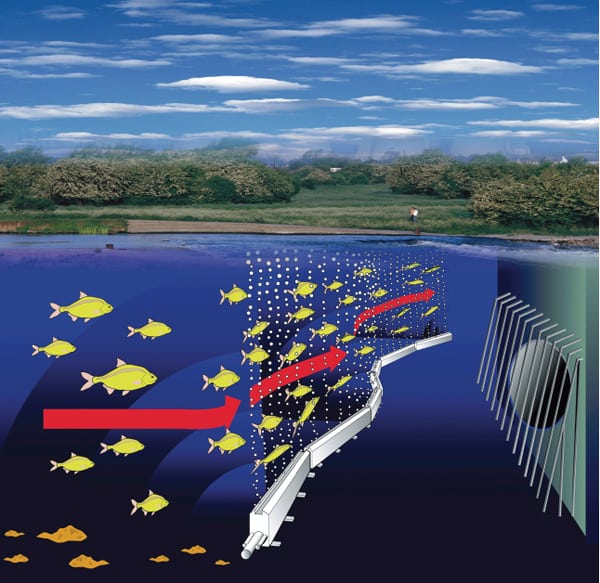 |
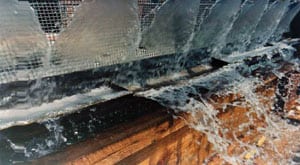
| 2. Virtual fence. A typical sound projector array with a high-intensity light bar with a curtain of bubbles forms an effective fish fence. Source: Ovivo USA LLC |
The novel method of entrapping sound and light inside the specially developed intense small air bubbles provides a significant deterrent in the immediate area of the barriers, but it also results in sound pressure levels only about one-tenth of that found in the center of the curtain at a distance of 5 meters (m/16.4 feet) from the barrier. The formation of the sound, light, and bubble curtain creates a sharp and intense barrier to divert the fish as they approach the barrier.
Case Study: Lambton Power Station
The effectiveness of the SPA and high-intensity lights was evaluated at Ontario Power Generation’s Lambton Station located on the St. Clair River, during 2004 and 2005. The demonstration proved the system was effective in deterring gizzard shad.
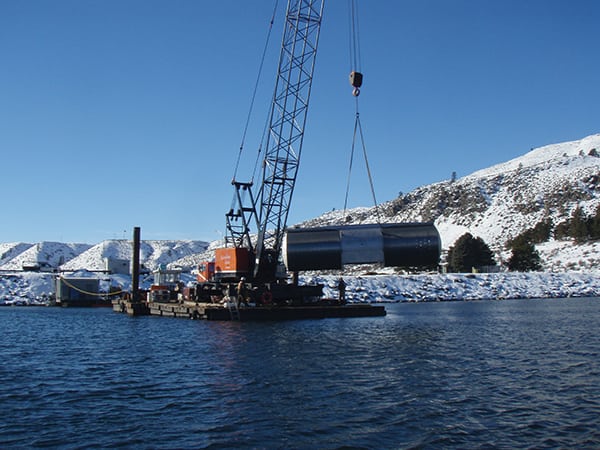
The Lambton Power Station was experiencing operational problems resulting from gizzard shad impingement. Following the initial demonstration, the plant installed a system consisting of 18 SPA and nine high-intensity light bars. A large number of gizzard shad were present in the discharge during testing and were concentrated in the dimensions of the thermal plume. It was reported that these fish were the source of fish impingement at Lambton, especially during winter months. Gizzard shad reside in the warm cooling water discharge during winter and leave in spring (April to May). In tests conducted during the day and at night, the SPA and high-intensity light barrier were effective in deterring the gizzard shad (Figure 3).
 |
| 3. Effective barrier. This photo shows the fish barrier being installed before the cooling water intake at Ontario Power Generation’s Lambton Power Station. Courtesy: Ontario Power Generation, Kinectrics Inc. |
Case Study: Sacramento Delta
Irrigation offtakes, pumping stations, and natural predations in California’s Sacramento Delta have significantly reduced the population of chinook salmon, which are now protected under the Endangered Species Act. Temporary porous rock barriers were used in the past to stop the chinook from traveling toward a major pumping station on the San Joaquin River in the Northern California Sacrament Delta. However, the rock barrier also stops boats from navigating the river and is detrimental to certain other fish species. A better solution was required.
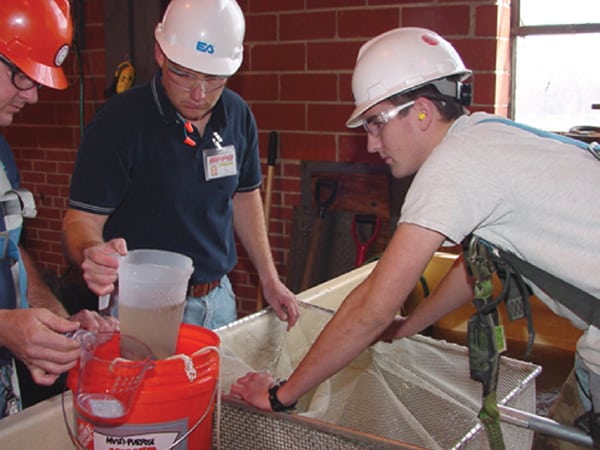
In 2007, the U.S. Bureau of Reclamation (USBR) constructed a scale model test at its Hydraulic Laboratory in Colorado, where the effectiveness of the BAFF using SPA, high-intensity light bars, and an air bubble curtain was tested (Figure 4).
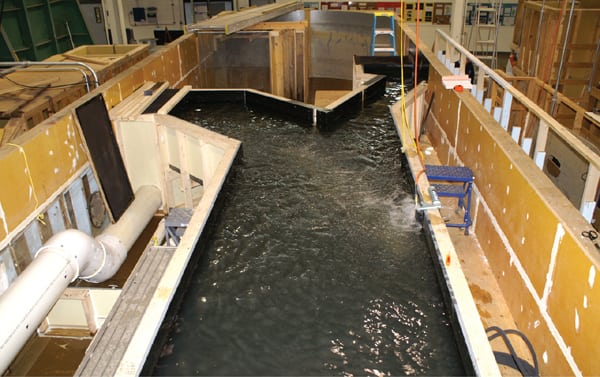 |
| 4. Scale-model testing. The U.S. Bureau of Reclamation tested a scale model of the Head of Old River located in the Sacramento Delta to determine the effectiveness of the bio-acoustic fish fence at its Hydraulic Laboratory in Colorado. Courtesy: U.S. Bureau of Reclamation |
The data collected from the USBR flume testing was used to design a full-scale 112-m barrier that was later installed by the California Department of Water Resources (CADWR) at the Head of Old River, located in Lathrop, Calif. (Figure 5). The configuration of the BAFF unit consisting of an SPA, lights, and air bubble curtain installed on the San Joaquin River at the Head of Old River Divergence is shown in Figure 6.
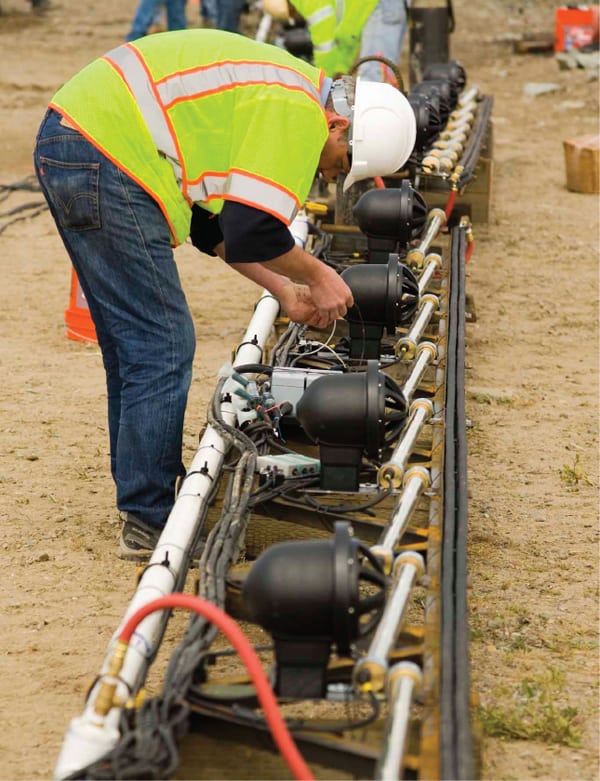 |
| 5. Barrier installation. A close-up of the bio-acoustic fish fence before installation at the Head of Old River. Courtesy: Ovivo USA LLC |
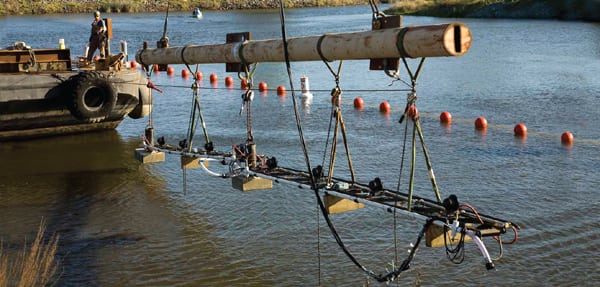 |
| 6. Modular design. A segment of the bio-acoustic fish fence being installed. Courtesy: Ovivo USA LLC |
The effectiveness of the BAFF system was tested by randomly releasing approximately 1,000 acoustically tagged hatchery smolts in batches over time about 15.5 miles upstream of the barrier, as part of the CADWR Vernalis Active Management Program. The travel of each tagged fish was monitored by series of hydrophones, located near the barrier. The travel path of the smolts fitted with acoustic tags was tracked as the barrier was turned alternately on and off over time (Figure 7).
 |
| 7. Altered paths. The location of the bio-acoustic fish fence is illustrated by the straight line. The yellow line represents the travel path of the tagged smolts with the barrier turned on (left) and turned off (right). Courtesy: Ovivo USA LLC |
At the conclusion of the tests, the deterrence efficiency of the active BAFF barrier was estimated at 81.4%. The BAFF was put into operation in April 2009 during the chinook salmon migration. In March 2011, CADWR deployed another, similar 328-yard-long BAFF system at the Georgiana Slough in Walnut Grove, near Sacramento.
— Kaveh Someah (kaveh.someah@ ovivowater.com) is general manager of the energy group for Ovivo USA LLC, formerly Eimco Water Technologies.