Owner/Operator: Covanta Energy Corp.
Covanta Energy Corp. doesn’t believe in wasting waste. Since 1995 the Covanta Onondaga waste-to-energy (WTE) plant has converted approximately 4 million tons of solid waste into 3 million MWh of clean electricity. Additionally, unlike power plants that use wind or solar energy, this 39-MW WTE facility operates 24/7, making it and similar WTE plants among the most continuously reliable sources of renewable electricity generation currently in operation.
Electric utilities are discovering that a cheap source of renewable energy is as close as the nearest trash Dumpster.
Recently, there has been renewed emphasis on the need for energy sources that promote U.S. energy independence, avoid fossil fuel use, and reduce greenhouse gas (GHG) emissions. Waste-to-energy (WTE) electricity generation is well-positioned to deliver these benefits while also providing for safe and reliable disposal of household trash. From a GHG production perspective, for every ton of nonhazardous solid waste processed at a WTE (also known as energy-from-waste) facility, a nominal 1 ton of carbon dioxide equivalent is prevented from entering the atmosphere (applying the U.S. Environmental Protection Agency’s [EPA’s] lifecycle analysis). Similarly, one barrel of oil is saved for each ton of solid waste processed.
Today, only approximately 2% of the electricity produced in the U.S. comes from non-hydro renewable sources, but the abundant supply of trash for fuel makes WTE facilities attractive and dependable sources of renewable power. Americans dispose of 278 million tons of municipal solid waste annually, of which less than 30 million tons is used as fuel in WTE facilities. It is clear that for the foreseeable future there will be no end to the amount of municipal solid waste available as a renewable fuel.
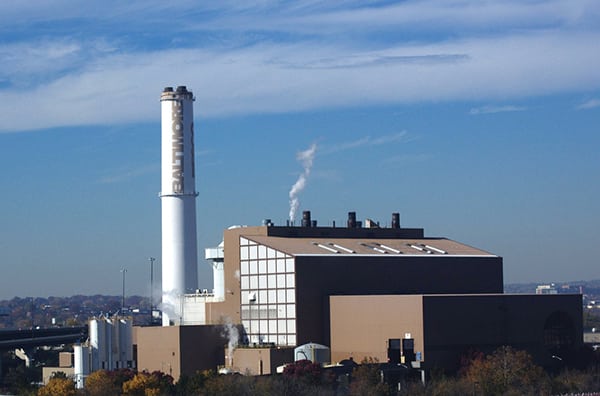
Since 1995, the Covanta Onondaga WTE facility has succeeded in turning garbage into green energy. The plant reroutes nonhazardous solid waste normally destined for landfills and gives the refuse a second productive life as a fuel source for generating electricity. According to Mark Byrne, the plant’s shift supervisor and facility safety coordinator, Covanta Onondaga processes approximately 350,000 tons of waste annually and produces 220,000 to 225,000 MWh of electricity. To date, the plant has avoided releasing more than approximately 4 million tons of carbon dioxide into the atmosphere by using waste instead of coal as a fuel source (Figure 1).
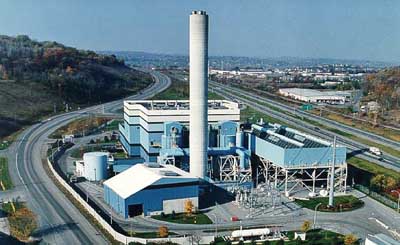
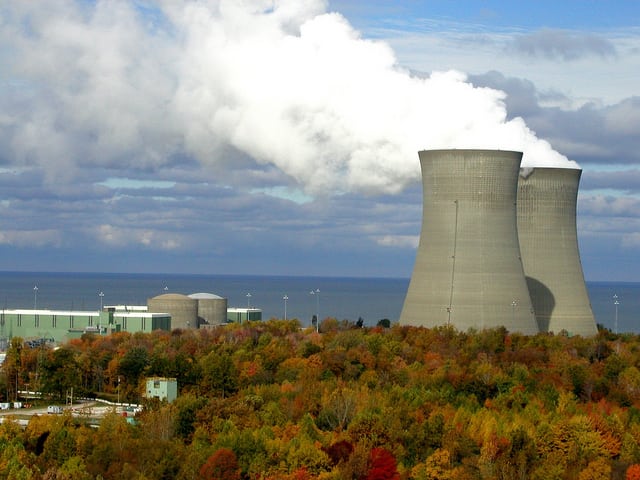
1. Choice location. Interstate Highways 481 and 81 intersect where the Covanta Onondaga waste-to-energy facility is located, providing fast and convenient access to the plant for waste haulers, suppliers, and other customers from all locations. Courtesy: Covanta Energy Corp.
The Covanta Onondaga WTE facility has continually exceeded industry benchmarks. Due to the high caliber of its operations, the facility has received numerous awards. "Most recently, in 2008 the American Society of Mechanical Engineers selected the plant as its Large Facility of the Year," Byrne said. "In 2007, the Solid Waste Association of North America honored the plant with its silver award for excellence in WTE facilities. Also in 2006 the facility achieved star status in the OSHA [Occupational Safety and Health Administration] Voluntary Protection Program, and in 2007 it obtained the EPA National Environmental Performance Track endorsement."
Plant overview
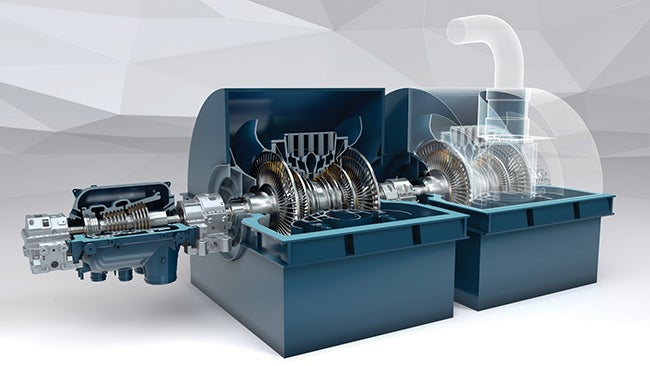
The Covanta Onondaga facility is engineered with three steam generators sharing a common steam header supplying a single condensing turbine generator set rated at 39.22 MW gross electrical generation (Figure 2).
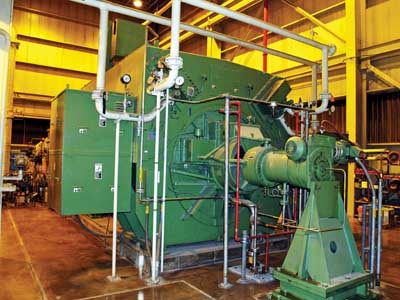
2. From trash pile to power station. The E&M Brushless Synchronous 43,580-kVA generator is powered by an ABB STAL VCT 2500 steam turbine. Courtesy: Covanta Energy Corp.
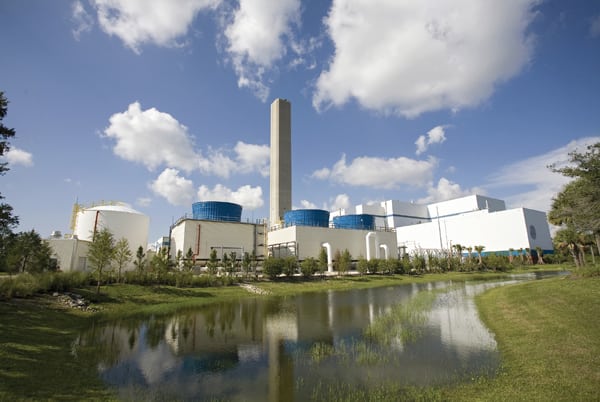
The full-time staff of 44 employees includes 20 shift operators; 10 maintenance technicians; eight equipment, utility, and scale operations personnel; and six workers providing administrative support. The facility also has management staff. Operations continue around the clock, seven days a week. Routine maintenance, performed on weekdays, is supplemented during semiannual outages by outside contractors who perform predictive, preventative, and corrective maintenance (Figure 3).
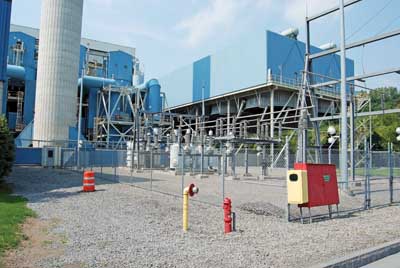
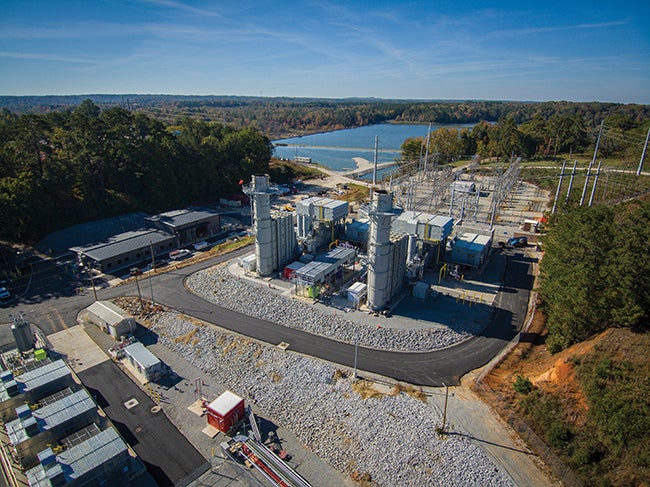
3. Converting currents. Behind the switchyard, with its step-up/step-down transformer, is the air-cooled condenser. Courtesy: Covanta Energy Corp.
"Stoker and boiler design, as well as attention to steam cycle efficiency have resulted in an average net electrical production for 14 years of 630 kWh per ton of waste processed compared to an industry average of 520 kWh per ton," Byrne said. "The waste is burned to produce superheated steam with steam conditions of 865 psi and 830F. The superheated steam propels a single condensing turbine generator unit rated at 39.22 MW."
The Covanta Onondaga WTE facility was uniquely designed with waste feed controls for the cranes located within the main facility control room instead of siting them remotely, in the plant. This arrangement increases communication between the fuel feed system and the control room, improves overall control of combustion, and avoids numerous problems.
According to Byrne, the facility is a "zero discharge" plant, with no wastewater discharged to the municipal sewer system other than the sanitary discharge from restrooms and showers.
To facilitate connecting the plant to the grid, the interconnect facility was included as part of the original plant construction. Close coordination with National Grid (formerly Niagara Mohawk Power Corp.) resulted in seamless integration of the facility with the grid.
Permitting process
Byrne pointed out that the original permitting of the facility was carried out through the New York State Department of Environmental Conservation (NYSDEC). The process lasted several years and included an environmental impact statement, a heath risk assessment, best available control technology analysis, and documentation concerning recycling requirements for the service area. In 1995, the NYSDEC issued the original permit to operate. In 2003, the EPA issued a Title V permit under the Clean Air Act that incorporated all state and federal permits related to air pollution control.
"The biggest political and regulatory hurdle was ensuring the construction of the facility did not compete with or jeopardize recycling," he said. "This was accomplished with specific recycling requirements and goals. The overall recycling rate in the service area of the Covanta Onondaga WTE facility has increased since commercial operation began and is currently around 60%."
According to Byrne, the facility fell under the Public Utility Regulatory Policies Act. Representatives of the Covanta Onondaga WTE facility negotiated a power purchase agreement (PPA) with National Grid (Niagara Mohawk Power Corp. at that time) requiring the utility to purchase the power generated by the plant. The PPA period exceeded the term of the original bonds, offering a floor price (above market rates) for the term of the debt with the pricing per kWh reverting to market pricing after the debt is retired. The stabilized tipping fees (the cost charged to customers) that exist during the debt service period will offer a profitable return to the utility after the debt is retired.
"Until 2009, the floor price paid by National Grid is $0.06 per kWh or current market rate, whichever is higher," Byrne said. "After 2009, the contract reverts to market-based pricing until 2015, which is roughly equivalent to avoided costs for the utility."
Total financing for the project was $178 million, which included a landfill and other infrastructure in support of the community solid waste management program. Financing was accomplished through the issuance of tax-free municipal bonds. The cost of the Covanta Onondaga WTE facility was approximately $140 million.
Renewable refuse
Municipal laws specify acceptable and unacceptable materials for processing by the facility. According to Byrne, the waste, which is delivered to the facility by haulers who are under contract, is weighed on scales equipped with radiation monitors that detect any radioactive material. A tipping floor attendant who operates a front-end loader for recyclable and/or unacceptable items performs visual inspections. Any unacceptable materials that are identified by the staff are managed in accordance with the facility’s waste control plan, which specifies how the materials should be handled and the proper method of disposal. After the initial screening, an overhead crane mixes the waste and produces a more homogeneous fuel prior to feeding the material to the feed chute hopper on one of the three combustion units.
Prior to start-up of the Covanta Onondaga WTE facility, the cost per ton to dispose of waste in Onondaga County was $99. The fee charged by commercial haulers collecting municipal and commercial waste was reduced to $55 per ton when the facility began commercial operation in 1995 and is currently $65 per ton.
Recovery and recycling operations
The Covanta Onondaga WTE facility is equipped with both ferrous and nonferrous metal recovery systems. The ferrous recovery system utilizes permanent magnets to separate and remove ferrous metal from the ash residue. The facility recycles and sells approximately 10,000 tons of ferrous metal per year that would otherwise go to a landfill.
"We recently installed a nonferrous recovery system," Byrne said. "It uses a series of screens to concentrate and clean the nonferrous metal, which is separated from the ash through the use of a sophisticated eddy current magnet system. Current market conditions ($1,500 to $1,800 per ton) provide a relatively short return on investment for this material that would otherwise go to the landfill. The system recovers approximately 350 tons per year of nonferrous metals consisting of aluminum, copper, brass, stainless steel, etc. Both systems are capable of recovering close to 90% of the available metals in the ash residue."
Currently, the Covanta Onondaga WTE facility is partnering with the Onondaga County Resource Recovery Agency (OCRRA) to implement a mercury recovery program that offers $5 gift certificates to residents within the service area who bring in mercury thermometers and thermostats. According to Byrne, this program helps to prevent harmful mercury-containing devices from entering the waste stream and provides for safe, environmentally responsible disposal or recycling.
The facility has a 20-year agreement with OCRRA to receive all nonhazardous residential, commercial, and light industrial solid waste from Onondaga County. OCRRA maintains contracts with private haulers and municipalities within the county to deliver 100% of their collected waste to the facility. Additionally, OCRRA delivers the combustible portion of waste delivered to its transfer stations, where delivered materials are separated into combustible and recyclable lots.
Tackling air pollution control challenges
Air emissions from municipal waste combustors can contain organics, metals, and acid gases. These emissions can cause or contribute to air pollution that may endanger public health and the environment. Therefore, to better control such emissions, the EPA has promulgated regulations under the Clean Air Act to establish operating practices and emission limitations.
When it opened in 1995, the Covanta Onondaga plant was the first WTE facility in the state of New York to be designed and equipped with air pollution control (APC) technology that anticipated the EPA’s maximum achievable control technology (MACT) standards that were later promulgated in 1998. The facility has consistently exceeded the most stringent standards issued by the EPA and NYSDEC subsequent to commencing commercial operation and has not needed to retrofit additional APC technology.
The facility’s air emissions are checked by a continuous emission monitoring system (CEMS) that measures equipment performance and stack emissions. The CEMS monitors carbon monoxide, carbon dioxide, oxygen, sulfur dioxide, and nitrogen oxides (NO x) as well as ammonia, opacity, and combustion temperatures. Annual air emission testing is also conducted for up to 33 constituents, including organics, heavy metals, acid gas, and particulates.
The plant also uses selective noncatalytic reduction technology that injects anhydrous ammonia into the upper furnace, where temperatures of approximately 1,400F are present, according to Byrne. Introduction of this chemical into the furnace creates a reaction that produces nitrogen and water instead of the formation of NOx.
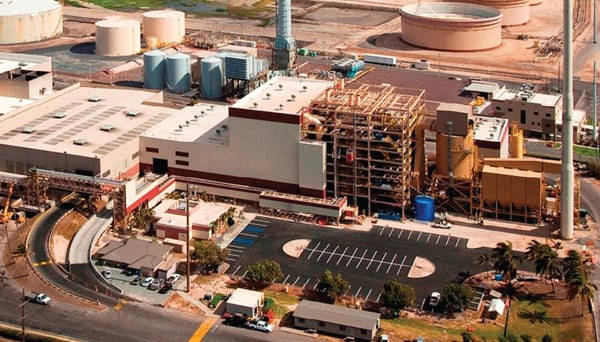
Acid gases such as sulfur dioxide, hydrogen chloride, sulfuric acid mist, and fluorides are controlled with spray dryer absorbers through the injection of high calcium lime into a reactor vessel. Typically, this achieves reductions of 85% to 99% (Figure 4).
Additionally, activated carbon is injected into the reactor vessel and captures mercury and dioxin/furans.
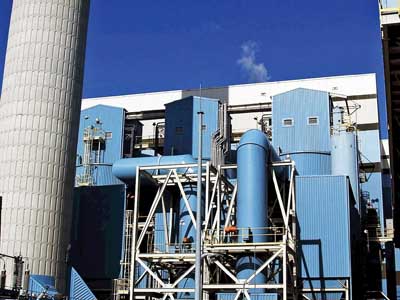
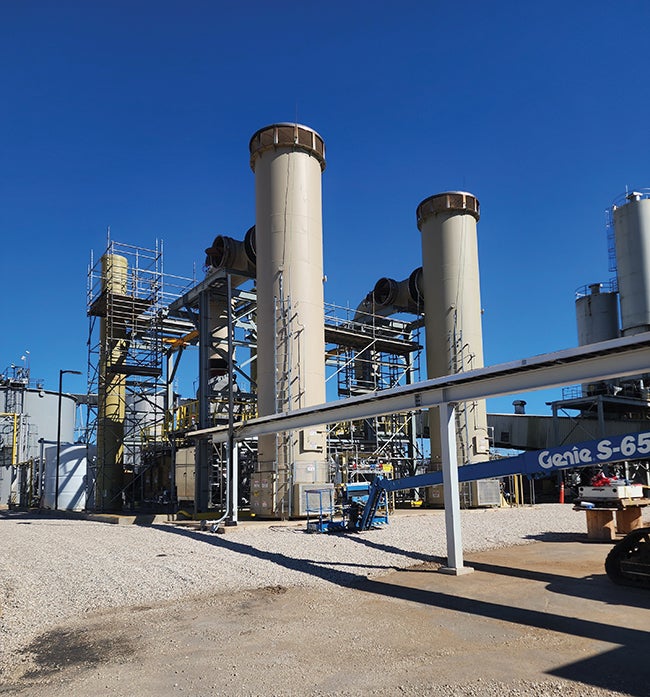
4. Scrubbing out acid gasses. The plant uses selective noncatalytic reduction technology that injects anhydrous ammonia into the furnace to control NOx emissions, activated carbon injection to control mercury emissions, and acid gas scrubbers with the baghouse to meet federal and state air emission limits. The center of the photo shows the induced fan ducting with continuous emission monitoring equipment. Courtesy: Covanta Energy Corp.
Each combustion unit is equipped with a six-compartment fabric filter containing 1,836 bags for continuous capture of particulate emissions. The APC equipment originally installed at the WTE facility continues to exceed the requirements of the MACT standards and consistently performs in the top percentile of WTE facilities in the U.S.
"While there are no current plans to add new APC equipment, we are continuously seeking ways to improve the already outstanding performance of the existing technology," he said. "An example of this was when we replaced the original fiberglass bag technology in the fabric filters with Ryton bags, which both improved collection efficiency and reduced pressure drop and associated power consumption."
Being a good neighbor
The plant is centrally located within Onondaga County and just outside the city limits of Syracuse, where the population concentration is greatest. Currently, the Covanta Onondaga WTE facility employs 44 people, primarily from the local area. It also has created a demand for new recycling facilities to meet the requirements of its permits and thereby has helped to create additional local jobs.
The facility’s contributions to the Jamesville community go beyond its regular plant operations. The plant also manages an enthusiastic community relations program that includes:
-
School partnerships with Jamesville schools, such as the annual Earth Day clean-up.
-
Environmental competitions for county high schools, such as the "Envirothon," which promotes environmental awareness, interest, and knowledge among area students.
-
Support for local fire department efforts.
Future directions
Although the facility is quite busy, Byrne emphasized that there are no plans to expand. "Covanta Onondaga’s initial design included the footprint for an additional steam generator that would be utilized to accommodate growth within the service area," he said. "However, the central New York area has not enjoyed significant growth and is not anticipated in the near future to see growth that would require the fourth unit."
Despite its decision not to expand its capacity, there is no doubt that Covanta Onondaga will strive to remain one of the leading American WTE facilities. For example, it recently completed installation of a new distributed control system. And, not satisfied to rest on its past achievements related to APC technology, the facility just upgraded its opacity and sulfur dioxide analyzers and will complete the installation of its new NOx analyzers in 2009. The plant also is investigating new methods and technology to further reduce mercury and NOx emissions while eliminating the routine use of anhydrous ammonia.