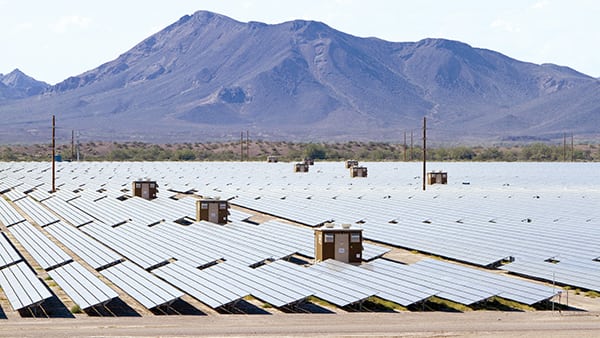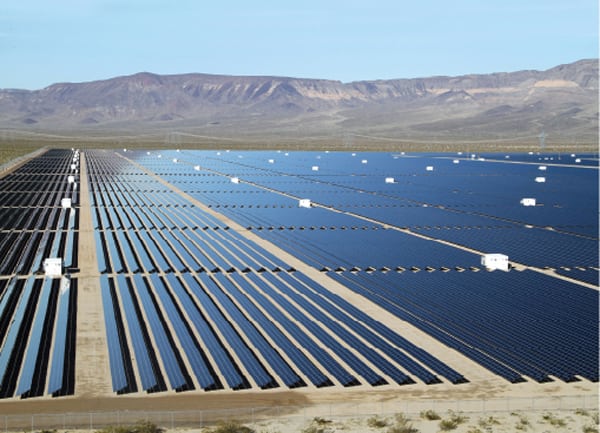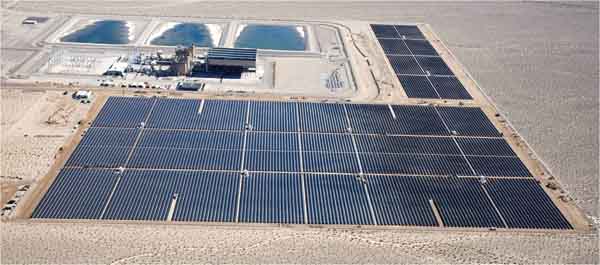
Owner/operator: Enbridge/First Solar The 80-MW Sarnia Solar Project is the world’s largest operational photovoltaic plant, with 1.3 million solar modules.
The facility utilizes First Solar’s proven thin-film photovoltaic (PV) technology, which has the lowest environmental footprint and the fastest energy payback of current PV technologies.
 |
| Courtesy: Enbridge Inc. |
A word-class solar plant in Canada? No doubt some readers may be caught off guard by this Top Plant choice. Well, forget about the “Frozen North” stereotypes of polar bears, dog sled races, and ice fishing that are sometimes associated with Canada. The Sarnia Solar Project is located in the southernmost part of Canada, just north of Detroit.
The Sarnia Solar Project has good solar resource, favorable access to the grid, strong community support, and low environmental impact. It also has compelling commercial features, including use of a proven technology, long-term power purchase agreements, and long-term operations and maintenance contracts, John Maniawski, Enbridge’s senior director, power generation business development, told POWER in October.
The Sarnia plant complements Enbridge’s renewable portfolio in Ontario, which includes three wind projects and two other solar projects, and “builds on the important community relationships that have been established with our crude oil terminal in Sarnia,” he said.
In 2009, Enbridge entered into an agreement with First Solar, a leading solar player, to expand the Sarnia facility from 20 MW to 80 MW, thereby creating what is, for now, the world’s largest photovoltaic (PV) facility. First Solar constructed the project under a fixed price engineering, procurement, and construction contract and provides operations and maintenance services.
CdTe PV Technology Benefits
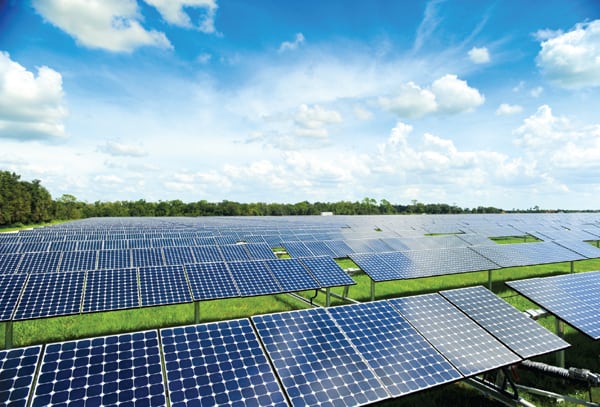
The Sarnia Solar Project uses solar modules made with First Solar’s thin-film cadmium telluride (CdTe) PV technology, which has been used in more than 4,000 MW of installations in the U.S., Europe, and Canada. The panels are constructed for durability and easy installation and can be recycled at the end of their lifecycle (Figure 1).
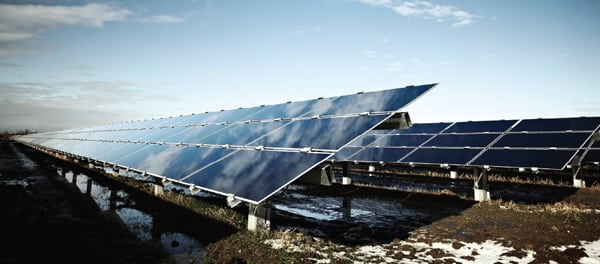 |
| 1. Leading the PV pack. First Solar’s thin-film cadmium telluride photovoltaic (PV) technology has one of the lowest environmental impacts of any PV technology and the fastest energy payback of current PV technologies. These attributes allow the technology to easily scale up. Courtesy: Enbridge Inc. |
CdTe PV has one of the lowest environmental impacts of any PV technology and the fastest energy payback of current PV technologies: under a year. (Energy payback is the time required for the output of an energy system to pay for the energy required to manufacture it.) The modules are manufactured in a state-of-the-art facility whose management systems are certified to ISO 9001:2008 quality and ISO 14001:2004 environmental standards.
“This technology is one of the lowest-cost technologies in the industry,” said Maniawski. “The cost of solar electricity continues to decline through improvements in technology and competition.”
Financing Ontario’s Solar Energy Projects
Enbridge’s three solar projects (the other two are in Tilbury and Amherstburg, Ontario) take advantage of the Ontario Government’s Renewable Energy Standard Offer Program (RESOP), which guarantees Enbridge a fixed price for the power that it sells to the Ontario Power Authority (OPA) under its 20-year power purchase agreements.
The price paid to solar power generators accounts for the cost of building solar facilities. The Government of Ontario recognized that cost when it decided to include a mix of renewable energy projects under the Green Energy Act.
The Environmental Commissioner of Ontario (ECO) is the province’s independent environmental watchdog and is appointed by the Legislative Assembly. According to ECO sources, in 2010, OPA paid electricity resource costs of C$317 million for conservation programs and C$269 million for renewables. (The Canadian and U.S. dollar were very near parity as this was written.) This amount is recovered over a total Ontario consumption in 2010 of 142 terawatt-hours (142 billion kWh), which amounts to 0.4 cents per kWh (split roughly equally between conservation and renewable subsidies).
According to OPA, that was 0.4 cents of the 13 cents per kWh that Ontarians paid on average (residential rate). In fairness, it must be acknowledged that this amount will rise as more green energy comes online in future years. Enbridge’s Ontario solar projects will not require an input cost from OPA once Enbridge’s agreements under RESOP have expired.
The Sarnia Solar Project makes good business sense for Enbridge. Maniawski noted that “it is an important implementation of our strategy to invest in renewable and alternative energy sources that complement our core operations and provide attractive returns to our investors.” He explained that the solar project has risk and return characteristics that are fully consistent with the company’s low-risk business model and similar to its crude oil pipeline business.
Promoting Environmental Success
“Our neutral footprint plan also ensures that the land and environment in and around our projects are protected and improved,” Maniawski noted. Under that plan, Enbridge’s goal is to maintain its environmental footprint at January 2009 levels by taking the following actions:
- Planting a tree for every tree the company must remove to build new facilities.
- Conserving an acre for every acre of natural habitat the company impacts.
- Generating a kWh of renewable energy for every kWh of energy its operations have consumed since January 2009.
The Sarnia Solar Project helps Enbridge meet its commitments in two ways. At the end of the project’s life, the company will fully restore the 950 acres of land that the project occupies, helping the company to meet its “acre for acre” commitment. More immediately, the PV project generates about 120,000 MWh per year of emissions-free power and prevents the production of more than 39,000 metric tons of carbon dioxide per year, which helps the company to meet its “kilowatt for kilowatt” commitment.
Community Impacts
At the peak of construction, the Sarnia Solar Project employed about 800 workers and provided indirect benefits to dozens of businesses in the Sarnia area, including engineering and design firms, construction subcontractors, suppliers, and service providers. In addition, locally sourced materials for the project were used whenever possible. Now that it’s operating, the Sarnia Solar Project employs two full-time employees.
Likewise, during construction, the 5-MW Tilbury Solar Project generated about 300 construction jobs, and the 15-MW Amherstburg II Solar Project employed about 350. As with the Sarnia project, the Tilbury and Amherstburg II projects provided indirect benefits to dozens of businesses in southern Ontario. All three sites have numerous contracts with local businesses for ongoing services such as landscape maintenance, security, and snow removal.
“In addition to contributing to the well-being of local communities and the environment, the Sarnia Solar Project has helped solidify Ontario’s reputation as a world leader in renewable and sustainable energy as the province moves towards a cleaner future,” Maniawski said.
The project also advances the Ontario Green Energy Act, under which the Ontario Government is aiming to increase investment in renewable energy projects, improve conservation, create 50,000 jobs for Ontarians, and create economic growth for the province.
— Angela Neville, JD, is POWER’s senior editor.