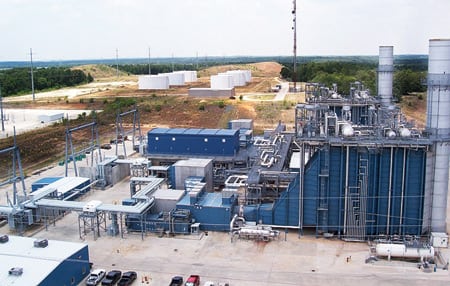
Lower Colorado River Authority’s (LCRA’s) Lost Pines Power Park (LPPP) is located in central Texas, 30 miles southeast of Austin. The site hosts two separate facilities that provide distinctly different services to the Electric Reliability Council of Texas (ERCOT) generation market. One is the Sim Gideon Power Plant (SGPP, Figure 1), a three-unit, 650-MW natural gas–fired steam plant whose forte is ancillary (load-regulation) services; the other is the Lost Pines 1 Power Project (LP1, Figure 1), a conventional 545-MW gas-fired combined-cycle plant.
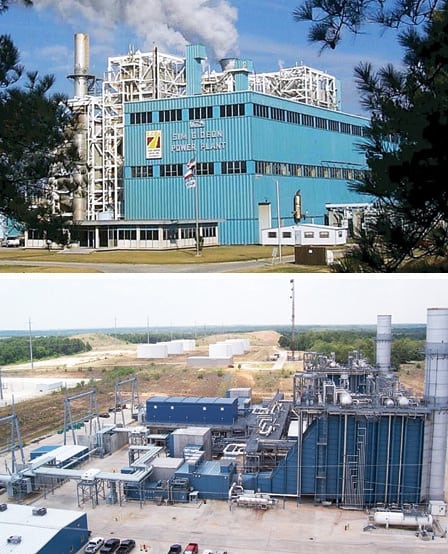
1. Two plants, one site. Lost Pines Power Park comprises the three gas-fired steam units of Sim Gideon Power Plant, built in the 1960s (top), and the seven-year-old Lost Pines 1 combined-cycle plant (bottom). A single staff operates both facilities. Courtesy: LCRA
POWER, in its June 2007 issue, profiled the control system upgrades of the three SGPP units that made them among the fastest responders in ERCOT despite their advanced ages: 35, 39, and 42. LP1, a 2 x 1 plant, began generating and selling electricity in May 2001. GenTex Power Corp., an LCRA affiliate, built the Lost Pines facility in an equal partnership with Calpine Corp. in 2001. Two years later, LCRA purchased the remaining half of the facility, becoming its sole owner.
Mind meld
A single plant staff was formed in February 2006 by merging the employees of both plants. The first order of business: find a way to effectively manage and efficiently operate an integrated facility at which each plant is operated independently. One of the principal challenges was to bridge the gaps between the facilities’ operator and technician experience bases (steam vs. gas turbine) and ages (new vs. 40 years old).
Integration of the two facilities’ control and communications networks at a fundamental level required not just a meticulous look at their wires and pipes but also consideration of issues such as:
- Personnel safety.
- How the two plants should talk to each other and share data to support routine O&M activities.
- Using the integrated control network to provide backup for the two separate control rooms for operating and training purposes. Overtime cost savings were the desired benefit of leveraging operations staff in this way.
- Enabling operator mobility by supporting field data logging.
However ambitious these goals appear, the transition to a fully integrated O&M staff began with determining the basics of how its members were to communicate. Let’s start at the beginning.
Integrating resources
LCRA management began looking to replace the public address (PA) systems of all facilities in its Wholesale Power Services business unit before LCRA and Calpine built LP1 six years ago. The push-to-talk hardwired PA systems that had been deployed across the entire generation fleet many years before were already showing signs of technological obsolescence.
LCRA’s telecommunications department solicited requests for proposals from various vendors for replacement PA systems. When the quotes came in, the combined cost of replacing the PA system at SGP and adding a PA system to LP1 (which was built without one) far exceeded the project budget. Most of the cost was for installing new conduit and wires throughout LP1 to accommodate a traditional hardwired system while dodging unknown underground obstacles. Sticker shock and other risk factors made the conventional approach less desirable and initiated a search for a creative solution.
In 1995, LCRA hired Invensys Process Systems (www.invensys.com) to provide IT infrastructure support under an agreement that was later renewed for another 10 years. Invensys is a leading supplier of innovative technologies to power plants. During an early meeting of the partners, the company proposed using wireless technologies to integrate communications and control of the two plants at Lost Pines Power Park.
Leveraging its partnership with Apprion Inc. (www.apprion.com), Invensys proposed that LCRA use a wireless Wi-Fi system under a WiMAX “umbrella” to provide a secure access point for interfacing any known wireless device protocol to control and corporate networks. Apprion’s vendor-neutral wireless solution also would allow continuous monitoring of system health and detect intrusions by rogue devices or cyber terrorists.
Communications system security is of paramount importance, given the new standards for power generators recently introduced by the Federal Energy Regulatory Commission and the North American Electric Reliability Corp. (see Focus on O&M). Complying with these standards and with LCRA’s internal IT standards was a major challenge, but making the effort to do so paid off: The wireless system cost 44% less than a conventional approach using wires and conduits.
Going wireless also “future-proofed” LPPP by enabling additional applications to be added at only incremental costs. LCRA says up to 75% savings have been realized by reducing engineering, drafting, installation, and materials costs and by minimizing administrative and overhead costs and implementation times.
The next step in the project was to perform a strategic assessment of LPPP’s infrastructure to determine if deploying a wireless network within and across its two power facilities was possible.
Going wireless
The assessment determined the optimal location of wide- and medium-bandwidth transceivers, identified where to put the logical integration terminals that provide the physical connections to SGPP’s and LP1’s existing fiber/wired IT infrastructure, and set the site-specific requirements that potential application vendors for LCRA’s plants would have to meet. This work was done by Invensys and Apprion using radio frequency spectral analysis at strategic locations.
The assessment determined that it would indeed be possible to implement a wireless broadband umbrella. It would use WiMAX to cover both plants but Wi-Fi for local-area network access and to reach their remote parts, eliminating the need to install costly Ethernet cables. The WiMAX umbrella provides wide-bandwidth wireless coverage throughout LPPP and connectivity up to 25 miles away. The WiMAX broadband connection serves as “virtual fiber” that connects LP1 to SGPP and enables the two facilities to share and communicate data using the same Voice over IP (VoIP) system. Plans are to extend the system to LCRA’s other remote sites.
Personal communications are now virtually instantaneous because all field workers wear a VoIP communications badge. When a worker needs to communicate with a colleague anywhere at LPPP, he or she voice-activates the device with a simple command, such as “find Bill.” Wireless communications make an 802.11b connection through an access point at a local mesh network. The command is sent to the VoIP server installed at LPPP’s central management control center. The server manages all users, security, data, and communication.
Making it happen
The following wireless network infrastructure, components, and features are now on-line at LPPP:
- A sitewide wireless backbone, including a 360-degree WiMAX wireless umbrella covering the entire site (Figure 2).
- A wide-bandwidth backhaul 802.16 network featuring a simple antenna configuration and placement.
- Layered implementation of secure and managed WiMAX, Wi-Fi, and other networking technologies.
- Fifty-one Wi-Fi access points installed at strategic locations throughout the plant (Figure 3).
- A wireless speaker system with push-to-talk capability and an integrated private branch exchange (Figure 4).
- Plantwide voice communications and loudspeaker broadcasting throughout the facility.
- Emergency broadcasts throughout the site. They are used to initiate evacuation and to notify local first responders.
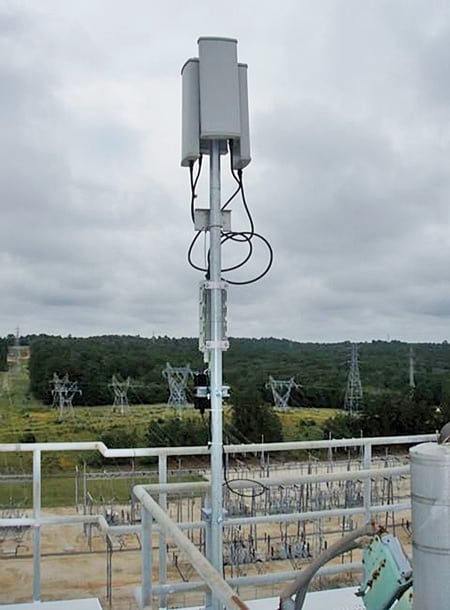
2. 360-degree coverage. WiMAX antennas are the backbone of LPPP’s wireless infrastructure. Courtesy: LCRA
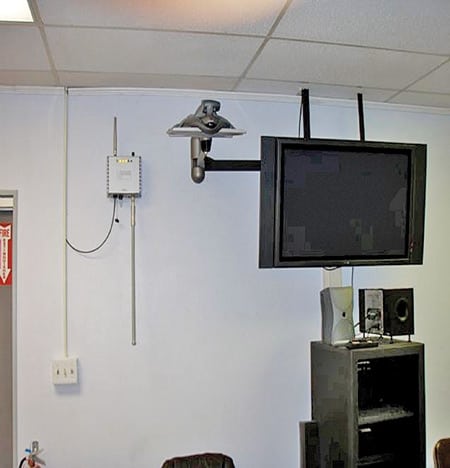
3. Hot spots. Fifty-one wireless access points provide connectivity throughout Lost Pines Power Park. Courtesy: LCRA
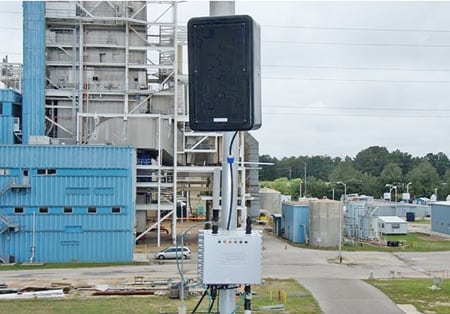
4. Shout it out. Wireless PA speakers were added to Lost Pines 1, eschewing a much more expensive approach using cables and conduits. Courtesy: LCRA
An industrial wireless application network manages the Wi-Fi/wireless infrastructure by:
- Monitoring all access points at both plant areas for real-time failure detection.
- Monitoring the network for rogue device detection.
- Managing the VoIP communications server and all VoIP data.
- Controlling all device management of network gateways and access points.
- Reporting on all wireless data activity.
Leveraging the networks
The single wireless platform that LCRA deployed to meet the communications and data monitoring needs of two large plants is scalable, so software applications can be added to it in the future. The company has also used that capability to optimize and automate a number of its work processes and to reduce LPPP’s operating costs.
For example, the system includes a comprehensive wireless network support package that should be able to handle virtually all of the site’s communications and data needs well into the future. The package comprises:
- Apprion’s industrial wireless application network. Called the ION system, it includes the IONosphere, a centralized application that manages data services, workflow, security, monitoring and maintenance, and third-party application integration. IONosphere management software continually monitors the health, performance, and integrity of the overall wireless infrastructure to ensure optimal performance of QoS-based applications, such as voice, in a shared data environment.
- Apprion’s ION Services. It supports site analysis, technology selection, infrastructure design and implementation, performance monitoring, security management, and continuous network administration and optimization.
Extended benefit coverage
LCRA is already reaping the benefits of its new wireless infrastructure at LPPP. Employees of both SGPP and LP1 can now communicate freely using the VoIP, wireless, push-to-talk system. The infrastructure’s design enables LCRA to easily extend wireless coverage by adding new applications in various plant locations (Figure 5).
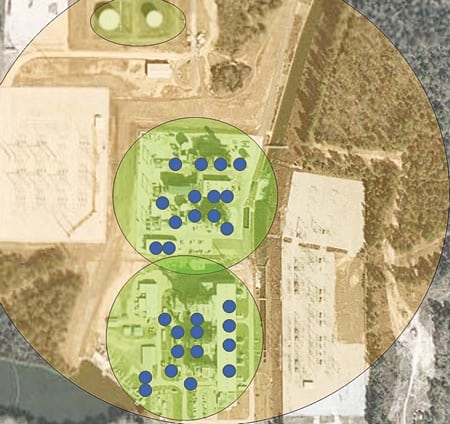
5. Overlapping circles. Wireless umbrellas support voice, data, and control communications within Lost Pines Power Park’s two plants and adjacent support facilities. Sim Gideon Power Plant is within the bottom circle, with Lost Pines 1 Power Project just above it. Areas in green have 802.11 coverage, blue has VoIP/PA coverage, and light orange has WiMAX coverage. Courtesy: LCRA
Next on LCRA’s agenda is extending the wireless infrastructure to many other areas of the two plants to leverage its communications and control capabilities. The objective is to continue increasing worker mobility and to find other ways to cut O&M costs by raising productivity. Among the wireless applications now being considered or developed are:
- Noncritical closed-loop level controls and alarming functions on auxiliary plant equipment.
- Alarming of various temperatures, levels, and other key operating parameters. Applications under development include feedwater heater level control and alarming, and furnace video monitoring to check burner performance and tilt and the condition of the fireball.
- Condition monitoring of equipment health. Providing vibration data in real time to operators helps them detect incipient equipment problems early.
- Detecting ammonia leaks and communicating them in real time, before they cause serious problems.
- Remote tank level monitoring. Tank sensors will wirelessly relay level status information to access points and to the plant’s main control system. Once tank level monitoring is in place, it will be easy to add condition-monitoring metrics (such as pressure, temperature, and voltage) to flesh out a complete preventive maintenance system.
- Using tablet PCs to give operators remote, wireless access to the Foxboro and Westinghouse control systems used by the Sim Gideon and Lost Pines power plants, respectively.
Now that it is reaping the benefits of wireless technologies at LPPP, LCRA is integrating them into the conceptual design of a remote, unmanned peaking plant to be built about 24 miles away. (For more on power plant controls technology, see the sidebar.) The concept is to expand connectivity through LCRA’s existing fiber network and WiMAX technology to provide the same capabilities—and then some—currently showcased at Lost Pines. The new plant, tentatively called the Winchester Power Park, will be remotely operated from the Sim Gideon plant.
2008 POWID meeting nears

POWER is privileged to be the official publication of the 51st annual Power Industry Division (POWID) Conference/18th Annual Joint POWID/EPRI Conference scheduled for June 8–13, 2008, at the Hilton Scottsdale Resort & Villas in Scottsdale, Ariz. The theme of this year’s conference is “The Pathway to Power Automation for the 2010 Decade.” Its agenda will cover topics ranging from software for fossil-fueled plants to cyber security standards compliance to advanced plant controls and wireless technologies. For more information, check out the conference program details at www.isa.org/~powid/powid_2008_%20main.htm.
Acknowledgement: Portions of this article are based on a paper by David Runkle of LCRA and Stephen Lambright of Apprion titled “Wireless Infrastructure Implementation in a Power Generation Site: Lower Colorado River Authority (LCRA), Lost Pines Power Park.” It was presented at the 17th Annual Joint ISA POWID/EPRI Controls and Instrumentation Conference.
—David Runkle (drunkle@lcra.org) is production manager of LCRA’s Lost Pines Power Park.