Good quality benchmarking data are hard to come by unless you are part of an organization like the EUCG (www.eucg.org) or write a big check to a consulting firm that makes a living collecting and analyzing data. Even regional differences can have a marked effect on the comparative operating statistics of plants within a single utility. But perhaps the most difficult benchmarking data to obtain are consistent data comparing maintenance practices across different industries. That is where the Aberdeen Group’s benchmark report, "Collaborative Asset Maintenance Strategies," makes a significant contribution to the power industry (see box to download the report).
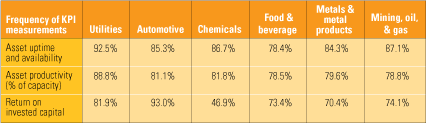
Utility companies that Aberdeen recently surveyed boast 92% asset uptime and availability, earning them top billing in asset management performance, above all other industries that participated in the "Collaborative Asset Maintenance Strategies" report. How’d they do it? In part, with effective use of technology solutions, including analytics, enterprise asset management software, and predictive maintenance tools.
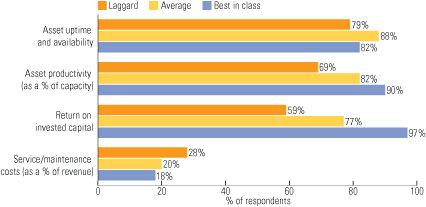
The "Collaborative Asset Maintenance Strategies" benchmark report examines how leading organizations in asset-intensive industries are excelling in maintenance practices and differentiating themselves from the rest of the pack in areas such as process definition, organizational alignment, data management, technology integration, and performance management. The report found that leading companies have achieved differentiated performance in key performance metrics such as return on invested capital, asset productivity, and asset uptime (Figure 1).
|
1. Out in front. Best-in-class companies prove their mettle on all counts. Source: Aberdeen Group
|
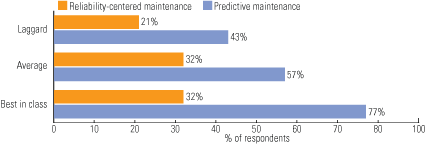
The survey also found that proactive maintenance processes that augment regularly scheduled preventive maintenance routines tend to boost organizations into the best-in-class category. Corollary data strongly support the conclusion that best-in-class organizations operate in a "break-fix" mode far less often than do their laggard counterparts (Figure 2).
|
2. Eat my dust. Best-in-class companies use proactive maintenance strategies more frequently. Source: Aberdeen Group
|
Developing best practices
Thanks in part to proactive maintenance strategies and automation tools, utility companies are seeing improved asset performance on a greater scale than are other asset-intensive industries. Utility companies see higher asset availability, greater asset productivity, and a stronger return on investment in assets than nearly all other industries, according to the report. For example, the study found that:
- Utilities are twice as likely as other industries to use standardized, enterprisewide maintenance processes such as predictive maintenance, reliability-centered maintenance, total productive maintenance, and root cause analysis.
- Utilities are up to five times as likely as other industries to measure their real-time or near-real-time performance against target key performance indicators (Table 1).
|
Table 1. Leadership position. This chart shows the frequency of key performance indicators (KPI) measurements across major industries. Source: Aberdeen Group
|

Closer to home
A power generation utility in the Pacific Northwest has improved asset reliability through a combination of preventive and predictive maintenance. For its efforts, it is the third-lowest-cost producer of electricity in North America.
This utility uses technology to monitor equipment performance in real time and to generate automatic alarms when potential problems are detected. The company places a great deal of emphasis on proactive maintenance practices, from fixed-interval maintenance to reliability-centered maintenance processes that continually evaluate the impacts and costs of maintenance activities. The company is also looking at implementing additional software that will allow it to identify machine performance anomalies through modeling and analytics.
A Northeast electric power cooperative—among the best-in-class survey respondents—reported that it consistently measures 20 different key performance indicators. To improve its performance against these metrics, it also instituted a variety of predictive maintenance processes and deployed maintenance automation solutions that allowed its service technicians to monitor asset performance from their desktops.
As a result, this utility’s equipment uptime has improved nearly 10%, with huge financial implications. What is more, the company has seen a 75% increase in reliability on some systems, and unscheduled downtimes have been reduced by as much as 75%.
The emphasis that utility organizations place on asset maintenance and on continually improving maintenance practices pays off. Utilities outperform nearly all other industries in major key performance indicators (Table 2).
|
Table 2. Leader of the pack. Utilities lead in major key performance indicators (KPI) measurements. Source: Aberdeen Group
|
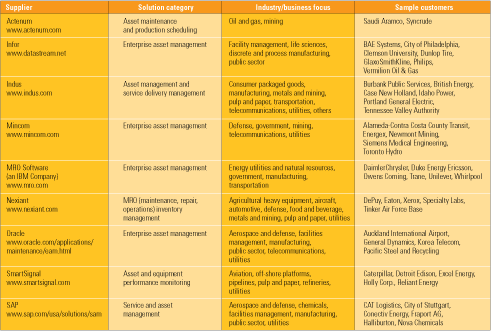
Asset-intensive organizations in all industries should evaluate solutions that will help improve maintenance processes and boost asset availability, reliability, and uptime. Table 3 is a partial list of suppliers that provide technology solutions for asset-intensive industries.
|
Table 3. Vendor landscape. This is a partial list of asset management systems identified during the study. Source: Aberdeen Group
|
Finally, the report offers manufacturers and service providers specific recommendations for asset maintenance improvement, which include the following:
- Implement aggressive proactive maintenance strategies.
- Use analytics software to measure actual asset performance against established goals.
- Centralize management and control of asset maintenance.
- Build a case for the CFO regarding the importance of investing to support proper service and maintenance practices.
- Consider spare parts/maintenance, repair, and operations (MRO) inventory planning solutions
—Michael Israel is research director, service chain management research for Aberdeen Group Inc. He can be reached at michael_israel@aberdeen.com.