U.S. electricity consumption continues to increase almost 2% annually. As the load growth spurs calls for new power plants and transmission lines, it’s easy to forget the impact of the additional current flow on the countless power transformers of utility transmission and distribution systems. Big step-up and step-down power transformers, which are among the most expensive components of the nationwide electricity delivery network, are seeing their average loads inching up as well, especially in regions of high population growth.
The average age of utility power transformers is about 40. Hartford Steam Boiler Inspection & Insurance Co. (www.hsb.com) reports that transformer failures consistently rank among its top five claim types, and the company expects their frequency to rise in coming years. Accordingly, transformer condition assessment and management has become a higher priority for utilities, particularly those that don"t wish to see their public image tarnished by a blackout triggered by the burnout of a critical transformer.
HMO for transformers
The typical transformer failure is caused by the inability of its conductor insulation to handle the stresses that arise during operation. Either the dielectric fails or internal mechanical components—such as winding clamps and bushing connections—loosen, causing a short circuit. The challenge isn"t so much determining why failures occur but, rather, eliminating them by using methods designed to accurately assess the health of a transformer and predict its remaining life.
Utility managers can avoid surprises by developing long-term health-maintenance procedures for their transformer assets. They include fixing defects, overhauling units (retightening and blocking loose windings or doing a complete rewind), relocating transformers to improve their voltage regulation or reduce their loading limitations, and—if all else fails—retiring and replacing a unit. Most utility load assessment programs are based on IEEE Standard C57.91, which provides useful loading recommendations, equations for calculating remaining transformer life, and tips for avoiding hot spots and excessive insulating-oil temperatures. Use of these tools can enable even an old transformer to remain in service past its expected retirement.
Health assessments are a financial challenge for any utility with hundreds or thousands of transformers spread across its service territory. Budget constraints require prioritizing health assessments according to criticality evaluations of the transformers. Such evaluations usually are based on a cursory inspection, monitoring, and the application of risk-based analysis tools.
A good condition assessment must balance the age and maintenance history of the transformer against its operating history and the quality of its preventive maintenance regimen (which—it is hoped—would include records of years of oil testing and thermography). The results of the assessment are then interpreted in the context of a systemwide transformer management and prioritization strategy that details where maintenance dollars are actually spent.
Serveron Corp. (www.serveron.com) uses the following categories to differentiate transformers by the consequences of their failure:
- Critical. Units whose failure would have a large negative impact on grid stability, utility revenue, and service reliability.
- Important. Units whose failure would have a significant negative impact on revenue and reliability. Most transformers found in transmission substations and in major distribution substations are in this class.
- Recoverable. Units whose failure would have a low impact on revenue and reliability. Most small transformers in distribution substations fall into this category.
Gas guzzler
Prior to the 1980s, the only way for utilities to gauge the health of a transformer was to sample its insulating oil periodically and send it off to a lab for analysis. Then combustible gas monitors, which measured predominately hydrogen, arrived on the scene. The late 1990s saw the introduction of on-line dissolved gas analysis (DGA) monitors.
Early DGA systems were more art than science. They measured the concentration of hydrogen and/or one other combustible gas in transformer oil as a loose predictor of future transformer problems. Modern on-line DGA systems monitor up to 11 "fault gases," trend their concentrations and other transformer operating parameters in near real time, and come up with a suite of diagnostic tools.
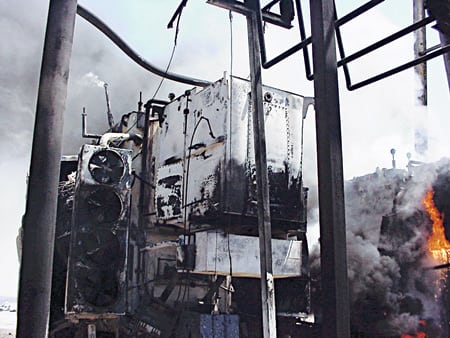
2. Ready for Recycling. The failed transformer’s load tap changing inspection door was partially ruptured. Source: Arizona Public Service
Laboratory DGA has given way to portable DGA kits that save money and enable faster detection of malfunctions that could cause a transformer failure within days. Many utilities use both approaches to be safe rather than sorry. The business case for DGA is clear: Utilities have successfully used the technique to detect the imminent or eventual failure of hundreds of critical transformers. Each "save" has prevented the loss of thousands or millions of dollars in revenue—as well as the loss of public confidence that a blackout produces. The table compares the capabilities and costs of four different types of DGA systems.
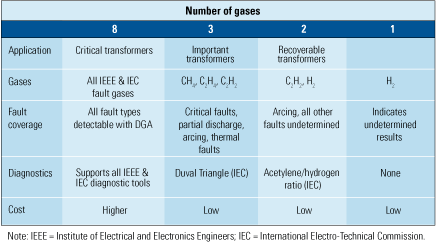
Key attributes of on-line dissolved gas analyzers. Source: Serveron Corp.
One extraordinary event
On July 4, 2004, Arizona Public Service (APS) found out what it’s like to have the media and public looking over its shoulder following the catastrophic failure of a huge, 1970s-vintage transformer at the Westwing Substation in northwest Phoenix that it co-owns with other western utilities.
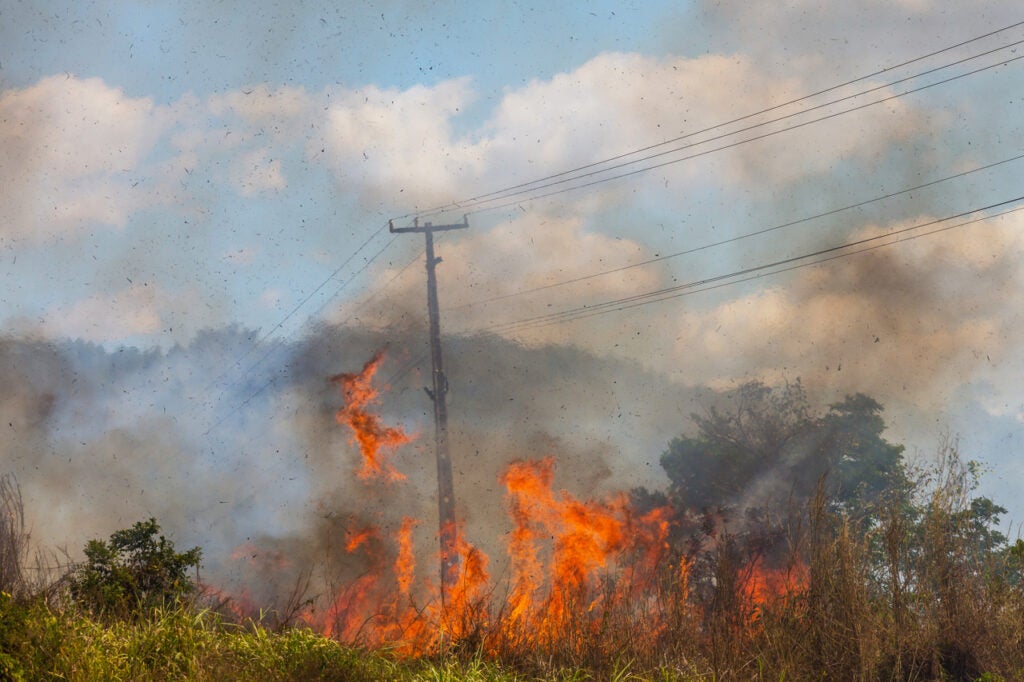
Measurements at the Westwing Substation, a key transmission portal into the Valley of the Sun, gave no advance warning of an impending failure. The resulting fire (Figure 1) destroyed the transformer (a single-phase unit that steps down 525 kV to 230 kV) and caused much collateral damage.

1. July 4th fireworks. A transformer failure and fire at the Westwing Substation left Phoenix with razor-thin margins for a month during the summer of 2004. Courtesy: Serveron Corp.
Fortunately, APS was able to quickly locate a suitable replacement: a spare at Bonneville Power Administration. However, the 400,000-lb unit’s tedious journey from Washington to Arizona took 21 days, with each move covered by the media as Phoenix teetered close to rolling blackouts. Although Westwing was placed back in service on August 9, APS had to ask valley residents to curtail their electricity usage between 3 p.m. and 6 p.m. daily for more than a month.
An independent analysis concluded that the failure of the transformer, in bank T1 of the substation, was an "extraordinary event" not attributable to lack of maintenance. The immediate cause of the fire, said the report, was an internal fault that caused high pressure within the transformer, which breached the transformer casing (Figure 2).
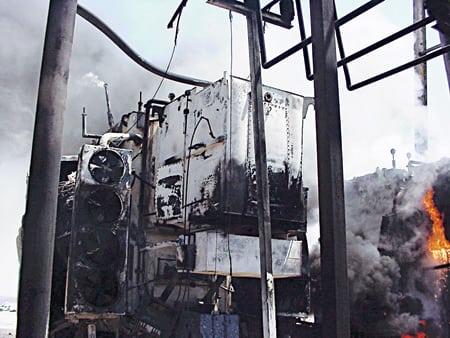
2. Ready for recycling. The failed transformer’s load tap changing inspection door was partially ruptured. Source: Arizona Public Service
The failure, however, was actually the final event in a long chain of problems. On June 14, a fault on a 230-kV transmission line caused a grid disturbance that knocked all three units of Palo Verde Nuclear Generating Station off-line. The disturbance went undetected by a 30-year-old relay protecting the transmission line at Westwing, eventually causing a 20-second fault during restoration efforts that appears to have mechanically damaged the transformer’s windings. Weeks later, the wound progressed to an internal fault and fire, which destroyed five transformers: all three phases of transformer bank T1, a spare transformer, and Phase 3 of transformer bank T4 (Figure 3).
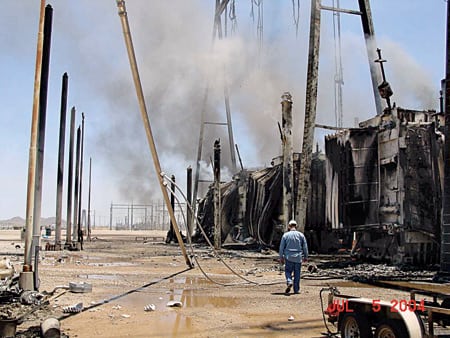
3. The lineup. When the smoke cleared, five transformers were found to be damaged. Source: Arizona Public Service
According to Steve Bischoff—general manager of construction, operations, and maintenance for APS—if an on-line DGA system had been on the job, it could have sensed the pending transformer failure due to the June 14 damage to the windings, and the July 4 fire may have been averted. Post-fault DGA and other testing, consistent with industry practice, did not indicate any problems with the transformer. The value of on-line DGA monitoring is being able to detect rapid changes in combustible gases, such as those seen in this case, which would not normally be detected through a manual sampling process.
At the time, APS was actively prototyping on-line DGA and shortly thereafter completed a criticality analysis of all 150 of its transmission-level (230 kV and above) transformers. Now APS makes sure that each new high-voltage transformer it purchases is monitored by a model TM8 (eight-gas) unit from Serveron (see box)—as do 13 other utilities across the U.S. APS also has accelerated the DGA retrofit program; 50 systems are already in service on transformers working at 230 kV or higher. Plans are to complete installation on all 150 transformers by 2010.
Inside the Serveron TM8
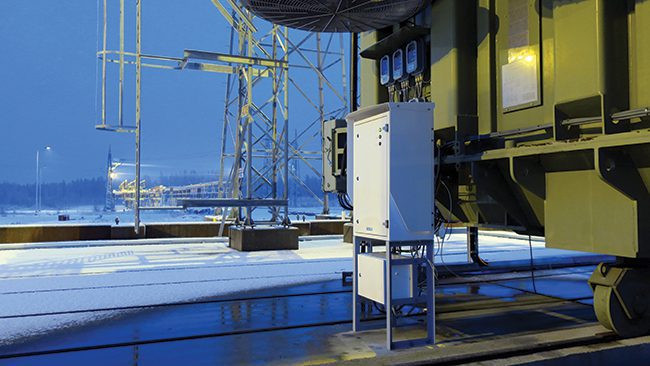
Serveron’s two lines of transformer monitoring systems—the eight-gas TM8 and the three-gas TM3—perform three functions: gas extraction, movement, and measurement. The system is made leak-tight to avoid contamination by atmospheric gases or the introduction of any other gases that could alter the gas-in-oil content of the sample being analyzed (Figure 4).
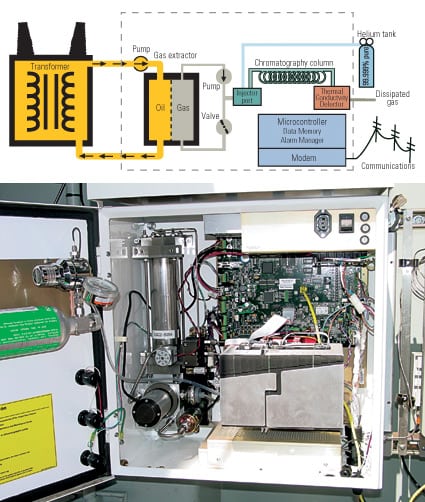
4. Inside the box. A process flow diagram of the TM8 eight-gas analyzer and a look inside its cabinet. Eight gas samples can be pulled every hour if necessary. Diagram source: Serveron Corp.; Photo: POWER magazine
To extract a sample, gas is first allowed to reach equilibrium pressure across the oil and gas spaces, regardless of temperature, via a semipermeable membrane. Next, the extracted gas is transferred to the gas measurement system, a laboratory-grade gas chromatograph. Chromatographic columns separate the gases present in the sample and display their concentrations as individual peaks that are then fed into a thermal conductivity detector (TCD).
The TCD measures concentrations of all eight fault gases from a single 0.5-ml injection of sample gas. Helium is used as an inert carrier to move the sample through the detector without contaminating its O2, CO, and CO2 components. The TCD measurements are then converted to gas-in-oil results using partitioning coefficients and pressure and temperature readings made at the point of extraction. The system automatically and periodically calibrates itself against a National Institute of Standards and Technology (NIST)-traceable gas standard.
Normally, the TM8 performs a sample DGA analysis once every four hours. The entire gas chromatograph analysis takes about 20 minutes. If any gas generates an alarm, the TM8 automatically begins sampling the oil on an hourly basis until the alarm is cleared.
The system also includes sensors of ambient temperature and “load guide”—a relative measure of transformer load. The readings of the sensors can be correlated with DGA gas information to produce a complete diagnostic overview of a transformer’s operation. Among the diagnostic methods supported are the Duval Triangle and the Rogers Ratios; both tools’ graphics are automatically populated with real-time gas data for acetylene (C2H2), ethylene (C2H4), methane (CH4), ethane (C2H6), and hydrogen (H2).
Once an analysis has been completed, the results can be viewed locally, or remotely over the Internet. Tracking the results over time enables users to check gas levels against defined caution and alarm values. The real-time sensing capability eliminates the biggest disadvantage of using laboratory DGA analysis—having to wait for results before taking action.
In one remarkable case—in which a TM8 was monitoring the performance of a single-phase 336-MVA 500/230kV auto-transformer—concentrations of C2H4 and CH4 increased exponentially and the level of C2H2 in insulating oil rose to 12 ppm over the course of just a few days. The rise in levels indicated a severe thermal problem. On-line DGA enabled the user to immediately look for the cause. Sure enough, carbon deposits had damaged the insulation used to isolate the transformer’s core and coil assembly from insulating oil in the lower tank (Figure 5). Replacing the insulation averted further damage.
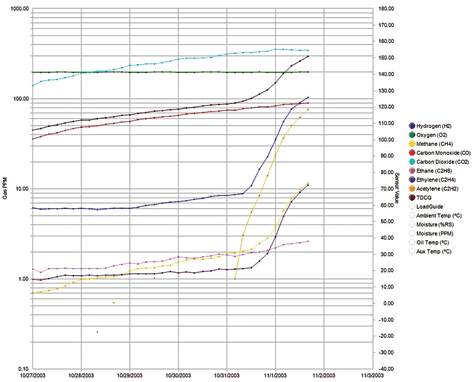
5. Rapid response. Note how quickly the on-line DGA system responds to increases in concentrations of dissolved gases. Quarterly sampling of transformer oil would never catch rapidly escalating indicators of an impending failure. Source: Serveron Corp.
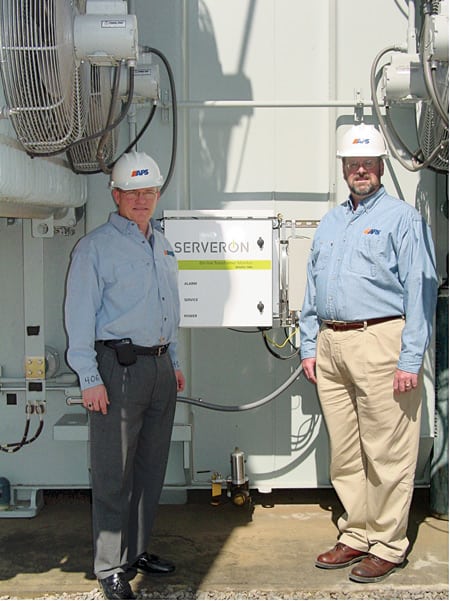
6. Oil’s well. Bart Tichelman, CEO of Serveron Corp. (L), and Don Lamontagne, section leader of APS’s T&D reliability analysis and management department, stand next to a Serveron TM8 eight-gas DGA. Source: POWER magazine