Participants in the CEO Roundtable at Electric Power 2006 raised a plethora of issues affecting decisions on future electric power generation. Representing a cross section of power producers, the industry leaders made clear that, although globalization has lost its luster in the power generation sector, its impact on the domestic industry remains profound.
Ten years ago, most major investor-owned U.S. utilities and many non-utility companies were seeking fame and fortune overseas, or were at least trying to figure out how to play in that game. Today, few U.S. gencos compete abroad, and those that still have assets there are busy divesting them.
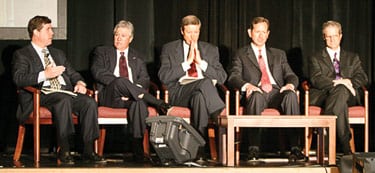
1. The Genco CEO Roundtable. Top executives from a diverse group of companies kicked off the Electric Power 2006 conference with a lively discussion of the challenges and opportunities facing our industry. Panelists included (from L to R) Paul Hanrahan, president and CEO of AES Corp.; Gary Taylor, CEO of Entergy Nuclear; James Jura, CEO of Associated Electric Cooperative, Inc.; Paul Bowers, president of Southern Company Generation; and Jim Dickenson, managing director and CEO of Jacksonville Electric Authority. The session was moderated by Jim Hoecker, FERC chairman from June 1997 to January 2001 and now a partner at the law firm Vinson & Elkins. Source: POWER magazine
Standing tall–globally
The exception is AES Corp. Paul Hanrahan, president and CEO, began his remarks by noting that AES owns and operates production and delivery assets in 25 countries. Half of its operations are U.S.-based, including the utility Indianapolis Power & Light Co. In a sense, AES is the one American global power company left standing after the meltdown and contraction period beginning in 2001. Interestingly, only 20% of AES’s capacity is merchant, and most of that is coal-based.
Hanrahan explained the current situation in Chile as a consequence of what he calls the "interconnectedness of various economies." Worldwide demand for natural resources and commodities is soaring, and Chile is one of the world’s leading producers of copper. It needs power plants to extract and process the ore. Chile, says Hanrahan, "is an example of a market that works," as it is based on bilateral contracts.
China and India account for much of the global boom in demand for copper, petroleum, and electricity. Hanrahan, conceding that markets "have to be cyclical," asserted that these markets "cannot grow at 10% annually" forever.
Hanrahan also made an astute observation about financing. There is currently a huge excess of capital in financial markets. Available private equity is approaching $1 trillion, or 10% of the capitalization of the New York Stock Exchange. More of this private money is going into the sector even as the institutional capital (large banks) holds back, still hung over from the irrational exuberance of the late 1990s. However, the private equity funds are "chasing the existing plants," Hanrahan explained, because there aren’t enough incentives for them to invest in new plants.
Hanrahan and Gary Taylor, president of Entergy Nuclear, both emphasized the growing importance of climate change and CO2. Carbon credits in Europe have reached $36/ton, but at one point they dropped to $18/ton in one day. In other words, a ton of carbon credits over there costs about as much as a ton of coal over here, but with much more severe price volatility. "This affects the coal/nuclear debate," Hanrahan stated, at which point Taylor jumped in. "America is dependent on world politics," he said, and "nuclear [power] is a question of national security." To drive his point home, Taylor offered two chilling statistics: China went from 5th to 2nd in worldwide CO2 production, and India moved from 13th to 5th-in one year!
Coal vs. nuclear
As the lowest-cost generation options, nuclear and coal power help keep American goods and services in global markets. Paul Bowers, president of Southern Company Generation, compared U.S. electricity demand growth in the southeast (2.0%) with that in the nation as a whole (1.6%). However, he conceded that customers cannot bear the impact of pending and anticipated electricity rate increases. It was somewhat surprising to hear one of the largest operators of coal-fired capacity in the U.S. say, "Nuclear might be the best option, but can you afford it on the balance sheet?"
Bowers predicted that even the "first" next-generation nuclear unit (compared to the "Nth" unit) will have a cost structure as favorable as that of a coal-fired plant. Taylor later quantified this assertion with one of his own: A nuclear unit can be built in U.S. to support $44 to $55/MWh electricity prices without subsidies or environmental credits. Apparently, what was weighing on Bowers is the current strain on coal resources, in particular the reliability of supply out of the Powder River Basin. Bowers also questioned the ability of coal-fired units smaller than 500 MW to remain competitive after spending millions for mandated pollution-control gear. The larger units "will get the scrubbers and SCR [selective catalytic reduction] and other cleanup devices," he said, but the smaller ones could be shut down.

Keeping costs down, skills up
Managing costs was the focus of remarks by Jim Dickenson, managing director and CEO of Jacksonville Electric Authority (JEA), and he reviewed two ways JEA has discovered to keep them in check. One is increasing the burn of opportunity fuels. Some 18% of JEA’s generation is fueled by petroleum coke, a refinery by-product. The coke is burned in two large JEA-owned and -operated circulating fluidized-bed boilers, which Dickenson expects will meet the air regulations through 2010. JEA’s other cost-reducing "secret" is Co-Electric Partners, a supply chain company it owns jointly with other public power entities.
Like Paul Bowers, Jim Jura-CEO of Associated Electric Cooperative Inc. (AEC)-said that rate increases give him pause. Jura also dwelled on some of the critical aspects of managing generating assets. Last year, AEC’s business strategy was "really tested," he explained. Going into the summer peaking season, the company lost a 300-MW unit due to a generator failure, and two weeks later a 600-MW unit went down. One reason the outages were so costly to AEC is that its coal assets were "topping out," which meant its gas assets had to run more to make up the difference. Last year, he remarked, "90% of our energy [came] from coal." To improve the balance, AEC-like many of its brethren in the Midwest-announced plans to bring a new coal unit on-line, this one by 2012.
Jura, like most utility executives at industry forums these days, lamented the declining state of the workforce across the entire U.S. electricity supply chain, from generation to delivery. "Experienced workers are leaving at a time when the system is growing," he observed. During the CEO panel’s Q&A session, audience members easily framed the problem as one of a shortage of skilled labor. But there was no consensus on the solution. Drawing engineering skills from the global talent pool, as one attendee suggested, is hampered by problems with obtaining visas for foreign workers, said another.
Help for AC power? Look to D.C.
In contrast to the hallmarks of the U.S. electricity industry in the 1990s-deregulation and privatization-this decade’s leaders are less shy about asking for government action. Taylor said, "Government has to help solve the [nuclear waste] problem." Hanrahan called for "certainty on federal CO2 rules" to avoid a state-by-state approach, which would be a disaster. Bowers noted that Southern is pursuing a "diversified path" toward future generation, including nuclear and integrated gasification combined cycle (IGCC). The federal government’s support of IGCC from an RD&D perspective has been clear for decades. Now there are specific incentives for IGCC and nuclear (as well as many other options) in the recently passed energy bill.
National security, with energy independence playing a key role, clearly has a seat at the table of priority forces shaping the U.S. generation sector today. It sits comfortably with reliability, environmental impact, and cost. If there’s one clear difference between today and 10 years ago, it’s that worries about global climate change are fostering renewed interest in-and driving the debate between-coal and nuclear power. It may boil down to a simple choice: Manage spent nuclear fuel, or sequestered CO2, for centuries to come.
Overall, the subtext of the CEO panel appeared to be that globalization is having a huge impact on the domestic scene. Given the labor and cost pressures produced by voracious Asian demand for commodities, the public’s realization that something must be done about climate change, and the shift in the national psyche toward security and energy independence, perhaps we’re being victimized by globalization. That’s ironic, because only a decade ago, U.S. gencos were leading the charge.