Daniel Yergin, founder and CEO of Cambridge Energy Associates (CERA), is among the best at connecting the dots of the energy industry’s past and turning them into a coherent picture of its future. Dr. Yergin’s accomplishments include a Pulitzer Prize for The Prize: The Epic Quest for Oil, Money & Power, a book that was made into an eight-hour PBS documentary. When Yergin talks, people listen.
The theme that Yergin chose for CERA Week 2007 in Houston this February—"Strategies for a High Stakes World: Innovation, Investment, and the Future of Energy"—correctly cast today’s energy business as a game with big financial risks and rewards. High and volatile gas and gasoline prices, concerns about global warming and the long-term adequacy and security of energy supplies, and the behind-the-scenes geopolitical maneuverings that shape today global energy environment have become front-page news.
The first two days of the conference were devoted to worldwide oil and gas supply and demand. The third day—Power Day, the one of most interest to readers of this magazine—began with a panel of utility CEOs discussing "The Next Big Ideas" for the electricity industry.
Seven steps to heaven
Jeff Sterba—CEO of PNM Resources (the parent of Public Service Co. of New Mexico), and chairman of EPRI as well—kicked off the discussion with a presentation titled, "Technology Needs for a Carbon Constrained World." He reminded the audience that, as of the end of 2006, the U.S. electric utility sector was responsible for roughly one-third of America’s emissions of carbon dioxide (CO2), or about 2,400 million metric tons (mt) annually (Figure 1). If no action is taken to curb them, the sector’s emissions are projected to increase to 3,300 million mt/year by 2030.
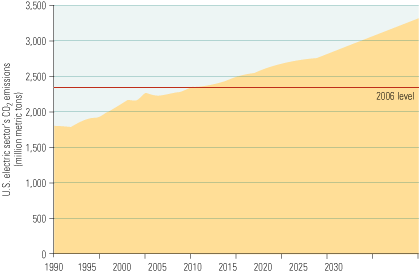
1. Steep slope. U.S. power plants’ CO2 emissions continue to rise. Source: PNM Resources/EPRI
It will be challenging enough to hold CO2 emissions at today’s levels, much less reduce them. Assuming, as the projections do, that advanced carbon capture and sequestration technologies (see Special Reports) will not be ready or affordable enough to be part of a nationwide solution for many years, it’s clear that the only near-term way to decelerate climate change is to deploy proven technologies.
Sterba described a step-by-step approach for halving the 3,300 million tons expected under the "do nothing" scenario to 1,700 million tons by 2030:
- Increase the efficiency of appliances and lighting to reduce annual demand growth from the current 1.5% to 1%. This step alone would reduce CO2 emissions 9% by 2030.
- Build 50 GW of wind farms and solar power plants by 2020, and an additional 2 GW/year thereafter.
- Add 24 GW of nuclear capacity by 2020, and another 4 GW/year thereafter.
- Target raising the efficiency of new coal-fired plants to 46% by 2020 and to 49% by 2030.
- Make 90% of the new coal plants carbon capture ready by 2020.
- Strive to have electric cars constitute 10% of all U.S. vehicles by 2017, and 30% by 2027.
- Increase distributed generation’s share of U.S. installed capacity from less than 0.1% today to 5% by 2030.
Sterba’s concluding remarks were directed to the U.S. Congress. He urged the House and Senate to join forces and pass legislation that would impose a tax on electricity consumption and thereby curb demand and power plants’ overall CO2 emissions. The rate, said Sterba, should be high enough to provide $2 billion to $3 billion per year for research into carbon-constrained generation technologies.
Use the plug, not the pump
The next speaker, Thiery Vandal, CEO of Hydro Qubec (HQ), stood apart from the other utility panelists in that his province is blessed with and relies heavily on hydro power. He explained that HQ invests more than $100 million annually to research and develop new hydro turbine and transmission technologies.
Vandal explained that there is a way for global warming’s two main causes—coal-fired plants and petroleum consumption by cars and trucks (Figure 2)—to work in concert to reduce each other’s negative impact. He praised plug-in hybrid cars as the single best idea for achieving large reductions in CO2 from the transportation sector. Several car makers agree, and they are preparing to introduce vehicles with that capability over the next few years.
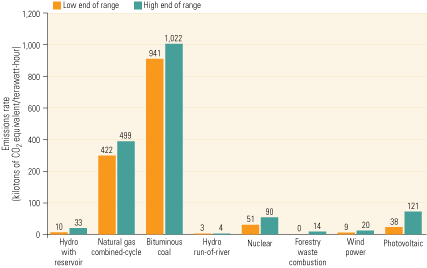
2. Inconvenient truths. CO2 emission rates of various power generation technologies. Figures for fossil fuels include emissions from transporting them to the plant. Source: Hydro-Quebec

3. From power plant to pedal. Hydro-Quebec’s prototype plug-in vehicle car holds great promise for reducing CO2 emissions in the future. Courtesy: Hydro-Quebec
Doing well by doing good
A third speaker on the opening panel of CERA Week 2007’s Power Day was just as enthusiastic about plug-in hybrids, but he also saw the scheme as an opportunity to expand power markets. Indeed, David Crane—CEO of NRG Energy Inc.—boldly declared that utilities have "A Moral Imperative to Act" to reduce their greenhouse gas emissions.
Crane explained that utilities would have to generate 33% more kilowatt-hours annually if the 240 million automobiles in the U.S. were to be retrofit with plug-in hybrid technology. As Vandal suggested, the additional revenues would not have to be invested in new plants or transmission lines because the growth in demand would be during off-peak hours. "Try to think of any other thing that an electric utility could do to increase its capacity factor by one-third," Crane asked. He then reminded the audience that it took eight years from Alan Shepard’s first orbital flight until Neil Armstrong walked on the moon. "CO2 reduction? We can do this!"
The best of the rest
Among the other highlights of Power Day was the keynote address by John Rice, vice-chairman of General Electric Co. and president and CEO of GE Infrastructure. Rice described GE’s commitment to develop and manufacture products that have less adverse impact on the environment—part of its Ecomagination initiative.
Going green can simultaneously be a socially responsible effort and a source of revenue growth for a $20 billion/year business, Rice said. The private sector needs to become involved in greenhouse gas reduction, he explained, and the only way to do that is for governments to reward successful risk takers with profits. "The reduction of CO2 should have a value," said Rice.
GE went on record supporting a properly structured cap-and-trade system for carbon two days before President Bush’s 2007 State of the Union address—an address suggesting a willingness to participate in an action plan to reduce global warming. Rice noted that solar energy is today where wind power was 10 years ago, ready to begin rapid growth and adoption. GE also supports federal subsidies for renewable energy such as the Production Tax Credit for wind, as well as the new incentives for nuclear power plant construction contained in the 2005 Energy Policy Act. Referring to CO2 reduction, Rice said, "The United States must lead; India and China will follow us."
Rice wasn’t the only top executive of a major power generation equipment vendor to attend CERA Week. See the box for highlights of a wide-ranging interview with Philippe Joubert, president of Alstom Power Systems. Among the topics discussed were Alstom’s steam and gas turbine businesses, carbon capture and sequestration in general, and, in particular, whether integrated gasification combined-cycle (IGCC) plants will ever completely replace pulverized coal plants for baseload service.
Alstom Power’s chief on turbines, carbon, and IGCC
POWER Contributing Editor Mark Axford sat down with Philippe Joubert, president of Alstom Power Systems, during CERA Week to get his perspective on the future of the industry. Following are excerpts of their conversation.

Philippe Joubert
POWER: Before we talk about industry issues, how did your turbine businesses do last year?
Joubert: I felt that 2006 was a strong year for Alstom on both the gas and steam turbine sides. We received orders for 19 gas turbines, with a combined capacity of 3,000 MW. Nearly all were for combined-cycle plants, and Alstom won the steam turbine award on most of the projects as well. We also were very happy with our steam turbine bookings in Europe for coal-fired projects. In Germany, Alstom had a 60% market share of the steam turbine market during 2006, and that wasn’t easy to do, considering the strength of Siemens and some demanding customers. We attribute our success to the superior efficiency of our machines.
POWER: The GT26 seems to have made a comeback during the last two years. How do you see the future of the GT24 gas turbine in the 60-Hz market?
Joubert: During 2001–2005, demand for large 60-Hz turbines was soft, so Alstom focused first on the 50-Hz GT26 and then applied technical improvements to our entire 50-Hz line. Later this year, we plan to demonstrate the improvements we’ve made to the GT24 at the Island Cogen project in Vancouver, Canada.
POWER: Will any of the product improvements on the horizon for the GT11 and GT13 address fuel efficiency and emissions?
Joubert: Keep in mind that the GT11 and GT13 gas turbines are older machines with a heritage going back to ABB. Alstom has invested continuously in product improvements for the GT13. It is popular in the Middle East, where fuel flexibility is often more important than fuel efficiency. We’re happy with our ongoing sales of the GT13, but I’m sad to say that the GT11 hasn’t competed very well during the last five years. To answer your question, there are no current plans to fund major improvements or upgrades for the GT11.
POWER: Does Alstom have any plans to add any small or medium-size gas turbines to its current lineup? Or will you continue to focus on 100-MW and larger units?
Joubert: Over the years, Alstom has had small and medium-size turbines in its product line. For example, we’ve manufactured GE Frame 5, 7, and 9 machines under license. Recently, the European Union mandated that Alstom divest its small turbine business. So at this time, we have no plans to acquire or develop small or medium-size gas turbines for our product lineup.
POWER: How important to Alstom is the North American market for gas turbines and steam turbines?
Joubert: Until we demonstrate our improved GT24, we are not focused on North America for sales of turbine-generators. However, our manufacturing shop in Mexico is very actively supporting steam turbines in North America, whether those turbines were manufactured by Alstom or another company.
POWER: Is Alstom planning to stick with its turnkey focus for large combined-cycle plants? Or do you see yourself working with the engineering and construction firms as a channel to market?
Joubert: We think that we can optimize a combined cycle comprising Alstom gas turbines, heat-recovery steam turbines, and steam turbines better than any other company. We do not have to apply risk premiums for performance guarantees or late deliveries because those are risks that we understand and can control. For that reason, we’ll continue to offer our gas turbines on a turnkey basis, rather than offer equipment through other turnkey providers.
POWER: What do you forecast as the year-on-year order growth rate for Alstom’s GT and steam turbine businesses during 2007 and 2008?
Joubert: We expect strong demand to continue for the GT13 and GT26 in Europe and the Middle East. We are also expecting a strong order rate for steam turbine-generators for both nuclear and coal plants.
POWER: On to a few industrywide issues. Have the sharp increases in metals costs to manufacturers stabilized? How does a 1% cost increase in steel or copper affect your selling price?
Joubert: The pressure on materials is coming from increased demand for power generation equipment in general, and from India and China in particular. We worry more about the noble metals and materials than about steel and stainless steel. But a greater concern is the capacity of forges and foundries. There are only a few sources for large castings and forgings, and the cost of these components has increased far more than for raw materials.
POWER: Has Alstom developed any technology or products for carbon sequestration?
Joubert: Alstom has several innovative CO2-capture technologies in development and/or demonstration, with solid paths to commercialization over the next five to eight years. These include postcombustion capture technologies, oxy-fired pulverized coal and fluidized-bed power plants, and—in the somewhat longer term—chemical looping. All of these technologies will produce a concentrated CO2 stream for compression and transport to the storage/sequestration site.
These CO2-capture technologies will be suitable for power plants to be built in the future and retrofittable to the high-efficiency units being built today. We believe that the timing for commercialization of these CO2-capture technologies is consistent with the timing of possible deployment of large-scale CO2 sequestration/storage.
Alstom is largely focused on the capture part of the capture and sequestration, or CCS, equation. However, we are closely monitoring—and, in some cases, actively contributing to—activities of the U.S. and EU organizations deploying the protocols and legal framework necessary for successful deployment of sequestration. We will design our capture technologies to be consistent with the requirements of sequestration in terms of CO2 quality, pressures, etc.
Of course, with growing interest in planning for future CCS, there is increased market focus on higher efficiency as the first step in CO2 reduction and as a foundation for future deployment of CO2 capture. Efficiency improvement will remain the most reliable and lowest-cost method for mitigating CO2. All markets around the world are shifting to more-efficient generating technologies, including ultra-supercritical boilers for steam power plants. Modern supercritical plants emit 25% less CO2 than older plants.
POWER: Where do you see the future of coal-fired power? Will it be IGCC, or pulverized coal with CO2 sequestration technology applied to the exhaust stack?
Joubert: We’re not convinced that IGCC will replace PC technology. IGCC is still not cost-effective. Today’s most cost-effective way to reduce CO2 emissions is to make the steam cycle more efficient. It’s less expensive than the incremental cost of IGCC or carbon capture and sequestration. So, while advanced technologies for CO2 reduction are being developed and refined, we should focus on improving efficiency because we already know how to do that.
To answer your question, I think the future of coal-based power is . . . a near-zero emissions power plant, with the capability to capture CO2. There are a number of competitive technology paths to this future. We believe that the market will require a portfolio of technologies for coal-based generation, including advanced combustion-based generation with CO2 capture, as well as gasification—that is, provided IGCC meets its projected reliability and cost goals.
The reality of coal-based power is that no single technology is optimal for all coals, plant locations, or operational regimes. Generators need options from which to select a coal conversion technology that provides them with clean, cost-competitive, reliable power. A balanced portfolio of coal-based power technologies, using both combustion and gasification, will create a healthy competitive market, drive innovation, and reduce the risk of relying on any single technology. Given the magnitude and breadth of issues facing the power industry, it is most likely that all of these clean coal technologies will be needed to meet industry’s diverse long-term needs.
Finally, engineering/procurement/construction (EPC) contractors also had their say on Power Day. An afternoon panel session focused on the cost of fossil-fueled plant construction. Steve Edwards, an executive VP of Black & Veatch, minced no words when he said, "The capital cost of a coal plant in the U.S. has gone up 25 to 35% over the last year, and it’s still rising. . . . Why? We’ve all heard about the rising prices of steel, copper, and other raw materials." Edwards cited three other causes:
- Machinery supplier shops are now loaded, causing price pressure on steam turbines, cooling towers, fans, motors, and switchgear.
- There’s a shortage of EPC talent with experience on large coal projects.
- Craft labor is not available to support the expected wave of construction that will peak in 2009-2012.
Edwards’ advice: Either get your project construction contract in place now, or devise a strategy to delay construction until after 2012.