
The Energy Policy Act of 2005 gave the Federal Energy Regulatory Commission (FERC) the authority to override state and local opposition to the construction of interstate transmission lines if the agency determines that they will reduce system congestion. In April, the Department of Energy designated two regions that might qualify for such treatment as "national interest electric transmission corridors." One covers a broad territory stretching from Maryland to New York and as far west as Ohio. The other includes a large chunk of southern California, southern Nevada (including Las Vegas), and parts of Arizona all the way to Phoenix.
In announcing FERC’s plan, Energy Secretary Samuel Bodman said, "The parochial interests that shaped energy policy in the 20th century will no longer work." Maybe so, but instead of serving the "national interest," the proposed corridors are looking a lot like poaching routes. Their result will be to enable regions that have resisted building generation locally—in hopes of buying cheaper power from other regions—to avoid paying the full costs of "their" power. The problem with this plan is that it saddles generating regions with the environmental and lost resources costs and consequences.
California dreamin’
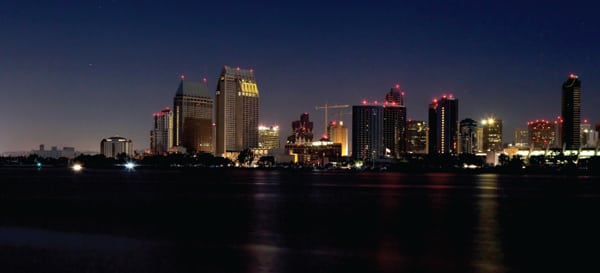
The Sunrise Powerlink is probably the most ambitious project developed by San Diego Gas ‘ Electric (SDG’E) in many years. The project contemplates running a new 150-mile transmission line east from San Diego into the deserts and then south to an Imperial Valley substation near the U.S.-Mexico border. SDG’E claims the link will spur development of renewables (geothermal and solar), lower transmission system congestion costs, and "reduce subsidies paid to local, aging power plants that are more expensive to operate."
The second and third issues are closely related. In the reports backing its national corridor designations, the DOE states that one of the biggest reasons it considers the southern California grid "troubled" is the high cost of running those old plants—typically gas-fired units in urban areas. No surprise: SDG’E hasn’t built a new power plant in its service territory in more than 30 years.
What isn’t discussed in the project description on the Sunrise Powerlink web site is what I’d call a web of deception: the larger master plan for linking it to additional transmission lines into Arizona’s Valley of the Sun and to the huge power park 50 miles southwest of Phoenix. The overall vision of multiple interconnected links is discussed in a report on future transmission projects on the California Independent System Operator web site.
Buddy, can you spare a megawatt?
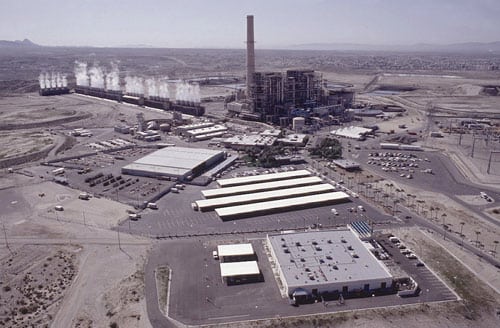
I recently drove my 4WD truck to the top of a small mountain just south of the Palo Verde Nuclear Generating Station. The power park view warms a power engineer’s heart: The three-unit 3,739-MW nuke lies to the north, and to the south sit Sempra’s 1,250-MW Mesquite Generating Station, Pinnacle West Energy’s 1,136-MW Redhawk Power Plant, and LS Power’s 713-MW Arlington Valley Energy Facility. Travel over the next hill and south a few miles and you’ll find the 2,400-MW Panda Gila River Project. All but Palo Verde are gas-fired combined-cycle plants.
I’d venture that a big chunk of the more than 9,200 MW I could survey is just aching to find a path into Southern California. Why? The average retail electricity price is more than 50% higher there than in Arizona: 14 cents/kWh vs. 8.5 cents/kWh. Finding new customers willing to pay more for the same commodity would be a business coup for the plants’ owners. The only hurdle would be permitting the new lines needed to deliver it. But the Arizona Corporation Commission (ACC) saw a different vision of the future.
Import the electrons, outsource the mess
To its credit, the ACC saw through the "master plan" scheme and unanimously voted down a Southern California Edison (SCE) proposal to build a 231-mile transmission line to connect the power park to a substation near Palm Springs (and ultimately to the Sunrise Powerlink and points west). SCE execs argued that the link would "increase the state’s ability to transmit energy." What they really meant was the ability to transmit energy to Southern California.
Bill Mundell, an Arizona energy commissioner, explained the rejection succinctly: "I don’t want Arizona to be the energy farm for California." Commissioner Kris Mayes added, "You [SCE] are trying to drop a giant extension cord into Arizona."
The final meeting on the project turned a bit testy when commissioners quizzed Dian Grueneich of the California Public Utilities Commission about her state’s recent lack of progress building new power plants and transmission lines. Mundell asked, "Why should Arizona put its natural resources, environment, and future energy supply on the line while California does relatively little?"
That’s indeed what California is asking Arizona to do, in an updated version of Aesop’s fable of the grasshopper and the ant. And that’s precisely why the entire national interest corridors program will face challenges from power "donor states." In California’s case, taxing that nasty coal-fired power coming into the state up north and strong-arming its neighbor to the east for a bigger slice of existing gas-fired capacity is an energy plan doomed to failure. Nevada, keep an eye on these guys.
Don’t go away mad . . .
The Arizona Corporation Commissioners didn’t want SCE execs to leave the meeting empty-handed so they slapped the utility with a $4.8 million fine. It seems some commission staffers researching the SCE proposal discovered that the utility used the wrong type of power tower on a transmission project 20 years ago—apparently, a crime for which there is no statute of limitations.
SCE now knows how we deter poachers in the West.