What do you do when your research institution is losing roughly half a million dollars annually as a result of multiple electricity outages — and electricity demand keeps rising? If you’re the Illinois Institute of Technology, you turn the challenge into a campuswide learning experience by teaming with the Galvin Electricity Initiative and other experts to design and construct a prototype Perfect Power System (PPS). Even during its implementation, the PPS promises to provide more reliable and sustainable electricity to the university at a lower cost than it had been paying.
Between 2004 and 2006, the 120-acre campus of the Illinois Institute of Technology (IIT) in Chicago (see cover photo and Figure 1) experienced an average of three unplanned electricity outages per year. Those outages ranged from partial to complete loss of load on the main campus and cost the university an estimated $500,000 annually in destroyed experiments, damaged equipment, lost productivity, cancelled classes, and other consequential damages.

1. Windy City campus. This shot looks northeast across the IIT campus. Main is the red brick building to the left, and the Galvin Library is the one-story building to the right of Main. The three-story Siegel Hall, which houses the Department of Electrical and Computer Engineering, is directly up from the Galvin Library. Courtesy: IIT
IIT offers degrees in engineering, science, psychology, architecture, business, and law. Together with the IIT Research Institute (IITRI), its contract research affiliate, the institution specializes in areas such as aerospace, synchrotron radiation science, environmental engineering and regulatory policy, polymer science and recycling, food safety and technology, and transportation and infrastructure. A common concern among researchers working on such projects is insulating their long-term and critical experiments from the university’s notoriously unreliable electricity supply (see "The Cost of an Unreliable Electricity Supply"). Each of the research laboratories is much like a small business that is open 24/7 — but with student employees who can’t take a weekend off or head to Daytona for spring break when an experiment is in process.
Together, IIT and IITRI enjoy annual research revenues of $130 million. Protecting that revenue means ensuring a reliable power supply.
In response to the too-frequent outages, some laboratories shifted key experiments to evening and/or weekend hours, when the risk of an outage was less than during the day. By the summer of 2006, the mounting costs and complaints captured the attention of senior university administrators and even the IIT Board of Trustees.
Robert W. Galvin, former chairman of the IIT Board of Trustees, extended an invitation to the IIT power engineering faculty to join the Galvin Electricity Initiative (GEI) and proposed using IIT’s main campus as a possible site for what Galvin calls the "Perfect Power System" or smart microgrid. IIT soon signed on with the GEI (see sidebar) and began work on GEI’s first Perfect Power System (PPS) installation with the goal of improving electricity reliability and reducing costs on the IIT campus.
Energy efficiency projects were soon under way at IIT after its 2006 Energy Master Plan to maximize energy efficiency technologies and introduce renewable energy options was adopted. That plan requires energy efficiency improvements to reduce electricity consumption by up to 11 million kWh (20% reduction) and reduce natural gas consumption by nearly 1 million therms (10% reduction) per year. IIT was soon to find that a PPS could produce this level of energy savings while significantly improving overall system reliability.
The Cost of an Unreliable Electricity Supply
The Lawrence Berkeley National Laboratory (LBNL) attempted to capture the costs incurred by consumers because of unreliable electricity supplies in a September 2004 study titled, "Understanding the Cost of Power Interruptions to U.S. Electricity Consumers." This report, prepared after the August 2003 Northeast Blackout, revealed that the cost of power interruptions approaches $80 billion annually and that the bulk of that cost is being born by commercial users (Figure 2). One of the report’s authors estimated that the level of investment in the grid needed to improve reliability was in the range of $50 billion to $100 billion.

2. The average cost of a power interruption. Lawrence Berkeley National Laboratory (LBNL) estimated that the total losses due to U.S. power outages are
approximately $80 billion per year. Source: LBNL
The LBLN researchers found that the industry knowledge base available to analyze power outages had many data gaps. Lab researchers aggregated data from three key sources: surveys on the value electricity customers place on uninterrupted service, information recorded by electric utilities on power interruptions, and information from the U.S. Energy Information Administration on the number, location, and type of U.S. electricity customers.
One of the key conclusions of the study was that mere momentary outages, which tend to be more frequent, have a bigger impact on the total cost of interruptions than major outages. Intermittent outages were estimated as accounting for two-thirds of the $80 billion annual loss.
The Electric Power Research Institute (EPRI) estimated the annual cost of interruptions and power quality events at $104 billion to $164 billion annually in another study of the impact of power outages on the digital economy. That study also found that between $15 billion and $24 billion in losses were attributable to power quality problems.
The EPRI study concluded that the cost of an outage increased with the length of the outage, although even very short outages were expensive (Figure 3). In addition, the average cost of even a recloser event is more than that incurred by a 1-second outage. Perhaps some utilities are operating their equipment in ways that are detrimental to their customers.
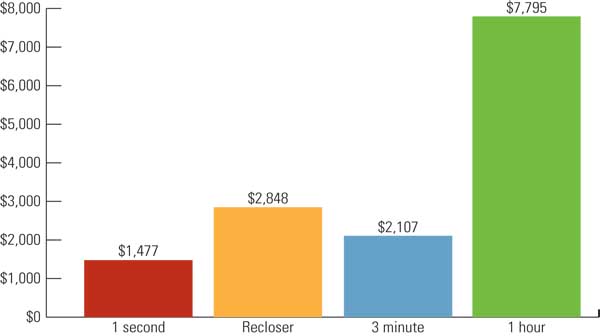
3. The average cost per outage by duration. Source: EPRI
The EPRI study also concluded that the distribution of costs related to outages is uneven (Figure 4). For example, almost three-quarters of the businesses surveyed reported virtually no cost to their business for a 1-second outage or a recloser event. In sum, the majority of businesses incur little or no costs from an outage, but a few have very large costs. Five percent of businesses studied incurred costs in excess of $20,000 or more for a 1-hour outage, and a select few reported losses as high as $1.5 million or more.
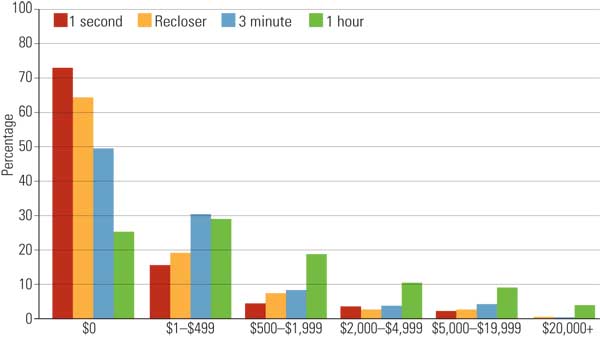
4. Distribution of costs per outage by duration. Fewer companies experience large losses than smaller losses as a result of a power outage, but a small portion of companies experience losses as large as $1.5 million or more. Source: EPRI
Assembling the Team
During the summer of 2007, IIT joined forces with several key organizations in the electric power industry to assemble a team of experts capable of designing and implementing Galvin’s first PPS at IIT. A proposal submitted to the Department of Energy’s (DOE’s) Renewable and Distributed Systems Integration Funding Opportunity within the R&D Division of the Office of Electricity Delivery and Energy Reliability "[to] demonstrate peak load reduction on distribution feeders with the implementation of distributed energy and energy management systems at a cost competitive with system/capacity upgrades" was successful. After that funding was secured, the project team was assembled.
In addition to IIT and GEI, the expert team included Exelon/Commonwealth Edison Co. (ComEd), S&C Electric Co., Endurant Energy, and Integrys. The five-year PPS project began construction in early 2009.
The project consists of six distinct steps inspired by Six Sigma quality methods developed by Motorola.
Step 1: Adopt Quality Methods
The first step in developing any quality program is to develop a methodology to collect discrete statistics from which to measure progress and determine a set of desired end-state metrics (Table 1). The IIT team participated in two training courses on Six Sigma quality methods and principals at the Joseph M. Juran Center for Leadership in Quality at the University of Minnesota, Carlson School of Management. The purpose of this training was to develop a replicable methodology for creating PPS. The team subsequently adopted the following standard quality methods for the project:
-
Determine what is critical to quality (CTQ) from the customer’s perspective.
-
Process map CTQ elements and develop measures that quantify performance or the cost of poor quality.
-
Perform a Failure Modes and Effects Analysis (FMEA) for each process step.
-
Engage in error proofing, innovative problem solving, and solution set generation.
-
Prioritize the implementation steps.

Table 1. Energy system quality metrics. The Perfect Power System team began by defining IIT’s power quality needs and a set of desired end-state metrics. Source: IIT
Step 2: Do Process Mapping
Once the key project metrics were established, the process mapping quality method divided the IIT utility system into the following major processes:
-
Supply or transmission systems, larger area switch stations, area substations, and step-down transformers.
-
Campus distribution or substations, substation breakers, building feeders, building isolation, and communications.
-
Building distribution or switches, transformers, and circuits within the building.
-
Backup power or standby generation to protect critical loads.
-
Procurement and sustainable energy systems to minimize the energy and environmental impacts of the campus loads.
Step 3: Assess Major Subsystems
The team then performed an assessment of the existing campus infrastructure and power supply system processes from Step 2. They confirmed that a number of significant infrastructure upgrades were required before they could apply the PPS principles.
The team found three separate underground circuits, fed from a single substation, that supply three 7-MW ComEd transformers. ComEd designed the electricity system to accommodate a single circuit failure, so the effective demand at the substation was 14 MW. Campus records show IIT’s highest peak load through 2006 was approximately 10 MW. ComEd tested all the substation components and subsequently upgraded the supply circuits to improve short-term reliability.
IIT also installed over 2 MW worth of natural gas – fired engine generators for standby generation to protect critical loads as part of the PPS project. Distributed resources can reduce peak demand and can eliminate or defer new transmission and distribution capacity and decrease electricity wholesale or market prices. Enhanced on-site peaking generation resources can also improve reliability and security.
In addition, IIT is in the middle of a major upgrade to its steam heating system that entails adding new natural gas – fired boilers.
IIT is also working to slow the growth of its electricity demand by installing advanced lighting, windows, and other energy-reducing technologies that will help it avoid rising electricity costs as it continues to expand the campus.
On-site generation, when combined with a new automatic demand response capability, will be capable of sustaining campus operations in the event of a loss in ComEd electricity supply. The completed PPS will be able to remove 10 MW of demand from the grid when called upon by ComEd or the PJM independent system operator to do so. On-site generation sources will also support distribution- and transmission-level load control programs.
Step 4: Identify the Weakest Links
Many organizations fix problems after the fact and thereby incur the cost of failure in their product cost, according to the Juran Center for Quality. Others avoid fixing problems by adding unnecessary costs at the end of a process by, for example, increasing the number of inspectors and production redundancy. In contrast, the IIT PPS team applied Six Sigma quality principles, including failure modes and effects analysis and error proofing quality tools, to identify and define the types of failures that were possible and determine how to minimize or prevent those failures before they occur.
The team determined the severity (major, moderate, and minor), probability (frequent, occasional, uncommon, and remote), and severity factors (severe weather, aging, usage, and human error) for each failure mode. The severity of the impact of a power failure depends upon the severity of the impact of the loss of power on the customer and may vary from customer to customer.
This process identified several weak links in the system that are now part of the planned PPS upgrades:
-
ComEd electricity supply. IIT is located in an area subject to severe weather, but it has only one transmission feed, which makes it more vulnerable to outages. In addition, the campus electricity supply is via older direct buried cables that have been experiencing failures. Furthermore, some of the ComEd supply system is still above ground and subject to weather damage. These conditions resulted in an offsite power supply rating of "frequent." In addition, the severity of the impact was rated as "moderate" due to the economic impacts from the loss of productivity. The analysis concluded with the imperative that IIT will need to ensure that the campus can be supplied by a local alternative power source.
-
Site distribution cables. IIT supplies a number of the campus buildings via direct buried cables. The buildings are supplied by two feeder cables that must be manually selected. The PPS design requires that these failure modes be eliminated.
-
South Substation. The IIT South Substation is more than 30 years old and nearing its supply capacity. The substation should be upgraded and the power feeds reconfigured to move some of the loads to the newer North Substation.
Step 5: Design the Perfect Power System
IIT’s PPS is modeled after the "High Reliability Distribution System" (HRDS) developed and implemented by S&C Electric for the University of California at Santa Barbara. The team divided the IIT campus into logical groups of buildings that will form electricity and thermal loops to maximize reliability and efficiency. The HRDS leverages a continuously energized loop feeder concept, which provides a redundant supply of electricity to designated campus buildings (Figure 5). Both feeds will be energized and will supply electricity to designated buildings. They will also be capable of carrying the entire building load. In addition, feeder redundancy will allow the rerouting of power to buildings in the event of a distribution feed fault.
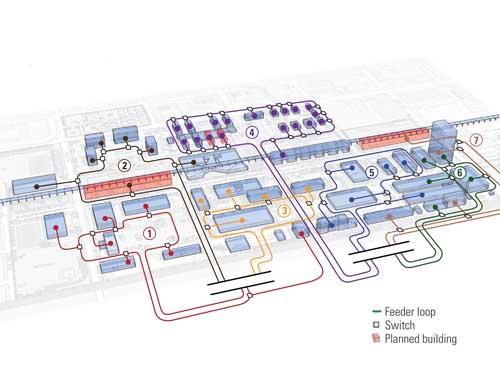
5. The perfect number. The IIT High Reliability Distribution System divides the campus
into seven independently controlled and redundantly supplied management zones. Siegel Hall
is the far right building in zone 3. Source: Michael Meiners, Galvin Electricity Initiative
This approach was based on the team modeling projected loads on campus based on expected increases in enrollment and planned construction of new and recommissioned campus buildings. Transformers will be upgraded where necessary, and new 15-kV cables will be installed to provide additional flexibility. The result will be a robust feeder network that will give IIT the option of eliminating the existing above-ground ComEd transformers that step down ComEd distribution voltage of 12.46 kV to the switchgear rating of 4,160 V.
The backbone of the PPS is an intelligent trending, detection, and mitigation system that collects thousands of inputs, trends their parameters, determines their potential impact, and changes the system operation to mitigate the consequences of adverse trends. An Intelligent PPS Controller (IPPSC) that monitors and trends critical parameters to determine the system state manages the PPS. The IPPSC then changes system operating conditions to maintain the system within the specified limits of operation. The monitoring and communications system includes the robust deployment of lower-cost mesh sensors and modules that communicate via either a wireless or a wired IP-standardized communications network, including:
-
Advanced meters for each building that measure voltage, frequency, current, reactive power, power consumption, and harmonics as well as individual building loads.
-
Signals from the IPPSC to dispatch generation based on PJM real-time electricity and natural gas prices.
-
Local generation and storage output levels, storage capacity, and fuel supply status.
For example, in the event of a loss of one section of cable or a switch, the design concept provides for the rapid assessment of fault conditions and opens within 1/4 cycle, simultaneously isolating the fault and allowing power to flow along a secondary feeder route without interrupting power to any loads. This approach uses S&C Vista fault-clearing switchgear in a closed-loop system with directional overcurrent protection relays. This combination of high-speed automated breakers, switches, and redundant feeders allows for the instant reconfiguration of the system to keep power flowing to all buildings.
Siegel Hall, a research lab, is a good example of specific infrastructure upgrades that will mesh with the PPS technology. Siegel Hall’s distribution system consisted of two 4,160-V feeds from the North Substation (Figure 6). Feeders 12 (primary) and 11 (secondary) provided feeder redundancy through manual switches 176 and 177, respectively, which fed into a 500-kVA transformer where power was stepped down to 240 V. Typically, two panels on each of the three floors distributed electricity to lights, fans, and computers. A high-pressure campus steam system supplies heating to the building.
Figure 6 also provides an overview of Siegel Hall’s future Building Integrated Energy System. The PPS upgrades include a redundant electricity supply, efficient hot and chilled water supply, uninterruptible power source and/or generation, renewable energy sources, and an advanced building control system.

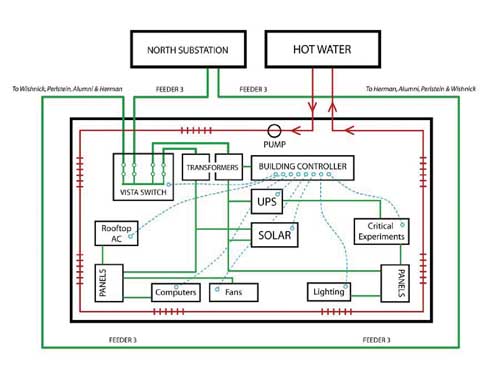
6. A world of difference. Each building will have a number of energy system retrofits completed. For example, these diagrams show Siegel Hall’s distribution system before (top) and after (bottom) the planned Perfect Power System upgrades. Source: Michael Meiners, Galvin Electricity Initiative
Step 6: Implement the Plan and Achieve Cost Savings
IIT’s PPS is being implemented in the following four phases, determined mainly by the prerequisite infrastructure upgrades described previously.
Phase 1: Perfect Power Foundation. The first phase, started by IIT several years ago and currently near completion, built the foundation for this project by improving the overall efficiency of the campus and the reliability of the ComEd supply system. During this phase, the existing IIT gas turbines were modified for fast-start capability and to meet expanding building demand response capability, thus providing for continued operation of the IIT campus in the case of a loss of offsite power.
Phase 2: Real-Time Pricing and Ancillary Services. IIT and ComEd are located in the PJM Independent System Operator territory, which will provide IIT the opportunity to purchase lower-cost electricity in real time from the retail electricity market. With every opportunity, however, comes risk.
Entering the real-time markets without a means of hedging hourly price spikes could result in a sizable increase in electrical costs of $1 or more per kWh during peak periods. This volatility is the reason most facilities such as IIT do not accept real-time market risk. However, IIT’s on-site generation, coupled with expanded building demand response capability, can be operated to mitigate peak demand prices and provide demand response. Fast-starting gas turbines also can provide new spinning reserve services to ComEd and PJM, effectively capping prices at the operating costs of the on-site generation. This arrangement will give IIT the flexibility in the future to purchase electricity when real-time markets’ costs are lower than the cost of generating power on site and to deploy its backup generation when the price of electricity exceeds seven to eight cents per kWh.
If IIT had procured electricity in the real-time market in 2008 by leveraging the PPS to hedge peak prices, the campus would have reduced its annual electricity bill by about $800,000. IIT today can also generate revenue by participating in system operator load or demand response programs and purchase power contracts. A purchase power contract with Constellation Energy for 2009 is expected to reduce IIT’s electricity bill by 25% this year.
Phase 3: Perfect Power, Distribution System Reliability, and Automation. Next, a redundant and intelligent distribution system that interfaces with a dynamic campuswide energy system controller will be implemented. This upgrade will ensure continuous service to IIT buildings in the event of a site cable or switch failure. The S&C Vista switches automatically and instantaneously reconfigures when a fault is detected, with no loss of service.
Phase 4. Distribution-Level Peak Demand Reduction. A local uninterruptible power supply, solar energy, and demand response capability will complete the PPS. This system will optimize building operating efficiency and reliability, demand response revenues, and ancillary services.
What’s the Price?
The PPS, funded by IIT and the DOE, will allow IIT to avoid costly system upgrades and realize efficiency savings well into the future. The team estimates that the PPS will pay for itself even as it is being built over the next five years (Table 2).

Table 2. Estimated Perfect Power System costs and savings. Source: IIT/Endurant Energy
Coincidentally, IIT’s investment will save all Illinois customers money by eliminating $2,000,000 in upgrades to the ComEd area substation that would have been needed to meet the rise in IIT’s expected demand had the PPS upgrades not been proposed.
Implementation of a PPS at IIT will provide a powerful resource for attracting students and government/industry funding. For example, the electrical engineering program expects to raise an additional $1,000,000 per year in research funding due to the added campus features and functions.
In fact, the DOE recently awarded IIT a $6.7 million research grant to develop and demonstrate more advanced PPS technologies.
IIT plans to have construction photos and project status updates on its web site (www.iit.edu).
–James M. Hylko is a POWER contributing editor.