Synovus is a financial services company that includes 30 southeastern banking divisions, trust brokerages and mortgage companies, plus a credit/debit card processing company. The divisions of Synovus provide banking, investment, and mortgage services to customers in Georgia, Alabama, South Carolina, Florida, and Tennessee. The company recently constructed a new mission-critical data center in Columbus, Ga., to handle its e-banking, telecom, and ATM transactions. Synovus relies on emergency standby generator sets to prevent any loss of services or data in the event of a utility outage.
“While Synovus has other off-site facilities for data storage and disaster recovery, the Columbus facility is the main data center for all our banking activities,” says Charley Whipkey, facility maintenance coordinator for Synovus. “Whenever a Synovus customer makes a purchase with one of our bank cards, uses one of our ATMs, or conducts business at any of our several hundred branches, that data is handled by this 50,000-square-foot facility. The Network Operation Center is manned 24 hours a day, and there is constant data communication with our network to transact business.”
Redundancy a Key Design Factor
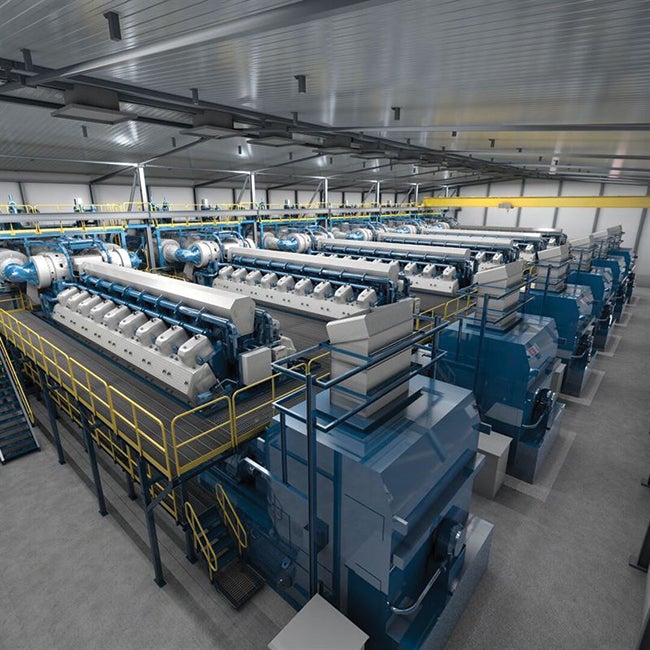
As in most mission-critical facilities, the Synovus data center uses layers of redundancies to prevent loss of services or data. Starting at the server cabinets, Whipkey explains, every cabinet has two power supplies. These, in turn, are backed up by dual utility feeds and uninterruptible power supply (UPS) systems. The last line of defense is the emergency standby power system, consisting of two 2,250-kW MTU Onsite Energy diesel generator sets that operate independently (Figure 4).
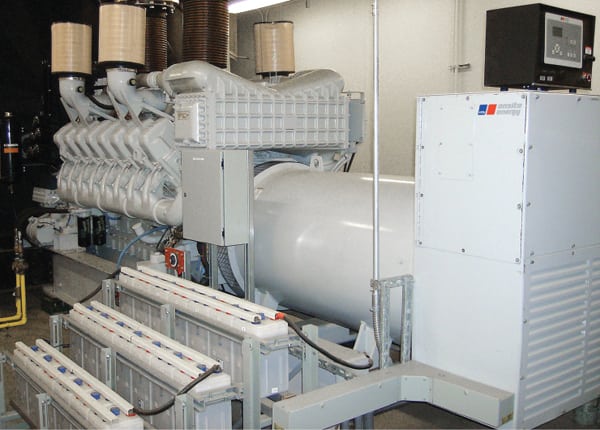 |
| 4. Eight-second ride. Two MTU Onsite Energy 2,250-kW generator sets back up the main data center for Synovus Financial. The generator sets can start and assume full load in less than 8 seconds in the event of a major power disruption. Courtesy: MTU Onsite Energy |
“We have a fairly unique backup system at Synovus. The critical power system is a redundant configuration using static UPS systems with flywheels instead of chemical batteries. We wanted to get away from a battery-backed UPS system because of ecological concerns regarding acid containment. There also are maintenance issues with wet cells that we wanted to avoid,” said Whipkey. “The flywheels give us about 25 seconds of full load facility power after a utility outage, so we needed emergency standby generators that could start and accept load in 8 seconds or less. One of the reasons we chose MTU Onsite Energy was because these generators can start and assume full load in just 7.5 seconds.”
The system was designed by the project’s electrical consultant, Barnett Consulting Engineers (BCE), and allows for redundancy in all critical components. “The design is a modular, expandable, tri-redundant system providing N+2 reliability to all critical loads,” says John Barnett, PE of BCE.
To make this system a reality, Synovus looked to its electrical contractor, Alexander Electric Co., to ensure that its new generator sets were properly coordinated, installed, and tested with all other critical equipment.
Currently, the facility’s total electrical load is only a small portion of the combined capacity of the two standby generator sets. This means that even if the electrical load grows over time, the facility would still have one fully redundant generator set that could supply sufficient power if the other unit didn’t start. If the facility’s load grows beyond that level, Whipkey says there is already a third electrical room and space for a third generator set and transfer switch, thanks to the center’s long-range planning.
When the Power Goes Out
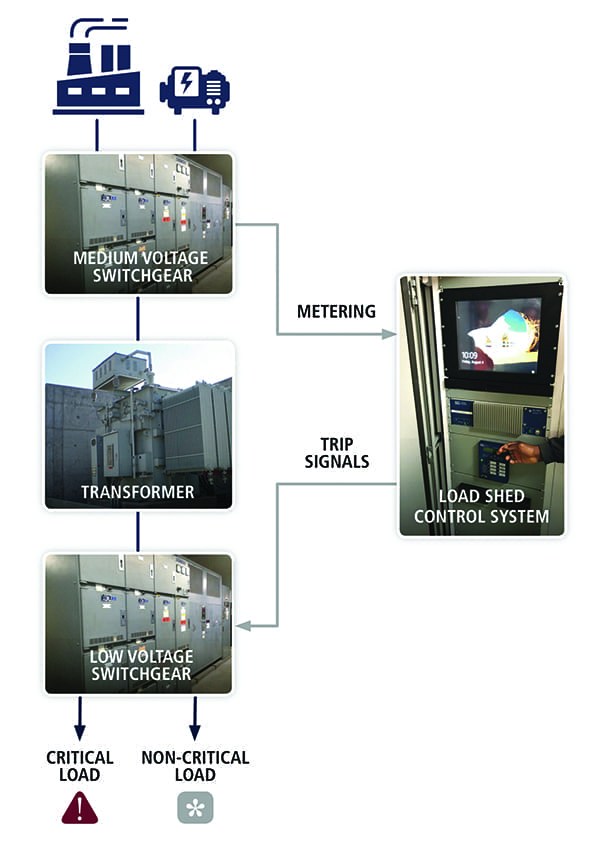
In the event of a utility outage, the facility’s control system is designed to first try switching to the alternate utility feed. If the second utility feed is also down, the UPS system picks up the building’s critical loads, with the exception of the air conditioning chillers. Within 1 second of the outage, a signal goes to the generator sets to start; the emergency generators accept the critical loads within 8 seconds. A few seconds later, the chillers are picked up by the generator sets. The generator sets also have dual, full-size starting systems as part of the redundant design. To date, the units have not had a single failure-to-start event in over two years of operation.
Once power is restored, Synovus is cautious about returning the load to utility power. “Because of the center’s criticality,” says Whipkey, “we don’t let the system automatically transfer back to the utility when normal power is restored. When the utility comes back on, we choose to manually transfer the power back because we want to make sure that everything is working normally. The operator has to physically check the building, the generator sets, and the breaker positions, and also make sure the flywheels have recharged, before we hit the transfer button.”
Maintenance Is a Big Factor in Reliability
Power system reliability starts with good design and good equipment, but Synovus recognizes that ongoing maintenance also plays a vital part. Regular maintenance and exercise of generator sets, breakers, and transfer switches are essential, and Whipkey has a precise schedule that he follows. “Every Monday, the generators are exercised for about 30 minutes—long enough to get them to operating temperature. Then, once a month, both generators are started and run for an hour with the full building load, completely off the grid. The switchgear is a closed-transition system that allows a nice, smooth transition from the utility to the generator sets and back.”
With electronic financial transactions, such as e-banking and ATM and bank card use, increasing almost daily, Synovus will be relying on its central data center—and on reliable electric power. Whipkey says that the company’s Columbus data center will be able to accommodate the anticipated growth for the next 10 to 15 years before the facility reaches capacity.
—Contributed by MTU Onsite Energy, a subsidiary of Tognum America Inc.