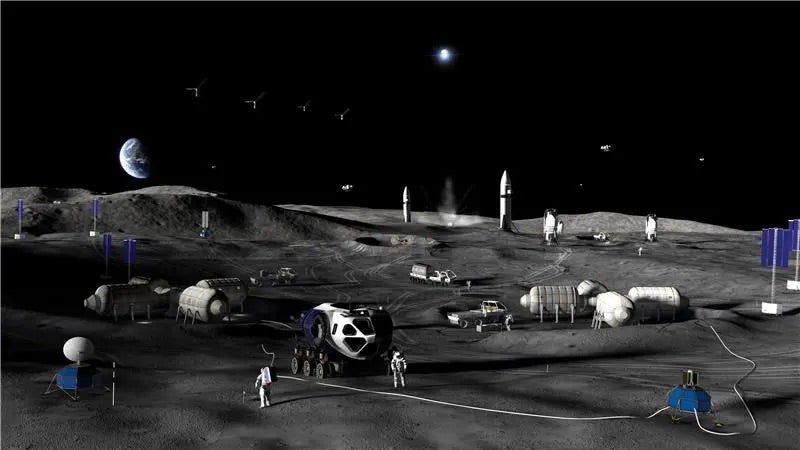
The White House has launched a coordinated federal initiative to deploy nuclear reactors in space, directing NASA and the Department of War (DOW) to run parallel design competitions for fission systems that could power lunar bases and in-space missions by the end of the decade, and tasking the Department of Energy (DOE) to support fuel supply, infrastructure, and technical development.
National Space Technology Memorandum‑3 (NSTM-3), issued April 14 by the White House Office of Science and Technology Policy (OSTP), formally launches the National Initiative for American Space Nuclear Power and sets near‑term timelines for low‑ to mid‑power space reactors in orbit and on the Moon, as well as a higher‑power system in the 2030s.
The memo gives NASA 30 days to initiate a program to develop a mid-power space reactor, including a lunar fission surface power variant targeted for launch by 2030 and an option for a space-based system to support a nuclear electric propulsion demonstration. In parallel, the DOE must, within 60 days, assess the readiness of the U.S. nuclear industrial base to produce up to four space reactors within five years and provide recommendations to address any gaps.
Nuclear for Space: Years in the Making
The directive points to a growing urgency within the federal government to establish reliable, continuous power sources for lunar and deep-space missions, as well as to accelerate development timelines amid increasing commercial and national security interest in space-based nuclear systems.
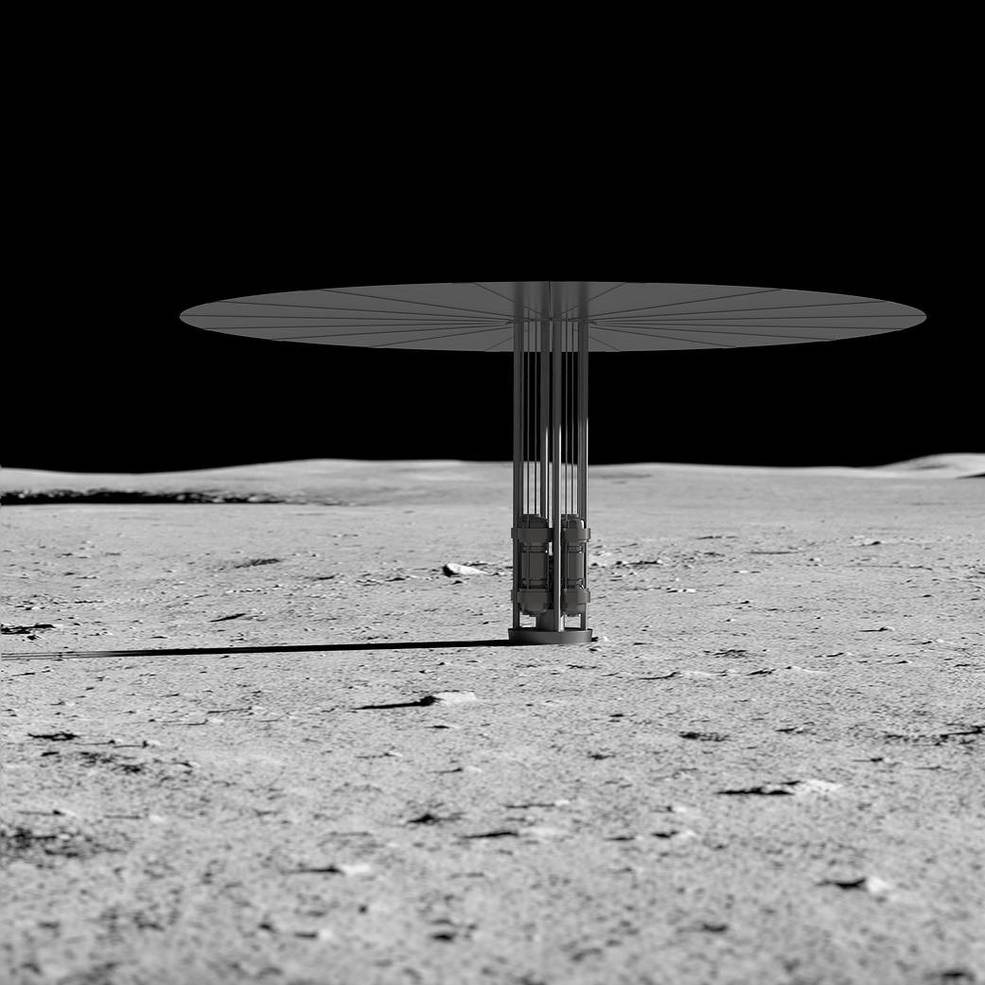
Federal efforts to develop space-based nuclear power systems have been underway for years, but progress has been uneven. In 2020, NASA and the Department of Energy began formally pursuing a lunar fission surface power system, building on earlier Kilopower reactor demonstrations and decades of small-reactor research. As POWER reported at the time, the effort marked the start of a U.S. push to develop a reactor capable of supporting sustained operations on the Moon. More recently, renewed attention to lunar nuclear power—driven by Artemis mission planning, rising power demands, and intensifying global competition in space—has reinforced the role of fission systems as a long-duration, reliable energy source for off-world applications.
On Dec. 18, 2025, notably, the White House issued Executive Order 14369, “Ensuring American Space Superiority,” which directed the federal government to enable “near-term utilization of space nuclear power by deploying nuclear reactors on the Moon and in orbit, including a lunar surface reactor ready for launch by 2030.” The order called for Americans’ return to the Moon by 2028 and the establishment of initial elements of a permanent lunar outpost by 2030, and it explicitly tasked OSTP with coordinating a National Initiative for American Space Nuclear Power—the initiative NSTM-3 now formally launches.
Then in January, NASA and the DOE announced a renewed commitment to jointly develop, fuel, authorize, and ready a fission surface power system for the Moon by 2030 under the Artemis campaign. The two agencies signed a memorandum of understanding (MOU) committing to the deployment of nuclear reactors on the Moon and in orbit. Secretary of Energy Chris Wright compared the January MOU to the Manhattan Project and the Apollo program, and called the reactor goal “one of the greatest technical achievements in the history of nuclear energy and space exploration.”
On March 24, NASA held its “Ignition” initiative event and released a sweeping set of agencywide programs to implement the National Space Policy. According to its Ignition fact sheet, the agency is pursuing a three‑phase Moon Base architecture in which nuclear power plays an escalating role—from radioisotope heater units and thermoelectric generators on early Commercial Lunar Payload Services (CLPS) robotic missions to fission surface power systems as human habitation demands continuous electricity through the 14‑day lunar night. The event also confirmed NASA’s plan to fly Space Reactor‑1 Freedom to Mars before the end of 2028—the first fission‑powered interplanetary spacecraft—to establish flight‑heritage nuclear hardware, set regulatory and launch precedent, and reactivate an industrial supply chain dormant for six decades.
The flurry of activity was capped on April 1, when NASA’s Artemis II mission lifted off from Launch Complex 39B aboard the Space Launch System rocket and Orion spacecraft Integrity, carrying Commander Reid Wiseman, Pilot Victor Glover, Mission Specialist Christina Koch, and CSA astronaut Jeremy Hansen on an approximately 10‑day circumlunar flight that ended in a Pacific splashdown off San Diego on April 10.
Under the updated Artemis plan, NASA released on Feb. 27, that flight is followed by an Artemis III systems test in low Earth orbit in 2027 and an Artemis IV lunar landing in 2028, with at least one surface landing every year thereafter. Missions will ultimately depend on the fission systems outlined in NSTM‑3.
Three Power Classes
NSTM‑3, issued this week, is significant given it effectively outlines a three‑tier reactor strategy covering low‑, mid‑, and high‑power systems that share common technology and industrial base support.
The memo, notably, instructs NASA to prioritize “integrated designs” that can serve both lunar fission surface power (FSP) and nuclear electric propulsion (NEP) applications, using common reactor hardware and nuclear fuel where possible. The memo also highlights the importance of power conversion systems and radiator design—critical elements for space-based reactors, where heat rejection in a vacuum environment is a central engineering constraint.
Mid‑power reactors must provide at least 20 kW of electric power during at least three years in orbit and at least five years on the lunar surface. At least one selected design must be extensible to 100 kWe or more, creating a pathway to high‑power systems suited for future crewed Mars missions.
In addition, it says NASA “should consider” including one low‑power reactor providing at least 1 kWe if that option offers lower cost and schedule risk, while maintaining commonality with mid‑power designs. The agency must downselect to no more than two designs within one year, based on assessments of cost, schedule, and program objectives. It also requires that NEP variants must be compatible with launch vehicles that will be readily available by 2029 and must be designed so that power demands do not drive overall technical, cost, or schedule risk for the demonstration.
For high‑power systems, NASA has been directed to pursue development of a reactor capable of at least 100 kWe that can be ready for launch in the 2030s and will build on preceding NASA and Department of War achievements in space nuclear power. OSTP’s memorandum states that NASA should consider designs optimized for in‑space propulsion that can also be adapted to surface power needs.
U.S. Space Nuclear Reactor Timeline2030 — Lunar Surface Reactor (NASA)
2029 — Launch Compatibility Requirement
2031 — In-Space Reactor (Department of War)
2030s — High-Power Systems (NASA)
|
Effort Led by DOW and NASA
However, the memorandum also expands the Department of War’s role alongside NASA, directing it to field a “mission-enabling” mid-power in-space reactor by 2031 and, within 90 days, brief the White House on operational use cases and payloads for low-, mid-, and high-power systems.
During the first year, DOW must channel its space nuclear funds into NASA’s initial fission power work. Following year two, it is required to run its own competition with at least two vendors, drawing heavily from NASA’s FSP/NEP contractor pool and retaining the right to swap in NASA‑vetted performers if its suppliers miss milestones. The memorandum also calls for shared development of ground infrastructure, including specialized facilities for integration, fueling, and testing, to support both NASA and DOW programs.
The DOE, meanwhile, is tasked with fuel supply, safety analysis and industrial‑base triage, including a 60‑day assessment of whether U.S. industry can build up to four space reactors in five years and authority to tap a federal uranium bank if commercial HALEU falls short, while OSTP has 90 days to deliver a roadmap that clears regulatory and environmental bottlenecks and then report quarterly on the initiative’s progress.
Across the initiative, agencies are directed to use firm fixed-price contracts with payments tied to milestone completion and hardware delivery, allowing vendors to propose interim milestones and emphasizing demonstrated performance over cost-plus development.
—Sonal C. Patel is senior editor at POWER magazine (@sonalcpatel, @POWERmagazine).