
For nearly a century, electric utility business models have been shaped by a simple premise: build infrastructure, earn a regulated return on equity, and grow the rate base. This framework helped finance the expansion of centralized generation, transmission build-out, and distribution systems that underpin today’s grid.
But as electricity demand accelerates, driven by electrification, data centers, and artificial intelligence (AI) infrastructure, that same incentive structure is increasingly misaligned with the needs of modern ratepayers. What once ensured reliability and growth is now prioritizing capital deployment over cost efficiency, leaving customers to bear the financial burden.
COMMENTARY
Today, utilities, their executives, and their shareholders are positioned to benefit from the current dynamic. Under traditional regulation, large capital expenditures, such as new substations, transmission lines, and centralized generation assets, translate directly into rate hikes and thus earnings for investor-owned utilities (IOUs). As grid constraints emerge, the default solution often remains infrastructure expansion, even when distributed alternatives could defer or avoid those investments.
Increasingly, rooftop solar and behind-the-meter (BTM) storage are challenging this model by reducing demand for utility-supplied electricity and avoiding capital-intensive upgrades. The result is predictable: many utilities have been slow to embrace distributed energy resources (DERs) and, in some cases, have reshaped rate structures and compensation mechanisms to limit their growth. This is not simply resistance to change. It is a rational response to incentive structures that favor building infrastructure over technology advancement and energy optimization and efficiency.
The costs of this misalignment are not distributed evenly. Customers with the least flexibility, for example low-income households, renters, and small businesses, are the most exposed to rising rates driven by grid constraints and infrastructure spending. Unlike wealthier customers, they often lack the means to install rooftop solar, add battery storage, or shift consumption patterns. While community solar can offer an alternative, access to rooftop solar still depends heavily on homeownership, creditworthiness, and roof suitability. Without intentional policy and program design, the transition to a more distributed grid risks deepening existing inequities and creating a system where those who can afford to opt out do so, while others are left to absorb increasing costs.
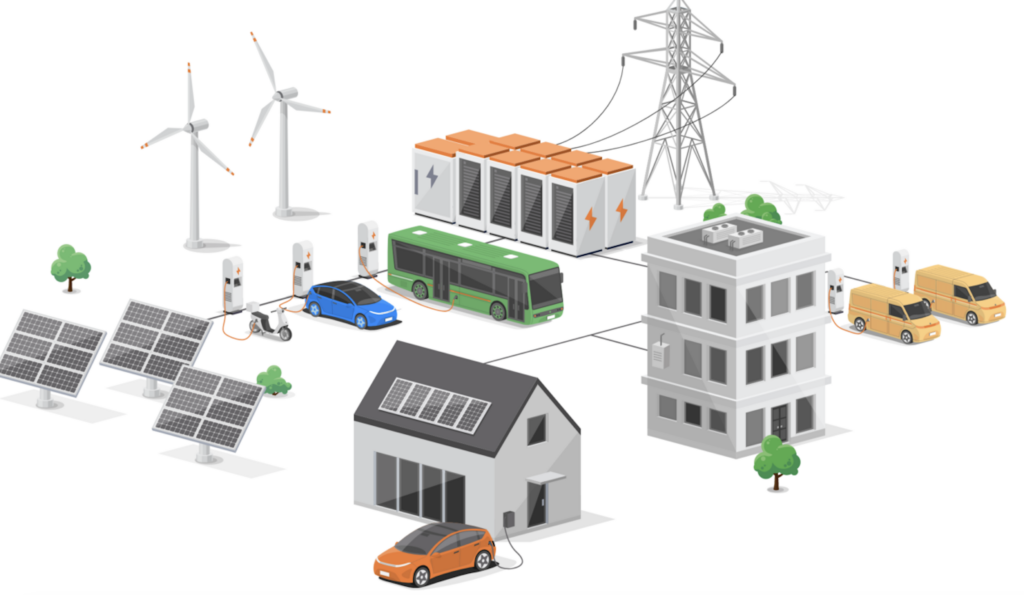
Yet this trajectory is not inevitable. A different model is emerging, one in which utility incentives are aligned with ratepayer needs, rather than shareholder gains. Distributed solar and storage are already demonstrating their ability to act as grid resources, reducing peak demand, deferring infrastructure upgrades, and improving resilience in targeted areas. This aggregated model provides broad benefit for all ratepayers versus for the individual DER owners. This means that the rapid deployment of BTM DERs offers a complementary pathway to traditional capacity expansion. While they don’t replace centralized generation, BTM assets handle a greater share of peak demand and capacity constraints, shifting the utility’s role toward system balancing and reliability. In this business model, utilities evolve from builders of infrastructure to orchestrators of a more dynamic, distributed energy system.
This shift is becoming increasingly urgent in the age of AI and data centers, which are driving unprecedented load growth. While distributed solar-plus-storage alone cannot meet around-the-clock energy demands of hyperscalers, it can play a critical role in supporting the surrounding grid by reducing peak loads, improving resilience, and increasing overall system flexibility. As power availability becomes a key constraint for economic development, the ability to deploy fast, flexible, and modular power capacity is essential. Distributed energy, including solar, storage, and demand flexibility, is uniquely positioned to fill the power capacity gap if the utility business model is regulated to value it appropriately.
Realigning utility incentives with these new realities will require deliberate policy and regulatory changes. First, distributed energy must be treated as a core capacity resource, not a peripheral or customer-driven anomaly. This means integrating DERs into utility planning, improving visibility at the feeder level, enhancing forecasting capabilities, and deploying DER strategies to reduce local constraints.
Second, rate structures and compensation mechanisms must be redesigned to reflect the system value of DERs, rather than undermining their economics. Third, policies that incentivize or reward utilities for reducing system costs, improving reliability, and enabling customer participation need to shift the business focus from capital investment to be outcome and performance-based.
At the same time, the grid needs modernization of its planning and operational frameworks. Traditional load forecasting models, built for a one-directional grid that predict gross demand, are no longer sufficient in a world of BTM generation, energy-shifting batteries, smart devices that support flexible demand, and electric vehicles (EVs). More granular, dynamic forecasting approaches are needed to accurately assess net load and identify where distributed resources can provide the greatest benefit. Finally, expanding access to distributed energy through community solar, shared storage, and inclusive program design will be critical to ensuring that the benefits of the energy transition are broadly shared.
This path forward does not diminish the role of utilities; it simply redefines it. In fact, utilities become more important, but in a different way. This new business model requires utilities to think less like centralized commodity sellers and more like network operators and coordinators. Their job would be managing a complex energy ecosystem, where customer-sited assets, such as solar, batteries, EVs, and flexible demand, all play a role in keeping the grid reliable and affordable.
There are already utilities forging ahead with this new path. In New York, Con Edison’s Brooklyn-Queens Demand Management program leveraged DERs to reduce local load and defer a major substation investment. Hawaiian Electric has used customer battery programs to help support grid reliability, especially on islands where capacity constraints are more evident and harder to ignore. In California, there are also programs designed to use customer and aggregated DERs during high-stress periods to reduce blackout risk. And Green Mountain Power in Vermont has done similar work with customer-sited storage to help lower peak demand and reduce system costs. These utilities that are integrating technology and leveraging DERs to their advantage are best positioned to meet rapid energy demand growth.
The question is no longer whether the grid will become more distributed. It is whether utilities will evolve quickly enough and adapt their business models to stay ahead of the fast changing market dynamics.
—Deep Patel is the founder and CEO of Gigawatt Inc., the parent company of Unbound Solar and Real Goods. Unbound Solar has provided DIY solar kits and expert support for over 19 years, serving homeowners, contractors, and professionals. Real Goods, established in 1978, is a legacy brand in the solar industry known for reliable solar and energy storage products.