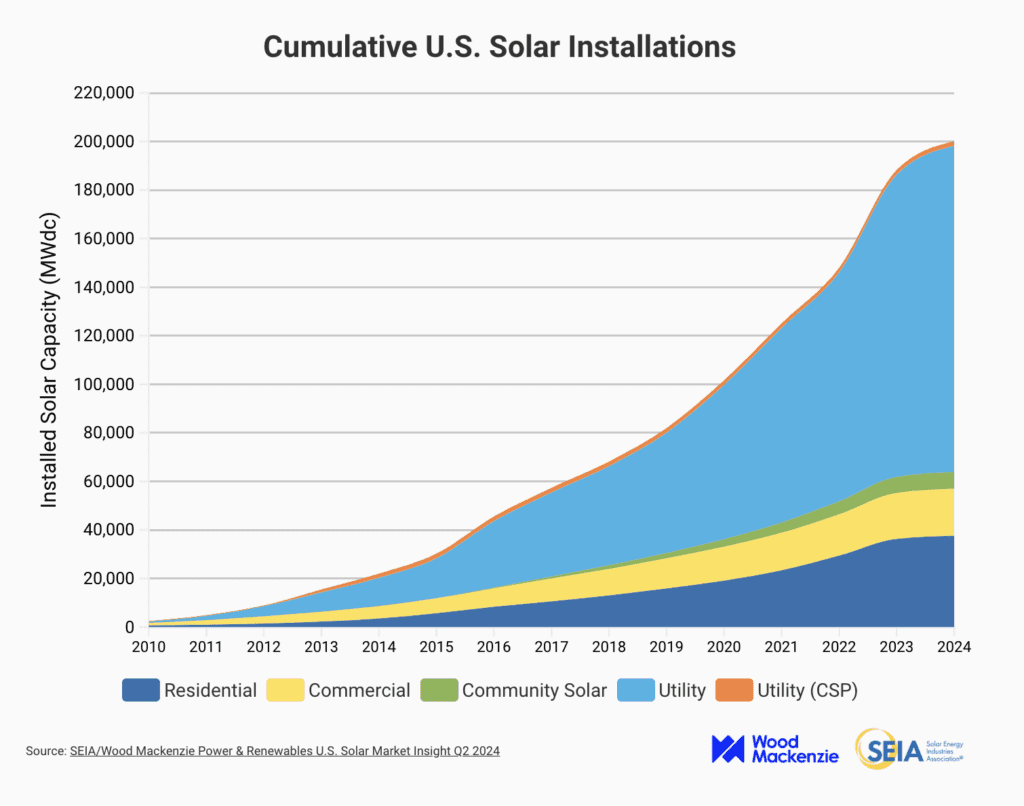
The U.S. solar power industry installed 11.7 GW of new generation in the third quarter of this year, according to a report from Wood Mackenzie and the Solar Energy Industries Association (SEIA). It’s the third-largest quarterly gain on record, and moves total solar installations in 2025 above the 30-GW level.
The groups’ U.S. Solar Market Insight Q4 2025 report released December 9 (read the executive summary here) noted that 73% of all new solar capacity installed in the U.S. has been added in so-called “red states,” those won by Donald Trump in the 2024 presidential election. That’s notable because the Trump administration has supported fossil fuels, and taken actions to limit renewable energy, since starting his second term in January.
The report said that 85% of all new power generation capacity from January through September of this year was solar power and energy storage.
The SEIA/WoodMac said the top states for new solar installations include Texas, the nation’s leader in renewable energy capacity. Others on the list are Indiana, Florida, Arizona, Ohio, Utah, Kentucky, and Arkansas. Utah enters the list after bringing two utility-scale solar projects online totaling more than 1 GW of capacity. The other two states in the top 10 for new installations are California and Illinois.
A memo from the U.S. Dept. of the Interior (DOI) in July, along with several other actions by the Trump administration, have impeding utility-scale solar and storage projects, according to the report. The groups cited “significant business uncertainty” due to “the absence of clarity from DOI on permitting timelines or project approvals.” SEIA in November released an analysis of Energy Information Administration data that showed more than 73 GW of solar projects have permits pending, and are vulnerable to what it called politically-motivated delays or cancellations.
“This record-setting quarter for solar deployment shows that the market is continuing to turn to solar to meet rising demand,” said SEIA president and CEO Abigail Ross Hopper, who has announced she will step down from her post in January of next year. “Remarkable growth in Texas, Indiana, Utah, and other states won by President Trump shows just how decisively the market is moving toward solar. But unless this administration reverses course, the future of clean, affordable, and reliable solar and storage will be frozen by uncertainty and Americans will continue to see their energy bills go up. America’s manufacturing surge, our global competitiveness, and billions of dollars in private investment are on the line.”
The groups on Tuesday said that with the opening of two new solar module manufacturing facilities in Louisiana and South Carolina, totaling 4.7 GW of production, the U.S. has now added 17.7 GW of new module manufacturing capacity this year. The recent opening of a new wafer facility in Michigan means that domestic manufacturers can now produce every major component of the solar module supply chain.
“We expect 250 gigawatts of solar to be installed from 2025—2030,” said Michelle Davis, head of solar research at Wood Mackenzie and lead author of the report. “But the U.S. solar industry has more potential. Wood Mackenzie is tracking substantial increases in power demand across the nation. The solar industry would be well-positioned to meet more of this new demand if existing constraints were alleviated, presenting upside to our forecast.”
—Darrell Proctor is a senior editor for POWER.