
POWER
-
 O&M
O&MPut a lid on rising chemical costs
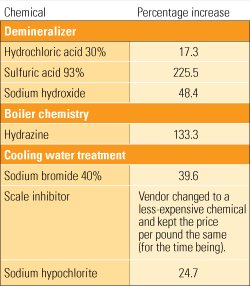
News reports tell us that rapidly growing economies, such as China’s, are importing more oil and raw materials each year, thereby pushing up commodity prices on the world market. One of the side effects of rising commodity prices is considerable increases in the cost of water treatment chemicals. Don’t be tempted to skimp on chemicals to save a buck but risk catastrophic damage. In the words of NASA’s former flight director, Gene Kranz: “Failure is not an option.”
-
 O&M
O&MDeaerator degradation: Managing remaining life and component replacement
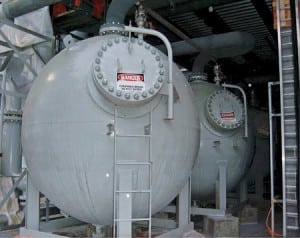
Proper attention to dissolved oxygen levels in feedwater is fundamental for long-term equipment reliability, especially in a combined-cycle plant. When equipment approaches its design life, proper use of new analytic tools and technical expertise can identify impending corrosion and erosion problems and provide you with an estimate of remaining equipment life.
-
 Commentary
For the center to hold
As oil prices soar and power prices threaten to follow, our republic’s mix of diverse cultural and economic interests must cooperate to achieve our common goal of energy self-sufficiency. Those interests seem to fall into one of four main groups—policy, corporate, finance, and technical innovation—each seeking to control the direction of our nation on major […]
-
 Coal
CoalWisconsin Public Service Corp.’s Weston 4 earns POWER’s highest honor
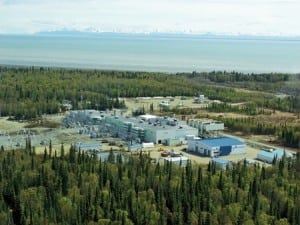
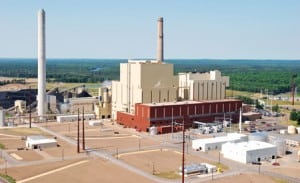
Wisconsin Public Service Corp. placed its world-class Weston 4 into commercial service on June 30 and is now enjoying the benefits of coal-fired supercritical technology’s inherently higher efficiency, operating flexibility, and lower CO2 emissions. For its unequalled environmental protection credentials, well-integrated project team, and employing without a doubt the most advanced coal-fired steam generation technology in the U.S. today, Weston 4 is awarded POWER magazine’s 2008 Plant of the Year award.
-
 Coal
CoalLamar Repowering Project’s creative melding of old and new wins Marmaduke Award
Lamar Light and Power is a municipal utility that has been generating the southeastern Colorado city’s electricity since 1920. Rising natural gas and oil costs pushed LL&P to retire its steam plant five years ago and begin hunting for more economic power sources. The answer: repower the existing plant with a state-of-the-art coal-fired circulating fluidized-bed combustor and cross-connect old and new steam turbines. The $120 million project will stabilize the region’s electricity rates for many years to come and is the winner of POWER’s 2008 Marmaduke Award for excellence in O&M—named for Marmaduke Surfaceblow, the fictional marine engineer/plant troubleshooter par excellence.
-
 O&M
O&MCondensate polishers add operating reliability and flexibility
Many of today’s advanced steam generators favor either an all-volatile treatment or oxygenated treatment chemistry program, both of which require strict maintenance of an ultra-pure boiler feedwater or condensate system. Those requirements are many times at odds with the lower-quality water sources, such as graywater, available for plant makeup and cooling water. Adding a condensate polisher can be a simple, cost-effective solution.
-
 Nuclear
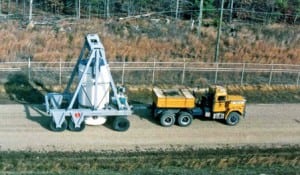
How to solve the used nuclear fuel storage problem
A familiar argument against building new nuclear power plants in the U.S. is that there’s no long-term solution to the used nuclear fuel storage problem. This situation was created in 1977 with the indefinite suspension of programs to reprocess commercial used nuclear fuel. The Global Nuclear Energy Partnership’s announcement in February 2006 that it was reconsidering the reprocessing of used nuclear fuel represented a major shift in policy. It may even open the door to building new U.S. nuclear plants.
-
 O&M
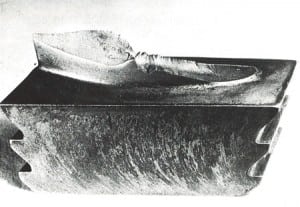
O&MField application of compressor coatings saves big dollars
Over time, turbine compressors and other driven compressors suffer from corrosion, oxidation, and, in many cases, severe fouling, which in turn can cause in-service breakdown and premature overhaul. Today’s innovative protective coatings can be applied on-site to rotors and individual components to replicate the surface finish, corrosion resistance, and antifouling properties of new components.
-
 Coal
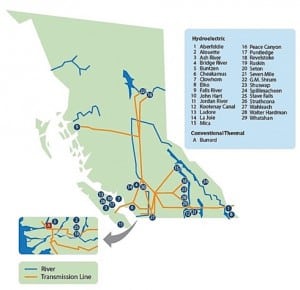
CoalOh Canada! B.C. ratifies North America’s first carbon tax
British Columbia began collecting increased tax revenue on fossil fuels on July 1 with a promise to rebate those taxes through reduced income and business tax rates. This "revenue recycling" plan makes little progress toward the province’s goal to reduce CO2 emissions 33% by 2020, yet it is hailed by proponents as a legislative milestone. Others believe B.C. residents are victims of another governmental "bait and switch" program. Does it matter to the rest of the world?
-
 Marmaduke
Marmaduke straightens a chimney
Steve Elonka began chronicling the exploits of Marmaduke Surfaceblow—a six-foot-four marine engineer with a steel brush mustache and a foghorn voice—in POWER in 1948, when he raised the wooden mast of the SS Asia Sun with the help of two cobras and a case of Sandpaper Gin. Marmy’s simple solutions to seemingly intractable plant problems remain timeless. This Classic Marmaduke story, originally published more than 40 years ago, illustrates that finesse often overcomes brute strength when solving delicate construction problems.
-
 Commentary
The EPA’s blueprint for disaster
Opponents of massive new energy taxes and regulations breathed a small sigh of relief in June when the Lieberman-Warner climate-tax bill went down in flames on the Senate floor. Even 10 Democrats broke with the party and voted against it, writing that they would have opposed the bill on final passage. Unfortunately, power-mad bureaucrats at […]
-

The man with a plan
I haven’t always been a supporter of former President Jimmy Carter’s politics, but I did vote for him, mainly because we shared the Navy experience and he was educated as an engineer. His later opposition to nuclear power surprised many of us in the power business at the time, and I found his suggestion to […]
-
 Nuclear
Global Monitor (August 2008)
Australia considers seabed sequestration legislation / ElectraTherm installs its first commercial waste-heat generator / Mass. researchers achieve dramatic increase in thermoelectric efficiency / Nuclear power option for developing nations gaining steam / The great green wall of China / POWER digest / Correction
-
 O&M
O&MFocus on O&M (August 2008)
Assess your cooling tower’s condition / Proper technique for vertical-up stick welding / Move material with a sonic horn
-
 Legal & Regulatory
Reality bites California GHG plan
The California Air Resources Board (ARB) recently issued its long-awaited draft Climate Change Scoping Plan (Draft Plan) for implementing Assembly Bill (AB) 32, California’s ambitious greenhouse gas (GHG) emissions-reduction initiative. AB 32 requires California to reduce GHG emissions to 1990 levels by 2020—roughly a 30% reduction in projected “business-as-usual” emissions levels or 168 million metric […]
-
 Coal
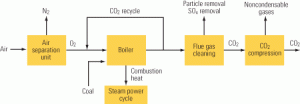
CoalOptions for reducing a coal-fired plant’s carbon footprint, Part II
A conventional coal plant’s CO2 emissions can be reduced either after combustion (see Part I of this article in POWER, June 2008) or before. In the latter case, typified by integrated gasification combined-cycle (IGCC) plants, the fuel used is synthesis gas (syngas), which contains mostly hydrogen (H2) and CO. A water-shift reactor converts the CO […]
-
 Coal
CoalWoods and power company CEOs agree: “The state of the industry is cautious”
It is rare indeed to witness, at an otherwise staid industry forum, the public rebuke of the country’s most prominent supplier to the electric power industry. But at the Keynote session and Power Industry CEO Roundtable of the 2008 ELECTRIC POWER Conference & Exhibition in Baltimore this May, Milton Lee, general manager and CEO of […]
-
 Coal
CoalCarbon Constraint Conference: Dealing with the climate change conundrum
“Once it’s enacted, the impact of climate change legislation on the electric power industry will be ten times bigger than that of the Clean Air Act,” said Dan Adamson, an attorney with the law firm of Davis Wright Tremaine and chair of the opening session at the 2nd Annual Carbon Constraint Conference (Figure 1). 1. […]
-
 Nuclear
A race for winning reactor designs and approvals
A week before the Preakness and two weeks after the Kentucky Derby, it was an atomic horse race in Baltimore. Reactor vendors trotted out their technologies at the ELECTRIC POWER Conference & Exhibition in sessions that filled the nuclear track’s 96-seat room at the Baltimore Convention Center. The reactor makers were also soliciting help from […]
-
 Coal
CoalPRB Coal Users’ Group enjoys growing interest in its concerns
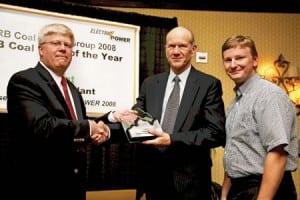
The 2008 Powder River Basin Coal Users’ Group (PRBCUG) set new records for attendance again this year with more than 400 registered members for the three-and-a-half-day event, 268 of whom were from operating companies. The meeting’s Grand Sponsor was Benetech and its Plant Professionals group. The meeting began with the Power Plant Awards Banquet on […]
-
 Water
WaterNew strategies for conquering environmental challenges
No doubt some power plant engineers feel that tackling environmental problems is a lot like dealing with the Hydra, the ancient mythological serpent monster with multiple heads. When an attacker would cut off one of the Hydra’s numerous heads, two new ones would grow back in place of the head that was removed. All too […]
-
 Instrumentation & Controls
Digital technology spawns need for configuration management
Documenting changes to the distributed control system and other digital plant applications should be considered a critical element of managing risk—and of safe, efficient daily operations and maintenance. Coming up with a practical configuration management approach, though, isn’t easy.
-

Not a quarter’s worth of difference
What, if anything, distinguishes the three major presidential candidates on energy and environmental policy? Not much, based on papers posted on their web sites, public comments, and interviews reported on in the nation’s newspapers. Let’s split some hairs on the candidates’ energy and climate change policy positions.
-
 Geothermal
Tapping seafloor volcanic vents
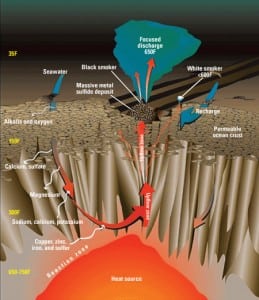
Modern ocean power systems look to convert the mechanical energy of waves or tidal movement to electrical energy. But that’s not all the sea has to offer. It may also be possible to capture and convert the enormous quantities of heat produced by magma escaping through seafloor vents—an undersea version of geothermal energy.
-

It’s all about power
—Dr. Robert Peltier, PE Editor-in-Chief The Lieberman-Warner Climate Security Act (L-W) that proposes to cut carbon emissions by two-thirds by 2050 was delivered stillborn on the Senate floor in early June, as expected. Faced with public outcry over record-high gasoline prices, no senator was able to breathe life back into a bill that is estimated […]
-
 Commentary
Kilowatt-hour tax is fairest approach
By Jim Rogers, Duke Energy Corp. The climate change debate has been dramatized in movies, on Hollywood’s red carpets, and in documentaries featuring melting ice caps. The collective effect is extraordinary, and positive. America now stands ready to address one of its toughest challenges since the industrial revolution—decarbonizing our energy supply and economy. Now the […]
-
 Coal
CoalGlobal Monitor (July 2008)
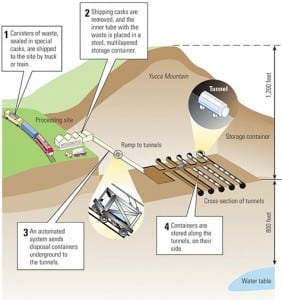
Yucca Mountain plan sent to NRC/ CPV cells get cooling chips from IBM/ StatoilHydro to pilot test first offshore floating wind turbine/ U.S. rivers next massive power source?/ Siemens delivers 500-MW gasifiers/ Algae: A green solution/ POWER digest
-
 O&M
O&MFocus on O&M (July 2008)
Protection against arc flash more important than ever; Laramie River Station uses new coating technology; Protecting power plant pipes: Basics you must know
-
 Legal & Regulatory
Climate change: Policy via litigation?
By Steven F. Greenwald and Jeffrey P. Gray David Crane, the CEO of NRG Energy, was recently quoted in a widely disseminated publication as saying: “It is a moral imperative that we take steps to reduce CO2 concentration in the earth’s atmosphere.” One might expect those reacting to Crane’s comments (made in a February 2007 […]
-
 Business
Generation next: Strategies for recruiting younger workers
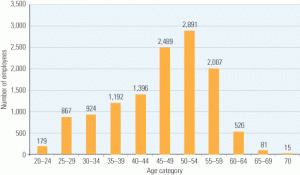
In our April 2008 issue, the article “The aging workforce: Panic is not a strategy” focused on how to reconfigure human resource practices in order to find enough well-trained new personnel to replace the large number of baby boomers who will be retiring in the next few years. This month we profile several utilities that are using innovative approaches to recruit younger technical staff and skilled craft labor to fill positions being vacated in growing numbers by retiring employees.