
POWER
-
Smart Grid
Modernizing the Grid, Modernizing Our Industry
David K. Owens, executive vice president, Business Operations Group for the Edison Electric Institute, comments on the progress U.S. utilities are making toward a smarter electrical power grid.
-
Commentary
Geothermal Projects Race to Meet Incentives Deadlines
At the close of 2009, the U.S. geothermal industry had seen seven new geothermal power plants come online in the previous 12 months. In 2010, only one new power plant was completed.
-
News
Bad Gas Policy
The late Dr. Carl Sagan once observed, “We live in a society exquisitely dependent on science and technology, in which hardly anyone knows anything about science and technology (S&T).†I would add that those who know the least about S&T are often the ones responsible for determining policy and funding priorities. One good example of this problem is the piecemeal approach taken to developing carbon capture and sequestration (CCS) technologies.
-
 Coal
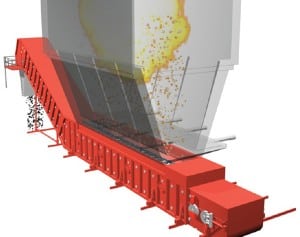
CoalThe Better Environmental Option: Dry Ash Conversion Technology
After the 2008 incident involving the failure of a large surface impoundment containing wet coal ash, the EPA began investigating all coal-fired power plants employing this wet coal ash management method. Now a new dry ash management technology offers coal-fired power plants an environmentally suitable alternative for handling coal ash that also increases energy efficiency.
-
Wind
Charting the Wind: Where the Sector Is Headed
Perhaps the most echoed sentiment at the American Wind Energy Association’s (AWEA’s) WINDPOWER 2011 Conference & Exhibition, which took place May 22 to 25 in Anaheim, Calif., was the call to extend the Production Tax Credit (PTC), the industry’s policy driver, before it expires at the end of 2012. But that wasn’t the only theme. The throngs of companies and organizations that are shaping the rapidly emerging sector around the world had different notions of the factors that help or hinder the growth of wind power, and POWER was there to listen to their perspectives about everything from grid integration, to offshore energy, to technology innovation.
-
 Gas
GasPushing the 60% Efficiency Gas Turbine Barrier
Gas turbine makers GE, Siemens, and Mitsubishi Heavy Industries (MHI) in the last week of May separately profiled unprecedented results from development or testing of three innovative combined-cycle gas turbine (CCGT) technologies.
-
 O&M
O&MTitanium Tubing Still Going Strong After 40 Years
Since 1972, titanium-tubed power plant surface condensers have been providing corrosion-free service. Recent process advances are making the material suitable for even more applications.
-
 Instrumentation & Controls
K-Power Upgrades Combined- Cycle Automatic Generation Controls
Tightly managed grids require combined-cycle plants equipped with power block controls that can quickly respond to automatic generation control signals with minimal error. K-Power’s successful controls upgrade demonstrates that that goal—and more—is achievable.
-
Business
The Urge to Merge
Utility mergers and acquisitions are on the upswing again. When faced with flat load growth, pervasive regulatory uncertainty, and the rising cost of doing business, larger companies are better able to afford expensive new plants while maintaining shareholder dividends.
-
 Instrumentation & Controls
Fully Automating HRSG Feedwater Pumps
Modern distributed control system platforms can provide many tools to capture best operating practices and automate them. This case study shows the steps taken to automate a hypothetical simplified feedwater pump system for a combined-cycle power plant. It describes a combination of controls automation strategies and human-machine interface techniques designed to increase the overall level of automation while improving ease of use.
-
News
Turning Gold into Lead
Despite California’s deep economic wounds, Governor Jerry Brown (D) last month signed a bill (SB 2X) that increased the state’s already ambitious renewables portfolio standard (RPS) goal from 20% to 33% by 2020. Together with the state’s Global Warming Solutions Act of 2006, which requires caps on greenhouse gas emissions starting next year, the new law will push up the price of electricity and further delay the Golden State’s economic recovery by permanently driving away irreplaceable businesses and manufacturing jobs.
-
 Gas
GasThe T-Point Plant: The Ultimate Validation Test
Fourteen years ago, the MHI T-Point demonstration combined-cycle plant in Takasago, Japan, changed the way modern gas turbines are validated under real operating conditions. In February, T-Point marked yet another milestone by starting to validate the world’s largest and highest efficiency gas turbine, which operates at the unprecedented turbine inlet temperature of 1,600C.
-
 Hydro
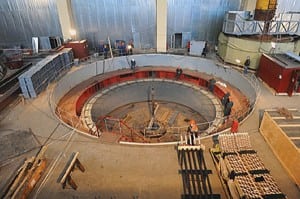
HydroSeven Charged in Siberian Hydropower Plant Accident
The Russian Investigative Committee has completed a probe into the August 2009 accident at the Sayano-Shushenskaya Hydro Power Plant in Siberia that killed 75 people. The committee has charged seven people—including the plant’s former head, Nikolai Nevolko, his deputies, and the plant’s former chief engineer, Andrei Mitrofanov—for violating safety rules. If found guilty, the officials could face five years in jail.
-
 Gas
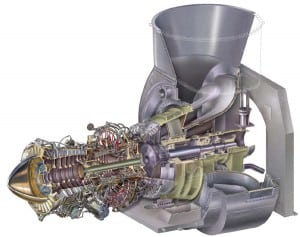
GasSelecting Your Next Combustion Turbine
With natural gas serving as the fuel de jour, many utilities and merchant generators will be considering the purchase of new combustion turbines in the near future. If you are in the market for a gas turbine, here are some key design features you should discuss with turbine vendors prior to your next purchase.
-
 Nuclear
Recovery Efforts Continue at Fukushima Daiichi
In April, Japan’s Nuclear and Industrial Safety Agency provisionally raised the accident rating for three reactors at the crippled six-unit Daiichi nuclear plant in Fukushima Prefecture to Level 7—making it a “major accident” and putting it on par with the 1986 Chernobyl accident in the Ukraine. Recovery efforts continue at the nuclear plant with workers […]
-
 Business
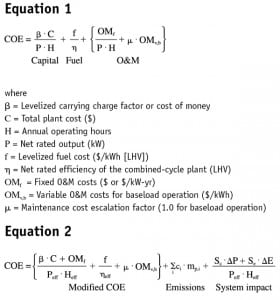
A More Accurate Way to Calculate the Cost of Electricity
Life-cycle cost of ownership is a common metric used to compare power plant system alternatives. However, the familiar formula for calculating the cost of generating electricity omits factors that are becoming increasingly important to business decisions. A new formula addresses those blind spots by estimating the value of the part-load performance of cycling combined-cycle plants.
-
 Nuclear
Germany Considers Accelerated Nuclear Exit on Fukushima Worries
In the wake of the devastating nuclear crisis afflicting the Fukushima Daiichi nuclear plant in Japan, Germany has embarked on an abrupt shift away from nuclear power, shutting down eight reactors for safety checks and ditching concerted efforts to keep nuclear power plants open in the long term. In mid-April, Chancellor Angela Merkel told reporters that leaders of Germany’s 16 states all want to “exit nuclear energy as soon as possible and make the switch to supplying via renewable energy.” The policy reversal has incited ardent opposition from the energy sector and industry.
-
 News
NewsSecurity-Enhancing Distributed Control System
ABB has launched its Symphony Plus distributed control system (DCS), a product the Zurich-based company says will improve power plant productivity and energy efficiency as well as enhance operational security and plant safety. Symphony Plus meets a broad spectrum of plant configurations and applications, and it is flexible and scalable, designed to serve the needs […]
-
Solar
Countries Abandon Subsidies for Renewables en Masse
Stricken by the economic crisis and forced to implement austerity measures, several countries around the world have been forced to abandon or slash subsidies for renewable power producers.
-
 News
NewsPortable Emission Analyzer
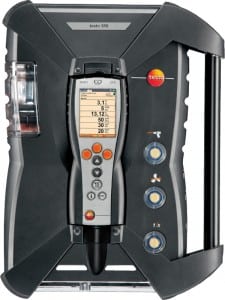
Testo’s 350 portable emission analyzer is a complete redesign of the company’s existing emission analyzer for measuring nitrogen oxide, nitrogen dioxide, sulfur dioxide, carbon monoxide, and oxygen. Improvements include a high-definition color graphic display, new exclusive sensor design, and a new housing, bump protection, and industrial connectors, so it can stand up to any field […]
-
 Water
WaterBattery That Extracts Energy from Water Salinity Difference
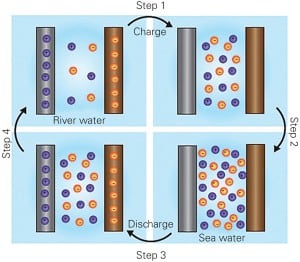
A rechargeable battery developed by researchers from Stanford University employs the difference in salinity between freshwater and saltwater to generate a current.
-
 News
NewsClose-Coupled Pumps
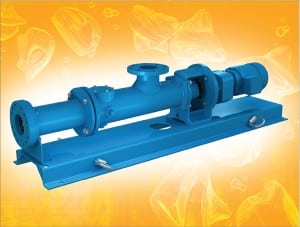
The new Moyno 2000 Model WA and WB pumps provide unmatched performance in a compact, close-coupled configuration. The close-coupled pumps are specifically designed for lower-pressure, lower-flow applications that do not require the full features and benefits of the Moyno 2000 G1 pump. They are ideal for municipal and industrial applications that require the transfer of […]
-
Business
POWER Digest (June 2011)
Italian Firm Wins Contract to Build Massive African Hydropower Plant. Italian construction firm Salini Costruttori said on March 31 it has signed a €3.35 billion contract with Ethiopia state-owned Ethiopia Electric Power Corp. to build a 5,250-MW hydropower plant on the Blue Nile, a tributary of the Nile River. The project, slated to be completed […]
-
 News
NewsDigital Pressure Transducer
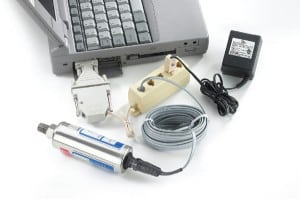
The new Heise DXD digital pressure transducer delivers the unique benefits of digital communication at what the manufacturer says is a bargain price. This instrument is now available with a LabVIEW driver and new LabVIEW-based utility software that allows the user to address, configure, and monitor one or more DXDs. The DXD is offered in […]
-
Business
NERC CIP Update
The North American Electric Reliability Corp. (NERC) Reliability Standards are under constant revision even while new requirements are under active development. Three important regulatory definitions are currently being contested.
-
 News
NewsHermetically Sealed Piezoelectric Accelerometers
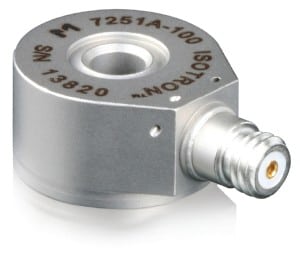
Meggitt Sensing Systems introduced the Endevco model 7251A series, a family of small, lightweight, hermetically sealed piezoelectric accelerometers with integral electronics. The centrally located thru-bolt mounting hole of this series provides both 360-degree cable and connector orientation, allowing the sensor to offer a flat mounting surface, even when not fully perpendicular, for ease of use […]
-
O&M
Air Preheater Uses New Adaptive Brush-Sealing Design
Radial, axial, and circumferential metallic seals installed on rotary, regenerative air preheaters have evolved little from the original metal strip designs that date back to the original Ljungström preheaters developed nearly a century ago. Unfortunately, metallic strip seals degrade soon after installation, allowing excessive air-to-gas leakage, which translates into increased fuel consumption and fan power.
-
 News
NewsFilters for Lower-Pressure Liquid and Gas Applications
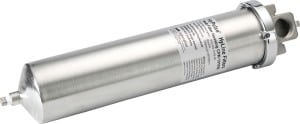
Mott says its new 7710 Series filters are designed to accommodate lower-pressure liquid and gas filtration applications at a value price point. Porous metal elements for this model are 10-inch long, 316L stainless steel cartridges in either a double open ended or 1-inch NPT connection configuration. The 316 stainless steel housing comes standard with a […]
-
Instrumentation & Controls
Twin Pac Controls Upgraded
In November 2008, a central Texas utility commissioned HPI, a full-service turbomachinery design and construction firm based in Houston, to perform a major upgrade of its plant’s power distribution and turbine control systems.
-
Commentary
U.S. Nuclear Operations in a Post-Fukushima World
Perhaps more than for any other industry, a nuclear accident in any part of the world affects nuclear operations elsewhere. Such an incident necessarily and inevitably results in industry self-examination, heightened regulatory oversight, and third-party scrutiny.