
POWER
-
Commentary
While Congress Bickers, Solar Industry Holds Its Breath
Energy is the most regulated sector of the American economy, making public-private partnerships essential to scaling the solar industry. Such partnerships have helped other energy sectors to reach scale over the past hundred years.
-
 Coal
CoalSpain Makes Headway in CCS Efforts
A 14-MW pilot plant built by energy firm ELCOGAS at its 335-MW integrated gasification combined-cycle (IGCC) facility at Puertollano in Spain in September captured its first metric ton of carbon dioxide. Now the company plans to begin tests to procure more technical and economic information about carbon capture and storage (CCS), including how efficient it is to co-produce hydrogen and power with carbon capture processes.
-
 Waste to Energy
Top Plant: Kaukaan Voima Oy Biomass-Fired Power Plant, Lappeenranta, Finland
Located in the heavily forested country of Finland, the Kaukaan Voima biomass-fueled power plant produces process steam and electricity for UPM’s Kaukas pulp and paper mill as well as electricity and district heating for Lappeenrannan Energia, a city-owned power company. Launched in 2009, the plant can provide 125 MW of electricity, 110 MWth of district heat, and 150 MWth of process steam thanks to one of the world’s largest wood-fired fluidized bed boilers.
-
 Gas
GasTurkey Opens Record-Breaking Combustion Gas Engine Plant
Turkey, a country that has seen rapid economic growth since the 1980s, largely spurred by a shift in governmental strategy to open up markets and increase private participation, has been actively overhauling its power infrastructure to meet soaring electricity consumption. According to grid operator Turkish Electricity Transmission Co., national consumption increased to 17 billion kWh this September—an 11% increase over the 15.3 billion kWh consumed in September 2009.
-
 Wind
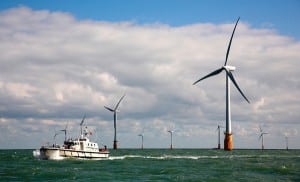
WindTop Plant: Thanet Offshore Wind Farm, Isle of Thanet, UK
In September, the 300-MW Thanet Offshore Wind Farm, the world’s largest offshore wind energy facility, began operation off the southeastern coast of England. The wind farm has 100 3-MW turbines manufactured by Vestas. The facility will generate electricity equivalent to the annual consumption of more than 200,000 British households.
-
 Solar
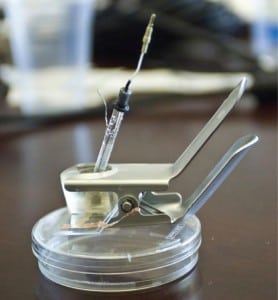
SolarMIT Researchers Invent Self-Renewing PV Technology
Scientists at the Massachusetts Institute of Technology (MIT) have a created a set of self-assembling molecules that can turn sunlight into power, and which can repeatedly be broken down and reassembled by adding or removing solution. The scientific breakthrough—inspired by a natural process used by plants to renew light-capturing molecules that have been degraded by the sun—could mean that researchers are closer to creating a self-healing photovoltaic (PV) technology that can keep repairing itself to avoid loss in performance.
-
 Solar
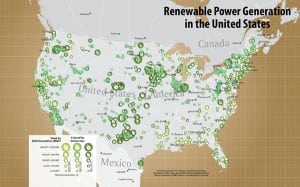
SolarMap of Renewable Power Generation in the United States
For a full-size map, contact Platts. Courtesy: Platts Data source: POWERmap All rights reserved. No reproduction allowed.
-
 Gas
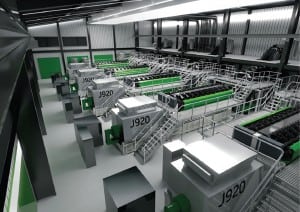
GasGE Launches 9.5-MW Engine for Distributed Generation
A 9.5-MW gas engine unveiled by GE this October for decentralized, independent power producers in remote, hot, or high-altitude regions features a 48.7% electrical efficiency and promises to reduce lifecycle costs by lowering fuel consumption.
-
 Hydro
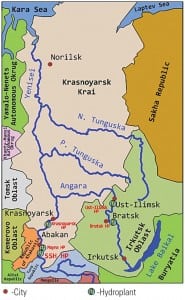
HydroInvestigating the Sayano-Shushenskaya Hydro Power Plant Disaster
The destruction of the turbines and auxiliary equipment at Russia’s Sayano-Shushenskaya Hydro Power Plant in August 2009 claimed the lives of 75 workers and wrecked an indispensable source of electricity that will take years to fully restore. The disaster, as this report explains, was predictable and preventable.
-
 Hydro
HydroUK Cancels Tidal Barrage Plans, Approves Key Nuclear Sites
The UK government in late October shelved plans to build the Severn barrage—a project that would have involved building a 10-mile dam across the mouth of the Severn River—after a two-year-long feasibility study failed to convince ministers to use public funds to build it. The Department of Energy and Climate Change instead gave its long-awaited approval to eight sites for new nuclear reactors, saying that private companies could begin building the country’s new fleet of reactors, provided no public subsidy is involved.
-
 Wind
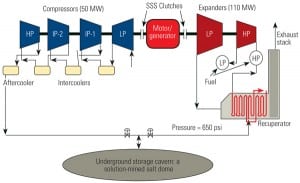
WindCould CAES Answer Wind Reliability Concerns?
As wind and solar energy capacity in the U.S. continues to grow, compressed air energy storage (CAES) and other bulk energy storage technologies will increasingly be used to help balance electrical supply and demand.
-
Hydro
Massive Energy Storage Facility Planned for Mexico-U.S. Border
Dubai-based energy firm Rubenius in October proposed to build a $4 billion energy storage facility based on sodium sulfur (NaS) technology on a 345-acre site in the Mexican state of Baja California, close to the U.S. border. If it comes to fruition, the facility—dubbed a “mega region energy warehouse” by Mexico’s President Felipe Calderon—will feature 1,000 MW of battery storage and offer “storage space” to energy companies and utilities in both Mexico and the U.S.
-
 Wind
WindNew Design Tool Improves Manufacture of Composite Wind Turbine Blades
Composite materials are ideal for producing wind turbine blades because of their strength, light weight, and ability to be tailored to provide the precise mechanical properties needed for any blade design. Now, best practices originally developed for rotorcraft blade manufacturing can be applied to designing and manufacturing wind turbine blades that are constructed from composites.
-
 Nuclear
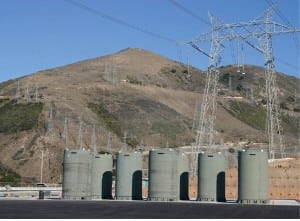
NRC Confident in Long-Term Dry Cask Storage
The U.S. Nuclear Regulatory Commission (NRC) approved an updated “waste confidence” rule in mid-September that reflects the agency’s confidence that spent nuclear fuel (SNF) can be safely stored for at least 60 years beyond the closing date of any U.S. nuclear plant. Approval of this rule was required before the NRC can license any new reactors that will be required to store SNF on site indefinitely.
-
Commentary
Biomass Power Under Attack
Biomass energy has been an up-and-down industry for decades. As public awareness grows, it inevitably influences new tax legislation and environmental regulations. Two recent events have made the climate for development of this renewable resource even more volatile.
-
Nuclear
EPRI Updates Spent Nuclear Fuel Storage Handbook
EPRI recently issued a handbook on nuclear spent fuel storage that examines regulatory trends affecting used fuel storage, describes available dry storage technologies, reviews planning considerations for spent fuel storage installations, and discusses technical issues affecting dry storage.
-
 News
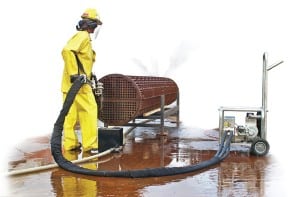
NewsSemi-Automated Tube Bundle Cleaner
Part of a family of automated and semi-automated tube-cleaning accessories, the new Saflex 2000 makes tube bundle cleaning more productive because it can clean four times as many tubes in a given period as manual water jetting, says NLB Corp. Operating at pressures up to 40,000 psi, the semi-automated accessory cleans two tubes (ranging from […]
-
 O&M
O&MCSB Releases Hot Work Safety Notice
The Chemical Safety Board (CSB)—an independent federal agency charged with investigating serious chemical accidents such as equipment failure, as well as inadequacies in regulations, industry standards, and safety management systems—recently released multiple reports that should be made part of every power plant’s safety training program.
-
 News
NewsNo-Glass ORP Sensors
Engineers and technicians searching for a high-performance oxidation-reduction potential (ORP) sensing solution will find that the S10 and S17 ORP Sensors from Electro-Chemical Devices (ECD) feature a no-glass design with platinum or gold sensor tips to operate safely in a wide range of applications. ECD’s ORP S10 and S17 Sensors come with easily replaceable ORP […]
-
O&M
NFPA Gas Purging Rules Updated
The CSB has made urgent recommendations to the NFPA and the International Code Council to prohibit indoor purging and require companies and installers to purge flammable fuel gases to safe locations outdoors, away from workers and ignition sources.
-
 News
NewsPre-Cleaner for Vulcanized Conveyor Belts
The new QC#1 MT Pre-Cleaner from Martin Engineering is a high-quality cleaning blade for use on vulcanized conveyor belts. It features a special polyurethane blend and tungsten carbide tip to deliver service life two to three times longer than conventional urethane blades, the company claims. Designed to provide excellent cleaning performance without any break-in period, […]
-
 O&M
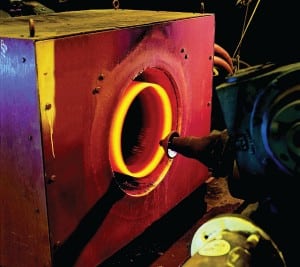
O&MAbrasion-Resistant Pipe Handles Ash Slurry
Steel piping systems are widely used at coal-fired power plants for a variety of purposes, including the conveying of coal ash slurry to nearby settling ponds, the transfer of limestone slurry to absorber spray towers for removal of SO2 and dilute hydrochloric acid from flue gases, and for transporting away the calcium sulfate by-product of the flue gas desulfurization process.
-
News
Correction (November 2010)
Correction In the September issue’s “Taming Condenser Tube Leaks, Part I,” the first full paragraph in the main text on page 57 should say, “If chloride and sulfate in the steam cannot be maintained below 8 ppb….” POWER regrets the error.
-
 O&M
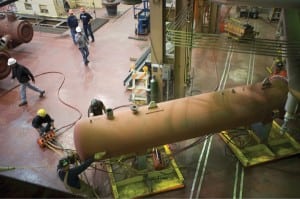
O&MAir Casters Speed Equipment Moves
When it comes to moving megaton items like feedwater heaters or recirculating pumps, conventional moving tools such as wheel rollers, cranes, hoists, and come-alongs may be virtually useless. In some cases, moving large components is dangerous in a space-constrained location surrounded by delicate process control equipment. Feedwater heater and recirculating pump removal and replacement are […]
-
Solar
The Global Smart Grid Scene
Presenters at the inaugural GridWise Global Forum in Washington, D.C., September 21 to 23 had a lot to say about the prospects for smarter grids. This synopsis of facts and opinions shared at the event, which attracted several smart grid A-listers, looks at the major challenges ahead, especially for the U.S.
-
Legal & Regulatory
EPA’s Mercury Rule: Another Incarnation Coming
Much like the shape-shifting substance it regulates, the mercurial enforcement rule that governs mercury emissions from coal-fired power plants has changed unpredictably several times in recent years.
-
 Distributed Energy
Matching Load and Generation at UCSD
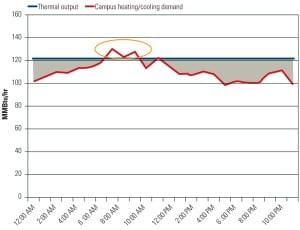
“Smart Power Generation at UCSD” explains how the University of California, San Diego (UCSD) is maximizing the value of combined heat and power. However, like any other grid-controlling entity large or small, the campus has to match generation and load. Its two Solar Turbines gas turbines operate in baseload mode 24/7 while the cogeneration side of the plant maximizes the value of “waste” heat and electricity that isn’t needed to serve immediate load by generating steam and chilled water for campus heating and cooling.
-
 Nuclear
Collaborative Team Investigates Long-Term Nuclear Operations
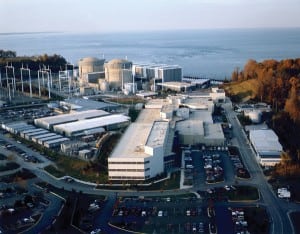
The Atomic Energy Act originally established the length of a U.S. commercial nuclear reactor license as 40 years and made it renewable for another 20 years. The U.S. Nuclear Regulatory Commission has stated that it bases the length of these licenses (and the 50+ renewed licenses granted to date) not on any particular technical limitation but on whether the plant meets current safety requirements. Does this mean there could be reactor life after 60?
-
Smart Grid
Combined Heat and Power Across the U.S.
The University of California, San Diego (see “Smart Power Generation at UCSD”) is just one of many combined heat and power (CHP), or cogeneration, systems in the U.S. A 2008 report by Oak Ridge National Laboratory (ORNL), “Combined Heat and Power: Effective Energy Solutions for a Sustainable Future,” notes that Texas has the most CHP capacity—much of it used by the petrochemical and petroleum refining industries. California ranks second, largely a result of “industrial demands, stringent air quality requirements, and effective policies that encourage adoption of CHP.”
-
News
Follow the Leader
Another year has passed and the promised U.S. nuclear renaissance is still in the Dark Ages. Blame for slow progress is usually cast on the pedestrian pace of finalizing loan guarantees, the economy and slow load growth, or the rising cost of construction. The excuses end when competition increases. Two years have elapsed since the […]