
POWER
-
 Coal
CoalAbundant Clean Energy Fuels Brazil’s Growth
Brazil’s power industry has long been dominated by its vast hydro resources, which historically have accounted for over 80% of the country’s generation capacity. With engineering marvels like the massive Itaipú dam and the proposed Belo Monte project, the country is a leader in the development and use of hydroelectricity on a grand scale. But as the 2001 energy crisis proved, dependence on a single source leaves the country vulnerable to severe shortages. Thanks to government programs designed to take advantage of the country’s favorable climate, Brazil is committed to diversifying its energy mix while continuing to maintain a renewable energy focus.
-
 Wind
WindEuropean Firms Complete Wind-to-Hydrogen Power Plant
A consortium of European developers, with funding from the German federal government, have completed a power plant in Prenzlau, near Berlin, Germany, that uses excess wind energy to convert water into oxygen and hydrogen in a process called hydrolysis, and then uses hydrogen and biogas to generate power and heat.
-
 Coal
CoalColstrip’s Cure for Mercury
In January 2012 a new mercury control system at the Colstrip power plant in Montana reached its first major milestone: two years of operation with mercury emissions below the state regulatory limit. The plant uses Alstom’s unique Mer-Cure technology to capture up to 90% of the mercury leaving the stack.
-
 News
NewsCost-Cutting Nanoparticle Electrode for Batteries
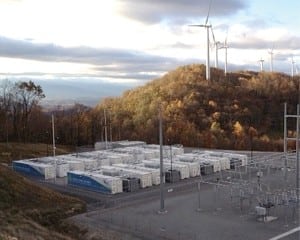
Using nanoparticles of a copper compound to develop an inexpensive and durable high-powered battery electrode could be the breakthrough solution to the problem of sharp drop-offs in the output of wind and solar systems, scientists at Stanford University say.
-
 O&M
O&MCondenser Backpressure High? Check Vacuum System Sizing
In a power plant, the primary use of vacuum systems is to remove air and other noncondensable gases from the shell side of the condenser in order to maintain design heat transfer and thus design vacuum. If holding condenser vacuum is a persistent problem, one often-overlooked cause is an inadequately sized vacuum system.
-
 Wind
WindNovel Floating Wind Turbine Deployed in the Atlantic
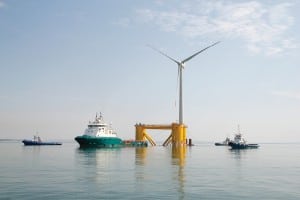
A semi-submersible structure supporting a 2-MW wind turbine was towed nearly 350 kilometers (217.5 miles) to water depths of about 35 meters (114.8 feet) into open Atlantic waters and deployed off the coast of Aguçadoura, Portugal, last November.
-
 O&M
O&MAvoiding Flow-Induced Sympathetic Vibration in Control Valves
Compressible fluid flow through control valves will inevitably cause some form of flow-induced vibration in the fluid system. Identifying the type and cause of the vibration requires detective work. Determining the design changes required in the valve and fluid system to prevent the vibration from occurring requires advanced analytical techniques.
-
 Coal
CoalOne Step Forward, Two Steps Back for CCS Projects
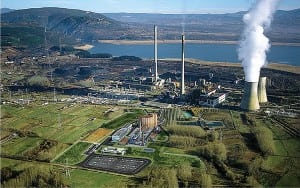
Last December, as Spain’s national carbon capture and storage (CCS) research laboratory Fundación Ciudad de la Energía (CIUDEN) began a much-watched testing phase of oxycombustion in its 30-MWth circulating fluidized bed (CFB) boiler in Cubillos del Sil, Vattenfall scrapped the €1.5 billion ($2 billion) Jänschwalde CCS demonstration project that it had planned to build and begin operating by 2015 in the German federal state of Brandenburg.
-
 News
NewsHandheld Fluorometer
Turner Designs has introduced the Opti-Check Handheld Fluorometer for performing system verifications for industrial water process control applications. The Opti-Check is a small, lightweight, highly durable handheld fluorometer that is ideal for quick measurements in the field. Configurable for either PTSA or Fluorescein as well as both dyes, the Opti-Check enables monitoring of either cooling […]
-
 Coal
CoalWorld Energy Outlook Forecasts Great Renewables Growth
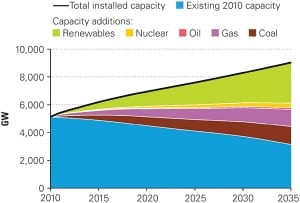
Driven by policies to limit carbon emissions, as well as government subsidies, the share of worldwide nonhydro renewable power is set to grow from just 3% in 2009 to 15% in 2035, the International Energy Agency (IEA) forecasts in its recently released World Energy Outlook 2011. Under the same scenario—which assumes that carbon pricing, explicit […]
-
 O&M
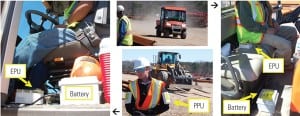
O&MReal-time Proactive Safety in Construction
For each of the past 10 years, nearly 1,200 U.S. construction workers have died as the result of injuries received on the job. Of these fatalities, 25% involved heavy equipment—most categorized as struck-by incidents. Remote sensing and visualization technology promises to improve worker situational awareness on congested and busy work sites.
-
Coal
Australia Levies Landmark Carbon Tax
After more than a decade debating whether to pass a carbon-limiting law, Australia’s Senate in November voted in a landmark bill that will impose a price on carbon emissions. The country, which accounts for just 1.5% of global carbon emissions, but which is the world’s highest emitter per capita because 80% of its power comes […]
-
 News
NewsA Wireless Cellular Controller
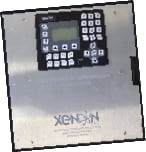
Xenon has introduced the T925 Wireless Cellular Controller for connecting remote sites with central control and monitoring stations through cellular networks. A T925 remote communications network eliminates the need to make hardwired Ethernet connections to the Internet or an intranet at each remote site and the central control and monitoring station. The network operates from […]
-
 Nuclear
NRC to Implement Lessons Learned from Fukushima
The U.S. Nuclear Regulatory Commission (NRC) in October directed staff to begin implementing seven safety recommendations put forth by the federal body’s Near-Term Task Force on lessons learned from the nuclear accident at Tokyo Electric Power Co.’s Daiichi power plant in Japan’s Fukushima prefecture last March. The recommendations affecting all 104 nuclear reactors (Figure 1) […]
-
 News
NewsNonmetallic Pump/Tank Carts Caustics, Acids
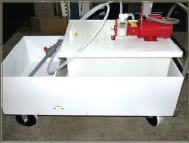
A new nonmetallic Mobile Pump/Tank Cart from Vanton Pump and Equipment Corp. transfers wastewater and caustic/acidic chemicals with no corrosion and ultrapure fluids with no contamination. All fluid contact surfaces of the tank, base plate, and secondary containment chamber are of solid polypropylene, polyethylene, PVC, or other inert thermoplastic, precluding corrosion across the entire pH […]
-
 Gas
GasGE Uses Steel Mill Gases to Power Turbine
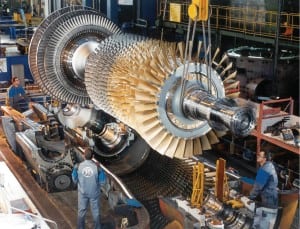
The world’s steel industry is power-hungry. Using energy both to supply heat and power for plant operations and as a raw material for the production of blast furnace coke, the sector uses a major fraction of the world’s total energy consumption. China’s steel and iron sectors have been mushrooming on the back of skyrocketing demand, […]
-
 News
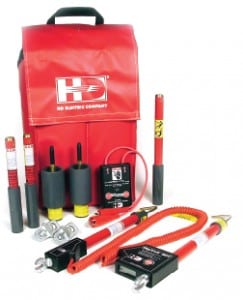
NewsUniversal Voltmeter Kit
HDE’s newly launched DVM-80UVK Universal Voltmeter Kit expands features of the DVM-80 series voltmeter and includes several accessories that enable voltmeter and phasing operations for virtually all overhead and underground applications. HDE is offering the kit as a complete, ready-to-use universal voltmeter package. It includes a dual-stick phasing voltmeter with overhead hook probes for use […]
-
 Business
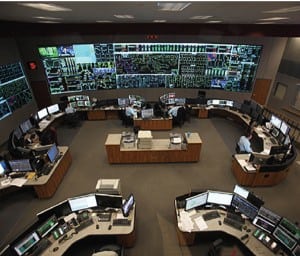
PJM Completes Unique Dual-Primary Control Centers
Swift technology developments in the power sector and increasingly sophisticated security threats have prompted regional transmission organization PJM Interconnection to switch from its aging centrally dispatched legacy system to two “state-of-the-art” primary control centers as part of its $200 million Advanced Control Center (AC2) program. The grid operator that serves parts of the Eastern Interconnection […]
-
 News
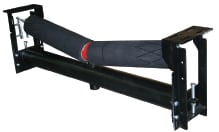
NewsV-Return Style Conveyor Belt Tracking System
ASGCO, a manufacturer of proprietary bulk conveyor components and accessories, announced a new addition to its line of Tru-Trainer conveyor belt tracking idlers: a V-Return style of the company’s Dual Return Tru-Trainer Conveyor Belt Tracker. Tru-Trainer idlers react as the conveyor belt moves off center, maintaining the belt’s original position, minimizing belt wear and conveyor […]
-
Business
POWER Digest (January 2012)
South Korea, China Poised to Make Colossal Investments in Wind Power. South Korea, a nation that recently announced it would spend 1 trillion won ($884 million) on feed-in tariffs for wind and solar projects, on Nov. 10 said it planned to invest 10.2 trillion won ($9 billion) in a 2.5-GW offshore wind farm that could […]
-
 News
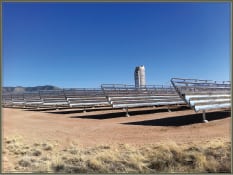
NewsAdvanced PV Tracking System
SunPower has introduced the SunPower C7 Tracker, a solar photovoltaic (PV) tracking system that concentrates the sun’s power seven times to achieve what the company claims could be “the lowest levelized cost of electricity (LCOE) for utility-scale solar power plants available today.” The C7 Tracker combines single-axis tracking technology with rows of parabolic mirrors, reflecting […]
-
 O&M
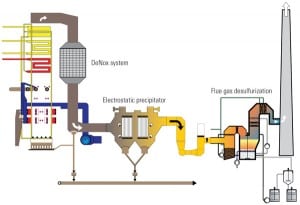
O&MLevel Switches Keep Electrostatic Precipitators Online
Measuring the level of dust and fly ash collected in electrostatic precipitators (ESPs) is a very difficult technical problem. At one utility, level switches were so unreliable that operators could not trust their readings because failures were so frequent. When a switch did fail, the precipitator would often clog up, costing the utility up to $100,000 in downtime and repair costs.
-
 News
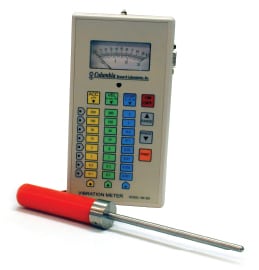
NewsHandheld Vibration Meter
Columbia Research Laboratories has introduced the Model VM-300 vibration meter, a general purpose vibration-measuring instrument designed for periodic routine checks of industrial equipment where portability and ease of use are required. Acceleration, velocity, and displacement measurement modes are provided, along with a number of value-enhancing features. Dual power allows the VM-300 to be powered from […]
-
 Coal
CoalAsian Sub-Bituminous Coal Users’ Group Formed
Over the past 11 years, the Powder River Basin Coal Users’ Group (PRBCUG) has grown to become the voice of North American generating companies that are dedicated to the safe and efficient use of PRB coal. POWER, the group’s media sponsor, has reported on the PRBCUG’s annual meetings, which are colocated with the ELECTRIC POWER Conference & Exhibition each year. POWER also reports annually on the group’s coal plant of the year award. For 2011, in the large plant category the award went to Kansas City Power & Light’s Iatan Unit 2 (see our August 2011 issue); the small plant category winner, Muscatine Power & Water, is profiled in this issue, beginning on page 56.
-
 O&M
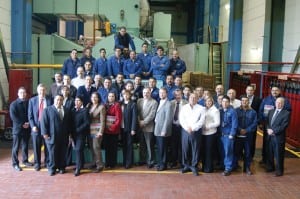
O&MMarmaduke Award Trophy Presented
The 2011 Marmaduke Award winner was CTG Universidad, a two-unit combustion turbine plant built in the early 1970s in Monterrey, Mexico. The award was made to the plant in recognition of its upgrade of one 14-MW unit to operate as a synchronous condenser, thus relaxing power restrictions caused by a lack of sufficient reactive power production in the north of the city. More reactive power production by this urban plant also allows delivery of more power produced by efficient combined cycle plants located outside the city, because it reduces the amount of reactive power that must be moved over transmission lines.
-
News
Condenser Life Cycle Seminar
The November issue of POWER featured a special section titled “Condenser Life Cycle.” That set of four articles covered topics including condenser performance, operation and maintenance (O&M), failure mechanisms, and retubing—topics you will surely find useful at some time in your career. The authors of those four articles work for companies that are part of […]
-
News
Correction
In “Siemens Releases ‘ShapingPower’ Option for Renewables Integration” (December 2011), the Figure 3 callouts for wind and solar were reversed. POWER regrets the error. A corrected version can be found in the online version of the article. â–
-
 Solar
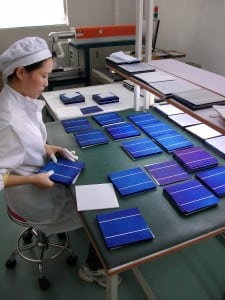
SolarU.S.-China Solar Trade Dispute Gets Thornier
A trade row between the Chinese government and solar panel makers around the world intensified in December. As China’s Ministry of Commerce refuted allegations that the Chinese government uses illegal subsidies, discounts for raw materials, preferential loans, tax incentives, and currency manipulation to drive down prices and amplify exports of Chinese solar photovoltaic (PV) panels, the U.S. International Trade Commission (ITC) affirmed the U.S. solar industry is “materially injured” by imports, at “less than fair value,” of Chinese crystalline silicon PV cells and modules.
-
Legal & Regulatory
Green Technology = Green Jobs?
In discussing implementation by the California Public Utilities Commission (CPUC) of California’s new renewable energy law, CPUC Commissioner Timothy Alan Simon urged consideration of the economic, technical, and political consequences of the CPUC’s actions: “Renewable energy is a fuel source—it’s not a religion.” The promotion of renewable energy remains critical, but as Commissioner Simon admonishes, […]
-
Coal
Editors Select Top Five Stories of 2011
The POWER editorial staff’s picks for the most significant stories of 2011.