Decommissioned or underutilized turbine generators can be retrofitted to produce revenue by providing regional electric grid stability.
This is the fifth article in a POWER magazine series. The first article, Futureproofing Gas Power Plant Investments, discussed various technologies to extend the life of existing facilities. The second article, Autonomous Power Generation – The Future is Now, describes unmanned power plant operation. The third, Maximizing Combined Cycle Plant Operating Flexibility, helps combined cycle plants ramp faster and achieve better turndown to maximize profits. The fourth, Evaluating Combined Cycle Plant Upgrades to Capture Profit Opportunities, discusses techniques that help sites identify projects to increase plant performance and profitability.
This article explores options for converting out-of-service generators into revenue producing grid stability assets that improve power network reliability, even as destabilizing renewable sources enter the market.
What is grid stability?
A power grid is a highly variable and dynamic entity, accepting power from generators and distributing it to users across a vast network. The grid operator has the challenging job of matching incoming power to user demand on a moment-by-moment basis. The grid is constantly subjected to spikes and surges as generators unexpectedly trip offline or large users suddenly add or shed load. There are four key parameters for grid stability:
- Frequency: The system frequency must be maintained within a very narrow band. If frequency falls too low, automatic trips will engage and disconnect loads.
- Voltage: System voltages must also be maintained within a narrow band to provide quality power and avoid damaging under or over voltage. System voltage must also be robust enough to handle instantaneous short circuit events.
- Load: Generally, generated power must match the delivered power across the grid. Transmission lines also have load limits which cannot be exceeded as power is moved across the region.
- Black Start Capability: If grid power is lost, it must be restored in a stepwise, top-down fashion. Generators must have the ability to provide enough power to start and establish grid frequency.
Historically, all these features were incorporated in the large steam driven turbines that were the primary source of power. A large spinning turbine has significant mechanical inertia, which provides inherent frequency stability since the rotating mass will resist any frequency change. Similarly, the spinning generator can instantly provide momentary high short circuit currents to help ride through spikes and dips. In addition, a synchronous generator can be adjusted to provide reactive power compensation to ensure stabilization of grid voltage, and to enable grid restoration after a complete blackout.
A rapidly changing market
Today’s power markets are experiencing a host of changes that threaten grid stability. Large, coal-fired power plants are being taken offline due to their excessive greenhouse gas emissions and they are being replaced with renewable power sources, such as solar and wind. This reduces the inherent grid stability of large, rotating steam turbine generators and often replaces it with grid-following renewable power sources that have no inertia at all. The resulting power supply system has less ability to ride through faults and power system instabilities, such as surges and dips, and it cannot easily restart after a power outage.
Utility scale grid-forming inverters are becoming available and very large battery power storage systems are beginning to come online, but these solutions are expensive and generally take several years to implement. Fortunately, there is another solution that can address this problem in a far shorter timeline and at significantly less capital and operating cost, and it is a proven and reliable technology
Synchronous condensers and rotating grid stabilizers
As mentioned previously, many large coal power plants are being taken out of service to address global warning concerns. These decommissioned sites reduce grid reliability as previously discussed, but they also represent an enormous loss of capital investment, which can have a significant economic impact on the neighboring communities. Fortunately, there is an alternative for these units.
Many large, out-of-service turbine generators can be converted to synchronous condensers, also known as rotating grid stabilizers (RGSes), which allows these units to continue generating revenue by providing regional grid stability. A major advantage of RGS conversions is the ability to re-use a significant proportion of the existing infrastructure, such as the rotating shaft line and high voltage grid connection. This often results in lower costs and implementation lead-time compared to equivalent new build solutions.
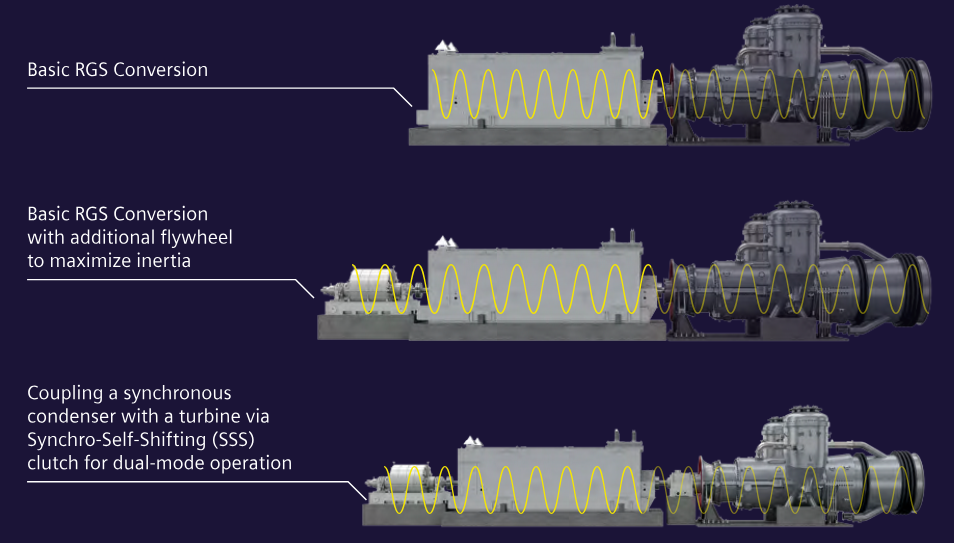
There are three RGS conversion options:
- Basic conversion: The steam turbine is disconnected from the synchronous generator, with the latter reconnected to the grid. The resulting synchronous condenser provides inertia that resists frequency changes and helps the grid ride through voltage surges and spikes. It also can produce or absorb reactive power to better handle major load changes and support voltage stability.
- Flywheel conversion: This option replaces the steam turbine with a large flywheel. The added inertia provides enhanced grid stability by reducing frequency rate of change.
- Hybrid conversion: This upgrade is suited for a peaking plant that needs to generate power at some times and provide grid stability at others. The hybrid option installs a clutch between the turbine and the generator, allowing the unit to operate either in power or grid stability mode. An optional flywheel can be added to further increase system inertia if required.
Detailed specifics of these conversion options can be found here and are shown in Figure 1. The first two options are often utilized for large coal fired plants that are no longer in service. The hybrid option can be a good choice for peaking plants, allowing them to continue producing revenue, even when they are not generating electricity.
Case Studies
RGS conversions have been successfully implemented at multiple sites all over the world. In many cases, the conversions were relatively easy to implement, utilizing existing infrastructure for most of the installation. This saved significant capital, up to 50% compared to purchasing all of the equipment new instead of repurposing some of it, and it allowed the projects to be completed and brought online in short timelines.
- Case Study 1: This project involved a flywheel conversion of two turbine generator sets at the Killingholme Power Station in the UK. The units were decommissioned in 2017 but brought back into operation as part of a nationwide project to improve grid stability. The turbine was replaced with a flywheel in each unit, allowing the site to provide 60% more inertia than it originally provided when in power service. Details of the project can be found here.
- Case Study 2: Australia needed to address grid stability issues as renewable energy sources became a significant provider of nationwide power. The increasing share of renewables was resulting in grid stability and system strength issues due to the inherent variability of solar and wind power. The Townsville Power Station operated as a peaking plant during certain times and dropped offline when not needed. A hybrid RGS conversion installed a new synchronizing clutch between the generator and the gas turbine. This allowed the site to produce power as before, but to also instantly switch to RGS mode to provide rotating grid stability when not in operation as a power producer. Details of this installation can be found here.
Conclusion
RGS conversions can be an excellent solution for power producers that have decommissioned turbogenerator sets operating on grids that suffer from reduced stability. Utilization of existing assets can dramatically reduce the capital installation cost, and many sites can receive operating revenue by providing rotating grid stabilization across the electrical distribution network.
If such a conversion is of interest, consult your Siemens Energy representative to arrange an evaluation of your specific equipment to ensure compatibility. An RGS conversion may be an expedient way to start generating profits from out-of-service or underutilized generator assets.
All Figures courtesy of Siemens Energy