When people talk about innovation in energy storage, the conversation usually starts with batteries: chemistry, capacity, and duration. Those areas are important, but they are not the whole system. As energy storage systems move toward higher voltages, higher power, and more compact designs, the components inside them must also handle more demanding electrical conditions.
This changes how components need to be selected. Meeting a voltage and current rating is only the starting point. Designers must also consider what happens during startup, normal switching, maintenance, and abnormal conditions, as well as how the component will perform after years of operation. Progress in energy storage will depend not only on batteries and power conversion, but also on the components that connect, isolate, and control power throughout the system.
Higher Voltage Brings New Component Challenges
One of the clearest energy storage trends is the move toward higher-voltage and higher-power architectures. At a basic level, increasing voltage allows a system to deliver the same power with less current. This can help reduce conductive losses and the amount of copper required in parts of the system, supporting greater efficiency and more compact equipment.
However, higher voltage also makes component selection more challenging. Insulation, creepage and clearance distances, terminal design, heat dissipation, and DC arc control all become more important. These considerations apply across the electrical path, including busbars, connectors, fuses, switching devices, sensors, and the power conversion system.
In other words, the trend is not simply toward components with higher ratings. The components also need to provide dependable isolation and thermal performance while fitting into equipment that is becoming increasingly space constrained.
Reliable DC Switching Becomes More Important
Energy storage systems need a controlled way to connect and disconnect the batteries from the rest of the power path. This is where high-power relays and contactors can play an important role. Depending on the system architecture, they may be used for main switching, service isolation, or other controlled switching functions.
Not every relay in the system has the same job. Main relays carry the normal operating current and create the primary connection to the battery. A separate pre-charge relay may handle the lower-current startup path, while auxiliary contacts or other feedback can tell the controls whether a switching device has actually changed state. Looking at these functions separately helps designers choose the right device for each task instead of expecting one component to do everything.
DC switching is especially demanding because direct current does not naturally pass through zero every cycle the way alternating current does. When contacts open, the resulting DC arc can therefore be more difficult to extinguish. The contact structure, arc-control method, insulation, terminals, and thermal design all have to work together to achieve reliable switching.
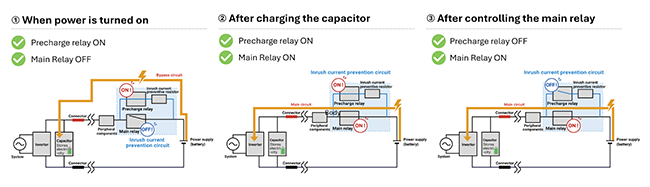
Startup also needs to be managed carefully. Energy storage systems commonly connect to equipment containing DC-link capacitors. If the main switching device closes before those capacitors are charged in a controlled way, the inrush current can place unnecessary stress on contacts and other components. A pre-charge circuit creates a controlled current path before the main connection is completed. A pre-charge relay, used together with a resistor and the system controls, can help limit that initial current and create a more predictable startup sequence.
Selecting a high-power relay also involves more than comparing the largest voltage and current numbers on a datasheet. Designers need to consider the continuous current the relay will carry, the conditions it must actually make or break, how often it will switch, the expected service life, and the temperature inside the enclosure. Coil power, mounting, terminals, control voltage, and available feedback can also affect the surrounding design. A relay that fits the electrical requirement but creates extra heat, wiring, or control complexity may not be the best choice for the complete system.
It is also important to separate switching from overcurrent protection. High-power relays do not replace fuses, circuit breakers, or other dedicated protective devices. They are one part of a coordinated design in which the switching device, protection, control logic, and feedback mechanisms all need to work together.
Compact Does Not Only Mean Physically Smaller
Higher power density is pushing manufacturers to fit more capability into less space. However, a physically smaller component does not automatically create a better or more compact system. If it generates too much heat, requires complicated wiring, or cannot maintain performance across the required operating range, it may create new design challenges elsewhere.
 |
|
1. Typical pre-charge and main-relay switching sequence used to limit inrush current during system startup. Courtesy: Aratas America |
The total design footprint matters. Power consumption, current paths, heat dissipation, terminal arrangements, and feedback functions can all affect enclosure size, cooling needs, assembly time, and long-term reliability. Auxiliary contacts, for example, can confirm switching status to the control system without requiring a completely separate method for that function.
The operating environment must also be considered. Storage systems may operate for years while experiencing repeated charge and discharge cycles, temperature changes, vibration, dust, humidity, and different installation altitudes. Component selection should reflect the real electrical load, switching frequency, ambient conditions, and maintenance strategy, not only an ideal rating on a datasheet.
Safety, Reliability Come from the Complete System
An important point is that no single component makes an energy storage system safe or reliable. These are system-level outcomes. UL 9540, for example, evaluates an energy storage system as a complete assembly and addresses charging, discharging, protection, control, and communication. A component rating or certification can support the design, but it does not prove that the complete system will operate safely.
The most valuable component innovations are therefore the ones that make safe operation easier to design, verify, and maintain. This includes dependable isolation, controlled switching, clear status feedback, manageable thermal performance, and operation suited to the intended environment. Designers also need to define how the components interact during startup, shutdown, maintenance, and fault response rather than evaluating each one by itself.
Component Innovation Will Help Enable Next Generation of ESS
Energy storage systems will continue to increase in capability while becoming more compact and integrated. Reaching those goals will require progress across batteries, power electronics, software, thermal management, and the components that carry and control power between them.
High-power relays and other switching technologies are one part of that progress. They may not be the most visible part of an energy storage system, but they directly affect how the system starts, stops, isolates, and operates over time. As the industry moves toward higher voltage and greater power density, thoughtful component selection and coordination will be essential for building energy storage systems that are safe, reliable, and scalable.
—Javi Tiggelaar is Business Development Associate for the Energy Industry at Aratas Americas.