Small modular reactors (SMRs) are emerging as a potentially critical part of the future power mix. Only a year ago, SMRs were still framed as a promising but distant technology. But that’s all changed as electricity demand accelerates, grids struggle to expand at the pace required, and affordability and reliability move back to the top of the energy agenda.
COMMENTARY
What started the year as a trend to watch now looks like a technology tipping into commercial reality—driven less by climate ambition, and more by advancements in industrial artificial intelligence (AI) and the world’s need for more reliable and affordable energy. But the challenge will be not just how to manage the lifecycle of a nuclear power plant from planning through to implementation, but how to deal with its eventual decommissioning.
SMRs are advanced nuclear fission plants that are a fraction of the size of traditional reactors and come without their enormous capital requirements and lengthy development timelines. They are a clean energy source that can be permitted and built far more quickly than a large-scale nuclear power plant.
The conversation has definitely shifted. It’s no longer a question of whether SMRs could play a role, but about where they fit, how quickly they can be deployed, how and what needs to happen to make them commercially viable at scale, including the use of AI. Indeed, in recent IFS research, SMRs were identified by utilities as the second most popular emerging technology for clean baseload power.
While the technology is still emerging, challenges remain, but at the moment, Industrial AI is helping power the move, reliability is reshaping the energy debate, and SMRs are ticking boxes.
What’s Spurring the SMR Drive? Where Sustainability Meets its Match
The energy transition was never about sustainability alone, though this certainly topped the energy and utilities agenda for some time. But in the current market climate, the priorities are reliability and affordability.
While the public likes the idea of sustainability in the abstract, when it collides with a higher bill or an unreliable supply, priorities quickly shift—and in a comfort-driven society, few people are willing to accept real sacrifice to keep sustainability as the top global priority.
For utilities, businesses, and consumers alike, electricity needs to be reliable and affordable. But with the current electrical grid under severe pressure from growing demand, aging infrastructure and geopolitical uncertainty, those priority shifts are becoming increasingly prominent—and it’s exactly where SMRs are stepping in.
SMR Investment Has Gone Global
Every emerging technology follows a familiar arc. It starts out looking like a moonshot—solar power looked exactly this way 10 or 15 years ago, a nice idea that was simply too expensive to take seriously. Then, early adopters step in, and government funding and public capital arrive which de-risk the technology enough for private investment to follow, adoption climbs, and costs come down.
SMRs are now following a similar trajectory. Global government support and early-stage investment are helping to move SMRs from concept toward commercial reality and the market is becoming increasingly international. For example, the UK’s backing of domestic SMR development, alongside growing interest from governments and energy organizations worldwide, is creating momentum that simply did not exist at the same scale a few years ago. The U.S. now treats SMRs as central to its nuclear and renewable power mix, while the European Commission has built them into its Clean Industrial Deal. Canada is widely viewed as an important market to watch as commercial deployment progresses, while China and Russia continue to invest heavily as their own energy requirements grow.
That’s why companies, such as Rolls-Royce, have pushed ahead with their own commercial SMR designs.
The Promise of SMRs—There’s a Lot to Like
As the name suggests, SMRs are made up of smaller, modular units, that offer the potential for a more flexible approach, particularly where a large-scale nuclear facility would be impractical or excessive for the power requirement.
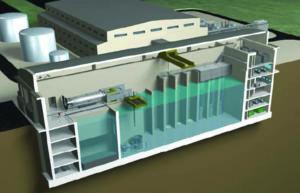
SMRs provide a source of low-carbon power that, unlike renewables, doesn’t rely on the weather for reliable generation. They can be built underground, making them less vulnerable to extreme weather events such as earthquakes, can start up from a completely de-energized state without receiving energy from the grid, and offer great promise for remote regions with less developed infrastructures. This makes them particularly attractive as demand grows from energy-intensive industries and large commercial users.
One of the greatest advantages of SMRs is their potential flexibility. Rather than relying on one enormous generation asset, multiple smaller units could potentially be deployed together to meet the requirements of a large industrial facility, data center or community. The modular design could make it easier to match generation capacity to demand and expand over time, however, it by no means makes the process simple.
SMRs Are Better Together—Demand Barriers Remain
Currently, there are more than 80 SMR designs and concepts globally, and without greater standardization, scaling the technology across borders could become increasingly complex. A collection of SMRs has to function as a coordinated energy system, and it’s where design complexity creeps in.
A collection of SMRs must operate as part of a coordinated energy system. Different manufacturers are in the process of developing various designs, while regulatory requirements can vary by country or region.
A single unit can’t support a data center or major industrial facility on its own, so the model now emerging is a cluster of SMRs operating together as effectively a virtual power plant, aggregated to meet the load of whatever they’re powering.
And barriers go beyond the technology! The challenges are not purely technical. Public confidence in nuclear power with its chequered history of safety, remains a hurdle. Permitting, waste management, supply chains, and site approvals can all add complexity and time to deployment. SMRs may be smaller, but they still operate within the same high-stakes regulatory environment that has historically made nuclear projects complex.
The Real Challenge is Once They’re Switched On—AI Helps Manage the Full Lifecycle
A solution that spans nearly every stage of an SMR’s lifecycle will be essential. Building an SMR is only one part of the equation. The decisions made long before construction begins—around investment, location, capacity and risk—will shape the value and viability of the asset for decades. It’s where Industrial AI can help plan what to invest in, how to size and place it, and building the ROI case as part of a broader asset investment plan. Construction extends into procurement, supply chain coordination, and workforce management for the build itself.
But once they’re switched on, attention will increasingly turn to the technology needed to make them an operational reality. Industrial AI and software must support the development, deployment, and operation by providing unified enterprise asset management, project tracking, and regulatory compliance tools.
Decommissioning is as important as commissioning. Once an SMR is operational, continuous AI-driven monitoring becomes critical—not just for efficiency, but for the public safety assurance regulators and communities demand. And at the end of the asset’s life, that same lifecycle approach carries through to decommissioning and recycling.
From Promise to Power: The Next Chapter for SMRs
The catalysts driving interest in SMRs are becoming increasingly difficult to ignore. Electricity demand is rising, grid infrastructure is struggling to keep pace, and the pressure to balance sustainability with affordability and reliability is intensifying.
What looked a year ago like a promising but distant technology now looks like something closer to commercially viable—with thanks to industrial AI and forward-looking software. Nuclear may increasingly play a role as organizations balance decarbonization ambitions against the immediate need to keep the lights on, but it’s likely the future energy mix will remain diverse because for SMRs, significant challenges still lie ahead.
—Carol Johnston is VP Industries, Energy, Utilities, and Resources at IFS.