Lower-emissions gas sourcing, efficient combined-cycle generation, and carbon capture-ready construction offer hyperscalers a way to meet data center power demands without compromising on emissions.
As hyperscalers race to build the next generation of artificial intelligence (AI) data centers, they face a difficult balancing act. On one hand, they need large quantities of reliable power delivered quickly. And while it is hardly the only concern raised by communities recently about data centers, having dedicated facilities to supply such power, so as not to pass cost through to the communities, appears increasingly important.
On the other hand, many of the hyperscalers have made public commitments to reduce greenhouse gas emissions. This commitment points to using nuclear, advanced geothermal, and emerging low-carbon energy technologies as opposed to fossil fuels. Yet, while these low- and no-carbon solutions may eventually play a major role in supplying AI infrastructure, their meaningful deployment is many years away. Thus, natural gas remains one of the few energy sources that can be deployed at the scale and speed required over the next several years.
This reality is reflected in the announcements for dedicated data center power generation projects, with about 100 GW of natural gas–fired plants versus roughly 10 GW of nuclear and more than 3 GW of geothermal. Hyperscalers’ renewable energy commitments appear to be outpacing these three combined, but this includes grid power and reflects power needs to support legacy infrastructure, muddying the comparison.
The hyperscalers’ challenge, therefore, is how to lower natural gas’ carbon footprint without compromising speed to market and 24/7 operability. One practical pathway combines three elements: procuring lower-emissions natural gas, using power efficient combined-cycle gas generation, and designing facilities today so that carbon capture can be added in the future. Together, these can materially reduce carbon emissions over the lives of the power facilities without slowing deployment.
Buying Lower Methane Gas
The first element addresses fugitive methane emissions throughout the natural gas supply chain. Methane is the primary component of natural gas. It is considered a “super-pollutant” because it has far more warming impact than a comparable amount of carbon dioxide. As a result, even relatively small methane leaks can have a significant impact on the climate footprint of natural gas–fired electricity.

In This Issue
Full issueConsider that a modern combined-cycle gas plant with a heat rate of approximately 6.5 MMBtu per MWh emits roughly 345 kilograms (kg) of carbon dioxide (CO2) per MWh from combustion. To produce that electricity, the plant consumes approximately 125 kilograms of methane. If the gas supply chain leaks 1.5% of the product (Figure 1), approximately 2 kg of methane are emitted for every MWh generated. Using the United Nations’ latest assessment of the global warming potential of methane, those methane emissions contribute roughly 155 kg of CO2-equivalent (CO2e) emissions per MWh. Thus, lifecycle emissions are about 500 kg of CO2e per MWh: 345 kg from combustion and 155 kg from upstream methane leakage.
 |
|
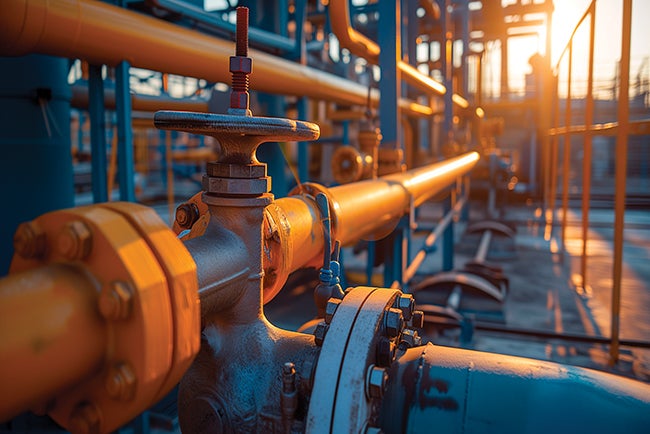
1. Fugitive methane emissions, including from valves, flanges, and fittings, can account for supply-chain losses of more than 1%. Courtesy: Envato / kostinat |
Now consider a lower-emissions gas supply with a leakage rate of just 0.2%, which is attainable today. Methane emissions fall to 20 kg of CO2e. Thus, total plant lifecycle emissions are approximately 365 kg of CO2e per MWh (the 345 kg referenced above + 20 kg), a reduction of more than 25% of total lifecycle emissions relative to using conventionally produced gas. Importantly, this reduction can be achieved without changing the power plant itself and without delaying construction schedules. Thus, lower-emissions gas represents one of the fastest available emissions-reduction opportunities.
It is important to note that systems to measure, assess, and make transparent fugitive methane emissions from natural gas value chains have advanced rapidly. Early efforts to quantify methane emissions relied heavily on engineering estimates and emission factors tied to specific hardware. Today, continuous methane sensing systems, along with periodic aerial surveys and satellite observations, plus refined analytical models and chain-of-custody frameworks allow producers to better quantify and document methane performance across the supply chain. As a result, hyperscalers increasingly can buy lower-emissions gas—and soon may be able to buy just the environmental attributes of the gas (unbundled from the gas itself)—and claim the climate benefit.
Using More Power Efficient Plant Design
The math above assumes new gas-fired generation is built using combined-cycle technology. Combined-cycle plants produce significantly more electricity from each unit of fuel than simple-cycle turbines, reducing both fuel costs and emissions. Because AI data centers are expected to operate continuously and at high utilization rates, combined-cycle facilities are the most economical long-term gas-fired solution, with their higher efficiency more than offsetting their approximately 10% to 30% higher upfront capital cost.
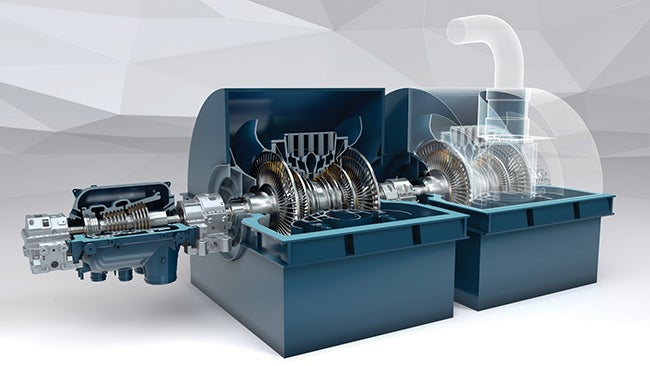
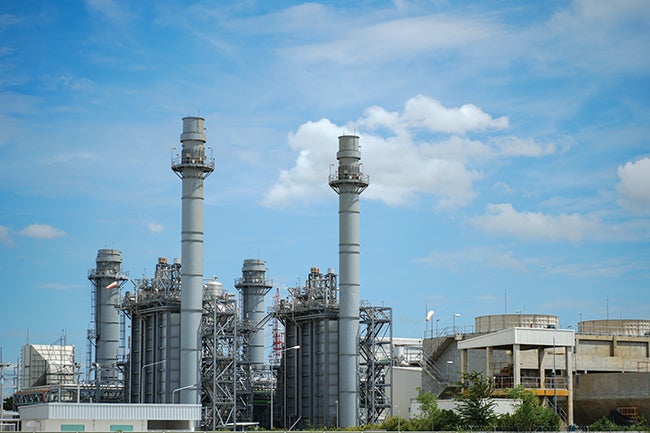
Combined-cycle plants (Figure 2) raise efficiency by using the hot exhaust gases from the gas turbine to produce steam in a heat recovery steam generator (HRSG), which then drives a separate steam turbine to generate additional electricity from energy that would otherwise be wasted. As a result, combined-cycle facilities typically achieve 55% to 65% thermal efficiency, compared with 35% to 40% for simple-cycle gas turbines, allowing them to produce substantially more electricity from the same amount of fuel while reducing both operating costs and emissions per MWh.
 |
|
2. Combined-cycle plants use heat recovery steam generators (HRSGs) to convert gas turbine exhaust into additional electricity, boosting overall efficiency. Courtesy: Envato / Kenstocker |
Building in Carbon Capture Capability
Tackling the balance of gas-fired power emissions involves carbon capture. Capture systems can remove approximately 90% of the CO2 emissions associated with combustion.
Developing a gas plant with carbon capture active as operations commence is not prevalent today, although there have been a few such announcements. However, several hyperscalers do appear to be planning to integrate it in the future—in a recent survey of more than 150 data center–related professionals, nearly one-third of onsite gas-fired plants were expected to incorporate carbon capture by 2030.
The most capital-efficient way to prepare for carbon capture in the future is to design these gas-fired facilities to be “capture-ready.” The incremental upfront costs of a capture-ready plant are modest, and appropriate design can minimize the future retrofit expense. In effect, developers preserve the option to capture most of the remaining emissions once policy, economics, or customer requirements justify the investment.
Some of the key elements of building a plant to be capture-ready include sufficient land (reserved for future carbon capture equipment), adequate water resources, and proximity to geological storage and/or CO2 transportation infrastructure can significantly lower the costs of storage. More specifically, a capture-ready plant will have reserved sufficient space for absorbers, regenerators, compressors, and associated process equipment; designed flue gas ducts and stack layouts to facilitate future tie-ins; sized electrical systems, cooling water infrastructure, and water treatment facilities to accommodate the additional load; and selected turbine and heat recovery equipment with operating characteristics compatible with future carbon capture integration. By incorporating these design features during initial construction, developers can significantly reduce the cost, complexity, and operational disruption associated with a future retrofit.
Addressing Sound Concerns
It is worth noting that appropriate upfront planning can also help address another form of pollution: noise. High noise emissions from continuously operating gas-fired power plants rank among the most common community concerns surrounding dedicated data center generation. Engineering solutions for noise attenuation are not in conflict with making a plant capture-ready, but they do require additional space and modestly higher upfront capital investment. These measures can include acoustic enclosures around gas turbines and generators, inlet and exhaust silencers, sound-attenuating ventilation systems, noise barriers or earthen berms, vibration isolation for rotating equipment, and thoughtful site layout that increases setbacks between major noise sources and neighboring properties.
The cost impact of such attenuation measures, if planned for in advance, is thought to be modest. Although project-specific costs depend on plant size, layout, and proximity to neighboring communities, case studies suggest that acoustic enclosures, silencers, and related mitigation measures typically represent well below 1% of total plant capital costs.
Similarly, operating expenses can also be mitigated through upfront planning. The principal operating consideration is the pressure drop introduced by inlet and exhaust silencers, which slightly increases the work required to move air through the turbine, reducing overall generating efficiency. Industry guidance notes that unusually high pressure losses, such as a stack silencer producing approximately 30 millibars of pressure drop, can reduce overall generating efficiency by roughly 2%. Well-designed acoustic systems are therefore engineered to minimize pressure losses while still meeting noise requirements. Equipment maintenance is expected to be very modest as these systems have long service lives and generally have few moving parts.
Not a Trade-Off, But a Pathway
The AI-driven expansion of data center infrastructure is creating unprecedented demand for reliable electricity. Natural gas is likely to generate much of that power for years to come. However, the choice need not be between rapid deployment and climate impact. Lower-emissions natural gas can reduce emissions immediately, efficient combined-cycle generation can minimize fuel consumption for the life of the plant, and carbon capture–ready design can preserve a pathway toward much deeper decarbonization. Together, these measures offer a practical approach to reducing emissions while maintaining the speed and reliability that hyperscalers require.
—Brad Handler is program director of the Energy Finance Lab at the Payne Institute for Public Policy, Colorado School of Mines, and Matthew Safran is a student researcher summer intern at the Payne Institute. He is pursuing his bachelor’s degree in Economics at the University of California, Santa Barbara.