
Articles By

-
News
SEIA: Installed Solar in U.S. to Surpass 1 GW by 2011
Solar installations in the U.S.—both photovoltaic and concentrating solar power (CSP) installations—grew 114% in 2009, and by the year’s end, they could surpass 1 GW, a new report from the Solar Energy Industries Association (SEIA) says.
-
News
EPA Proposes SCR Controls for NOx, PM Reduction at Four Corners Coal Plant
The Environmental Protection Agency (EPA) last week proposed requiring the Four Corners Power Plant near Farmington, N.M., to install and operate selective catalytic reduction (SCR) controls on all five of the 2,040-MW coal-fired facility’s units. The measure would cut the plant’s nitrogen oxide (NOx) and particulate matter emissions by nearly 80%, the agency said.
-
News
EPA: 585-MW Ore. Coal Plant Violated Clean Air Act
The Environmental Protection Agency (EPA) has issued a notice of violation to Portland Gas and Electric (PGE), alleging that the company’s coal-fired Boardman facility in Oregon violated the Clean Air Act, including New Source Performance Standards and operating permit requirements.
-
News
DOE Offers Loan Guarantee to 845-MW Ore. Wind Farm
The Department of Energy (DOE) last week announced a conditional commitment to provide a partial guarantee for a $1.3 billion loan to the Caithness Shepherds Flat wind project, an 845-MW wind farm planned for eastern Oregon that it is calling “the world’s largest wind farm.”
-
News
NIST: Five “Foundational” Sets of Smart Grid Standards Ready
The National Institute of Standards and Technology (NIST), an arm of the Commerce Department designated by Congress to coordinate development of communication protocols, last week told the Federal Energy Regulatory Commission (FERC) it had identified five “foundational” sets of standards for smart grid interoperability and cybersecurity.
-
Commentary
U.S. Power Sector Must Embrace Low-Carbon Future
The U.S. electric utility sector is undergoing a transformation unparalleled in its history. Extraordinary challenges, driven by the urgency of climate change and other market forces, are compelling the industry to abandon its century-old business model of building large, fossil fuel plants to sell increasing amounts of electricity.
-
Commentary
Biomass: Short-Term Drawbacks, But Long-Term Climate Benefits
In recent months, two noteworthy letters have been sent to Congress by eminent scientists examining the merits—or demerits—of biofuels in the climate debate.
-
 O&M
O&MPulverized Coal Pipe Testing and Balancing
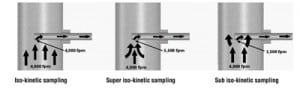
If you want the most accurate test results, it’s worth the extra effort to take isokinetic coal samples from coal pipes when collecting fuel and air measurements. Together, the data collected will allow more accurate balancing of coal pipes, measure fuel fineness, and improve the combustion efficiency of your steam generator.
-
Coal
EPA Air Regulations Shrinking Power Glut
Pending Environmental Protection Agency regulations to slash U.S. power plant emissions likely will lead to the closure of nearly 18% of the nation’s coal-fired generation capacity, trim demand for steam coal by 15% to 31% and boost demand for natural gas by 8% to 16%, a new Credit Suisse analysis concludes.
-
Coal
TVA Eyes Cleaner "Vision" with More Nukes, Less Coal
Responding to looming federal regulations to reduce power plant pollution, the Tennessee Valley Authority’s board signed off on a proposal to shut down 1,000 MW of older coal-fired generation and replace it with an equal amount of natural gas capacity while also pursuing 1,900 MW of demand response and energy efficiency programs and adding 1,140 MW of new nuclear generation by 2015.
-
Coal
EPA Boiler Regulations Will Strangle Construction of New Power Plants
An Environmental Protection Agency plan to tighten emission limits for new and existing industrial boilers has sparked alarmed protests from the biomass generation industry and electric utilities, who say the proposed regulations are so onerous they threaten to shut down existing biomass power plants and already are chilling deployment of new facilities.
-
 Coal
CoalOverblown: Wind Power on the Firing Line, Part I
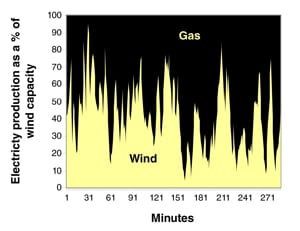
The conventional and oft-repeated truth is that wind generation directly reduces carbon emissions. Challenging the conventional wisdom has drawn much criticism from wind proponents, but the latest research has shown that wind has had, and will continue to have, negligible impact on the nation’s carbon emissions. The data are convincing and can no longer be ignored.
-
Coal
Overblown: Wind Power on the Firing Line, Part II
Wind electricity production must displace some existing generation. However, its relentless variability imposes daunting challenges for wind integration. Clever engineering schemes can mask the problem, but the data show that wind generation has and will continue to reduce carbon by negligible amounts, but at great expense.
-
Commentary
Ash Me No Questions
The Environmental Protection Agency is expected to select its approach for future regulations regarding coal ash storage later this year. One option would be to continue classifying the waste as nonhazardous and leave enforcement with the states. Another option—the worst case for the power industry—would be a determination that coal ash is a hazardous waste, which would result in increased federal oversight and lawsuits.
-
News
TCEQ Approves Air Permit for White Stallion Coal-Fired Facility
The Texas Commission on Environmental Quality (TCEQ) last week issued an air quality permit to the White Stallion Energy Center, a 1,320-MW coal- and petroleum coke–fired power plant proposed for construction in Bay City, Texas.
-
News
Graham Floats “Clean Energy Standard” to Include Nuclear, Coal
Sen. Lindsey Graham (R-S.C.) has introduced the Clean Energy Standard Act of 2010 (S. 20), which would require utilities to obtain 20% of their energy from “clean energy” sources by 2020, with the requirement rising by 5% every five years through 2050.
-
News
Bingaman, Snowe Release Comprehensive Energy Tax Incentive Package
U.S. Senate Energy and Natural Resources Committee Chairman Jeff Bingaman (D-N.M.) and Small Business & Entrepreneurship Committee Ranking Member Olympia J. Snowe (R-Maine) on Monday introduced a comprehensive package of advanced energy tax incentives for clean renewable energy, energy efficiency, and carbon mitigation.
-
News
Salazar OKs First Solar Power Projects on Public Lands, Signs Cape Wind Lease
U.S. Department of the Interior (DOI) Secretary Ken Salazar on Tuesday approved the first large-scale solar energy plants ever to be built on U.S. public lands, and today he signed the nation’s first lease for commercial wind energy development on the Outer Continental Shelf (OCS).
-
News
Electricity Regulator: Rewiring UK for New Generation Could Cost £200B
UK energy regulator Ofgem on Monday warned that the country would need to rewire in a smarter way to secure access to renewable plants, but that an investment of £32 billion ($50.8 billion) would be needed to overhaul the aging grid, including replacing old “pipes and wires.”
-
News
AREVA Wins TVA Contract for Bellefonte Engineering and Development
The Tennessee Valley Authority (TVA) has awarded French company AREVA an engineering and development contract to work on potential completion of the 1,200-MW Unit 1 at the Bellefonte nuclear power plant in northern Alabama.
-
 Wind
WindOffshore Devices Get Bigger and Lighter
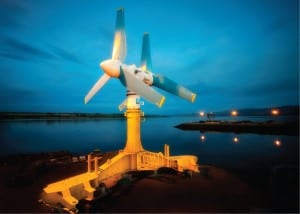
UK firms unveiled two innovative offshore turbines in July and August—one to reap the wind’s energy and the other, tidal power. Wind Power Ltd. made public the latest embodiment of its Aerogenerator project, a lighter 10-MW design, while Atlantis Resources Corp. unveiled and then deployed its mammoth AK1000 tidal turbine, which it says is the […]
-
 O&M
O&MTaming Condenser Tube Leaks, Part II
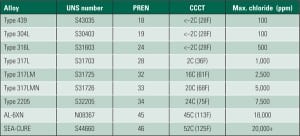
In Part I of this two-part report we examined the various chemical forces at work in condenser tube leaks, the steam plant components placed at risk, and the suite of instrumentation most capable of providing early warning of a leak. Assuming you were able to repair the leak and quickly resume operation, the next step is to identify the damage mechanisms that caused the problem so you can minimize future leaks.
-
Nuclear
India Kicks Off Construction of Indigenous Nuclear Fleet
India in August began building two 700-MW indigenous nuclear power reactors at Rawatbhatta, in the desert state of Rajasthan. The two pressurized heavy water reactors (PHWRs), which will use uranium as fuel and heavy water as both moderator and coolant, are the largest to be built by the central government–run Nuclear Power Corp. of India […]
-
 O&M
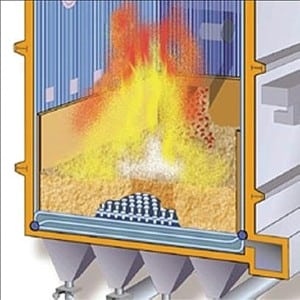
O&MFBC Control Strategies for Burning Biomass
As a boiler fuel, biomass has shown great promise while suffering from a slow development history. One factor limiting its use has been the combustion system. For the most part, conventional grate-fired boilers have been the only option. Today, the most efficient approach to burning biomass to produce electricity and steam is fluidized bed combustion (FBC). Whether you choose FBC or grate, biomass presents unique challenges to control system designers.
-
-
 News
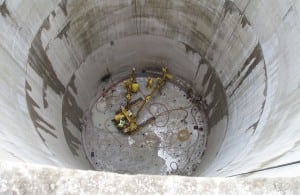
NewsDeep Excavation Support Systems Speed Plant Construction
As part of constructing the recently commissioned We Energies’ Oak Creek Power Plant Elm Road units, four remarkable below-ground structures were built. Each unique structure required creative designs and meticulous construction techniques to meet the project’s distinctive requirements.
-
Business
Lessons Learned in Reliability Standards Compliance
It has been three years and a few months since the North American Electric Reliability Council (NERC) Reliability Standards (Standards) became mandatory and noncompliance became subject to sanctions by the Federal Energy Regulatory Commission (FERC). You might assume that because we have had no further instances of widespread cascading outages that the Standards are working. You may also assume that—considering the database of documented noncompliance with the Standards—the industry as a whole is puzzled, unprepared, or negligent in carrying out its responsibility to keep the high-voltage electric grids reliable and secure. The truth likely lies somewhere in the middle.
-
 Coal
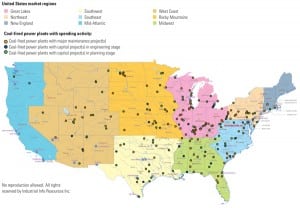
CoalU.S. Coal-Fired Power Development: Down but Not Out
Environmentalists renewed their attacks on coal-fired power development in 2010. At the same time, Congress dithered on cap-and-trade legislation while the Environmental Protection Agency marched forward rules to reduce carbon emissions from coal-fired power plants. Couple the regulatory uncertainty with lean economic times that have flatlined electricity demand growth plus low natural gas prices, and the result is predictable: New coal-fired plant construction is in the doldrums.
-
Smart Grid
Smart Grid Cyber Security Guidelines Released
The National Institute of Standards and Technology (NIST) has finalized its initial set of smart grid cyber security guidelines. NIST’s Guidelines for Smart Grid Cyber Security (NISTIR 7628) includes high-level security requirements, a framework for assessing risks, an evaluation of privacy issues in personal residences, and other information for organizations to use as they craft strategies to protect the modernizing power grid from attacks, malicious code, cascading errors, and other threats, according to NIST’s press release.
-
Commentary
The Nexus of Energy and Water
The age-old adage “water and electricity don’t mix” does not apply to 21st-century infrastructure planning. The two entities can no longer be viewed as separate commodities. The demands on both are intertwined, so solutions for meeting new and growing challenges associated with water scarcity and carbon regulations must also be integrated. Water is essential to […]