
POWER
-
O&M
NFPA Gas Purging Rules Updated
The CSB has made urgent recommendations to the NFPA and the International Code Council to prohibit indoor purging and require companies and installers to purge flammable fuel gases to safe locations outdoors, away from workers and ignition sources.
-
 News
NewsPre-Cleaner for Vulcanized Conveyor Belts
The new QC#1 MT Pre-Cleaner from Martin Engineering is a high-quality cleaning blade for use on vulcanized conveyor belts. It features a special polyurethane blend and tungsten carbide tip to deliver service life two to three times longer than conventional urethane blades, the company claims. Designed to provide excellent cleaning performance without any break-in period, […]
-
 O&M
O&MAbrasion-Resistant Pipe Handles Ash Slurry
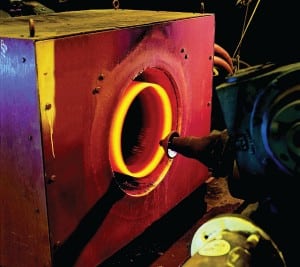
Steel piping systems are widely used at coal-fired power plants for a variety of purposes, including the conveying of coal ash slurry to nearby settling ponds, the transfer of limestone slurry to absorber spray towers for removal of SO2 and dilute hydrochloric acid from flue gases, and for transporting away the calcium sulfate by-product of the flue gas desulfurization process.
-
News
Correction (November 2010)
Correction In the September issue’s “Taming Condenser Tube Leaks, Part I,” the first full paragraph in the main text on page 57 should say, “If chloride and sulfate in the steam cannot be maintained below 8 ppb….” POWER regrets the error.
-
 O&M
O&MAir Casters Speed Equipment Moves
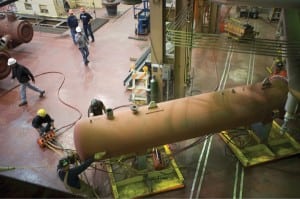
When it comes to moving megaton items like feedwater heaters or recirculating pumps, conventional moving tools such as wheel rollers, cranes, hoists, and come-alongs may be virtually useless. In some cases, moving large components is dangerous in a space-constrained location surrounded by delicate process control equipment. Feedwater heater and recirculating pump removal and replacement are […]
-
Solar
The Global Smart Grid Scene
Presenters at the inaugural GridWise Global Forum in Washington, D.C., September 21 to 23 had a lot to say about the prospects for smarter grids. This synopsis of facts and opinions shared at the event, which attracted several smart grid A-listers, looks at the major challenges ahead, especially for the U.S.
-
Legal & Regulatory
EPA’s Mercury Rule: Another Incarnation Coming
Much like the shape-shifting substance it regulates, the mercurial enforcement rule that governs mercury emissions from coal-fired power plants has changed unpredictably several times in recent years.
-
 Distributed Energy
Matching Load and Generation at UCSD
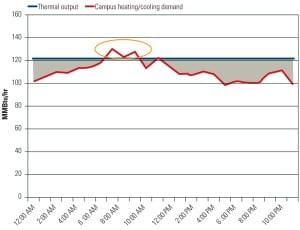
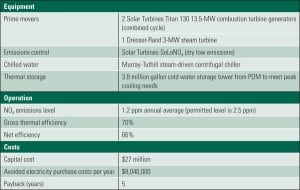
“Smart Power Generation at UCSD” explains how the University of California, San Diego (UCSD) is maximizing the value of combined heat and power. However, like any other grid-controlling entity large or small, the campus has to match generation and load. Its two Solar Turbines gas turbines operate in baseload mode 24/7 while the cogeneration side of the plant maximizes the value of “waste” heat and electricity that isn’t needed to serve immediate load by generating steam and chilled water for campus heating and cooling.
-
 Nuclear
Collaborative Team Investigates Long-Term Nuclear Operations
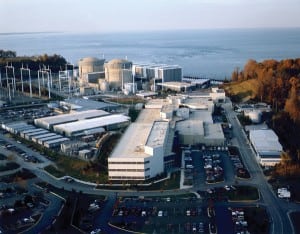
The Atomic Energy Act originally established the length of a U.S. commercial nuclear reactor license as 40 years and made it renewable for another 20 years. The U.S. Nuclear Regulatory Commission has stated that it bases the length of these licenses (and the 50+ renewed licenses granted to date) not on any particular technical limitation but on whether the plant meets current safety requirements. Does this mean there could be reactor life after 60?
-
Smart Grid
Combined Heat and Power Across the U.S.
The University of California, San Diego (see “Smart Power Generation at UCSD”) is just one of many combined heat and power (CHP), or cogeneration, systems in the U.S. A 2008 report by Oak Ridge National Laboratory (ORNL), “Combined Heat and Power: Effective Energy Solutions for a Sustainable Future,” notes that Texas has the most CHP capacity—much of it used by the petrochemical and petroleum refining industries. California ranks second, largely a result of “industrial demands, stringent air quality requirements, and effective policies that encourage adoption of CHP.”
-
News
Follow the Leader
Another year has passed and the promised U.S. nuclear renaissance is still in the Dark Ages. Blame for slow progress is usually cast on the pedestrian pace of finalizing loan guarantees, the economy and slow load growth, or the rising cost of construction. The excuses end when competition increases. Two years have elapsed since the […]
-
 Nuclear
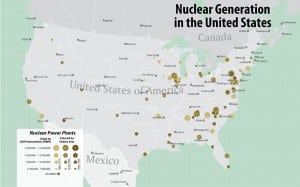
Map of Nuclear Generation in the United States
Courtesy: Platts Data source: POWERmap All rights reserved. No reproduction allowed. For full-sized maps, contact Platts.
-
 Nuclear
Russia Powers On, Boosting Nuclear Reactor Sales
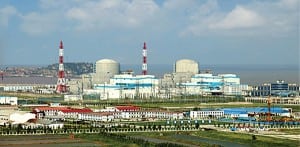
Atomstroyexport, the Russian Federation’s nuclear power equipment and services export monopoly, in September signed a US$1.8 billion contract with the Chinese government for development of the second stage of the Tianwan nuclear power plant in Lianyungang City. Under the agreement, Units 3 and 4 are to be built in a way similar to construction of the first stage of Tianwan—two Russian-designed VVER-1000 reactors that came online in 2007, each with a rated capacity of 1,060 MW.
-
 Nuclear
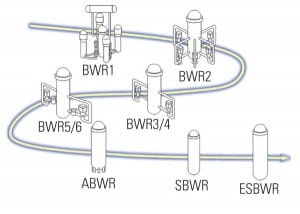
The Evolution of the ESBWR
The commercial nuclear industry is in the midst of developing multiple reactor technology options. Next in our series of articles exploring competing reactor technologies are GE Hitachi Nuclear Energy’s Advanced Boiling Water Reactor (ABWR) and Economic Simplified Boiling Water Reactor (ESBWR). The design improvements incorporated into these reactors include passive safety systems, design and construction simplification, and component standardization to reduce construction and operating costs.
-
 Nuclear
China Begins Operation of First CPR-1000
The first unit of Ling Ao phase II (Unit 3) in Guangdong Province, China, entered commercial operation in late September. The 1,080-MW reactor is the first CPR-1000—a Chinese design—to be built, and its start-up marks a major milestone in the country’s concerted nuclear power expansion.
-
 Gas
GasSmart Power Generation at UCSD
The University of California, San Diego has been accumulating awards for its savvy use of a constellation of power generation and energy-saving technologies. The campus already controls a fully functioning microgrid—including a cogeneration plant—and, as befits a research institution, is constantly looking for new ways to make its energy system smarter. This “living laboratory,” as campus leaders like to call it, demonstrates what it takes to build a smarter grid and why the effort is worth it.
-
 Wind
WindWorld’s Largest Offshore Wind Farm Opens in the UK
Swedish company Vattenfall in late September officially opened the 300-MW Thanet Offshore Wind Farm in southeast England. Covering an area of 35 square kilometers, the installation comprising 100 Vestas V90 turbines, each 115 meters (m) high, is the largest offshore wind farm in the world to date.
-
 Gas
GasMicroturbine Technology Matures
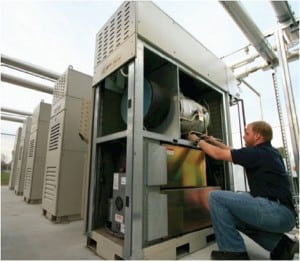
Microturbine technology has evolved from early systems of 30 kW to 70 kW to today’s systems, which can have individual ratings of 200 kW to 250 kW. Packages up to 1 MW are now available that can be assembled into multipac units for projects of 5 MW to 10 MW. These modern units are packaged with integrated digital protection, synchronization, and controls; they produce high combined heat and power efficiencies; and they are capable of using multiple fuels.
-
News
Storing Energy Cryogenically
Researchers at the University of Leeds in the UK and the Chinese Academy of Sciences say they may have found a solution to dealing with short-lived power demand spikes—and it could be more environmentally friendly and halve the fuel needed when compared with gas-fired generation. Noting that gas-fired generators typically used to feed peaking demand […]
-
 O&M
O&MAir Preheater Seal Upgrades Renew Plant Efficiency
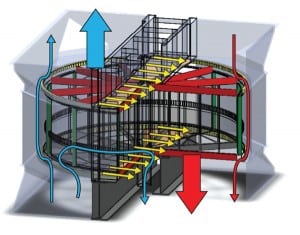
The air preheater is a critical, yet often overlooked, component of the boiler combustion air system. Evaluating and optimizing a heater’s performance is difficult given how entwined it is with the entire combustion system and the lack of standardized calculation tools. Reducing leakage by using modern seal technology will improve combustion efficiency, maintain fan performance, and keep your downstream air quality control equipment operating within spec.
-
 Wind
WindOffshore Devices Get Bigger and Lighter
UK firms unveiled two innovative offshore turbines in July and August—one to reap the wind’s energy and the other, tidal power. Wind Power Ltd. made public the latest embodiment of its Aerogenerator project, a lighter 10-MW design, while Atlantis Resources Corp. unveiled and then deployed its mammoth AK1000 tidal turbine, which it says is the […]
-
 O&M
O&MTaming Condenser Tube Leaks, Part II
In Part I of this two-part report we examined the various chemical forces at work in condenser tube leaks, the steam plant components placed at risk, and the suite of instrumentation most capable of providing early warning of a leak. Assuming you were able to repair the leak and quickly resume operation, the next step is to identify the damage mechanisms that caused the problem so you can minimize future leaks.
-
Nuclear
India Kicks Off Construction of Indigenous Nuclear Fleet
India in August began building two 700-MW indigenous nuclear power reactors at Rawatbhatta, in the desert state of Rajasthan. The two pressurized heavy water reactors (PHWRs), which will use uranium as fuel and heavy water as both moderator and coolant, are the largest to be built by the central government–run Nuclear Power Corp. of India […]
-
 O&M
O&MFBC Control Strategies for Burning Biomass
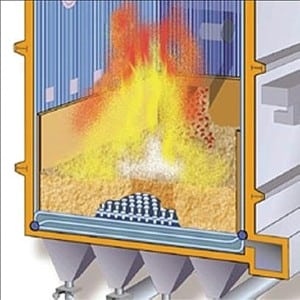
As a boiler fuel, biomass has shown great promise while suffering from a slow development history. One factor limiting its use has been the combustion system. For the most part, conventional grate-fired boilers have been the only option. Today, the most efficient approach to burning biomass to produce electricity and steam is fluidized bed combustion (FBC). Whether you choose FBC or grate, biomass presents unique challenges to control system designers.
-
-
 News
NewsDeep Excavation Support Systems Speed Plant Construction
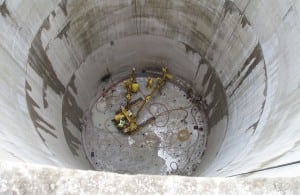
As part of constructing the recently commissioned We Energies’ Oak Creek Power Plant Elm Road units, four remarkable below-ground structures were built. Each unique structure required creative designs and meticulous construction techniques to meet the project’s distinctive requirements.
-
Business
Lessons Learned in Reliability Standards Compliance
It has been three years and a few months since the North American Electric Reliability Council (NERC) Reliability Standards (Standards) became mandatory and noncompliance became subject to sanctions by the Federal Energy Regulatory Commission (FERC). You might assume that because we have had no further instances of widespread cascading outages that the Standards are working. You may also assume that—considering the database of documented noncompliance with the Standards—the industry as a whole is puzzled, unprepared, or negligent in carrying out its responsibility to keep the high-voltage electric grids reliable and secure. The truth likely lies somewhere in the middle.
-
 Coal
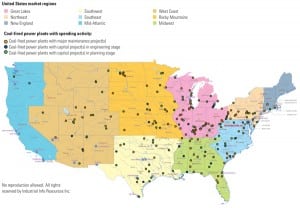
CoalU.S. Coal-Fired Power Development: Down but Not Out
Environmentalists renewed their attacks on coal-fired power development in 2010. At the same time, Congress dithered on cap-and-trade legislation while the Environmental Protection Agency marched forward rules to reduce carbon emissions from coal-fired power plants. Couple the regulatory uncertainty with lean economic times that have flatlined electricity demand growth plus low natural gas prices, and the result is predictable: New coal-fired plant construction is in the doldrums.
-
Smart Grid
Smart Grid Cyber Security Guidelines Released
The National Institute of Standards and Technology (NIST) has finalized its initial set of smart grid cyber security guidelines. NIST’s Guidelines for Smart Grid Cyber Security (NISTIR 7628) includes high-level security requirements, a framework for assessing risks, an evaluation of privacy issues in personal residences, and other information for organizations to use as they craft strategies to protect the modernizing power grid from attacks, malicious code, cascading errors, and other threats, according to NIST’s press release.
-
Commentary
The Nexus of Energy and Water
The age-old adage “water and electricity don’t mix” does not apply to 21st-century infrastructure planning. The two entities can no longer be viewed as separate commodities. The demands on both are intertwined, so solutions for meeting new and growing challenges associated with water scarcity and carbon regulations must also be integrated. Water is essential to […]