A defining challenge for the U.S. electricity industry is to economically integrate renewable energy facilities into grid operations without sacrificing reliability. Bulk energy storage options are commercially proven technologies that enable that integration most expediently. Existing and emerging national and state policy frameworks are supporting their application in projects under development throughout the country.
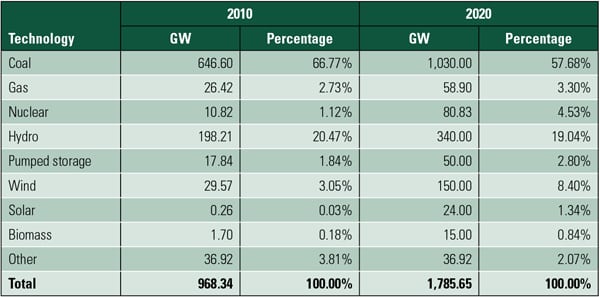
At the 2010 ELECTRIC POWER Conference Keynote Session, Richard McMahon, executive director of the Edison Electric Institute, noted that renewable energy facilities account for 60% to 90% of all generation capacity with interconnection requests to six independent system operators (ISOs)/regional transmission organizations around the U.S. Now combine that startling realization with a few other sobering observations:
- Coal-fired plants face an “environmental gauntlet” that will likely shutter dozens of smaller, older power stations around the country, according to utility executives.
- Renewable energy expansion is more bipartisan than most energy issues, because it is a “domestic” resource; it is leading a recovery in domestic manufacturing and jobs; and it reduces our carbon intensity.
- Many states have renewable portfolio standards in place.
- Where many wind energy facilities operate within one balancing authority, electricity prices are often driven into negative territory because of an excess of subsidized wind power at night, nuclear plants that don’t cycle, and large disparities between off-peak and on-peak electricity demand. Wind tends to blow least (at midday) when you want it the most and the strongest (at night) when electricity demand is lowest.
- Wind facilities are frequently curtailed because of transmission system constraints or because grid operators have little reserve available to balance forecasted wind versus actual variations in output.
- Fossil units are undergoing deeper and more frequent cycling and dispatch to “fill in” around wind energy. Studies confirm that cycling costs are significant and need to be accounted for in the overall evaluation of options.
- High penetrations of wind energy may exacerbate overall emissions levels because cycling and dispatch of fossil-fueled plants usually means higher levels of emissions.
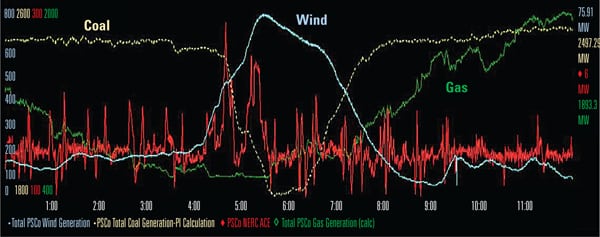
Barring a wholesale change in political sentiment, high penetrations of renewable energy in grids around the country are no longer a question of if, but when (Figure 1). Serious impacts on electricity markets, grid performance, plant operating costs, and environmental profiles are already being felt.
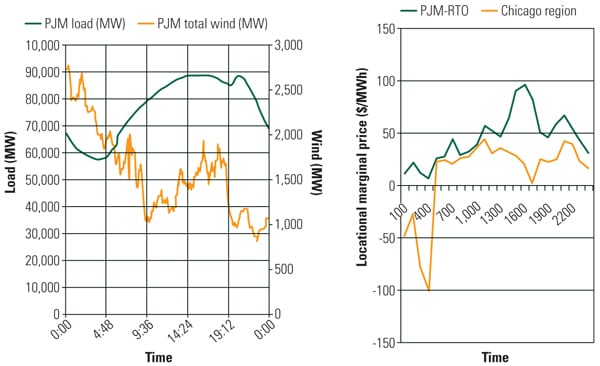 |
| 1. PJM load and wind resources. Growth in wind energy facilities in the PJM Interconnection is accelerating, growing from a few hundred megawatts in 2006 to an expected 25 GW in 2010, and rising to almost 41 GW in 2015. The impact on the PJM system is significant. These charts display data for April 7, 2010. Source: PJM |
Solutions Are Available
Three broad categories of solutions for more intelligently integrating renewable energy into grid operations are:
- Enhanced wind monitoring, forecasting, and communications with grid operators.
- Cycling and dispatching gas-fired assets.
- Adding energy storage technologies, both distributed and bulk.
A mix of solutions will undoubtedly be deployed for any given grid. But bulk energy storage has the greatest potential to optimize grid operations and enable greater renewable energy penetration with the least amount of system risk.
Some history is in order. Pumped storage hydroelectric (PSH) facilities aggregating up to 24,000 MW nationwide were built to assist the dozens of nuclear units coming online in the 1970s and 1980s. Ironically, these units were built because nuclear plants are not allowed to cycle—at least, it is uneconomical to do so. So the storage facilities were charged up at night and electricity was released during the day so nuclear plants could continue operating at baseload. (See sidebar “Taum Sauk Pumped Storage Facility Back in Business.”)
Taum Sauk Pumped Storage Facility Back in Business
AmerenUE’s Taum Sauk pumped storage plant, located about 90 miles south of St. Louis, uses a pure pumped-back design exclusively for electrical peak shaving. Unlike a typical hydroelectric plant, water only flows to make electricity when requested by the system dispatcher. The upper reservoir sits on top of Proffit Mountain about 800 feet above the lower reservoir, located on the East Fork of the Black River. The hydroelectric plant, located at river level, pumps water through a 7,000-foot tunnel to the upper reservoir during off-peak hours. The flow is then reversed during periods of high electricity demand. The two reversible pump-turbine systems are each capable of producing 225 MW.
On December 14, 2005, the upper reservoir was breached, loosing about a billion and half gallons of water in roughly 15 minutes, which caused damage to Johnson Shut-Ins State Park and other downstream damage. In late 2007, federal regulators approved plans to rebuild the upper reservoir with a more robust design and numerous safety precautions to ensure that a repeat of earlier events is not possible.
AmerenUE officially unveiled its new $490 million, 1.5 billion gallon Taum Sauk reservoir on May 27, 2010. The new construction added walls 100 feet high and 3 feet thick surrounding the 54-acre reservoir and a new drainage system to handle the unlikely event of a future overflow (Figure 3).
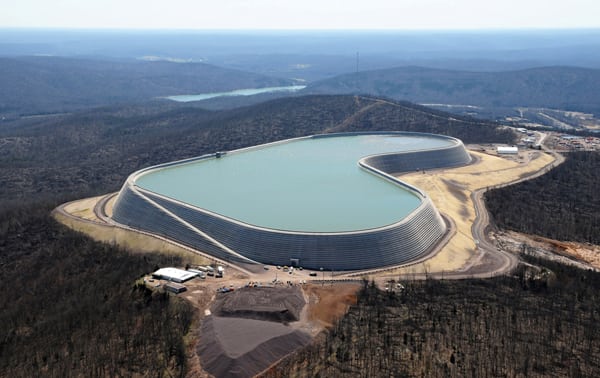 |
| 3. Reservoir ready. The new upper reservoir of the Taum Sauk pumped storage plant was dedicated on May 27 by AmerenUE. The previous reservoir failed at the end of 2005. The new reservoir cost almost half a billion dollars, completely paid for by insurance. AmerenUE reports the facility has been performing as expected since its restart. Courtesy: AmerenUE |
The walls of the new reservoir were formed with a roller-compacted concrete process that produces a much stronger concrete mixture. During the same week as the reservoir was dedicated, the Johnson Shut-Ins State Park also reopened with new state-of-the-art facilities.
The situation with renewable energy is similar. We want wind turbines to operate flat out at night when the resource is most potent and to capture the electricity for distribution during the day. And we need a new dimension in electricity supply and delivery that not only integrates renewable energy but also stabilizes electricity markets, provides ancillary services more economically than today’s methods, and modulates supply with demand.
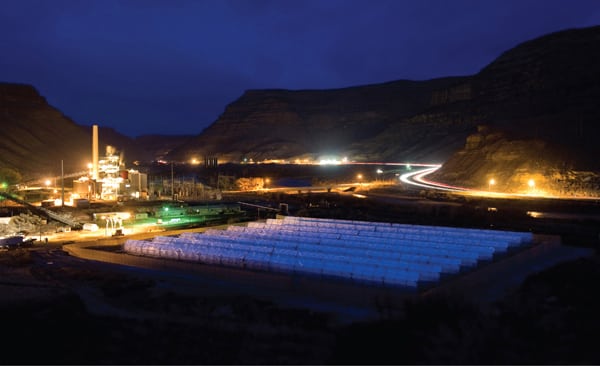
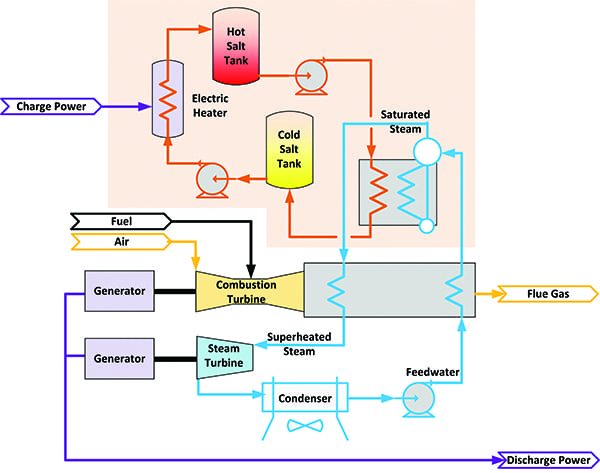
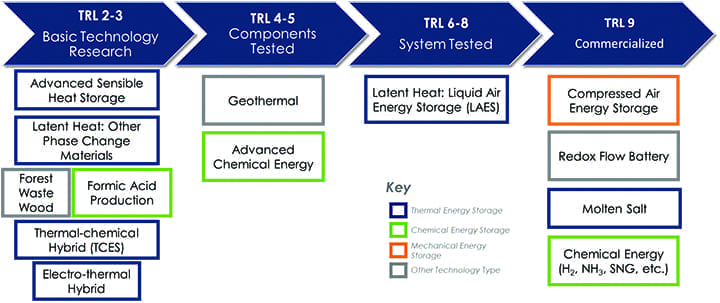
Today, advanced PSH technologies are complemented in the marketplace by compressed air energy storage (CAES) plants (Figure 2), which use large subterranean voids to store compressed air during offpeak hours and then produce electricity when it is required. Both are offered by vendors on a fully commercial, warranty basis. At the lower end of the bulk storage range, from 10 MW to 100 MW, several battery and flywheel technologies have emerged in demonstration facilities, as well as the venerable lead-acid battery technology, which has been demonstrated at the 10-MW to 20-MW scale in California and Puerto Rico for grid-connected systems.
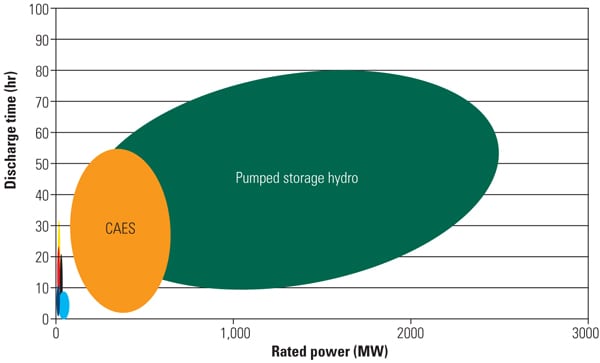 |
| 2. Dwarfing the competition for large-scale storage. Pumped storage hydro and compressed air energy storage (CAES) technologies offer substantial economies of scale compared with distributed storage options. The colored areas on the far bottom left represent double-layer capacitors; flywheels; and nickel-metal hydride, lithium-ion, nickel-cadmium, sodium-sulfur, vanadium redox, lead-acid, and zinc-bromine batteries. Source: HDR TDA |
PSH and CAES are the best energy storage candidates for not only integrating renewable energy facilities but also for optimizing grid operations and enhancing electricity markets because they provide:
- Load and supply. Importantly, bulk storage systems function as load and generation. This makes them ideal for meeting the range of grid ancillary services. Technologies from the other two categories of solution (enhanced monitoring and forecasting, and dispatching gas-fired facilities) do not have this characteristic.
- Fast response. Both CAES and PSH can move from idle position to full load in less than 10 minutes, sometimes in as little as 3 minutes.
- Long-duration cycling. Unlike many battery and flywheel technologies, CAES and PSH can comfortably charge or discharge for 2-, 6-, or even 12-hour periods, if necessary.
- Improved emissions profile. PSH has no emissions profile. CAES, in versions that can be supplied on a commercial basis today, does require a minimum input of natural gas, but its overall emissions profile is significantly better than cycling/dispatching gas-fired units or fossil units (Figure 4).
- A transmission resource. Depending on its location, bulk storage can optimize transmission line loadings and defer the need to build new transmission assets.
 |
| 4. Low profile. CAES exhibits a much lower emissions profile than gas-fired generation assets. Source: CAREBS |
System Operations Tool
In simplistic terms, energy storage maximizes the penetration of actual wind energy megawatt-hours into the grid rather than replacing them with megawatt-hours from fossil-fired power stations. Here’s how it works.
Wind facilities operate at between 25% and 40% annual capacity factors. Importantly, however, their operating profiles are typically far worse during peak periods. In Texas, ERCOT plans for only 8.7% of the total wind capacity as being “available” during peak summer days. The 3,000 MW of wind on the PJM system—according to Mike Kormos, senior VP operations, PJM Interconnection, speaking at the ELECTRIC POWER Executive Roundtable—gets credit for only 13% of its capacity value during peak periods.
Available capacity at peak is only part of the story. Wind resources have a tendency to shift suddenly and even dramatically. Seasonal wind resource patterns and daily wind resource patterns must be accommodated by the grid, but sudden disruptions and changes also must be accommodated on a time scale of minutes. (See the Global Monitor story in this issue on the variability of wind due to climate phenomena.) Officials at the Midwest Independent System Operator (MISO) note that operators manually curtail thousands of megawatts of wind each day and that 1,800-MW swings over an hourly period are common.
For sub-hourly changes to wind resources, grid operators can request that operating plants quickly increase or decrease their output. Because nuclear plants are required to operate at full capacity 24/7/365, only the gas and coal power plants already online can provide this cycling.
Unfortunately, coal-fired plants are ill-suited for this type of cycling. Not only do emissions increase, often from plants that are not well-equipped with emissions control devices, but plant efficiency also suffers at less than full load. If you stomp on the gas pedal in your car, it will accelerate quickly, but the metal parts of the engine will also experience more rapid degradation and wear. The same is true of fossil-fired power stations. Cycling costs are not insignificant, nor are the emissions, according to at least one recent study by Bentek Energy, “How Less Became More: Wind, Power, and Unintended Consequences in the Colorado Energy Market,” published in April of this year.
Cycling and dispatching gas-fired plants is better than cycling coal plants, but it’s still not the best approach. Gas turbine–based power stations suffer significant reductions in efficiency when they operate at part load. Combined-cycle plants, many of which are already cycled and dispatched heavily, have suffered similar metallurgical degradation as coal-fired plants. The fact is, the emissions-free megawatt-hour from wind is being traded for an emissions-laden megawatt-hour from fossil fuel.
Now consider a bulk energy storage facility that is storing renewable, emissions-free electricity. Instead of a wind farm producing megawatts at night when no one needs them, it charges up a bulk storage facility. This electricity is then discharged to the grid during the day, when additional load is needed. Though neither PSH nor CAES will deliver to the grid all the electricity used to charge the storage system, the overall economic efficiency compared to fossil-fired power stations is much better.
The most advanced commercially available CAES plant suffers only 7% deterioration in cycle efficiency between 25% and 100% output. In other words, efficiency remains fairly constant throughout the load range. Combined-cycle facilities typically suffer more than 30% deterioration; a gas turbine peaking unit is even less efficient. The CAES cycle efficiency, or heat rate, is at least 30% better than that of the best combined-cycle facilities operating today and 60% to 70% better than a peaking gas turbine generator. Combined-cycle units typically require at least 40 minutes to come up to full load from a “warm” condition (such as being shut down overnight) and several hours from a cold condition. Simple-cycle gas turbines are more flexible but are limited in the amount of down-regulating or decremental reserves they provide to the system operator.
Avalanche of Support
Last year, DOE Secretary Stephen Chu began to speak publicly about the benefits of bulk energy storage. In the spring, the Federal Energy Regulatory Commission issued a Notice of Inquiry regarding the integration of variable energy resources into the grid and followed that up with a “Request for Comments Regarding Rates, Accounting, and Financial Reporting for New Electric Storage Technologies.” In April, PJM and EPRI jointly sponsored the Energy Storage Summit, held in Valley Forge, Pa. Lawmakers have also been active in developing the proper regulatory frameworks and incentives and subsidies (see sidebar). Most recently, the California ISO released a study of energy storage system requirements for the state to achieve its stated goal of 33% renewable energy.
Up to 40 new PSH facilities either have obtained a preliminary FERC permit or have applied for one, according to data from HDR/DTA Inc. The majority are concentrated in the western U.S. CAES projects are known to be under development in California, Kansas, Iowa, Texas, New York, Ohio, North Dakota, and Vermont. Equipment suppliers report that between a dozen and two dozen CAES projects are seeking technical and budgetary proposals from equipment suppliers. Expect new CAES plants to break ground in the very near future.