Is a paradigm shift—an economic and engineering earthquake—in nuclear power plant design on the horizon? For most of the past 50 years, the mantra in planning new nuclear plants has been “bigger is better.” But a growing number of nuclear power engineers and designers are contemplating a world where small is beautiful.
In the 1960s and 1970s—the heyday of new nuclear plants in the U.S.—nuclear plant size marched steadily upward, from 100 MW to 300 MW to 1,000 MW. That trend remains dominant. Most of the new designs of the 21st century that are part and radioactive parcel of the “nuclear renaissance” are even bigger than their ancestors. Westinghouse’s offering, the AP1000, is scaled at 1,154 MWe, while the General Electric ABWR ranges from 1,350 MW to 1,460 MW. AREVA’s EPR is rated at 1,650 MW.
Nuclear Upstarts
But the once-heretical notion that small is beautiful is gaining technical and political traction in the nuclear power industry, as firms find that building conventional 1,000-MW and larger plants presents severe financing, licensing, and construction obstacles. Within a two-week period last June, The Energy Daily held a webinar on small, modular reactors and Platts, along with the U.S. Department of Energy (DOE), held a well-attended (250 by one estimate) 1.5-day conference on the topic at Washington’s tony Mandarin Oriental Hotel, at a price of $1,500 a head.
At the ELECTRIC POWER Conference & Exhibition in Baltimore last May, the session on small and modular nuclear power plants was the most-attended session in the nuclear track. Although bigger designs still capture the most serious industry attention, interest in smaller designs appears to be growing substantially. If the advocates of smaller, modular win the argument, the nuclear future will look far different than what was envisioned just a couple of years ago.
Small, modular reactor technology is getting noticed by the DOE. Out of its fiscal 2011 nuclear energy budget of $912 million, small modular reactors are slated for $39 million.
According to Richard Black, who runs the DOE office of advanced reactor concepts, the DOE defines small, modular reactors as “those reactor designs that are smaller or equal to 300 MWe and fabricated in modules that are transportable from the factory to the site by rail, truck, or barge.”
Scale Economies Have Been Missing
What compels the designers, developers, and dreamers of small reactors to swim upstream to seek their future of atomic power? In his latest book, Power Hungry, energy journalist Robert Bryce observes that smaller reactors “would cost a fraction of the cost of the larger plants. Second, they could be used as single or multiple units…. Third, small reactors could be manufactured in a central location.”
In large part, the case for small and modular reactors grows from past experience with ever-larger conventional reactors. Some 15 years ago, small and modular reactor maven Rod Adams, proprietor of Adams Atomic Engines Inc. of Annapolis, Md., and former engineering officer on the USS Von Steuben ballistic missile submarine, argued that the commercial nuclear reactor business has been governed by a “failed paradigm.” Adams wrote, “Though accurate cost data is difficult to obtain, it is safe to say that there has been no predictable relationship between the size of a nuclear power plant and its cost. Despite the graphs drawn in early nuclear engineering texts—which were based on scanty data from less than 10 completed plants—there is not a steadily decreasing cost per kilowatt for larger plants.”
Though small, modular reactors may be the nuclear “next big thing,” there is nothing new about them. U.S. reactor vendors have been making successful small reactors for 50 years, powering a variety of Navy ships, starting with submarines, as Adams frequently points out. According to the open literature, the current U.S. nuclear submarine power plant for Virginia-class submarines is a pressurized water reactor made by General Electric and identified as the SG9, or ninth-generation plant. It produces about 40,000 shaft horsepower, or about 30 MW of power, and is designed to operate for 33 years without refueling. Commercial economics, of course, does not drive Navy reactor technology, so Navy power plants are not close to an exact template for a small, modular commercial unit.
In his Platts presentation, Kenneth Hughey, Entergy Nuclear vice president for nuclear business development, highlighted the negatives of the current, build-big approach to civilian nuclear power generation:
- Large, multi-unit new reactors require so much capital to build that they often represent bet-the-company risks.
- Under current estimates, a new, large nuclear plant, if construction were to begin today, would likely not be in operation before 2018. AREVA’s attempt to build a new plant in Finland, using its advanced reactor, is some 18 months behind schedule.
- Failure to operate the plant, regardless of the quality of its construction, could be a business catastrophe. Just ask the Long Island Lighting Co. (LILCO). LILCO vanished at the end of the last century when it was unable to dispatch its catastrophic Shoreham plant. (The utility completed commissioning the plant after fuel was loaded, and the plant operated for only a few hours before permanent shutdown, thus multiplying the decommissioning cost several times.)
- A troubling history of projects over budget and behind schedule. See AREVA in Finland.
Downsized reactors, on the other hand, offer serious advantages, said Hughey. Among them:
- Their smaller size reduces the “bet-the-company” specter. Easier debt financing would follow from taking smaller bites of the economic apple.
- They would have an easier and more flexible supply chain, including factory manufacturing and a larger supplier base with more domestic suppliers.
- Small, modular reactors could be used for “brownfield” development and on military bases, to reduce the use of fossil fuels, and could bring new players onto the business field.
Players in the Small Modular Nuclear Game
The small modular nuclear reactor proposals that are closest to winning regulatory approval and finding a market in the U.S. are all pressurized light water reactors (PWRs), technology familiar to the Nuclear Regulatory Commission (NRC), the industry, and investors.
Scaled-Down PWR Reactors
The three leading contenders, at this writing, are all “integral” PWRs, meaning that in addition to the core, the steam generators, pressurizer, control rod drive mechanisms, and reactor coolant pumps are all located within the reactor pressure vessel.
Westinghouse. The Westinghouse Innovative and Secure Reactor (IRIS) machine was originally conceived in 2006 as a 325-MW power plant but subsequently was resized to 100 MW. The containment is a conventional above-ground steel vessel. The plant is designed to be refueled every four years and uses conventional enriched uranium fuel. The steam temperature at outlet is 330C. The developers, an international consortium, are expected to apply for design certification at the NRC in 2012 (Figure 1).
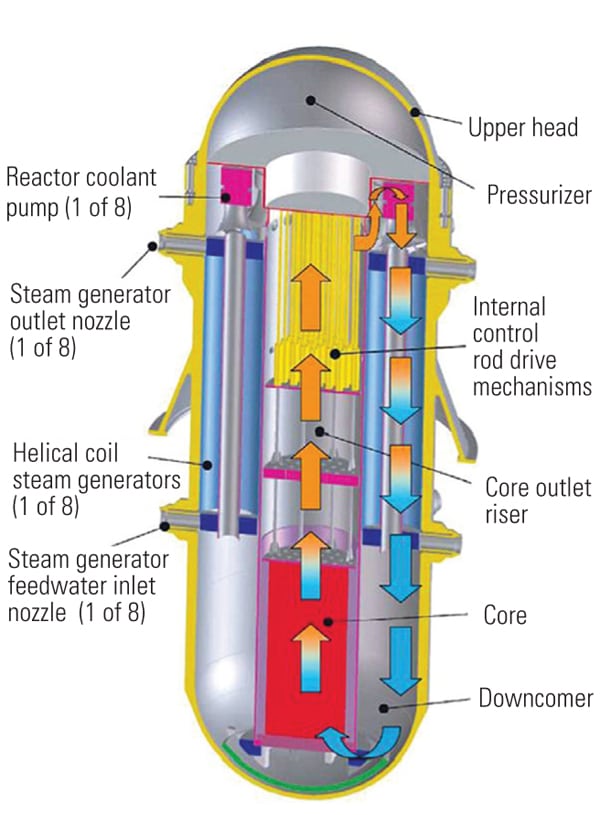 |
| 1. IRIS. The Innovative and Secure Reactor (IRIS) design places the components of the reactor and steam generator in a single vessel. Oak Ridge National Laboratory plans to seek funding to build a first-of-a-kind, power-producing IRIS reactor in east Tennessee in 10 to 12 years. Source: Oak Ridge National Laboratory |
NuScale. NuScale has a 45-MW design based on work done by Oregon State University for the Idaho National Laboratory (INL) early in this century. Kiewit Power Constructors of Omaha, Neb., is a NuScale partner. NuScale Power is a 2007 startup company. The integral reactor vessel would be installed in a water-filled underground pool, constituting the reactor containment. Outlet temperature is 300C. NuScale also expects to submit design certification documents to the NRC in 2012 (Figure 2).
 |
| 2. NuScale. The NuScale reactor design encloses the reactor vessel inside an air-evacuated containment vessel that sits within a water-filled pool located below ground. Each power module is 45 MW. The NuScale reactor operates using the principles of natural circulation. No pumps are needed to circulate water through the reactor. Courtesy: NuScale Power |
Babcock & Wilcox. Babcock & Wilcox’s (B&W’s) mPower, a 125-MW design, was unveiled in 2009. The Tennessee Valley Authority is partnering with B&W on the mPower project. Designed to be installed underground, the plant incorporates many features of Navy reactors. B&W has long been a major contractor for military reactors. Outlet temperature is 330C. B&W also plans a 2012 design application at the NRC. Engineering and construction giant Bechtel recently signed on to partner with B&W on the mPower project (Figure 3).
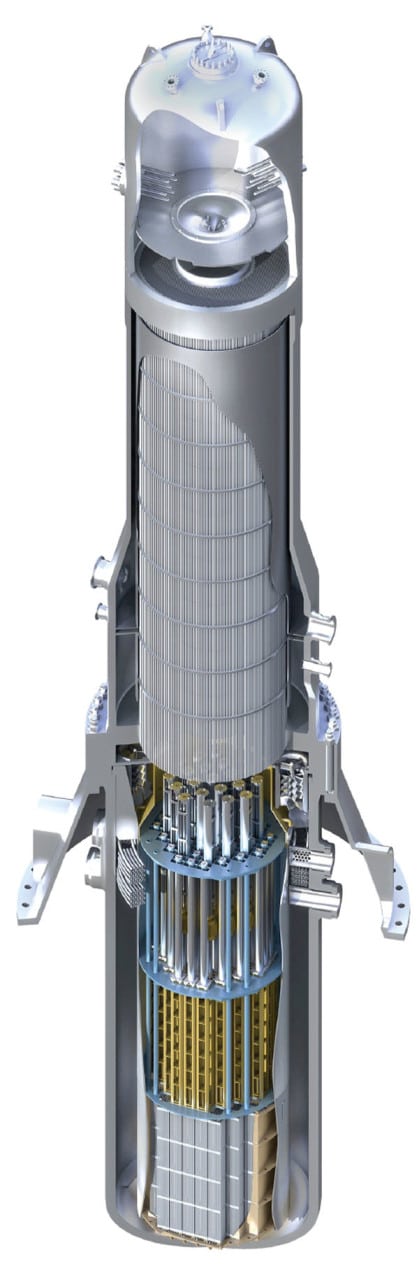 |
| 3. mPower. The mPower modular reactor was first announced in 2009. Since then, Babcock & Wilcox Nuclear Energy Inc. and Bechtel Power Corp. have entered into a formal alliance to design, license, and deploy the world’s first commercially viable Generation III++ small modular nuclear power plant. Courtesy: Babcock & Wilcox Nuclear Energy Inc. |
Based on B&W mPower small modular reactor technology, this new alliance, to be known as Generation mPower, brings together two recognized and established energy industry leaders in engineering, manufacturing, and construction. Both Bechtel and B&W are making a substantial commitment in forming Generation mPower.
Liquid Metal–Cooled Reactors
Further into the future, according to the NRC and DOE, are three conceptual liquid metal–cooled fast reactors.
Hyperion. Building on technology developed at the DOE’s Los Alamos National Laboratory, the 25-MW Hyperion module is designed to be installed underground and be factory refueled. It would have a steam outlet temperature of 500C. Hyperion Power Corp. is a privately held company, formed specifically to develop the Los Alamos technology. The company plans a 2012 submission to the NRC (Figure 4).
 |
| 4. Hyperion Power Module. The Hyperion Power Module (HPM) is said by its designers to offer a “perfect distributed independent energy solution for remote locations that are too difficult or expensive to reach with traditional electrical grid systems from one large, centrally-located power plant.” Each HPM-based electric plant generates 25 MW of electricity and can be configured for steam only, cogeneration, or electricity only. Source: Hyperion Power Generation |
Toshiba. Toshiba’s 4S (super safe, small, and simple) fast reactor is a 10-MW design, to be factory-built and installed below ground, with a 30-year refueling cycle and a 500C outlet temperature. Toshiba has been working with the city of Galena, Alaska, to supply a reactor for that rural community. Toshiba expects to apply to the NRC for design certification next year (Figure 5).
 |
| 5. 4S. Toshiba’s 4S (super safe, small, and simple) micro nuclear reactor design is rated at 10 MW and offered by a partnership of Toshiba and the Central Research Institute of Electric Power Industry of Japan. A 50-MW version is under development. Courtesy: Toshiba |
Advanced Reactor Concepts. Advanced Reactor Concepts’ ARC-100, another outgrowth of DOE technology, is based on the venerable EBR-II prototype breeder reactor that operated at INL from 1963 to 1994. The 100-MW reactor would have a 20-year refueling cycle and a core submerged in a pool of liquid sodium. The company, based in Reston, Va., unveiled the design in June, and its timetable for design submission to the NRC is unclear.
Pebble Bed Reactor Bites the Dust
But it’s not all radioactive beer-and-skittles for small reactors. The tale of the Pebble Bed Modular Reactor, the most fully developed of the commercial designs, with some 40 years of history behind it, may be cautionary.
On the Summer Solstice this year, the government of South Africa and its electric utility, Eskom, abandoned a project they had been supporting for over a decade with some 9 billion rand ($1.27 billion as of mid-September 2010). The 165-MW reactor with its helium coolant in water-short southern Africa and high-temperature output (900C) looked like a good fit for power-short Eskom, which took over development of the project from German interests in 1993. But this year, blaming the worldwide economic recession, Eskom essentially killed the project, which had been lagging for nearly six years.
What happened? A recent analysis in The Bulletin of the Atomic Scientists (June 22, 2009) casts doubt on the economic rationale Eskom offered. “Although the company claimed the global recession had driven it to make such changes,” the article observed, “it is hard to fathom that PBMR Ltd.’s problems are simply the result of the ongoing financial crisis since the project has been troubled for years. The company’s actions instead point to potentially deeper problems with the reactor design itself. If this is the case, there are bound to be implications for the only other major pebble bed reactor research program left, which is in China and based on the same technology.”
The Bulletin article highlighted a 2008 German analysis of that country’s experience with pebble bed technology, which suggested that the self-contained fuel pellets, coated with ceramics in order to obviate the need for a reactor containment, had seriously overheated to the point of threatening fuel damage. If that proved true, it would undercut the heart of the technology, the article concluded.
New Game in Town
None of the small reactors that developers are touting today have even begun the formal NRC licensing process; none is expected to make formal submission to the NRC until 2012. But the NRC has had pre-licensing discussions with the three pressurized light-water reactors in the small, modular race (see sidebar): mPower, NuScale, and IRIS.
In addition to the usual business hurdles involving novel, first-of-a-kind technologies, small reactors will present the NRC with unique regulatory issues. Among them, according to Michael Mayfield, director of the NRC’s advanced reactor program, are emergency planning, the radioactive source term (the mix and amounts of radioactivity that could be released in a severe accident), control room staffing, siting and site security, and operational issues such as in-service inspections and how to apply existing engineering codes to the new machines.
An example of the kinds of questions the NRC will face involves what might appear to be a mundane issue: control room staffing. In the large reactor paradigm, each unit has its own, separate, and separately staffed control room. As several speakers at the Platts meeting noted, part of the economic appeal of modular reactors is that one control room might control as many as 12 modules at a time. This has the regulators scratching their collective heads. Mayfield noted, “NRC is currently conducting research to support future reviews” of control room issues.
Siting small, modular reactors could also present vexing problems, particularly if the market for the new machines encompasses non-utility industrial customers seeking to self-generate or co-generate power at their factories and plants. The NRC is accustomed to dealing only with dedicated sites that have gone through a rigorous regulatory review.
All of these and many other still-unresolved regulatory issues will have major impacts on the costs of the small plants. Whether these plants are able to live up in reality to the economics that designers and dreamers have been speculating about likely will determine their future and the viability of a paradigm shift in nuclear plant design.
Entergy Nuclear’s Hughey summed up the business case for smaller reactors at the Platts meeting: “In the end,” he said, “all things being equal, it comes down to dollars per kilowatt to install and dollars per kilowatt to operate.”
— Kennedy Maize is executive editor of POWER’s sister publication, MANAGING POWER, and a POWER contributing editor.