Nearly a quarter-century after the Chernobyl nuclear power station disaster in Soviet Ukraine, Russia has been making deals with energy-starved nations all over the globe to help them build new nuclear power plants using Russian second-generation reactor technology.
At the same time, the federation has been securing uranium resources abroad: In 2009, the state’s uranium holding arm (and Russia’s only uranium miner) Atomredmetzoloto began collecting assets all over the world—mainly in African states, but even becoming the largest shareholder in Canadian uranium miner Uranium One. As Atomredmetzoloto official Vadim Zhivov told Russian magazine Atomic Energy, the stockpiling was prompted by a uranium crisis before 2007 in which Russia, second in the world in terms of reserves, couldn’t even meet the needs of its own operating nuclear plants. Asked directly about Russia’s strategy in the world’s uranium market, Zhivov responded that though state-owned Rosatom controlled 40% of the world’s enrichment capacities, its position in natural uranium was weaker, and that the federation was looking to eliminate that “imbalance.”
Will Moscow’s nuclear power expansion plans eventually pay off for the country, and what could this mean for the world’s nuclear industry? Time will tell, but here are a few recent developments that indicate the scope of Russia’s nuclear export ambitions.
India
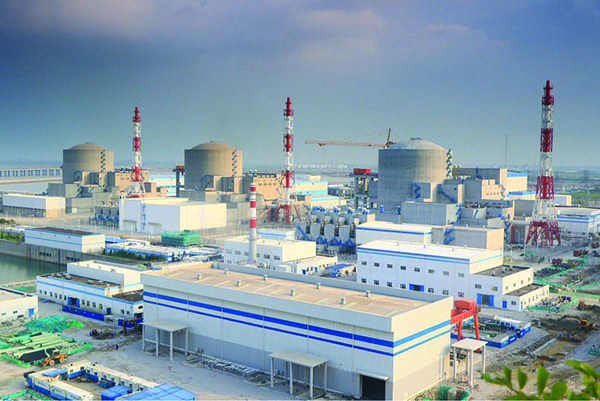
India and Russia in March agreed on the construction of four more water-cooled, water-moderated energy reactors (VVER-1000) during India’s 12th Plan period (2012–2017)—two at Kudankulam, Tamil Nadu, and two at Haripur in West Bengal. Russia is already building two VVER-1000s at Kudankulam, one of which is expected to go critical this September and the other one six months later (Figure 3). The March agreement called for progressive “indigenization” of the reactors. This means that while India’s Department of Atomic Energy will consider construction of more Russian reactors during the formulation of the 13th Plan period, the pact ordains that India will build the reactors while Russia will supply the equipment and components.
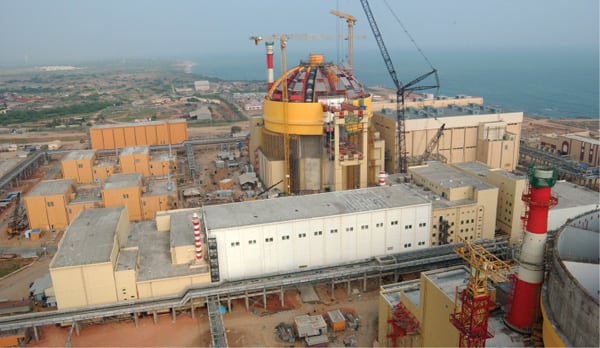 |
| 3. Nuclear expansion. Several countries stricken with power shortages have recently made, or are considering, agreements with Russia for new nuclear power plants. Russian state-owned company AtomStroyExport is currently building two VVER-1000 reactors at Kudankulam, Tamil Nadu, India’s first large nuclear power plant. The first of those units is expected to go critical this September and the other one six months later. Courtesy: AtomStroyExport |
Argentina
In April, Russian President Dmitry Medvedev was quoted by state media as saying Rosatom’s involvement in the Argentine market would lead to “several-billion-dollar[s] in investment intended to be spent on the creation of… nuclear reactors, as well as on the development of infrastructure.” Argentina has two operational nuclear power plants, the Atucha I and the Embalse. Atucha II is under construction, and the country is reportedly considering adding a third nuclear plant to the Atucha complex.
Venezuela
Russia reached an agreement with Venezuela to draft plans for the construction of the country’s first nuclear plant, President Hugo Chavez said in a joint news conference with Russian Prime Minister Vladamir Putin in May. The country is reeling from a recent drought-related energy crisis.
China
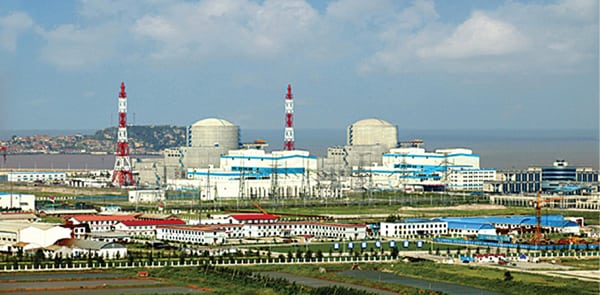
AtomStroyExport and its Chinese partner, the Jiangsu Nuclear Power Corp., agreed to build two more VVER-1000 reactors at Tianwan. The Russian company had already completed two VVERs at that site in 2007. AtomStroyExport was charged with design work, equipment and material supplies, construction and assembly work, as well as training Chinese personnel.
Syria.
Russia on May 11 said it was considering helping Syria build a nuclear power plant despite a two-year investigation by the International Atomic Energy Agency of a complex in the desert that the U.S. alleged was a facility designed to manufacture weapons-grade plutonium. The Arab nation’s power generation falls almost 33% short of demand, while its population is rapidly increasing.
Bangladesh
Its natural gas reserves dwindling and coalfields unexploited, Bangladesh has sought and formally agreed to assistance from Russia’s state-owned nuclear firm Rosatom for the establishment of two 1,000-MW nuclear reactors at Rooppur, 125 miles northwest of the capital Dhaka by 2015. The projects are expected to cost nearly $2 billion. According to the agreement signed May 22, Russia will not only help Bangladesh design, build, and operate the reactors for the country’s Atomic Energy Commission, it will also supply nuclear fuel, take back spent fuel, manage nuclear waste, and train personnel for operation and maintenance at the plants.
Vietnam
Vietnam’s recently announced plans to put 13 new nuclear reactors—15 GW—online by 2030 will be Russian-backed. State-run Vietnam Electricity Group reportedly signed a nuclear power cooperation agreement with Rosatom in December, and state-run media reported that the government has chosen Russian technology for the first nuclear power plant in Ninh Thuan province. Under the agreement, Russian nuclear engineers will also train Vietnam Electricity Group members this year.
Ukraine
Russia agreed in June to resume work on two partially built reactors at Ukraine’s Khmelnitsky nuclear power plant, as well as to finance the project’s design, construction, and commissioning. Russian news agency RIA Novosti reported that the project could be completed in five years and cost nearly $5 billion to $6 billion. Construction of the plant was originally begun in 1985, but work was stopped in 1990 when Units 3 and 4 were 75% and 28% complete respectively. Russia’s AtomStroyExport won a tender in 2008 to construct two AES-92 plants with V-392B reactors at Khmelnitsky, similar to the two VVERs already operating on the site. Ukraine generates almost half its electricity from its 15 operating nuclear reactors, all Russian-designed pressurized water reactors.
Armenia/Bulgaria
Also in June, Rosatom CEO Sergey Kiriyenko said that Russia expects to become a 50% co-owner—for the first time ever in another country—of a 1,060-MW VVER-1000 reactor planned for construction at Metsamor, Armenia. Construction is due to begin in 2011–12, with commissioning by 2017. The plant, designed for a 60-year service life, is projected to cost $4 billion. Kiriyenko also suggested that similar negotiations were under way in Bulgaria. “We expect not only to construct a nuclear power plant, but also to become an investor,” he said, adding that Russia intends to join a new venture with the Bulgarian government for the Belene nuclear power plant.
Russia
At home, an updated general plan for meeting consumption figures—which had declined, according to the government’s June figures—shows that Russia is planning to put 173 GW of new generating capacity online, including 43.4 GW of nuclear by 2030. New nuclear plants will include the second reactor at the Volgodonsk nuclear plant, a V-320 type VVER, which is set to start commercial operation in October this year. Two other VVER-1200 reactors are also planned at the plant, sometimes known as Rostov, after its region. Construction of Volgodonsk 3 started in 2009 with commercial operation set for 2013.
 |
| 4. Nautically nuclear. Russia on June 30 put the barge for its controversial floating nuclear power plant in the water. Dubbed the “Academician Lomonosov,” the 80-MWe plant is a non-self-propelled vessel that is 474 feet long, 98 feet wide, and 33 feet high. It weighs 21,500 metric tons. The floating power plant is expected to be operational by 2012. Courtesy: Rosatom |
Also in June, Russia floated the barge for its controversial floating nuclear power station at the Baltiysky shipyard in St. Petersburg, readying it for operation in 2012. The plant, dubbed “Academician Lomonosov” would have the capacity to produce 80 MW of electricity (Figure 4). The government reports that at least six sites for such plants have been chosen in Russia.