In the January 2012 issue of POWER, the Construction Industry Institute (CII) presented a portion of its groundbreaking work on job site safety in “Real-time Proactive Safety in Construction.” That article explained how real-time tracking of worker and construction equipment locations can be used to efficiently notify workers on foot and those operating moving equipment of each other’s location, thereby avoiding collisions, injuries, and, sometimes, fatalities. Not included in that CII study were over-the-road trucks that most large construction projects rely on for delivery of time-critical equipment and parts.
POWER recently talked with Erika Jakobsson, a project manager at Volvo Technology in Gothenburg, Sweden, who is responsible for developing intelligent trucks in response to European Union (EU) directives. According to Jakobsson, the truck of the future will have a digital co-driver on board, a virtual guardian angel that assists the driver or even takes over if the driver loses control. “We quite simply attach eyes to the truck,” says Jakobsson.
Causes of Truck Accidents
Weekends, accidents, bad weather, and road construction are some of the reasons for traffic snarls, but they all have one thing in common: Where there are traffic delays, there is also a risk of accidents. A survey by the European Truck Accident Causation Study shows that 47% of all truck accidents take place in monotonous situations such as traffic queues, with vehicles traveling in the same direction, or in stressful situations such as at crossroads and road construction. Now technology is being developed to help ensure that this type of accident becomes less frequent (Figure 2).
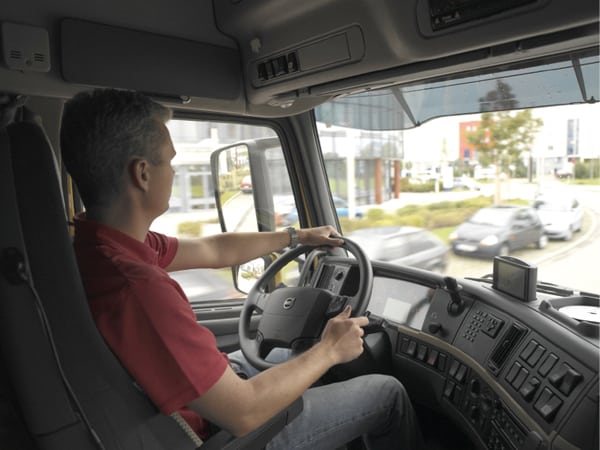 |
| 2. Smart trucks under development. Volvo Trucks is developing over-the-road trucks with enhanced safety equipment that can automatically adjust to traffic flow and employ a temporary autopilot. Courtesy: Volvo Trucks |
Right now, the EU’s Highly Automated Vehicles for Intelligent Transport (HAVEit) project is focusing heavily on next-generation intelligent vehicles that can save lives and the environment through the development of advanced driver-assistance systems. The HAVEit project is developing a virtual co-driver that responds to the current traffic situation and the driver’s needs. “One of the challenges is how the vehicle should communicate with the driver, what sort of displays, voice functions, and so on it should have. We all have different temperaments, so the system must recognize when the driver is feeling irritated or calm,” says Reiner Hoeger, project coordinator for HAVEit.
Sensors Add to Driver Awareness
The automotive industry has been building and conducting research into automated vehicles for some time now, and many new features have already made it into production. Tomorrow’s vehicles, however, are being optimized to assist the driver not just by helping the driver but by actually taking over certain tasks when necessary. This technology relies on a number of sensors on the outside of the vehicle that respond to the traffic environment and scan lane markings, road signs, the current traffic situation, and road conditions. These observations are then combined with an internal system that monitors the driver and interprets the driver’s needs. What is more, the truck is enhanced so that it can be controlled electronically. The same technology will also help make the vehicles more economical and help the driver drive in a more environmentally favorable way.
“We are not trying to make the driver superfluous; we want the driver to always have some form of control. We do this through continuous dialogue between driver and system, where the vehicle becomes more or less automated depending on the current circumstances,” explains Hoeger.
All told, 20 organizations are involved in the project that started in 2008—from vehicle manufacturers (including Volvo) to universities. The project will demonstrate the new technology in seven vehicles, three of them heavy commercial vehicles from Volvo. Two trucks are currently undergoing a digital transformation at Volvo Technology in Gothenburg, Sweden. One truck focuses more on safety, the other on environmental aspects (Figure 3).
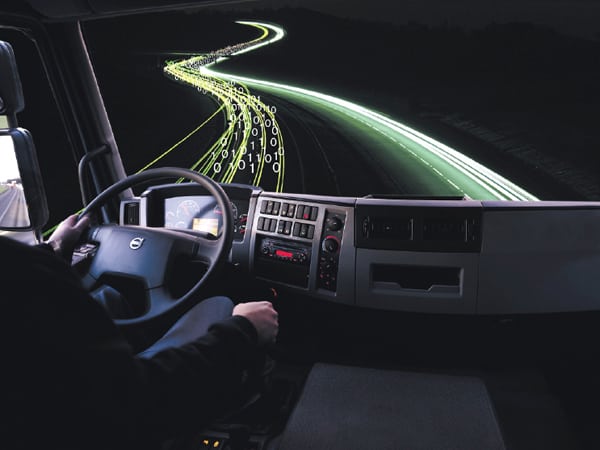 |
| 3. Adding a smart co-driver. The Safespot EU project develops technology that in the future could help prevent accidents in traffic snarls, construction zones, and crossroads. Courtesy: Volvo Trucks |
The safety truck will spotlight the development of systems and automation designed to assist the driver in repetitive traffic tailback situations characterized by monotonous low-speed progress. “The queue support system for trucks that is in production today works down to 30 kilometers per hour [km/h]. This is still a relatively high speed. We are working on queue support down to 0 km/h. What is more, the truck should automatically stop if the vehicle in front stops, and start moving again without the driver pressing the accelerator,” says Jakobsson.
Stay in the Right Lane
The other part of the automated queue support system that Jakobsson and her colleagues are working on is dedicated to keeping the truck in the correct lane. “Today’s lane support system issues an audible warning which requires that the driver responds. Now we are examining an entirely automated process so that the truck always drives in the middle of its lane without the driver having to do anything,” says Jakobsson.
This degree of automation is achieved through nine sensors installed on the safety truck: a lane and object camera above the windshield, a camera in the cab to monitor the driver’s status, two short-range radars (one on either side of the truck), and three lasers. In addition, the truck is fitted with vehicle-to-vehicle (V2V) communication and the E-Horizon system.
E-Horizon is a collective term for systems that are linked to map databases. With the help of GPS and highly detailed maps, the truck receives a continuous flow of information about gradients, curves, and crossings farther down the road, adjusting the driveline and tailoring progress so that it is as efficient and economical as possible.
V2V communication is a similar system that exchanges information with other vehicles in the vicinity. For instance, if the driver is in a traffic queue and a vehicle ahead slams on its brakes, the driver immediately receives a warning. In a traffic tailback, this means that the driver gets the necessary information several seconds before the vehicle immediately ahead hits the brakes.
This sensor-based technology also figures prominently in the other truck being developed as part of the project. It must be able to handle the use of a hybrid engine by optimizing the use of the combustion engine, electric motor, and correct gear ratio.
“Advance information from the sensors is a smart way of controlling the hybrid driveline, since we have two sources from which to obtain the power. We can also coach the driver in good driving habits that reduce fuel consumption—a sort of built-in driver training,” says Jakobsson.
—Contributed by Marie Vassiliadis (marie.vassiliadis@volvo.com), Volvo Trucks.