King Dionysius I, ruler of Syracuse, Italy, in the 4th century B.C., invited his courtier Damocles to exchange places with him for a day. While enjoying a feast, Damocles immediately lost his appetite when he noticed a sword suspended above him by a single horsehair. Dionysius, as they say in Las Vegas, was making his point the hard way: handling risk is part of a leader’s job, and danger can arise at the most unexpected times.
Today, utility executives have a better retirement plan than Dionysius, but there’s a figurative sword hanging over their heads: uncertainty about the timing and strength of future federal and/or state CO2 regulations. Congress currently seems to be favoring a European-style cap-and-trade approach over a straight tax on carbon emissions, but that may change once this election year passes. Indeed, it may take the rest of the decade to exorcise the devil from federal legislation that will surely raise everyone’s electricity rates and create a two-tier (large and small carbon footprint) national bulk power supply system.
Managing risk
The list of utilities that have decided to cancel a new coal plant rather than bear its unquantifiable carbon risk is growing. Last month, POWER’s 2008 industry forecast attributed the cause of this collective loss of appetite to FUD: fear, uncertainty, and doubt—each anathema to utility executives.
For example, last November Southern Company and Florida’s Orlando Utilities Commission terminated a 285-MW integrated gasification combined-cycle (IGCC) project just two months after it broke ground at the latter’s Stanton Energy Center. The stunning reversal of fortune was viewed as a slap in the face to the U.S. DOE, which was planning to pay $294 million of the project’s $855 million cost to make it a showpiece for the Bush administration’s Clean Coal Power Initiative.
Mike Tyndall, a spokesman for Southern Company, said no single event during the two-month period had changed the company’s mind about the IGCC project. “It was a culmination of the growing uncertainty,” he said of the cancellation decision. “The partners are just not able to take the financial risk.”
As another example, Florida’s Public Service Commission, citing potential CO2 control costs and other related project risks, last June rejected a proposed coal plant by Florida Power & Light. The “no” vote came shortly after Gov. Charlie Crist (R) issued an executive order to substantially reduce Florida’s emissions of the greenhouse gas. Fear of carbon risk wasn’t limited to the Sunshine State, parts of which are projected to end up under water if global warming raises worldwide sea levels. Far from any coast, two 700-MW coal-fired units that Sunflower Electric Power Corp. had proposed building at its existing plant near Holcomb were axed by the Kansas Department of Health and Environment in late October.
Perhaps another dozen coal projects have gotten a thumbs-down from a state regulator over the past year; the reason most often cited was the rising uncertainty of carbon controls or untenable project cost risks. The crazy quilt of different state carbon caps that could emerge if California’s emissions standards aren’t adopted as national standards would only heighten the FUD felt by utilities. Expect more utilities to take a wait and see position on carbon and, in the interim, resort to the lowest-risk option for adding capacity—building more gas-fired generation.
Big retrofit market
The industry may have put new coal projects on hold while it deals with carbon paralysis, but greater commercial opportunities for carbon capture lie with the future retrofitting of many of the 1,100-plus existing U.S. coal plants. Whether you prefer your carbon legislation with a cap-and-trade or a tax flavor, the aftertaste will be bitter: the need to build a small refinery on the power plant’s grounds.
Considerable chemical processing is needed to implement all of the post-combustion carbon capture processes that have proven their worth in the lab or at pilot scale and are now advancing toward commercial viability (POWER, October 2006, p. 60). Two processes that seem to have gathered the most steam in the marketplace are the chilled ammonia process favored by Alstom Power (see sidebar) and Powerspan’s Electro-Catalytic Oxidation (ECO) process, which was recently upgraded to include CO2 removal and relabeled ECO2. Powerspan and FirstEnergy Corp. plan to demonstrate the ECO2 process at a 1-MW (equivalent) pilot scale at the utility’s R.E. Burger plant in Ohio early this year (POWER, October 2007, p. 54).
There’s no doubt that Alstom is about to enter the flue gas treatment market; the company continues to fund an extensive R&D program whose target is to make a CO2 capture system commercially available before the end of 2011. The evolution of Alstom’s business development plans for its chilled ammonia systems has been transparent from the start:
- A 5-MW (equivalent) pilot plant with EPRI and We Energies.
- A 5-MW demonstration plant for E.ON in Sweden.
- A 30-MW (equivalent) product validation unit for American Electric Power (AEP), followed by the design, construction, and commissioning of a commercial-scale (up to 200 MW) unit by 2011.
- A 40-MW (equivalent) product validation facility for Statoil in Norway.
Inside Alstom’s chilled ammonia CO2 capture system
You don’t need a degree in chemical engineering to understand Alstom’s chilled ammonia CO2 removal process—but it wouldn’t hurt. First, let’s break the entire process down into three separate process blocks (Figure 1) and follow the exhaust gas as it leaves the plant and is treated to remove its CO2.
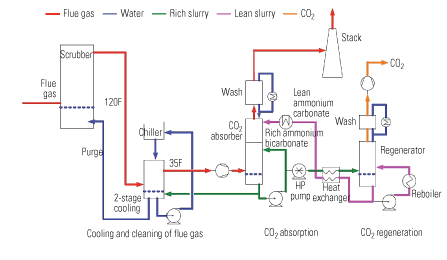
1. Coming to a coal plant near you? Schematic of a commercial chilled ammonia CO2 capture system added between a plant’s existing flue gas scrubber and stack. Source: Alstom
One key point about Alstom’s chilled ammonia design is that it does not require extremely low levels of SO2 removal from flue gas. If the candidate plant already has a scrubber operating at a 95% removal rate, and its steam system can be reconfigured to accommodate the process steam demand, a chilled ammonia system may be just the ticket, assuming there’s sufficient space for it.
Step 1: Cool and clean the gas
The first step is to cool and clean the flue gas, which typically is at 120F to 140F, is water-saturated, and contains residual amounts of SO2, NOx, HCl, and particulate matter. Both steps can be accomplished by injecting refrigerated water directly into the gas stream. As the gas is cooled, much of its water content condenses out, carrying the residual contaminants with it. The water is then evaporated in cooling towers, substantially reducing the total flue gas volume. The cooled flue gas leaves as a chilly (35F) and dry (<1% moisture) gaseous substance.
Cooling the flue gas first pays big dividends by reducing the size and cost of equipment required downstream. For example, if the volume of the saturated flue gas is one-third smaller at 32F than at 140F, a smaller, cheaper induced-draft fan would suffice. Flue gas cooling itself consumes only 1% to 2% of the plant’s power output.
Step 2: Absorb the CO2
The second process step is CO2 absorption, which is similar to the SO2 absorption common at many coal-fired plants today. After the 35F flue gas enters the bottom of the absorber vessel, it is forced upward against the current of a slurry containing a dissolved and suspended mix of lean ammonium carbonate (AC) and rich ammonium bicarbonate (ABC). Chemical reactions remove over 90% of the CO2 in the flue gas, leaving it only with nitrogen, excess oxygen, and low concentrations of CO2. Any residual ammonia is captured by a cold-water wash and returned to the absorber.
Step 3: Separate the CO2
The third step of the process takes the CO2-rich slurry at 1,200 to 1,500 psi (anticipated for commercial use or for transportation to an enhanced oil recovery process or sequestration) from the ABC-rich output of the high-pressure pump and directs it to a heat exchanger. The heat exchanger dissolves the slurry into a clear solution at about 175F and sends it on to the high-pressure regenerator, where additional heat is added by a reboiler to strip away the CO2 gas. The only by-product of the entire process is a small amount of water; it can either be treated by the plant’s wastewater system or recycled and reused.
A baseline study on the auxiliary load and cost of a full-scale CO2 capture project found that retrofitting a 462-MW supercritical pulverized coal–fired boiler operating at 40.5% net thermal efficiency would result in only small performance penalties (see table).
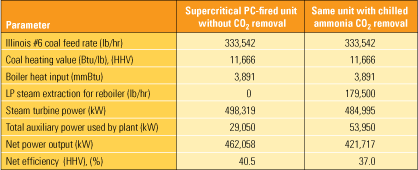
The performance penalties of a chilled ammonia CO2 separation system. Source: Alstom Power
Taking the first step
Alstom’s first carbon capture pilot project is currently under construction at We Energies’ Pleasant Prairie Power Plant (P4) in Kenosha County, Wis. (Figure 2). Working closely with EPRI, Alstom is responsible for the design, construction, and operation of the $10 million pilot plant, which engineers hope will be able to extract 90% of the CO2 from 1% of the flue gas produced by one of the plant’s two 617-MW coal-fired units. Project costs are spread among more than 30 project sponsors. The goal of the project is to capture about 15,000 tons of CO2 per year (Figure 3).
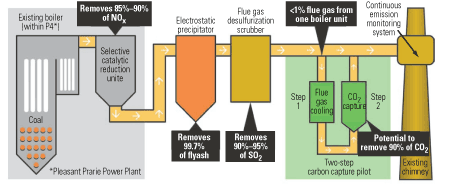
2. Beta version. This two-step, 5-MW (equivalent) pilot CO2 capture process is being implemented at We Energies’ Pleasant Prairie Power Plant. Source: Alstom
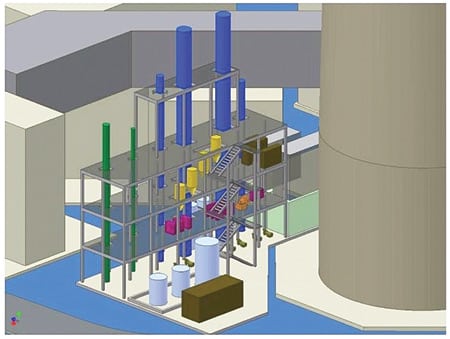
3. Virtual design. This 3-D representation depicts the completed pilot plant at Pleasant Prairie. Courtesy: Alstom
Construction of the pilot plant began last September; the plant will be operational by press time. Alstom will then operate the plant for at least one year while EPRI evaluates the performance of the technology from several perspectives (Figure 4). Specifically, Alstom and EPRI will:
- Validate operation of the entire system on actual flue gas.
- Measure the actual heat of reaction and compare it to theoretical values.
- Develop and evaluate the process control logic and operating system.
- Operate the system in long-term tests to identify O&M issues and establish system reliability baselines.
- Conduct a techno-economic analysis of scaling up the system for commercial use (Figure 5).
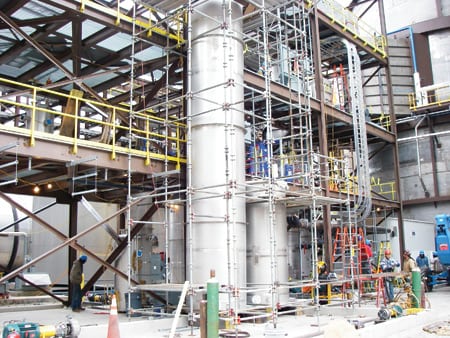
4. Up and running. The chilled ammonia pilot plant began operation in January. Courtesy: Alstom
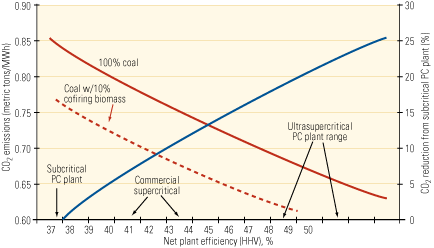
5. CAFE vs. CO2 standards for plants. As with automotive fuel economy, the effect of overall power plant efficiency on CO2 emissions can be significant. For example, a 47% efficient supercritical plant “naturally” has about 20% less CO2 in its flue gas than a 37% efficient subcritical plant. Today’s U.S. coal-fired fleet has an average thermal efficiency of about 33%. The curves shown were derived from plants firing Pittsburgh #8 coal. Source: Alstom
“The development of cost-effective carbon capture technology is one of the most important environmental challenges facing the utility industry in the 21st century,” said Gale Klappa, chairman, president, and CEO of Wisconsin Energy, the parent company of We Energies. “This pilot is a crucial step in the research and development process necessary for achieving a long-term technology solution.”
This pilot project is just the latest in a long line of improvements at the Wisconsin plant. Last October, POWER designated P4 as one of its Top Plants of 2007 on the strength of several recently completed air emissions upgrade projects. We Energies has added a hot-side selective catalytic reduction (SCR) system to Unit 1 and a wet-limestone, forced-oxidation scrubber to both units. Unit 2 was retrofitted with a hot-side SCR system in 2003.
Other steps to follow
Meanwhile, Alstom and AEP have signed an agreement to bring Alstom’s chilled ammonia process for CO2 capture to full commercial scale by 2011. The project will be implemented in two phases. In phase one, Alstom and AEP will jointly develop a 30-MW (equivalent) product validation plant that will capture more than100,000 tons of CO2 per year from the flue gas of AEP’s 1,300-MW Mountaineer Plant in New Haven, W.Va. Notably, the captured CO2 will be sequestered in deep saline aquifers at the site. This pilot project is scheduled to start up at the end of 2009 and operate for at least 12 to 18 months.
In phase two, Alstom will design, build, and add the first commercial-scale (up to 200-MW) CO2 capture system to one of the 450-MW coal-fired units at AEP’s Northeastern Station in Oologah, Okla., by late 2011. If the system captures about 1.5 million tons of CO2 a year, Alstom will consider the accomplishment a successful validation of the chilled ammonia separation technology. The CO2 captured at Northeastern Station will be used for enhanced oil recovery.
Alstom’s 5-MW (equivalent) CO2 capturing demo plant being built at E.ON’s Karlshamn Power Plant in southern Sweden is expected to begin operation later this year. The two companies plan to introduce the technology at other Swedish power plants if it passes muster.
For the longer term, Alstom has signed a joint development contract with Norway’s state-owned oil gas and company, Statoil-Hydro, to test the chilled ammonia technology’s ability to remove the CO2 from flue gases particular to natural gas–fired combined-cycle power plants. The first milestone of the agreement calls for designing and building a 40-MW (equivalent) test and product validation facility at Statoil’s Mongstad refinery in Norway by 2009–2010. The facility will then be operated for up to a year and a half to see whether it can capture at least 80,000 tons per year of CO2, either from flue gases from the refinery’s cracker unit or from a new combined heat and power plant now under construction on-site. A commercial-scale unit now in the early planning stages for Mongstad would capture over 2 million tons of CO2 per year.
Policymakers try to keep pace
Once CO2 has been removed from a power plant’s flue gas, what can and should be done with it? Given that a 1,000-MW coal plant produces about 3 million pounds of CO2 per hour, storing it on-site is not an option.
A bill called the Carbon Dioxide Pipeline Study Act of 2007 recently introduced by Sen. Norm Coleman (R-Minn.) would require the DOE to identify and resolve key obstacles to commercializing CO2 sequestration, transportation, and storage technologies. S. 2144 also would ensure that a robust national CO2 infrastructure would be created as part of any federal climate change legislation.
Last year also saw the introduction of the National Carbon Dioxide Storage Capacity Assessment Act of 2007 (S. 731) by Sen. Ken Salazar (D-Colo.) and The Department of Energy Carbon Capture and Storage Research, Development and Demonstration Act of 2007 (S. 962) by Sen. Jeff Bingaman (D-N.M.). The three bills are meant to work together to bring all relevant federal departments and regulators (Energy, Interior, Transportation, the Federal Energy Regulatory Commission, and the Environmental Protection Agency) together to address the broad range of policy questions surrounding CO2 sequestration, transportation, and storage.