Just as the Internet changed the way we communicate, so will the “smart grid” transform the way we deliver electricity. The Internet’s success is largely due to its networking capabilities. In a similar way, the smart grid will use broadband capabilities and high-speed computing to revolutionize the transmission and distribution of power to end users.
Though the notion has been around for at least a decade, there’s no consensus about what constitutes a smart grid. However, the many government, industry, technology, and policy groups that have been working to advance the idea from theory into practice (see sidebar, "Who’s shaping the smart grid" ) do agree that, in general, a smart grid will use digital technologies to enable integrated, real-time control of all the system’s elements, from generation to end use.
Future grid features
Industry observers agree that the basic way the U.S. power grid operates has not changed much in the past 100 years. Now, however, as a result of electricity deregulation and market-driven pricing in parts of the U.S., utilities are looking for a means to match the consumption of electricity with its generation. Many in the industry have a vision of a fully network-connected power grid that identifies all aspects of the grid and communicates their status and the impact of consumption decisions to automated decision-making systems.
The general definition of a smart grid, according to a recent white paper by power generation analysts at Xcel Energy, is an intelligent, auto-balancing, self-monitoring power grid that takes a variety of fuel sources (coal, sun, and wind, for example) and transforms them into electricity for consumers’ end use (heat, light, and warm water) with minimal human intervention. They assert that it is a system that will allow society to optimize the use of renewable energy sources and minimize our collective environmental footprint. A smart grid has the ability to sense when a part of its system is overloaded and reroute electrons to reduce that overload and prevent a potential outage. Additionally, it is a grid that enables real-time communication between the consumer and the utility, allowing the utility to optimize a consumer’s energy usage based on that person’s environmental and/or price preferences.
Several utilities have run pilot projects involving one or more smart grid technologies over the past decade or so. Most common has been the installation of advanced metering to enable time-of-use pricing programs that are designed to shave demand peaks. But Xcel Energy’s plan appears to be the most all-inclusive one yet.
Examples of technology being tested by Xcel Energy for future use to build intelligence into the power grid are as follows:
- Neural networks: This project creates a state-of the art system that helps reduce boiler slagging and fouling. Boiler sensors plug directly into the plant’s distributed control system. Neural networks will model slagging and fouling by using historical data to “learn” boiler behavior.
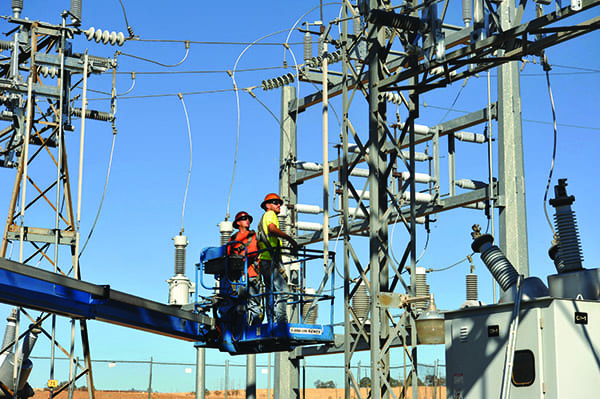
- Smart substation: This project is retrofitting an existing substation (Merriam Park) with cutting-edge technology for remote monitoring of critical and noncritical operating data. It includes developing an analytics engine that processes massive amounts of data for near-real-time decision-making and automated actions. The team will monitor breakers, transformers, batteries, and substation environmental factors, such as ambient temperatures and variable wind speeds.
- Smart distribution assets: This project tests existing meter communication equipment that can automatically notify Xcel Energy of outages and help the utility restore service more quickly.
- Smart outage management: This project tests diagnostic software that uses statistics on eight factors, including equipment maintenance and real-time weather, to predict problems on the power distribution system and create an outage-cause model. A substation feeder analysis system can detect and predict cable and device failures on monitored substation banks.
- Consumer web portal: This project will allow customers to program or preset their energy use for specified devices (such as air conditioners or dishwashers, for example) and automatically control power consumption based on hourly energy costs and environmental factors.
- Wind power storage: This project tests a 1-MW battery energy storage system connected directly to a wind turbine at the MinnWind wind farm in southwest Minnesota in an effort to store wind energy and return it to the grid when it is most needed. It is expected to demonstrate long-term emission reductions from increased availability of wind, help reduce impacts of wind variability, and allow Xcel Energy to meet renewable portfolio standard requirements.
In December 2007, Xcel established the Smart Grid Consortium, bringing together leading technologists, engineering firms, business leaders, and IT experts. Consortium members include Accenture, Current Group, Schweitzer Engineering Laboratories, and Ventyx. The group is providing guidance, products, and services needed to promote the implementation of Xcel’s smart grid vision (see sidebar, "Tommorow’s grid today").
Specifically, the consortium partners will make the following contributions:
- Accenture will provide guidance for best business/consumer outreach practices and overall IT integration consultin
- Current Group will provide the communications network (broadband over power lines) to connect all the smart grid components and allow them “talk” to each other (interconnectivity).
- Schweitzer Engineering Laboratories will provide substation technology and infrastructure such as monitors, relays, sensors, and switches for smart substations.
- Ventyx will provide work management solutions for deploying the smart grid technologies by identifying the right tools and sending the right crews to the right place, when needed. It will also provide planning and analytics for price and load forecasts as well as decision support for connecting customer actions to trading and investment decisions in real time.
Boulder leads the way
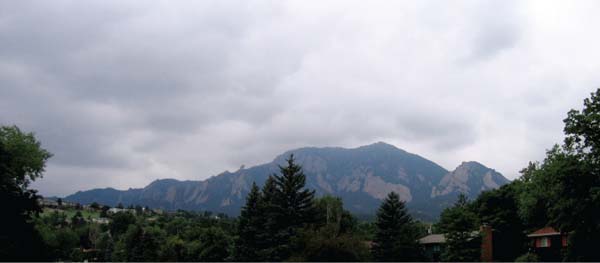
In an effort to give its smart grid vision a face, Xcel Energy has chosen Boulder, Colo. (Figure 1), to be the nation’s first “Smart Grid City.” When fully implemented over the next few years, the planned system will provide customers with a portfolio of technologies designed to provide environmental, financial, and operational benefits. Xcel Energy anticipates funding only a portion of the project and plans to leverage other sources, including government grants, for the remainder of what could be up to a $100 million effort.
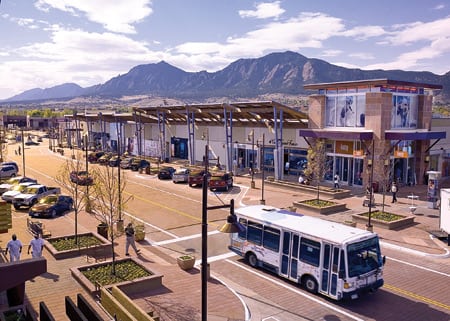
1. Prototypically Boulder. Boulder’s highly educated residents have long been known as early adopters of progressive ideas and emerging technologies—especially those related to the environment. It’s no surprise that a city that insists on pedestrian- and bike-friendly shopping centers (like the recently redeveloped 29th Street Mall pictured here, whose REI store earned one of the first U.S. Green Building Council Leadership in Energy and Environmental Design [LEED] Retail certifications) would embrace the idea of a modernized grid that promises efficient resource use and enhanced customer control. Source: Xcel Energy
“We realize this is an enormous task, which is why we are taking a collaborative approach to getting it done. Smart Grid City can only be accomplished with assistance from all the stakeholders involved and with the help of our consortium partners,” Michael Lamb, managing director of IT operations and strategy at Xcel Energy, said in an interview with POWER in March.
In addition to its geographic concentration, ideal size, and access to all grid components, Boulder was selected as the first Smart Grid City because it is home to the University of Colorado and several federal institutions, including the National Institute of Standards and Technology, which already is involved in smart grid efforts for the federal government.
Smart Grid City (Figure 2) could feature a number of infrastructure upgrades and customer offerings, including:
- Creation of a communications network providing real-time, high-speed, two-way communication throughout the power distribution grid (via broadband over power lines).
- Conversion of substations to “smart” substations capable of remote monitoring, near-real-time data collection and communication, and optimized performance.
- Installation, at the customer’s invitation, of programmable in-home control devices and the necessary systems to fully automate home energy use (Figure 3).
- Integration of infrastructure to support easily dispatched distributed generation technologies (such as plug-in hybrid electric vehicles with vehicle-to-grid technology, battery systems, wind turbines, and solar panels).
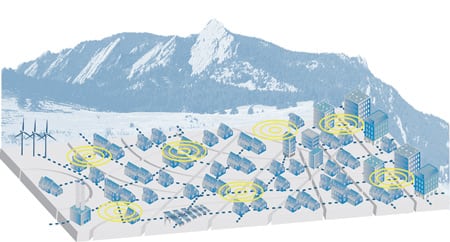
2. Xcel Energy’s concept of a Smart Grid City. It all depends on a dynamic system rich in information technology; high-speed, real-time, two-way communications; sensors throughout the grid enabling rapid diagnosis and correction; decision-making data and support for peak efficiency; distributed generation; automated “smart substations”; in-home energy control devices; and automated home energy use. Source: Xcel Energy

3. A smart house. Though many industrial users have for some time had the option of managing their energy budget by participating in time-of-use pricing and voluntary load-shedding programs, a smart grid could give residential customers similar—or even greater—control over their energy use. Source: Xcel Energy
The first phase of Smart Grid City is expected to be in place by as early as August 2008. Implementation throughout the city will continue through 2009. The consortium expects to begin initial assessment of the technologies in 2009. After initial implementation and assessment, Xcel Energy will use the results from this effort to talk with state, federal, and regulatory officials about a larger deployment throughout the company’s eight-state service territory.
“We don’t yet have a full understanding of the technical and economic challenges that we will face while implementing the smart grid system,” said Lamb. “That’s why the implementation of Smart Grid City is so important. Boulder will be the nation’s first fully integrated Smart Grid City and will serve as a test-bed for how all these technologies work together.”
Demand-response technologies hold the key
Several years ago, the U.S. Department of Energy (DOE) launched an initiative called GridWise, which promotes the agency’s vision that in the near future information technology will profoundly transform the planning and operation of the power grid. GridWise envisions a collaborative network—from generation down to customer appliances and equipment—filled with information and market-based opportunities.
DOE’s Pacific Northwest National Laboratory (PNNL) is the national lab most involved in developing new technologies designed to increase the grid’s ability to provide energy that is reliable, affordable, and clean. Robert Pratt, PNNL project manager for the GridWise project, told POWER that PNNL is helping with the formation of the GridWise Alliance, a collection of smart grid industry leaders and innovators who have been instrumental in moving demand response from a concept to a reality.
In addition, PNNL program leaders are conducting field demonstrations, such as the recently completed Pacific Northwest GridWise Testbed Demonstration of advanced demand-response network operations. This year-long demonstration project connected 112 homes with real-time electricity price information through new advanced meters and programmable thermostats connected via Invensys Controls home gateway devices to IBM software. The final results showed that participants saved approximately 10% on their energy bills and did not want to give up their grid-responsive appliances.
Such demonstrations highlight the benefits of demand-response technologies, including the ability to mitigate peak demand and increase reliability by making the grid more flexible and adaptable. They show how benefits could be derived even down to the distribution system level. Additional benefits include the ability to provide frequency regulation services that could make it easier to operate wind power resources on the grid and thereby help promote wind power penetration.
“Of note, the demonstrations led by PNNL gave consumers complete control over how much and when they participated, by providing them with simple, automated controls that responded to real-time (5-minute) prices reflecting the value of their response to the grid, and literally sharing some of that financial value with them as a reward,” said Pratt. “We feel this will be critical in gaining broad public acceptance of smart grid technologies as a natural part of everyday life.”
PNNL also has developed the means to allow even small household appliances, such as clothes dryers and refrigerators, to help keep the grid reliable. This is done by adding a simple controller that autonomously senses a grid frequency or voltage disturbance and then drops the load for up to a minute or two to “help out.”
According to Pratt, PNNL has shown in a field demonstration that this simple device is reliable and its operation is not noticed by the consumer. Because enabling this capability does not require communications, it can be inexpensive enough to build it into appliances at the factory. The result, if enough appliances were so enabled, could be a vast safety net to help keep our grid reliable.
Smart metering is the key enabling technology for demand response. It provides the hardware necessary to start moving the ball forward. “Until you can provide an incentive for customers or distributed resources to collaborate with the needs of the grid, they won’t,” Pratt said. “And, until you can measure the degree of that collaboration with some good time resolution, you can’t offer those incentives.”
Additionally, PNNL is developing GridLAB-D—an open-source time-series simulation of the smart grid from each individual appliance all the way up to substation operations—as a platform for designing technologies and control strategies and determining their benefits.
“We are hoping GridLAB-D becomes the basis for extensive technical collaboration among researchers and technology developers engaged in realizing various aspects of the smart grid,” Pratt said. “We are also looking at how these same smart grid concepts could be applied to managing the charging of large numbers of plug-in hybrid electric vehicles without adding new generation or T&D capacity.”
Challenges remain
Clearly, implementation of a smart grid will force U.S. utilities to deal with several complicated issues.
“First, consumer acceptance will be critical,” said Pratt. “It is important that they maintain control and can participate in demand response but do so to their own comfort level. Nobody wants to feel like the power company has the ability to control when you turn the air conditioner on. We found that even when consumers maintain control you can engage them enough that they will play along and reduce peak demand as much as 50% for short periods of time.”
Another looming issue is related to smart grids’ financial viability. State regulators need to allow utilities to earn a fair rate of return on smart grid investments, just as they do with the traditional grid infrastructure that smart grid investments displace, according to Pratt.
The PNNL project manager also focused on challenges related to the increased use of renewable energy sources, which could negatively affect the smart grid. He pointed out that in the face of the need to manage carbon emissions, there is tremendous pressure to rapidly bring large amounts of renewable generation onto the grid. Essentially, that means wind power in the near term, with extensive solar photovoltaics (PVs) following, as costs come down.
“[Renewable sources] add a great deal of complexity to grid operations. One challenge with wind power is that it is an intermittent resource. We can forecast wind to a degree, but many fluctuations are very rapid, and other generation must ramp up or down to compensate,” Pratt said. “Those fluctuations make a grid that is already hard to operate that much harder.”
He gave the example that during this past winter a fluctuation in wind output in West Texas was so large and rapid that power plants could not compensate. An unexpected cessation of wind power caused the regional transmission authority (ERCOT) to implement its voluntary load-curtailment program (which pays industrial users for ramping down power usage or going off-line temporarily to reduce load and avoid a blackout). That event was a tangible example of the complexity of using intermittent renewable energy resources.
“One thing we can do with a digital power grid is to use demand capability to soak up fluctuations in wind—creating a partnership. That will help solar, too. Unlike wind power, solar PVs are usually connected to the grid at a home or building,” Pratt said. “When there are enough of them to actually push power back up the lines toward the substation, new dynamic schemes for voltage regulation and short-circuit protection will be required.”
Higher grid IQ benefits
Overall, the transition to a smart grid should be a positive one for consumers, utilities, shareholders, and regulators. Consumers will be able to manage their energy consumption and peak demand by modifying their electricity usage habits and lifestyle. The PNNL demonstration project found that participants were able to accommodate these changes without bother. Utilities will benefit by having more-reliable systems, which will translate into a reduced need for building additional capacity. In return, consumers should get more control over their energy bills.
Customer participation in demand-response programs will close the loop between generation and consumption that power market economists have yearned for for years. As a result, utilities will be better able to manage energy demand with available resources and, thereby, create higher financial returns for investors. Automation and better feedback about individual consumers’ demand and consumption patterns should lead to more-efficient use of resources and lower operating costs.