Major power outage events in 2025 reveal a broad spectrum of reliability risks, spanning voltage instability and protection failures to extreme weather and heat-related transmission stress. Compared with recent years, which were largely characterized by weather-driven disruptions and resource-adequacy events, 2025 incidents more clearly highlight vulnerabilities in interconnected system operations, including voltage management, reactive power balance, and protection coordination.
The shift is documented in the International Energy Agency’s (IEA’s) Electricity report series, which tracks global power sector trends, reliability risks, and the evolving challenges of grid integration across more than 50 countries. IEA’s Electricity 2024 report—which first included a dedicated reliability chapter—focused primarily on weather-driven outages and generation-adequacy failures, including ice storms, Hurricane Beryl, which knocked out power for millions of Texans, and fuel supply crises plunging Cuba, Lebanon, and Ecuador into darkness. Last year, Electricity 2025 flagged the compounding risks of variable renewable energy (VRE) droughts—including Europe’s November and December 2024 Dunkelflaute events. That report warned that as VRE penetration rises, power system security would increasingly depend on dispatchable capacity, long-duration storage, and system inertia. Electricity 2026, released in February 2026, suggests the challenge goes beyond generation adequacy and storm hardening. It points to the operational complexity of managing interconnected grids under high renewable penetration—specifically voltage stability, reactive power balance, and protection coordination—and notes the need for heightened scrutiny as record-high connection queues and surging data center demand place unprecedented stress on transmission infrastructure worldwide.
Sources: POWER; International Energy Agency (IEA), Electricity 2026 (February 2026).
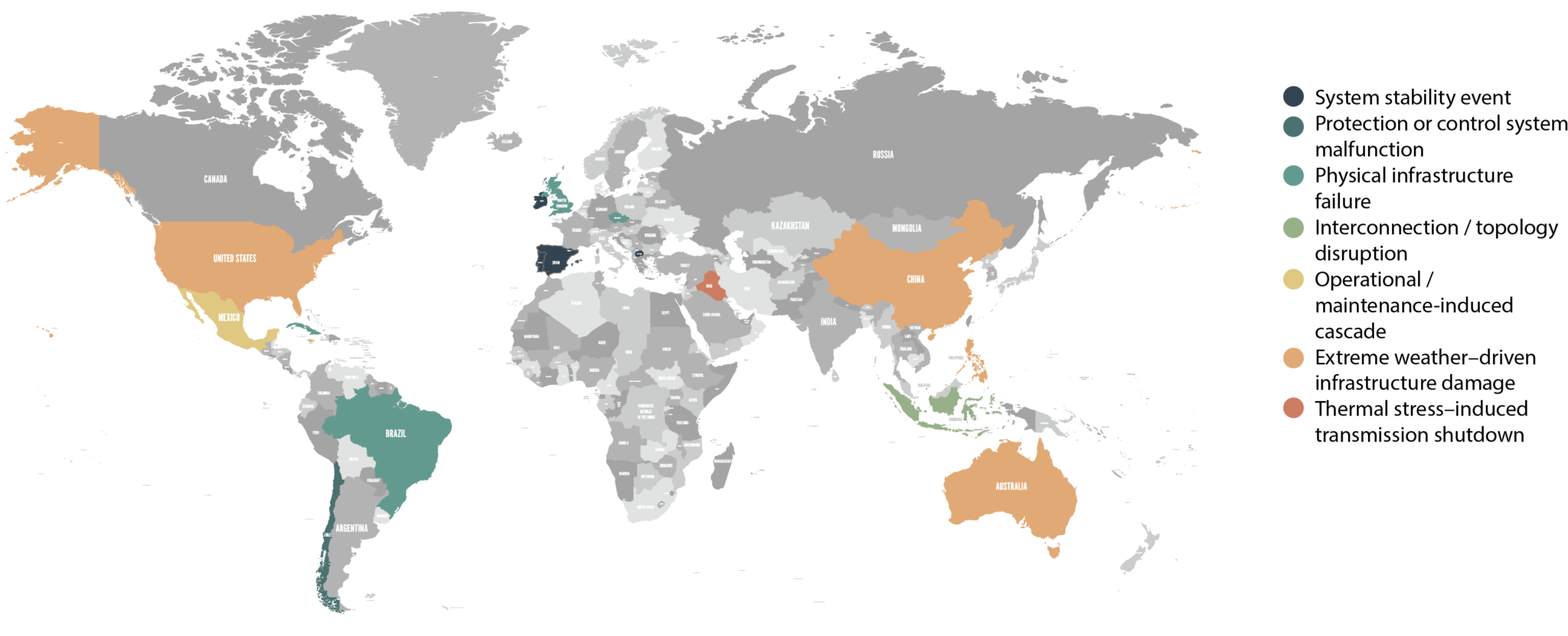
Event Categories
- ■ System stability event
- ■ Protection or control system malfunction
- ■ Physical infrastructure failure
- ■ Interconnection/topology disruption
- ■ Operational/maintenance-induced cascade
- ■ Extreme weather–driven infrastructure damage
- ■ Thermal stress–induced transmission shutdown
Extreme Weather–Driven Infrastructure Damage
Widespread Storm Impacts | Multi-State Infrastructure Damage
Winter Storm Blair opened the year by leaving more than 300,000 customers without power across seven states in January, as heavy ice accumulation snapped poles and downed lines from the Midwest to the mid-Atlantic. In March, a tornado outbreak spanning 180 tornadoes across central, southeastern, and eastern states—the second-costliest U.S. weather event of 2025 at $11 billion—left more than 230,000 homes and businesses without power across Texas, Arkansas, Louisiana, Alabama, Missouri, Illinois, and Indiana. A second major tornado outbreak in May swept across the central and eastern U.S., causing more than 600,000 power outages and $6.3 billion in damage. On April 29, a derecho-scale wind event with gusts exceeding 80 mph raced across Pennsylvania, cutting service to hundreds of thousands; the Pennsylvania Public Utility Commission’s January 2026 post-storm report cited the event as a critical test of utility emergency coordination.
By mid-2025, 45% of U.S. utility customers had experienced at least one outage—nearly half attributable to extreme weather—and the average duration of the longest outage had climbed to 12.8 hours, up from 8.1 hours in 2022, according to J.D. Power. The cumulative toll reflects a trajectory the North American Reliability Corporation (NERC) has been tracking with growing urgency. As POWER has reported, demand growth is now outpacing resource additions at the fastest rate since NERC began tracking in 1995. NERC’s 2025–2026 Winter Reliability Assessment warns that ERCOT, SERC, and several other regions face an elevated risk of supply shortfalls under extreme wide-area weather conditions—a finding reinforced by its latest Long-Term Reliability Assessment’s call for accelerated infrastructure development and improved gas-electric coordination.
Interconnection/Topology Disruption
Beyond weather-driven outages, two additional incidents in 2025 sharpened concern about structural vulnerabilities in interconnected grid operations. In February, approximately 40 data centers in Virginia’s Loudoun and Fairfax counties—consuming roughly 1,800 MW, enough to power more than one million households—simultaneously transferred to backup power following a high-voltage line failure, causing load to vanish from the PJM grid in seconds. The event was the second such incident in Northern Virginia in less than a year, following a July 2024 episode in which 1,500 MW of data center load dropped across 60 facilities and 25 substations after a 230 kV transmission line fault. NERC flagged both incidents as evidence that voltage-sensitive data center loads represent a new and largely unplanned-for class of grid stability risk—and launched a Large Loads Task Force to study their impact. Separately, NERC’s April 2025 Level 2 Alert on inverter-based resources (IBRs) found that since 2016, more than 15,000 MW of unexpected generation loss had occurred across 10 major bulk power system events—with 66% of generator owners applying protection settings that limit inverter ride-through, and 20% of solar PV sites operating under power factor limitations that reduce available reactive support to the grid.
Extreme Weather–Driven Infrastructure Damage
Extreme Wind Damage | Distribution Rebuild Required
Storm Éowyn struck Ireland on January 24, 2025—the worst storm since Hurricane Debbie in 1961—delivering gusts exceeding 130 km/h and knocking out power to 768,000 homes, farms, and businesses, roughly one-third of all premises in the Republic. ESB Networks described damage to approximately 3,000 poles and 900 kilometers of conductor as “unprecedented in scale”—requiring physical rebuilding of distribution assets rather than routine restoration, and drawing mutual aid crews from the UK and EU. Nearly 39,000 customers remained without supply more than a week later, while cascading outages disabled water treatment plants serving 217,000 households and destroyed what telecoms regulator ComReg described as the largest impact on Ireland’s national telecommunications userbase in its recorded history. The Irish government’s whole-of-government recovery response placed estimated insurance claims at €300 million—the most expensive weather event in Ireland in 25 years.
Protection or Control System Malfunction
Protection System Malfunction | North–South Grid Separation
On Feb. 25, 2025, at 3:16 p.m. local time, a communication channel failure during routine troubleshooting at a 500-kV substation operated by ISA Interchile—a subsidiary of Colombian state-owned ISA—caused differential protection functions on both circuits of the critical Nueva Maitencillo–Nueva Pan de Azúcar double-circuit line to automatically deactivate. The inadvertent relay operation tripped the backbone 500-kV corridor carrying power from the Atacama Desert to Santiago, cascading into failures on the parallel 220-kV network and separating the national grid into two islands within seconds. With approximately 1,800 MW flowing on the 500-kV corridor at the time of the event, neither island could maintain frequency and voltage within safe parameters. The blackout plunged 98% of Chile’s population—approximately 19 million people across 14 regions—into darkness, shutting down the Santiago Metro, disabling traffic signals, halting copper mine operations, and cutting internet connectivity to 25% of normal levels. President Gabriel Boric declared a state of emergency and imposed a curfew. Power was restored to 90% of customers within 24 hours, but 220,000 customers remained without service as grid instability persisted.
Physical Infrastructure Failure
Substation Breakdown | Nationwide System Collapse
Cuba’s power grid suffered two more nationwide collapses in 2025. On March 14, a failure at the Diezmero substation on the outskirts of Havana triggered the total collapse of the National Electric System (SEN), plunging all 10 million residents into darkness—the fourth islandwide blackout in six months. On Sept. 11, a false overheated-steam signal in the boiler control system triggered the automatic shutdown of the 330-MW Antonio Guiteras thermoelectric plant in Matanzas—the island’s largest generating unit—cascading into another total SEN disconnection lasting more than 24 hours. Both events reflect the structural fragility POWER has documented across multiple collapses: a thermal fleet composed largely of oil-fired plants that have surpassed their 30-year design lifespan, are routinely degraded by high-sulfur crude, and operate without meaningful reserve margin—conditions detailed in POWER‘s breakdown of the 2024 grid collapses that made each equipment anomaly a potential islandwide event.
Physical Infrastructure Failure
Transformer Fire | Redundancy Failure at Critical Infrastructure
At 11:21 p.m. on March 20, 2025, SGT3—one of three supergrid transformers at National Grid’s North Hyde 275-kV substation in Hayes, West London—tripped and caught fire. Moments later, the adjacent SGT1 also tripped, simultaneously losing connection to the remaining SGT2 and cutting all power from the substation. As POWER reported, the cascade produced an N-2 condition that the system had no design basis to survive, closing Heathrow—Europe’s busiest airport—for more than 16 hours, disrupting more than 1,350 flights and approximately 270,000 passengers. National Grid and SSEN Distribution worked through the night to reconfigure the network; full supply was not restored to all 64,000 affected customers until 6 a.m. on March 22. The National Energy System Operator’s (NESO) final report, commissioned by the Department for Energy Security and Net Zero and Ofgem, concluded that moisture ingress into a high-voltage bushing caused a “catastrophic failure”—and that an elevated moisture reading had been detected in 2018 but never remediated. Energy regulator Ofgem called it “a preventable, technical fault”; Energy Secretary Ed Miliband described the findings as “deeply concerning.” The incident exposed a critical gap between design-basis N-1 redundancy assumptions and operational reality at critical national infrastructure—a concern POWER’s inquiry coverage placed squarely in the broader context of aging transmission assets and deferred maintenance across the UK grid.
Extreme Weather–Driven Infrastructure Damage
Cyclone Damage | Prolonged Restoration Challenges
In late October 2025, a series of severe thunderstorms swept across southeast Queensland and New South Wales, producing hailstones up to 7 cm in diameter and wind gusts exceeding 95 km/h. On Oct. 26 alone, more than 73,000 customers lost power across southeast Queensland, including 35,500 in the Brisbane LGA, according to Queensland Energy Minister David Janetzki, with approximately 30,000 still without supply the following day as crews worked in 39C heat. A second severe storm on Oct. 31 again hammered southeast Queensland, extending the restoration burden across Energex and Ergon networks. In late November, around 75,000 properties lost power across Sydney and central western NSW as high winds and heavy rain swept through the state.
System Stability Event
Overvoltage Cascade | Synchronous Area Disconnection
At 12:33 CEST on April 28, 2025, Europe’s most severe blackout since 2003 unfolded in under five seconds. According to the ENTSO-E Expert Panel’s factual report, generators totaling 2,200 MW tripped in southern Spain, causing voltage to surge beyond operational limits across large parts of the Spanish transmission network. Frequency declined rapidly; automatic defense mechanisms activated, including the disconnection of 2.6 GW of pumped storage operating in pumping mode and the shedding of 3.6 GW of load via under-frequency relays. Within 1.5 to 5 seconds of the initial generator trip, a second generator tripped along with a massive disconnection of renewable energy sources across Spain; the AC interconnectors between France and Spain then tripped on loss-of-synchronism protection, islanding the Iberian Peninsula entirely and disconnecting 31 GW of load. As POWER reported in its early analysis, voltage swung from as low as 337 kV to as high as 450 kV on the 400-kV grid within seconds—an atypical cascading mechanism rarely seen at this scale.
The ENTSO-E Expert Panel’s preliminary analysis found two distinct oscillation periods in the 30 minutes prior—the first a local oscillation between 12:03 and 12:07, the second an inter-area oscillation beginning between 12:16 and 12:22—warning signals that did not trigger preventive action. A September 2025 investigation by the Institute of Technological Research (IIT) at Pontifical Comillas University identified four underlying causes: voltage instability in the days preceding the event—with surges observed on April 16, 22, and 24; insufficient synchronous generation online; a fragile transmission network state; and an inadequate security margin against overvoltage. ENTSO-E confirmed solar and wind generation levels were consistent with preceding days and seasonal averages, ruling out renewable overproduction as a direct trigger. As EPRI concluded: “It was a blue-sky day. No storm, no cyberattack, no extreme demand. And yet, a series of small factors aligned to create a continent-scale blackout in under 30 seconds.” EPRI’s Sean McGuinness was direct: “There were sufficient reserves to handle two gigawatts of generation loss. But once the third plant tripped, the system had no remaining flexibility.”
EPRI identified three priority lessons: improved real-time voltage control and rebalancing of static and dynamic reactive power resources; a review of protection settings for rooftop solar and behind-the-meter systems, some of which tripped while voltages were still within normal range; and attention to procedural and regulatory gaps across the full asset lifecycle—from planning through operations, including a new voltage-stabilization rule for inverter-based resources planned for later in 2025 that had not yet been implemented at the time of the event. Cross-border restoration via France and Morocco’s ONEE enabled recovery: 62% of Spanish substations were re-energized within 9.5 hours, all substations restored within 15.5 hours, and full load within approximately 24 hours. Portugal restored power within 12 hours. At least eight people died in outage-related circumstances across the Peninsula.
Interconnection/Topology Disruption
Subsea Interconnection Disruption | Island Dependency Exposed
At 4:05 p.m. local time on May 2, 2025, a fault in the high-voltage Java-Bali undersea transmission cable caused all power plants on the island to trip offline simultaneously, triggering a total blackout across approximately 80% of Bali province and affecting an estimated 940,000 customers, according to state utility PT PLN (Persero). I Gusti Ngurah Rai International Airport—Bali’s primary international gateway, serving 6.3 million international visitors in 2024—confirmed in an official statement that the Java-Bali cable disruption had affected airport power supply, and departures and arrivals were continuing on backup generation. PLN prioritized restoration to hospitals, government buildings, the airport, and hotels; power was substantially restored within 3.5 hours, with full restoration completed overnight. The Ministry of Energy and Mineral Resources (ESDM) confirmed the fault in the Java-Bali undersea cable as the cause. The event exposed a critical structural adequacy vulnerability. Bali generates only a fraction of its own electricity demand and relies almost entirely on a single subsea transmission corridor from Java—meaning any fault on that corridor, regardless of cause, produces an immediate islandwide collapse with no fallback supply path.
System Stability Event
High-Voltage Instability | Transformer Trips and Grid Separation
At 04:59 CEST on May 18, 2025, the power system of North Macedonia experienced a separation between its 400-kV and 110-kV transmission networks due to overvoltage, triggering a full blackout of the 110-kV network and the loss of approximately 79% of total national load—313 MW of generation and 485 MW of load—according to the ENTSO-E Expert Panel’s comprehensive factual report. The cascade began at 02:26 CEST, when overvoltage protection activated on transformers at two substations—Bitola 2 and Skopje 5—with additional transformer trips following at 02:49 and 02:52 CEST. By 04:59 CEST, all 400/110-kV transformers had tripped, fully separating the two voltage levels.
ENTSO-E’s preliminary assessment identified the conditions driving the overvoltage: unusually low domestic consumption typical of pre-dawn weekend hours in mid-season, very low cross-border electricity flows via interconnections, and multiple planned transmission outages—eight 220-kV and fifteen 400-kV lines across the Southeast European region were disconnected for scheduled maintenance during Calendar Week 21. The combined conditions caused reactive power to flow into the lightly loaded network from neighboring systems, pushing voltages at some 400-kV substations to 430–437 kV, well above the 380–420 kV normal operating range under MEPSO’s grid code. Crucially, the factual report noted that MEPSO had already identified recurring overvoltage situations during nighttime mid-season periods and had implemented preventive measures—including transformer protection setting optimization—but these proved insufficient to prevent the May 18 event.
During restoration, cross-border interconnections with Kosovo (KOSTT) and Serbia (EMS) had to be temporarily disconnected because reactive power flowing into MEPSO’s 400-kV network from neighboring systems was sustaining elevated voltages and preventing transformer re-synchronization. Both interconnections were disconnected to allow voltage stabilization; full restoration was completed by 07:47 CEST—approximately two hours and 48 minutes after the initial separation. On the same day, Bulgaria’s transmission system operator entered an alert state for eight hours due to high voltages in the western part of its system. The rest of the Continental European power system was not significantly affected.
Physical Infrastructure Failure
Conductor Failure | Islanded Operation Collapse
Shortly before 12:00 CEST on July 4, 2025, a phase conductor on high-voltage transmission line V411—a 45-kilometer route in the Ústí nad Labem Region of northwest Czech Republic—mechanically failed and fell. According to ČEPS, Czech Republic’s transmission system operator, the failure triggered automatic disconnection of several transmission lines and forced the ČEZ Ledvice coal-fired power plant to shut down. As ENTSO-E’s preliminary report confirmed, part of the transmission network went into island operation—disconnecting from the larger national system—and “almost immediately collapsed,” cutting power to eight major substations and affecting approximately 1,500 MW of production and 2,700 MW of consumption across five of the Czech Republic’s 14 regions, including Prague. The metro system was closed, trams halted, trains disrupted, and fire departments performed more than 200 elevator rescues across the country. Prime Minister Petr Fiala activated the Central Crisis Staff and intelligence services confirmed no cyberattack. ČEPS spokesperson Lukáš Hrabal stated: “The conductor simply fell. We are still investigating the cause.” By 14:09 CEST, all affected transmission substations were back in operation; full load restoration was completed by 17:35 CEST—approximately 5.5 hours after the initial failure. The ENTSO-E Expert Panel’s comprehensive factual report, published Dec. 19, 2025, presents a detailed account of system conditions, the sequence of events, and the restoration process.
Thermal Stress–Induced Transmission Shutdown
Extreme Heat | 6,000 MW Sudden Loss and Grid Collapse
On Aug. 11, 2025, temperatures soared to 50C (122F) across Baghdad and central and southern Iraq—some provinces registered even higher—as millions of Shiite pilgrims gathered in Babylon and Karbala for the Arbaeen commemoration, pushing electricity demand to unprecedented levels. The compounding load caused the failure of two 400-kV transmission lines—the Musayyib–Babil lines 1 and 2—triggering what the Ministry of Electricity told Iraq’s state-run Iraqi News Agency (INA) was a “total outage”: “record-high temperatures, surging demand, and increased electrical loads disconnected transmission lines, cutting more than 6,000 megawatts from the grid.” Ministry spokesperson Ahmed Musa stated that “the sudden drop accelerated the frequency of generating units, triggering their automatic shutdown”—cascading into a complete national collapse. Ministry Undersecretary Adel Karim told Rudaw the Babil and Karbala failures had “a cascading impact on power stations in other provinces.” The northern Kurdistan Region appears spared given that the autonomous territory had modernized its power sector independently. The Ministry’s own projections show peak summer demand requiring approximately 55,000 MW, while maximum available output reached only 27,000–28,000 MW—a gap exceeding 50%. Issues have been compounded by curtailments of Iranian natural gas supplies after the Trump administration revoked a sanctions waiver in March 2025.
Operational/Maintenance-Induced Cascade
Maintenance Event | Multi-Plant Cascade Shutdown
At 2:19 p.m. Central Time on Sept. 26, 2025, maintenance work on two 400-kV transmission lines—designated LT ESA A3Q20/A3Q30 TIC—triggered an electrical failure that cascaded across the peninsula’s power system. The Comisión Federal de Electricidad (CFE) issued an immediate public statement: “Due to maintenance work on the 400-kV LT ESA A3Q20/A3Q30 TIC lines with 2,174 MW, an electrical failure was recorded that affected 2,262,000 users in the states of Campeche, Yucatán, and Quintana Roo. As a result of this event, nine power plants in the Southeast, with 16 units, went out of service.” President Claudia Sheinbaum confirmed the event on social media: “A fault in an electricity transmission line in the southeast caused a blackout in Yucatán, Campeche, and Quintana Roo. CFE informs me they are working to restore service.” CFE and the National Energy Control Center (CENACE) coordinated restoration using strategic switching and remote control; 16% of affected users were restored within 57 minutes, 100% within 6 hours and 21 minutes. The cascade also severed Belize Electricity Limited’s supply from CFE—which at the time carried 46% of Belize’s total system load—triggering a nationwide blackout there as well. The event echoes a June 2022 maintenance accident that knocked out power to 1.3 million Yucatán Peninsula customers, and it seems to underscore the region’s persistent vulnerability as an electrical island dependent on a limited number of high-voltage interconnection corridors from the national grid.
Extreme Weather–Driven Infrastructure Damage
Transmission and Distribution Damage | Regional Infrastructure Impact
Typhoon Ragasa damaged transmission and distribution infrastructure, affecting approximately 750,000 households in the Philippines and 56,000 in China. Critical facilities relied on backup generation. Restoration was complicated by flooding and landslides.
Physical Infrastructure Failure
Substation Fire | 10,000 MW Load Loss
At 00:32 Brasília time on October 14, 2025, a fire in a voltage-control reactor at Eletrobras’s 500-kV Bateias Substation in Campo Largo, in the metropolitan region of Curitiba, Paraná, forced the entire facility offline. The fire severed the energy flow between Brazil’s South and Southeast/Central-West regions; at the moment of the failure, the South was exporting approximately 5,000 MW to the rest of the country. The sudden loss of this critical high-capacity transmission node triggered a severe contingency across the National Interconnected System (SIN). To prevent a total grid collapse, Brazil’s Regional Load Relief Scheme (ERAC) was automatically activated, deliberately shedding approximately 10,000 MW of load across all four of the country’s electrical subsystems: South (1,600 MW), Northeast (1,900 MW), North (1,600 MW), and Southeast/Central-West (4,800 MW).
The cascading event seems to have affected all 26 states and the Federal District, leaving more than 1 million customers without power. Brazil’s Minister of Mines and Energy Alexandre Silveira described the event as an isolated infrastructure failure—not an energy supply shortage. The Paraná State Fire Department controlled the blaze with no reported injuries or damage to additional equipment. ONS initiated immediate restoration; most regions recovered within 90 minutes, with the South region—closest to the failure point—fully restored within 2.5 hours.
The event exposed a structural vulnerability that analysts and Brazil’s own grid operator had previously flagged: the SIN’s dependence on a small number of high-capacity, long-distance transmission corridors to balance regional generation surpluses against load centers in the southeast. A secondary layer of concern emerged in post-event analysis: local protection systems at the Bateias Substation did not isolate the fault as designed—what should have been a contained equipment trip cascaded into a nationwide contingency. The incident has since accelerated debate over Brazil’s planned transmission auction investments, including a March 2026 auction targeting 888 km of new lines across 12 states and a larger second auction projected to mobilize more than R$20 billion for over 3,500 km of additional capacity.
Extreme Weather–Driven Infrastructure Damage
Category 5 Impact | Prolonged Infrastructure Disruption
More than 530,000 people lost electricity following landfall. Damaged roads hampered restoration efforts, with outages persisting for more than three weeks in some areas.
—Sonal Patel is a POWER senior editor (@sonalcpatel, @POWERmagazine).