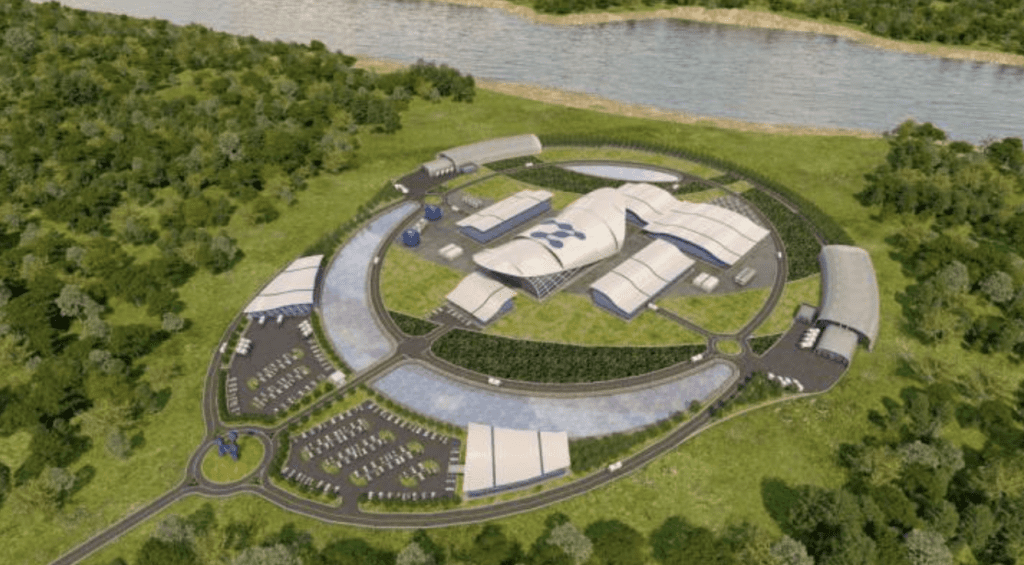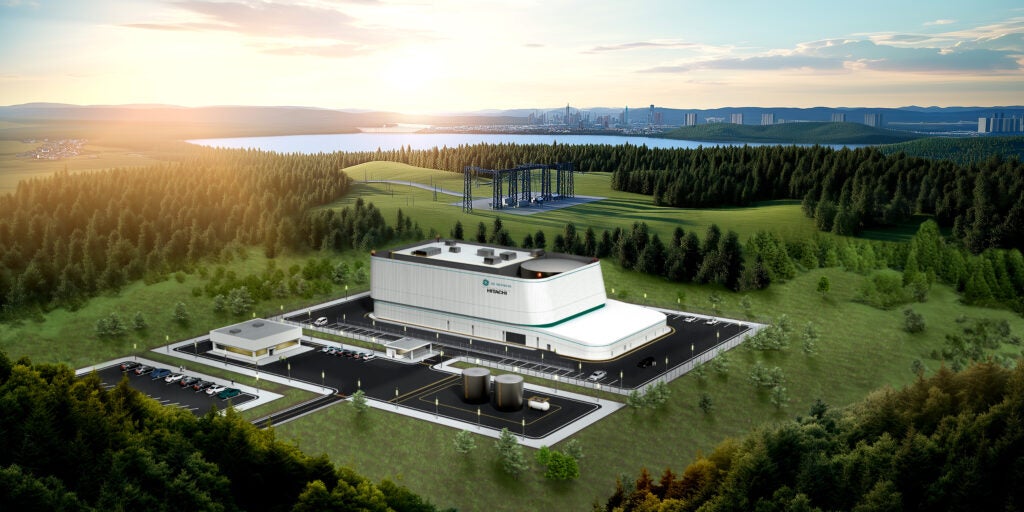
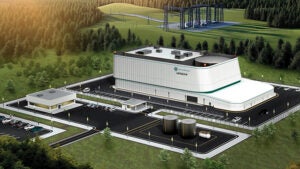
Following a competitive evaluation, Swedish nuclear technology company Studsvik AB has selected GE Vernova Hitachi Nuclear Energy and Samsung C&T as strategic collaborators for a proposed four-unit BWRX-300 project totaling about 1,200 MWe. The project is planned for either Studsvik’s licensed nuclear site in Nyköping or Målma in Valdemarsvik, and the first unit is expected to enter operation in the mid-2030s.
The Sept. 3 agreement also includes GE Vernova’s Financial Services business and South Korea-based DS Investment Partners. It is exclusive for a fixed period that the parties may extend, but it constitutes neither a final investment decision nor an authorization to construct.
Joint development work across commercial, technical, regulatory, and financing tracks is slated to begin immediately, the companies said. “A project company will be established to support development, financing, construction, ownership and operation of the plants, with details to be finalized in definitive agreements,” they added. While definitive agreements will establish the terms, the consortium will select the host site during development, they noted.
Both the Nyköping and Valdemarsvik candidate sites are part of ReFirm, a multi-site small modular reactor (SMR) development program created by Kärnfull Next, a Swedish new-build developer that Studsvik acquired earlier this year. Kärnfull Next’s development model covers siting and land rights, permitting and licensing, design, community engagement, financing, and procurement, which encapsulates what the company calls a “Ready-to-Build” project. Before the acquisition, Kärnfull Next had worked with GE Vernova Hitachi on BWRX-300 deployment in Sweden since 2022 and signed a strategic teaming agreement with Samsung C&T in December 2024. ReFirm also covers proposed campuses at Motala on Lake Vättern and Karlshamn on Sweden’s southern Baltic coast.
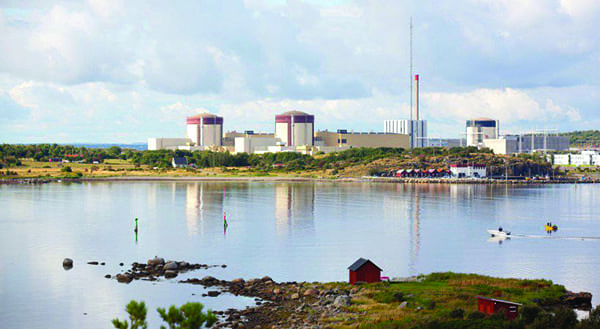
Nyköping is a coastal city about 100 kilometers south of Stockholm in the SE3 bidding zone, which serves the capital and surrounding demand centers. Kärnfull Next and Studsvik began evaluating an SMR campus at Studsvik’s licensed nuclear site in 2023, after Kärnfull Next secured prospecting rights and began feasibility work.
Valdemarsvik is a Baltic coastal municipality in Östergötland, roughly 220 kilometers south of Stockholm. There, the ReFirm Målma project derives its name from the 1,300-hectare Valdemarsvik Målma 4:9 property. Project company ReFirm Målma AB applied in March 2026 to develop a 1,200-MW to 1,600-MW campus and has identified a preliminary 64-hectare plant area near Lilla Syltvik. The filing was the first submitted under Sweden’s new Act on Government Approval of Nuclear Facilities.
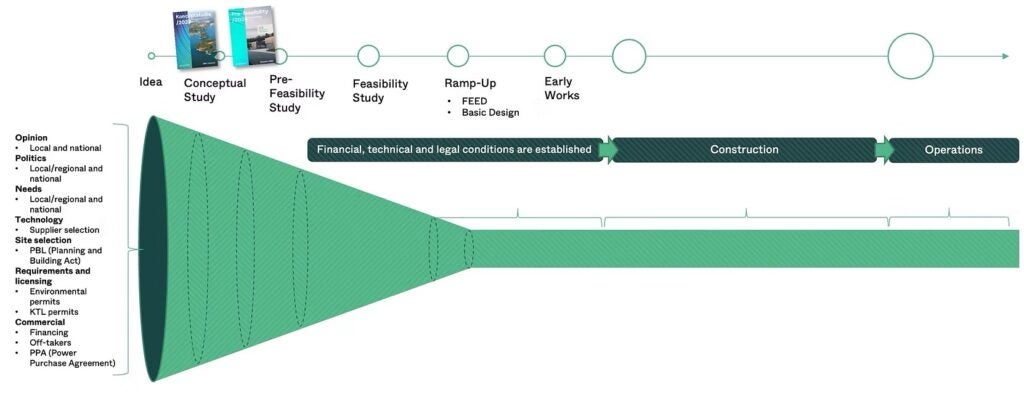
Two-Year Supplier Review Narrows to the BWRX-300
While Studsvik launched in 1947 as the center of Sweden’s national nuclear program, the company now provides services across the nuclear lifecycle, including reactor analysis software used at more than half of the world’s commercial reactors, fuel and materials testing, radiation protection, and radioactive waste treatment. It employs about 540 people in six countries and serves customers in more than 20 countries.
Studsvik’s May 25 application to the Swedish government sought 600 MW to 1,400 MW of new nuclear capacity “at and around” Nyköping. A project-specific supplier analysis had been underway since 2024, and “only a few Western reactor suppliers” remained in a parallel evaluation, as POWER reported in detail. The filing, however, left the reactor technology and supplier undetermined.
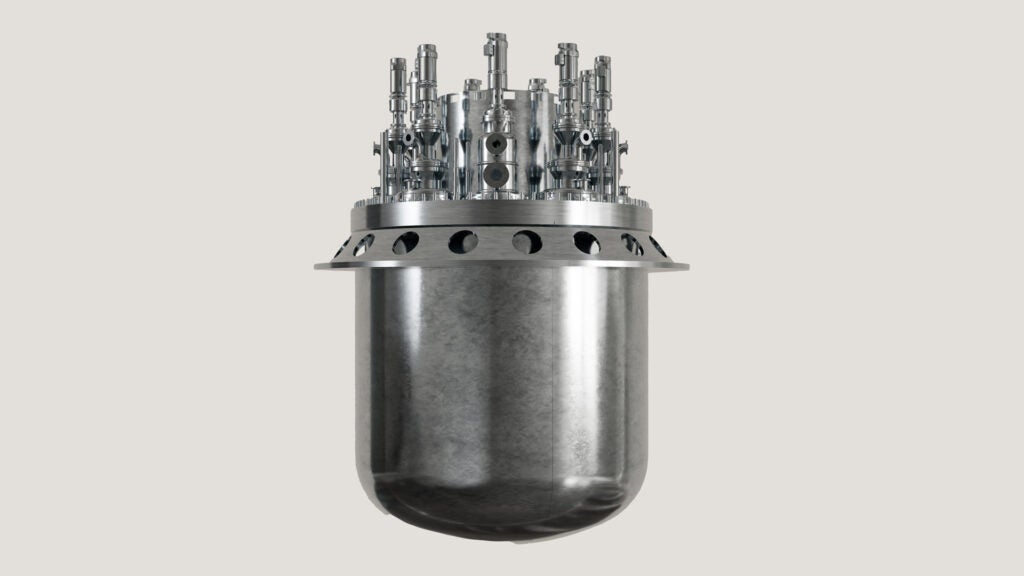
On Thursday, Studsvik said it selected GE Vernova Hitachi and Samsung C&T after a competitive evaluation and now plans to use the 300-MWe BWRX-300. Ontario Power Generation is building the first BWRX-300 at its Darlington New Nuclear Project in Canada.
“Today’s announcement is about helping Sweden turn its energy ambitions into reality in a timeframe that matters for its communities and industries. The country has a strong foundation of nuclear expertise and operational excellence, and the BWRX-300 combines boiling water reactor technology with the lessons being learned every day at the Darlington New Nuclear Project in Canada,” said Karl Thedéen, Studsvik president and CEO. “Together with a growing global pipeline of projects across North America and Europe, this experience gives Sweden access to a technology that is moving from first-of-a-kind deployment toward fleet-scale execution.”
Studsvik said the Sept. 3 agreement is not expected to materially affect group earnings for 2026. Before construction can proceed, the consortium must select a site, secure financing and permits, and execute definitive agreements, it noted.
A Phased, Multi-Unit Structure to Support Standardization
Studsvik will lead permitting, the environmental impact assessment, site rights, community engagement, and discussions with the Swedish state. GE Vernova Hitachi will lead reactor engineering, licensing support, and cost estimation and serve as engineering authority. GE Vernova Hitachi and Samsung C&T will jointly form the execution team, giving the project single-point responsibility for construction and execution, the companies said.
Samsung C&T’s Engineering & Construction Group has delivered 12 GW across 10 nuclear units, including the 5.6-GW Barakah plant in the United Arab Emirates. It has also performed front-end engineering design work for SMRs and undertaken a nuclear plant refurbishment project. DS Investment Partners, a Seoul-based investment firm focused on energy, technology, healthcare, and strategic infrastructure, will lead the investment during the exclusivity period. GE Vernova Financial Services will advise the consortium on financing and financial structuring.
“The phased, multi-unit structure is intended to support standardization across the program and creates opportunities to capture lessons learned from early deployment and apply them to subsequent units, helping improve cost, schedule and productivity outcomes,” the companies noted in their Sept. 3 statement. “It will also help increase Swedish industrial participation throughout engineering, procurement, construction, and long-term operations. This reflects the broader objective of building a supply chain that can help support not only the first project, but also follow-on units and wider deployment opportunities in Sweden and Europe.”
In a statement on Thursday, Studsvik CEO Thedéen emphasized fleet-scale execution. “Sweden’s electricity supply is a long-term play: existing nuclear capacity is aging, and demand for baseload power is growing. To meet that, we have looked for long-term partners and for the conditions that let projects like this succeed. In GE Vernova Hitachi and Samsung C&T we have found them. We intend to build the first project either on an existing nuclear site or on greenfield,” he said. “One plant is a project. Four is the start of an industry.”
Jason Cooper, CEO of GE Vernova Hitachi Nuclear Energy, also suggested the agreement will help Sweden “turn its energy ambitions into reality in a timeframe that matters for its communities and industries.” He said the BWRX-300 combines boiling water reactor technology with “the lessons being learned every day” at Darlington, and that a growing project pipeline across North America and Europe gives Sweden access to a technology “moving from first-of-a-kind deployment toward fleet-scale execution.”
Oh Se-chul, president and CEO of Samsung C&T’s Engineering & Construction Group, meanwhile, pointed out that the consortium combines proven technology, EPC execution, operational experience, and financing capability, and could ultimately establish what he called “a strong foundation for the successful development of the ReFirm program.” He said the company is “equally committed to strengthening Sweden’s industrial capability, expanding local supply chains and building a long-term strategic partnership.”
Sweden’s Burgeoning Nuclear Framework
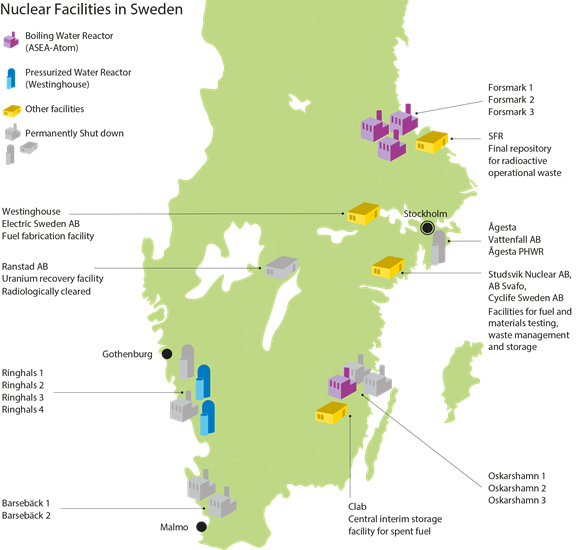
Sweden currently operates six reactors at three coastal sites to supply roughly 30% of national electricity generation. Vattenfall’s Forsmark, north of Stockholm on the Baltic, houses three boiling water reactors (BWRs) commissioned in 1980, 1981, and 1985 for a combined 3,396 MW.
Ringhals, on the Värö Peninsula about 65 kilometers south of Gothenburg, operates two pressurized water reactors (PWRs) commissioned in 1981 and 1983 for about 2,190 MW after two older units retired in 2019 and 2020. Oskarshamn 3, a 1,400-MW BWR commissioned in 1985, is the sole survivor at its site following shutdowns in 2015 and 2017. In June 2024, Vattenfall said it would extend the operating lifetimes of all five Forsmark and Ringhals units from 60 years to 80 years, an investment estimated at SEK 40 billion to SEK 50 billion and incurred mainly in the 2030s.
As POWER has reported in detail, Sweden’s reversal on new nuclear is recent—but it has been astonishingly swift. In September 2023, the government struck an Environmental Code provision that had barred reactors anywhere except existing nuclear sites and eliminated the cap on 10 simultaneously operating units. Three bills passed in March 2026 broadened eligible coastal siting areas, clarified the legal definition of a nuclear facility, and revised the licensing assessment framework. The Act on Government Approval of Nuclear Facilities entered into force on June 17 and applies to applications submitted from March 10, and the environmental code amendments took effect on July 15.
Targeting 2,500 MW of new nuclear capacity by 2035 and 10,000 MW by 2045, the government also directed SEK 20 million to municipalities to speed local permitting, tasked the Swedish Environmental Protection Agency with developing coordinated siting methods, and commissioned an investigation into a dedicated fast-track environmental review for nuclear. Meanwhile, the Swedish Radiation Safety Authority, given a fresh mandate and resources to rebuild licensing expertise lost during the phase-out years, declared itself ready for new-build reviews in December 2025.
The Riksdag in May 2025 authorized state support for up to approximately 5,000 MW of new capacity, roughly four large reactors, combining loan guarantees with a contract-for-difference structure that shields investors from wholesale price volatility.
Six Projects Seeking State Support
Applications for state financial support opened Aug. 1, 2025, and the Ministry of Finance had received six by Aug. 31, 2026.
| Project / Applicant | Site | Technology | Units | Capacity | Siting Application | State-Support Application | Target First Power |
|---|---|---|---|---|---|---|---|
Videberg Kraft AB Swedish state 60%, Vattenfall 20%, Industrikraft 20%
|
Värö Peninsula, Varberg municipality, SE3 | Rolls-Royce SMR, pressurized water reactor | 3 | 470 MWe each; approximately 1,500 MW total and roughly 12 TWh annually | Adjacent to the licensed Ringhals site; no separate government-approval application announced | Dec. 23, 2025; first application received | Mid-2030s at the earliest |
| Blykalla, Norrsundet | Norrsundet, Gävle municipality, near the SE2–SE3 boundary | SEALER lead-cooled advanced modular reactor | 6 | Approximately 330 MWe total; about 55 MWe per unit | May 18, 2026; first commercial application under the new approval process | June 5, 2026; second application received |
Not published |
Studsvik ReFirm, Nyköping |
Studsvik site, Nyköping municipality, SE3 | GE Vernova Hitachi BWRX-300 boiling water reactor | Initial project of 4; siting application contemplated 2 to 4 reactors | Approximately 1,200 MWe for four BWRX-300 units; siting application covered 600 MW to 1,400 MW | May 25, 2026 | June 12, 2026; third application received |
Mid-2030s under the Sept. 3 agreement |
Studsvik ReFirm, Målma |
Valdemarsvik Målma 4:9 property, Valdemarsvik municipality, SE3 | GE Vernova Hitachi BWRX-300 boiling water reactor | Initial project of 4; siting application contemplated 4 to 6 reactors | Approximately 1,200 MWe for four BWRX-300 units; siting application covered 1,200 MW to 1,600 MW | March 23, 2026; first application under the new government-approval process | June 12, 2026; covered by Studsvik’s single application for both sites |
Mid-2030s under the Sept. 3 agreement |
Nordic Baseload Power Malmö-based nuclear project company
|
Proposed Barsebäck site, Kävlinge municipality, SE4 | Large-scale reactors; technology and supplier not identified in the government announcement | 2 | 2,500 MWe combined | Not announced; site owner Uniper subsequently said it would not make the property available | June 16, 2026; fourth application received |
Not announced |
| NuCore Energi AB / Fortum
Newly established project company owned by Fortum
|
Ävrö, Oskarshamn municipality, SE3; adjacent to the existing Oskarshamn nuclear plant | Alternatives include small modular reactors and large-scale reactors; suppliers not announced | Not specified | Alternative configurations ranging from 1,200 MW to 3,400 MW | No separate government-approval application announced | Aug. 27, 2026; fifth application received |
Not announced |
| Blykalla, Untra | Untra, Tierp municipality, Uppsala County, SE3 | SEALER lead-cooled advanced modular reactor | Up to 8 | Up to 440 MW | Aug. 25, 2026 | Aug. 31, 2026; sixth application received |
First half of the 2030s |
Videberg Kraft AB, the vehicle backed by state-owned Vattenfall and Industrikraft i Sverige AB—a consortium of 17 large Swedish industrial companies that includes Alfa Laval, Boliden, Volvo Group, ABB, and SSAB—filed first in December 2025 for 1,500 MW on the Värö Peninsula adjacent to Ringhals in Varberg municipality. Blykalla applied in early June for Norrsundet, while Studsvik followed on June 12, covering two to four units at Nyköping and four to six units at Valdemarsvik. Nordic Baseload Power applied on June 16 for two large reactors totaling 2,500 MWe at Barsebäck in Kävlinge municipality. Uniper, which owns the former Barsebäck plant, subsequently said it had no involvement in the proposal and did not plan to make the site available to the developer, Dagens Industri reported.
A newly established project company owned by Fortum submitted the fifth application on Aug. 27, covering alternatives ranging from 1,200 MW to 3,400 MW at Ävrö beside the existing Oskarshamn nuclear plant. The alternatives include both small modular reactors and large-scale reactors. Blykalla filed the sixth application on Aug. 31 for up to eight lead-cooled modular reactors totaling as much as 440 MW at Untra in Tierp municipality.
For now, the Secretariat for Financing New Nuclear Power will review each application and negotiate the conditions and scope of the proposed support. The government then plans to conduct an ongoing dialogue with the European Commission’s Directorate-General for Competition before the support undergoes a formal state aid assessment.
Rolls-Royce SMR, BWRX-300, and a Lead-Cooled Bid
Videberg Kraft settled its own technology question on June 15, selecting Rolls-Royce SMR over the BWRX-300 and committing to three 470-MWe PWR units expected to generate about 12 TWh annually. Vattenfall said the four-year evaluation began from a field of more than 70 options.
The government on June 25, meanwhile, completed its acquisition of a 60% stake in Videberg Kraft, signing a shareholders’ agreement with Vattenfall and Industrikraft, which will each retain 20%. The spring amending budget provides an initial SEK 1.8 billion, or about $194 million, and authorizes up to SEK 34.3 billion, or about $3.7 billion, during construction, and allows the state to adjust its holding between 51% and 65% until the reactors enter service or 2045, whichever comes first. Vattenfall said the new ownership structure takes effect in 2027. “In this project, we combine Vattenfall’s experience in operating nuclear power plants with industry know-how, and state ownership provides even greater stability,” said Minister for Financial Markets Niklas Wykman.
The government has also proposed absorbing part of an estimated SEK 122 billion, or about $13.2 billion, in baseline fixed costs for a new nuclear waste management system serving new reactors. An additional SEK 61 billion, or about $6.6 billion, could cover cost increases, and state liability could extend from 2035 to 2159. Acting Minister of Climate and Environment Johan Britz said the aim is “to limit the initial actor’s share of fixed costs with the expectation of additional reactors being built, which will ultimately share in the overall fixed costs.”
Advanced reactor developer Blykalla is pursuing a third notable path. It filed the first commercial application under the new siting law on May 18 for a reactor park at Norrsundet, an industrial port in Gävle municipality. The company has proposed six lead-cooled advanced modular reactors for a combined 330 MWe on the boundary between the SE2 and SE3 bidding zones. On Aug. 25, it filed a second application for up to eight units totaling as much as 440 MW at Untra in Tierp municipality, Uppsala County, a site the company selected for its position in SE3, its proximity to existing hydropower at Untra and Söderfors, and its access to new 400-kV transmission Svenska kraftnät is building through the municipality under the Uppsalapaketet program.
Blykalla’s Swedish Advanced Lead Reactor, or SEALER, produces approximately 55 MWe per unit from a 6-meter by 6-meter footprint, operates at atmospheric pressure, and removes decay heat by natural convection without pumps or external power. The company is targeting first operations at Tierp during the first half of the 2030s and applied for state financing for that park on Aug. 31.
—Sonal Patel is a POWER senior editor (@sonalcpatel, @POWERmagazine).