A shorted rotor winding doesn’t care what year it is. Neither does a cracked retaining ring or a degraded stator insulation system. The physical mechanisms that take generators offline—fatigue, contamination, moisture, stress corrosion—have remained largely unchanged even as the industry around them has been transformed by deregulation, renewables integration, and now the demand pressures of data centers and electrification. That continuity is why two Electric Power Research Institute (EPRI) technical reports, one published 2004 and the other in 2006, still have something to say to today’s generator maintenance programs.
The more comprehensive of the two, Main Generator Rotor Maintenance: Lessons Learned, is built on survey responses covering 118 generators and distills the experience of utility and vendor personnel into 47 best practices and 27 lessons learned. Read today, the findings hold up because they describe failure physics rather than any particular vintage of hardware. The report identifies retaining rings, field windings, and rotor forgings as recurring trouble spots, and it’s blunt about the limits of some inspection methods.
For example, ultrasound testing of retaining rings is flagged as “not always reliable,” since the coarse grain structure of 18Mn-5Cr ring material generates a high level of residual signal that complicates interpretation. The report recommends pairing liquid penetrant inspection with eddy current testing, and taking material samples when flaws are found, rather than relying on any single method.
The same report puts particular weight on continuous flux probe monitoring, calling a permanently installed air gap flux probe “the most important instrumentation to indicate shorted field winding turns”—especially useful when a refurbished rotor wasn’t spin-pit tested for shorted turns before installation. By contrast, the report found Recurrent Surge Oscillography testing less conclusive than flux probe monitoring for the same purpose.
It also identified a subtler risk in temperature monitoring itself. Field temperature is typically calculated from winding resistance using a current reading. An inaccurate current signal—sometimes traced to incorrectly calibrated transducers—quietly produces an inaccurate temperature reading downstream.
Several of the report’s lessons point beyond the machine itself to how it’s operated and managed. Cycling a generator, rather than running it at constant load, was identified as a major contributor to main lead failures, insulation deterioration, and fatigue in pole-to-pole connectors—a reminder that maintenance burden isn’t set by age alone, but by duty cycle. Units carrying higher reactive power (VAR) loading showed shortened rotor life expectancy due to elevated field current and temperature.
And on the planning side, the report is emphatic that contingency planning matters as much as inspection. Without pre-arranged plans for spare parts, tooling, and repair procedures, an unscheduled outage from rotor failure can stretch from days into months. Utilities that fared best kept spare rotors on hand—some through consortiums with similar plants—and rotated them into service periodically so the spare itself didn’t sit unmaintained. The report also stresses vendor oversight during rewinds: assigning a utility representative to be present for the duration of a rewind, and requiring a root-cause investigation whenever a rewind is prompted by shorted turns, rather than treating the repair as the end of the inquiry.
The second report, Generator On-Line Monitoring and Condition Assessment: Partial Discharge and Electromagnetic Interference, tracked partial discharge (PD) and electromagnetic interference (EMI) testing across several generating units over multiple years, including Sammis Unit 6, Marshall Units 3 and 4, and Lake Road Unit 3. What distinguishes this study from a typical vendor comparison is that its later-stage findings were checked against actual physical inspections performed during major outages, when rotors were removed and the stator bore was accessible. At Sammis 6, for example, years of stable PD and EMI trending predicted a machine in good condition—and internal inspection confirmed it.
Across the units studied, EPRI’s reconciliation table rated most testers’ assessments as “substantially correct” when measured against what inspectors actually found (Figure 1), though some fell only to “partially correct,” particularly on lower-frequency PD measurements. That mixed record is itself a useful, durable lesson. Online monitoring is a strong screening tool for tracking trends and prioritizing attention, but it functions best as a complement to physical inspection rather than a replacement for it.
 |
|
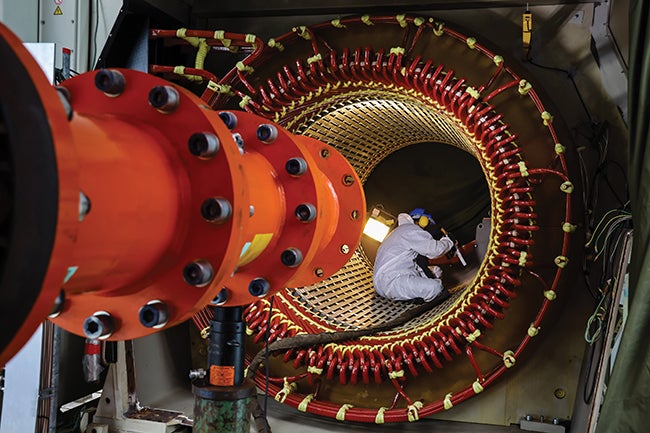
1. A technician cleans a generator stator bore with dry ice after rotor removal. Courtesy: Shutterstock / Nutthapat Matphongtavorn |
The report was also candid about where PD and EMI methods struggled. Discharge activity outside the winding—in isophase bus ducts or exciter components—was sometimes indicated with low confidence, and distinguishing “external” from “internal” sources required supplementary information the raw signal alone couldn’t provide. Interpreting a PD or EMI signature well still demanded a trained specialist, especially when the signal behaved in “non-classical” ways. And the report’s vendor recommendations remain a fair critique of the field even now: testers lacked standardized units of measurement, couplers and instrumentation weren’t interchangeable across vendors, and phase misidentification was common enough that EPRI urged hardware fixes rather than after-the-fact correction.
Taken together, these two reports make a case less for any specific product than for a research habit: systematically surveying failure data across a fleet, checking diagnostic predictions against real inspection outcomes, and being honest when a technique underdelivers. That habit is what let the 2006 studies identify problems—from stress-corrosion-prone retaining ring alloys to the operational toll of cycling—that plants are still managing today. Twenty years on, the monitoring hardware has improved, but the underlying questions EPRI’s researchers were asking remain exactly the ones a maintenance engineer needs answered before the next scheduled outage.
—Aaron Larson is POWER’s executive editor.