
Articles By

-
 Hydro
HydroWhat’s Damming Hydrokinetic Power in the U.S.?
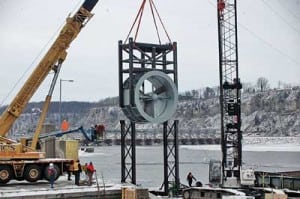
Barely a month after the U.S. Federal Energy Regulatory Commission (FERC) licensed the nation’s first commercial hydrokinetic power station, Houston-based Hydro Green Energy in January completed installation of the first of two turbines at an existing run-of-river hydropower plant on the Mississippi River for the Minnesota city of Hastings. When the second turbine is installed later this spring, the two hydrokinetic turbines will constitute a floating array that will sit on top of a barge at the Army Corps of Engineers’ Lock & Dam No. 2.
-
 O&M
O&MBoiler-Tuning Basics, Part I
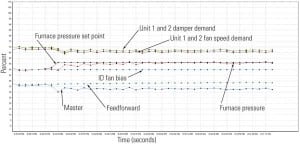
Tuning power plant controls takes nerves of steel and an intimate knowledge of plant systems gained only by experience. Tuning controls also requires equal parts art and science, which probably is why there are so few tuning experts in the power industry. In Part I of a two-part series, we explore a mix of the theoretical and practical aspects of tuning boiler controls.
-
 Waste to Energy
Power Generators Turn to Diverse Fuels
Like the airline industry, power generators all over the world have been seeking alternative fuels with which to produce electricity, and the blends are bound to get stranger. One company is looking to make liquid fuels from chicken fat, beef tallow, and pork lard, for example. Here’s a list of innovative fuels that generators could use in the near future.
-
O&M
"Blueprint" Your Pulverizer for Improved Performance
Pulverizer throughput is determined by the coal fineness desired for a given coal. However, compromising on coal fineness when your pulverizer isn’t up to snuff can increase NO x and cause many furnace problems. Your least costly option for increasing pulverizer capacity is to pay careful attention to key dimensions and critical tolerances during your next overhaul.
-
 Solar
SolarPV Sales in the U.S. Soar as Solar Panel Prices Plummet
Solar panel prices have taken a 10% tumble since October last year, and they are expected to drop another 15% to 20% this year, owning to an oversupply from the mass of new factories and draining demand in Germany and Spain, where solar incentives were recently cut. In the U.S., the low prices — pushed even lower by the renewed solar tax credits that took effect on Jan. 1 and other incentives — have heightened demand, both on the distributed generation level and at utility scale.
-
 Environmental
Update: What’s That Scrubber Going to Cost?
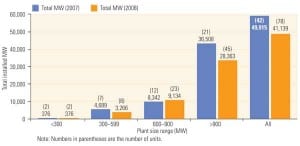
POWER published a summary of the flue gas desulfurization system scrubber cost survey conducted by the EUCG’s Fossil Productivity Committee in our July 2007 issue. Although the detailed results of the latest survey are proprietary to EUCG members that participated in it, we are privileged to present the newest summary data. The bottom line: Costs continue to rise but appear to be more predictable.
-
 News
NewsSuperconductor Motor for Navy Passes Full-Power Test
American Superconductor Corp. (AMSC) and Northrop Grumman Corp. in January said they successfully completed a full-power test of the world’s first 36.5-MW high-temperature superconductor (HTS) ship propulsion motor.
-
 O&M
O&MHelping Power Plant Control Systems Achieve NERC CIP Compliance
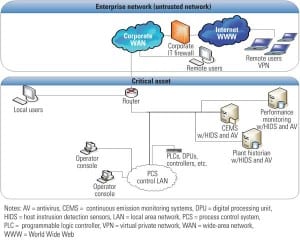
This guide offers suggestions from a control system engineering perspective for protecting power-generating units that are determined to be critical cyber assets
-
 Hydro
HydroSaving the Dead Sea
If measures aren’t taken immediately to replenish the rapidly shrinking Dead Sea, the very salty body of water in the Middle East will shrivel up within 50 years — and that could pose an environmental calamity, experts have warned.
-
 News
NewsBelow-the-Belt Protection
Skirtboard sealing systems are installed on the sides of belt conveyor loading zones to contain material, eliminate spillage, and reduce cleanup expenses. The new Double APRON SEAL Skirting system from Martin Engineering provides two wear surfaces on a single elastomer-sealing strip that’s installed along the bottom of the skirt board. When the bottom side of […]
-
Hydro
International Organization to Push Renewable Energy
Seventy-five countries from around the world joined a new political agency dedicated to the acceleration of green energy this January, but several notable nations — including the U.S., Canada, Australia, UK, Japan, and China — were not among them.
-
Commentary
Energy Efficiency Takes Center Stage in Texas
For decades, it’s been well-known in the country and western (C&W) music industry that "if you’re gonna play in Texas, you gotta have a fiddle in the band." The guitars, drums, harmonicas, and piano — they’re all expected on stage. But as the legendary C&W group Alabama recognized, a fiddle is a must when performing […]
-
 O&M
O&MBest Management Practices for Coal Ash Ponds
The unfortunate coal ash spill at the Tennessee Valley Authority’s (TVA’s) Kingston Fossil Plant that occurred on December 22 has heightened national awareness of the problems associated with utilities’ coal ash surface impoundments if they are not properly maintained.
-
 O&M
O&MReduce Costs with Wireless Instrumentation
New wireless technologies for power plant instrumentation offer significant cost savings when compared to traditional wired networks. The value of this cost savings is especially relevant in the highly competitive power industry, where aging facilities are common and upgrades are an expensive necessity. Modern wireless networks offer a reliable upgrade path that even provides some unexpected benefits when compared to traditional copper networks.
-
General
Will Happer: We need more CO2
By Kennedy Maize Princeton physicist Will Happer, a prominent skeptic about man-made global warming, told the Senate Environment and Public Works Committee Feb. 25 that the earth is in a “CO2 famine,” and more atmospheric carbon dioxide would be a very good thing indeed. “Almost never have CO2 levels been as low” as in the […]
-
News
Federal Court Rules EPA’s Fine Particulate Standards “Unsupported”
A federal court on Tuesday sided with 13 states that had challenged the U.S. Environment Protection Agency’s (EPA) annual air quality standard for microscopic pollutants known as particulate matter or soot, ruling that the government’s standards were “unsupported” by “reasoned decision-making.”
-
News
Appellate Court: FERC Overreached Authority in State Power Line Siting Case
A federal appeals court last week slapped the Federal Energy Regulatory Commission (FERC) on the hand for overreaching the authority granted to the agency by the Energy Policy Act of 2005 when it took an “expansive interpretation” of the law in asserting its power to override state decisions.
-
News
Energy Secretary to Reform and Expedite DOE Dispersal of Funds
U.S. Energy Secretary Steven Chu last week announced a sweeping reorganization of the Department of Energy’s (DOE) dispersal of direct loans, loan guarantees, and funding contained in the American Recovery and Reinvestment Act.
-
News
Study: Emission Regulations Could Cost 600-MW Ark. Coal Plant $2.8 Billion
If the Obama administration regulates carbon dioxide, future costs to contain or abate emissions at the 600-MW John W. Turk Jr. Power Plant proposed for southwest Arkansas by the Southwestern Electric Power Co. (SWEPCO) could exceed $163 million a year—or more than $2.8 billion for the 40-year life of the plant—says an economic study prepared for two environmental groups.
-
News
Feds Sue NRG Subsidiary for Modifications at Coal-Fired Big Cajun 2 Plant
The U.S. government has sued Louisiana Generating, alleging that the NRG Energy subsidiary violated the clean air rules by operating the Big Cajun 2 Power Plant without also installing and operating modern pollution control equipment after the generating units had undergone major “modifications.”
-
Smart Grid
Beacon Power and AEP to Build 1-MW Flywheel Regulation Facility in Ohio
Beacon Power Corp., whose much-watched flywheel system is designed regulate grids using efficient energy storage, is teaming with American Electric Power (AEP) and Columbus Southern Power Co. to build a 1-MW regulation facility in the coming months at an AEP site in Groveport, Ohio.
-
News
Nuclear Briefs From the U.S., Canada, and Japan
This week, the U.S. Nuclear Regulatory Commission (NRC) reinstated construction permits for Tennessee Valley Authority’s (TVA’s) Bellefonte units while it rescheduled its review of a construction and operating license of a planned UniStar project. The Canadian government, meanwhile, approved the first-phase design review of an advanced CANDU reactor, and a Japanese safety commission approved the restart of a major quake-hit generating facility.
-
News
FERC OKs EDF’s $4.5 Billion Purchase of Constellation Energy
The Federal Energy Regulatory Commission (FERC) on Thursday authorized the $4.5 billion purchase by EDF Development of nearly half of Constellation Energy’s nuclear generation and operations business.
-
News
Supreme Court Declines to Hear CAMR Case
A year after a U.S. appeals court vacated a Clean Air Act Rule that would have allowed a cap-and-trade approach for mercury emitted by power plants, the nation’s highest court on Monday declined to hear arguments on the case.
-
General
Yucca Mountain near death
By Kennedy Maize Yucca Mountain is stretched out on its deathbed. Earlier this month, the nuclear industry effectively agreed that the plan to bury spent nuclear reactor fuel under the Nevada mountain on federal government property is ready for political last rites. At meetings with Wall Street analysts and state utility regulators in February, leaders […]
-
Nuclear
900 U.S. Reactors by 2035?
A professor and consultant who has experience and connections with just about every part of the nuclear power world concludes that the U.S. will need to add 900 nuclear reactors in the next quarter century.
-
News
EPRI Outlines Research Required to Deploy Future Nuclear Power in the U.S.
Nuclear energy research, development, demonstration, and deployment can help the U.S. reduce carbon emissions and bolster energy security, a new report coauthored by the Electric Power Research Institute (EPRI) and the Idaho National Laboratory has shown.
-
News
Study: Western Climate Plan Could Prolong Recession, Weaken Power Grids, and Minimally Change Temperatures
A new study says that a climate action plan promoted by several U.S. Western governors could prolong the economic recession, weaken already overburdened Western power grids, and deliver a temperature “benefit” of only one ten-thousandth of a degree Celsius even after a century of operation.
-
Smart Grid
ITC Holdings to Build Midwestern "Green Power Express" Transmission Network
ITC Holdings Corp. last week said that over the past year it has worked to develop the “Green Power Express,” a network of transmission lines that would move12,000 MW of power from wind-abundant areas in the Dakotas, Minnesota, and Iowa to Midwest load centers, such as Chicago, southeastern Wisconsin, Minneapolis, and other states that demand renewable energy.
-
News
Happy National Engineers’ Week!
It’s here—the 59th annual event to encourage students to consider engineering careers while building public understanding and appreciation of engineers’ contributions to society. Created in 1951 by the National Society of Professional Engineers, National Engineers Week is backed by more than 100 professional societies, major corporations, and government agencies, with the goal of ensuring a diverse and well-educated future engineering workforce.