
Articles By

-
Commentary
Auctioning Allowances Will Not Cut Carbon Emissions Faster
Utilities generally support a cap-and-trade approach to reducing carbon emissions—but only when the objective of any legislation is to promote cost-effective reductions. The least-cost alternative for consumers requires free distribution of all carbon allowances.
-
 Coal
CoalFirstEnergy Retools Coal Plant to Burn Biomass
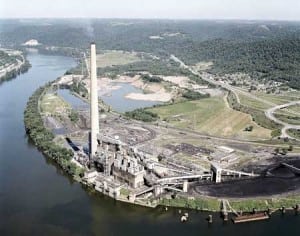
FirstEnergy has announced plans to repower two coal-fired units at the R.E. Burger plant to burn biomass. Conversion of the two units, expected to be completed by 2012, gets the utility off the hot seat with the EPA for alleged Clean Air Act violations.
-
 O&M
O&MA New Era in Power Plant Control Performance
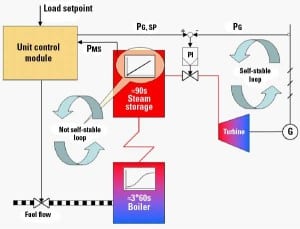
Recent improvements in the performance of steam power plants have been achieved with advanced computerized controls. These new control schemes not only reduce fuel consumption and make the plant much more responsive, but they also can significantly decrease start-up commissioning time and cost.
-
 Coal
CoalCommercial Experience with Concrete-Friendly Mercury Sorbents
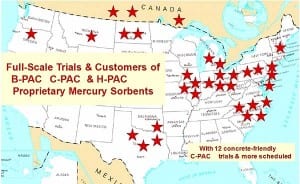
Commonly, 20% of the cement (by weight) in a concrete mix is replaced by fly ash. Fly ash enhances the workability, durability, and ultimate strength of concrete at a lower cost than cement. However, mercury sorbents can change the ash properties to make it unsuitable as a concrete additive. New “concrete-friendly” sorbents can keep the revenues from ash sales flowing.
-
 O&M
O&MBetter Combustion Airflow Monitoring at the Hunan Yiyang Power Plant
Measuring combustion airflow in a coal-fired power plant can be problematic when using annubar instruments that feature small holes that can easily plug with coal dust. Sierra Instruments eliminates this big maintenance headache with its more-accurate, nonplugging thermal mass flow meter design.
-
Commentary
Coal Lobby Message Missing the Mark
Demonstrating sound knowledge, having profound passion, and being consistent with your message are essential when trying to persuade someone to adopt your point of view. A recent press briefing hosted by a well-known pro-coal industry group failed on all counts.
-
Commentary
The Supreme Court and Best Environmental Practices
Did a recent Supreme Court decision give a license to firms to use “best practices” concepts to gut effective environmental standards?
-
Commentary
Go Ahead, Close Oyster Creek
The U.S. Nuclear Regulatory Commission (NRC) in early April granted Entergy Nuclear an extended license for the Oyster Creek nuclear plant in New Jersey, the oldest operating nuke in the U.S. The plant will now be able to operate until 2029, unless the NRC at some point in the future grants a further license extension. Nuclear power advocate William Tucker, with tongue in cheek, advocated closing the plant and other elderly units in the Northeast, in a commentary in the National Review. Tucker’s comments are reprinted with permission.
-
 Legal & Regulatory
Utility Customer Satisfaction: A Faith-Based Initiative?
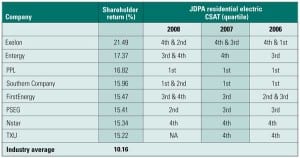
Does customer satisfaction play a meaningful role in guiding utility operations? Many utilities think it does, as do many regulators. The market apparently doesn’t. Data suggest that the jury is out on the question, and the intuitive answer may not match the empirical evidence.
-
Business
Of Prosperity and Pollution (supplement to Powering the People: India’s Capacity Expansion Plans)
Because India has large domestic coal resources (and virtually no other fuel sources); a strong incentive to deploy cheaper, well-proven generation technology; and needs to rapidly increase the availability of electricity to its citizens, the country will likely continue to rely on coal-based power in the long run.
-
Legal & Regulatory
Supremes Back Cost Reviews on Cooling Water
The Supreme Court backs restrictions on “once-through” cooling for new plants, while giving a pass to existing plants.
-
Commentary
Planet Earth: Too Big to Fail <!
The Obama administration is giving mixed signals on global warming: claiming the right to regulate greenhouse gases but also expecting Congress to rewrite climate change regulations.
-
Commentary
Bad Bosses Drive Out the Good
Bad bosses. We’ve all had them, we’ve all coped with them. They are a chronic management problem. But what can we do about them? A management guru offers some advice on how to deal with them and how to avoid becoming one.
-
 Legal & Regulatory
Coal Companies Peabody, CONSOL, and Arch Are Weathering the Economic Storm
Coal continues to demonstrate considerable financial muscle in the current economic downturn, despite anti-coal rhetoric and concerns about climate change.
-
Supply Chains
Uranium Prices: Up, Up, and Away?
Industry experts say raw uranium will face increased demand, reduced supply, and higher prices. Will the market bear out those predictions?
-
 Legal & Regulatory
Will Plug-in Hybrids Cause Blackouts?
Could demand from plug-in hybrid cars crash the grid? A DOE national lab addresses the issue.
-
 Legal & Regulatory
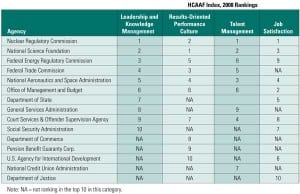
The Best and Worst of U.S. Government Employers
Working for Uncle Sam can be worthwhile or a life-sapping grind, depending on which agency employs you, according to a new survey by the U.S. Office of Personnel Management. Guess which agency ranked best. (Hint: It’s related to power.)
-
Legal & Regulatory
TREND: Coal Industry’s Future Faces Challenges
What role will coal play as the nation moves toward trying to reduce greenhouse gases? The picture is mixed, as these news stories from around the country demonstrate.
-
Commentary
Enjoy the Battle
Climate change legislation, despite its environmental focus, will raise vast sums of money. The Washington turf wars over how to spend the money will dwarf the skirmishes we’ve seen so far.
-
News
Cap-and-Trade Bill Clears House Committee
After a week of long and heated arguments, the House Energy and Commerce Committee on Friday passed by a vote of 33 to 25 the American Clean Energy and Security Act of 2009, a massive 946-page bill that would set up a cap-and-trade program and a federal renewable energy standard.
H.R. 2454 now heads to the House Ways and Means Committee, which will review the tax and trade implications of the bill. That committee could make more revisions to the bill. -
News
U.S. Power Sales Plunge on Weak Economy
U.S. power sales have plunged in the past six months on the back of an unprecedented demand decline that was caused by sharp contractions in the economy, and recovery is not anticipated until the 2010 to 2015 period, an analysis from Edinburgh-based Wood Mackenzie shows.
-
News
Russia Clinches $1 Billion Uranium Supply Deal with U.S. Companies
Russia’s federal atomic energy agency, Rosatom, reportedly said Tuesday that it had reached a landmark deal to supply enriched uranium fuel rods to nuclear power plants in the U.S.
-
News
Duke Energy Vindicated on Majority of EPA Pollution Control Charges
A jury in U.S. District Court for the Southern District of Indiana last week ruled in favor of Duke Energy and against the Environmental Protection Agency (EPA) on four of six projects involved in a decade-long pollution controls lawsuit affecting the company’s Midwest power plants. The jury ruled against the company on two Indiana projects.
-
News
Planned U.S. CCS Demonstration Will Be Largest Test of MHI’s Amine Technology
A public-private partnership that includes the Energy Department, Mitsubishi Heavy Industries (MHI), the Electric Power Research Institute (EPRI), and Southern Co. is planning the largest start-to-end coal-fired demonstration of MHI’s amine solvent carbon capture technology at an existing Alabama coal-fired unit by 2011.
-
News
U.S. Power Sector Carbon Emissions Fell 2.1% in 2008
Carbon dioxide emissions from the power sector decreased by about 2.1% as power generation declined by 1% last year, according to preliminary estimates released last week by the Energy Information Administration (EIA). The decrease reflected, among other factors, falling emissions from fossil fuel generation and an increase in wind-powered generation, the agency said.
-
Commentary
Polling on Warming No Surprise
As a democrat (that’s with a small “d” and a large “D”), I have a great deal of faith in the wisdom of the American people. That’s why I’m not surprised that the hysteria over alleged man-made global warming is in rapid decline in public opinion polls. It’s no longer in the top 10, or event the top 15, of issues that Americans care about.
-
News
World Bank: Global Carbon Market Doubles in 2008
Despite financial turmoil, the global carbon market doubled in size and grew to an estimated value of $126 billion, according to the latest State and Trends of the Carbon Market Report 2009, released today by the World Bank at Carbon Expo in Barcelona.
-
News
Legislators Begin Markup of “Contentious” Waxman-Markey Bill
The House Energy and Commerce Committee began markup of the American Clean Energy and Security Act of 2009 (H.R. 2454) on Monday and Tuesday this week, spending hours wrangling over the first of several hundred amendments proposed for the 946-page bill.
-
News
Utah Court Green-Lights Importation of Italian Nuclear Waste
A federal court has determined that Salt Lake City–based EnergySolutions can import 1.600 tons of low-level radioactive waste (LLRW) from Italy to its facility in Clive, Utah, ruling that its efforts fall outside the regulatory jurisdiction of the Northwest Compact, a coalition that includes Utah and seven other states.
-
News
AREVA Inaugurates French Uranium Enrichment Plant
French Prime Minister François Fillon and AREVA CEO Anne Lauvergeon on Monday inaugurated the first centrifuge cascade of the €3 billion Georges Besse II uranium enrichment plant, where production is set to commence this year.