
Articles By

-
 News
NewsGround-Penetrating Radar
Instrumentation specialist Ashtead Technology has launched the Handy Search, a ground-penetrating radar (GPR) that the company says provides a fast, easy way to examine reinforced concrete, bridges, roadways, tunnels, and buildings for inspection. The Handy Search is also useful for maintenance and quality assurance because it allows users to search for steel reinforcement bars, gas […]
-
Business
POWER Digest (July 2010)
Alstom and Schneider Electric Close AREVA T&D Acquisition Deal. Alstom and Schneider Electric on June 7 closed a €2.29 billion (US$2.75 billion) transaction to acquire AREVA’s transmission and distribution arm, AREVA T&D, after obtaining approvals from relevant competition authorities and the French Commission des Participations et des Transferts. A consortium agreement for the joint acquisition […]
-
 News
NewsBaghouse Filter Leak Analyzer for EPA-MACT
A new continuous particulate emissions monitor and baghouse filter leak analyzer incorporates automatic self-checks (zero and span) to ASTM standards to automate compliance with regulatory requirements for periodic instrument validation. The particulate monitor also features system checks to simplify installation and setup and to improve overall performance. Benefits include stack monitoring, detecting filter leaks, eliminating […]
-
Legal & Regulatory
Climate Change: Avoid Political Thickets
A federal judge recently dismissed a lawsuit in which the plaintiffs alleged that defendants’ production of chemicals and electricity had “added to the ferocity of Hurricane Katrina.” The judge’s reasoning reveals the inherent limitations of courts unilaterally initiating policies to address climate change issues.
-
 News
NewsDifferential Pressure Flowmeter
Endress+Hauser announced the Deltatop differential pressure (DP) flowmeter for measuring gas, liquid, and steam in ½-inch to 24-inch pipes. The company said that Deltatop is a complete flow monitoring solution, including an averaging pitot tube, and offers customers the most accurate and reliable DP flow technology in the industry. The flowmeter features precision-machined orifice plate […]
-
 History
China: A World Powerhouse
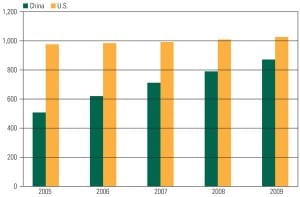
It’s no surprise that China leads the world in recent power capacity additions. What may surprise you is the precise mix of options this vast country is relying upon to meet its ever-growing demand for electricity. As a result, this ancient civilization is fast becoming the test bed and factory for the newest generation and transmission technologies.
-
 News
NewsAir Velocity Sensors
Degree Controls has introduced AccuSense F333 air velocity sensors, a series of low-cost airflow sensors designed for field systems. The AccuSense F333 provides air velocity measurements within the range of 0.2 m/s to 10 m/s (40–2,000 fpm) while maintaining a ±10% accuracy across a temperature range of 15C to 60C with a 2% or better […]
-
Legal & Regulatory
TREND: Fire Safety Again Tops Nuclear Agenda
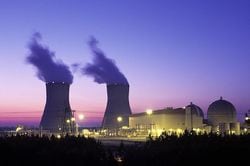
The U.S. Nuclear Regulatory Commission puts fire at the top of its safety concerns, calculating that fire constitutes half of all reactor safety risks, and lately fire safety has again become a major industry issue. For example . . .
-
 Water
WaterReACT Reduces Emissions and Water Use
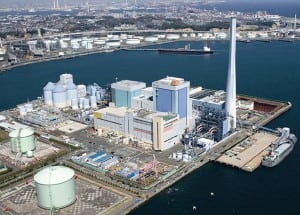
Regenerative activated coke technology (ReACT) is an integrated multipollutant control approach that removes SOx, NOx, and Hg from coal-fired plants by adsorption with activated coke to attain emissions levels found at natural gas–fired plants. One big advantage of this technology is that it uses only a fraction of the water used by conventional wet flue gas desulfurization. A recent license agreement brings this technology to the U.S.
-
Commentary
WTE: Next-Generation Sustainable Energy
It is clear that energy use will expand in the future as our population and society’s standard of living increase. Meanwhile, the push toward a sustainable lifestyle requires that all resources be utilized efficiently and sparingly. The National Academy of Sciences has identified paradigm shifts from current processes to an ideal vision centered on renewable energy and an atom economy—defined as maximum incorporation of starting materials into final products. These seemingly disparate paths converge if one considers energy production from municipal solid waste (MSW).
-
 Commentary
The Politics and Perils of Pork
An "emergency war supplemental" appropriation bill that Congress was considering at this writing has implications for the power industry: The measure includes $9 billion each for new loan guarantees for nuclear power and renewable energy projects.
-
News
Carbon Controls Fail Business Case Study
Cap-and-trade programs are featured in at least two U.S. legislative proposals to reduce carbon emissions, usually by around 80% by 2050 using a 2005 baseline. The benefits that accrue from the immense investment required to reach these goals are nebulous and don’t occur until decades after the investment. Based on my back-of-the-envelope analysis, the cost-benefit ratio of these proposals does not pass a cursory cost-benefit analysis.
-
 Water
WaterCirculating Fluid Bed Scrubbers Bridge the Gap Between Dry and Wet Scrubbers
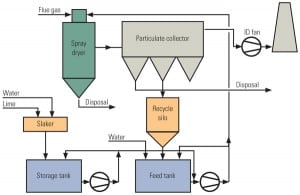
Circulating fluid bed (CFB) dry scrubbing technologies provide distinct advantages over conventional spray dryer absorber scrubbers for removing SO2 from flue gases. The CFB also competes well against wet limestone flue gas desulfurization processes typically favored for large boilers firing high-sulfur coals. With high SO2 removal rates in a dry treatment process, the CFB scrubber appears to be the best of both technologies: a water-stingy scrubber with high SO2 removal rates.
-
 Environmental
Determining AQCS Mercury Removal Co-Benefits
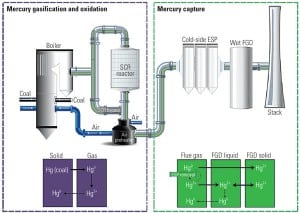
The U.S. Environmental Protection Agency is expected to propose an emissions standard for mercury and other hazardous air pollutants emitted by coal- and oil-fired electric generating units in March of 2011. The anticipated rule would require emission control to meet the various standards using maximum achievable control technology, as determined by the prescriptive requirements of the Clean Air Act. In response to the expected rule-making, utilities will be required to make technology decisions in order to ensure compliance. One cost-effective approach to compliance may be the use of “co-benefits” from air quality control systems (AQCSs) already in service that are designed to remove other pollutants.
-
 Legal & Regulatory
Regulators Embrace Nuclear—Awkwardly
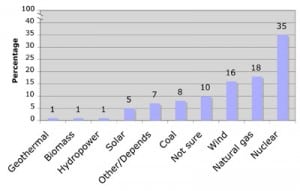
A recent survey finds utility regulators contradicting themselves on the touchy subject of nuclear power. They say they like new nukes, but their actions belie their stated beliefs.
-
 O&M
O&MNew Coating System Extends Life of Cooling Tower
American Electric Power’s (AEP’s) Cardinal Power Plant Unit 3 cooling tower in Brilliant, Ohio, was coated and lined in the spring of 2008 by a team of coatings professionals that included the plant’s project and coatings engineering staff, Sherwin-Williams (coatings supplier), Cannon Sline Industrial (contractor), and OTB Technologies (third-party inspector). The team completed the project in just 11 weeks through damp springtime conditions in the Ohio River Valley.
-
 Coal
CoalDrax Offers Model for Cofiring Biomass
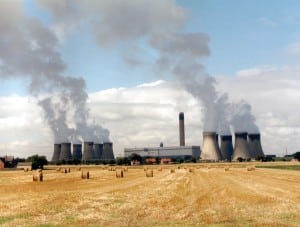
When it is completed, later this summer, the UK’s Drax Power Station biomass facility will become the largest dedicated cofiring project of its kind in the world. As U.S. coal-fired generators come under increasing pressure to cut emissions and take advantage of incentives to promote power generation from renewables, Drax offers an example of what is possible.
-
Supply Chains
DOE Helium Shortage Hits Nuke Security, Oil And Gas Industry
The Energy Department’s failure to recognize an impending supply squeeze for helium-3—a nonradioactive gas produced in the agency’s nuclear weapons complex—has created a national crisis requiring White House intervention and threatening key U.S. nuclear and homeland security programs, a wide range of medical and scientific research activities and development of U.S. oil and natural gas resources, according to testimony before a House subcommittee.
-
 O&M
O&MNew Process Transforms Waste into Product for Controlling Emissions
In April, Solvay Chemicals Inc. commissioned a new facility that uses an innovative process to recover and transform sodium carbonate waste streams into a market-grade sodium bicarbonate used in air emissions control.
-
 O&M
O&MUse Dry Fog to Control Coal Dust Hazards
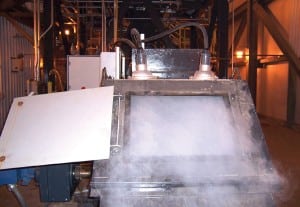
Fogging systems have been successfully used in the material-handling industry for more than 30 years to control explosive dust at transfer points. Today, fogging systems are an EPA Best Demonstrated Technology for subbituminous coal preparation plants.
-
 HR
HRWasting Time and Hating the Job
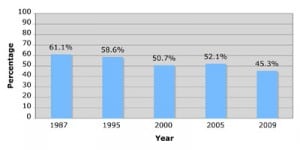
Does wasted work time equal job dissatisfaction? Two studies point in that direction.
-
 News
NewsShoring System Uses First Built-In Ladder Supports
Safety is the imperative for any construction project, and Duke Energy’s 630-MW Edwardsport integrated gasification combined-cycle station in Knox Country, Ind., is no exception.
-
Environmental
Regulations and Economics Drive Wet FGD Upgrades
Today’s coal-fired power plants face the twin challenges of improving their wet flue gas desulfurization (FGD) systems’ emission control capabilities in order to comply with environmental regulations while at the same time cutting their operational and maintenance costs. Smart strategies for retrofitting existing FGD systems can help plant personnel meet both of these objectives.
-
News
NRC Judges: DOE’s Motion to Withdraw Yucca Mountain Is Illegal
A three-judge panel at the Nuclear Regulatory Commission (NRC) on Tuesday unanimously denied a motion by the U.S Department of Energy to withdraw its 17-volume, 8,600-page license application to build a nuclear waste repository at Yucca Mountain, Nev. The withdrawal is illegal because it supersedes the Energy Department’s authority under the Nuclear Waste Policy Act (NWPA) of 1982, the judges said.
-
News
SWEPCO to Press On with Ultrasupercritical Coal Plant Construction
The Arkansas Supreme Court on Thursday declined to reconsider a ruling that voided a permit to build the John W. Turk., Jr. power plant—the nation’s first ultrasupercritical pulverized coal power plant. Southwestern Electric Power Co. (SWEPCO) now says it will continue construction of the plant that is 28% complete under an option to sell power in other markets.
-
News
Reports: Bingaman Crafting Utility-Only Cap-and-Trade Bill
President Obama’s meeting with 23 senators of both parties at the White House on Tuesday appears not to have moved either side on comprehensive energy and climate legislation. But from various reports, a new bill being drafted by Sen. Jeff Bingaman (D-N.M.), which seeks to limit a cap-and-trade program to just the utility sector, seems to gaining traction in Washington.
-
News
New Bill Promotes Domestic Production of Rare Earth Elements
Sen. Lisa Murkowski (R-Alaska) last week introduced legislation to promote the domestic production of rare earth elements—metals and their compounds that are used in high-temperature superconducting technologies, windmills, and battery technologies. China currently controls a majority of that market.
-
News
MIT Study: Modern Combined-Cycle Gas Generation Could Play Role in GHG Reduction
A new study from the Massachusetts Institute of Technology (MIT) that examines the future of natural gas through 2050 from the perspectives of technology, economics, and politics concludes that natural gas will play a leading role in reducing greenhouse gas (GHG) emissions over the next few decade if older, inefficient coal plants are replaced with modern combined-cycle gas generation.
-
News
China to Start Up Ling Ao II Reactor Ahead of Schedule
China’s Guangdong Nuclear Power Group (CGNPC) plans to start commercial operation of a nuclear reactor at the Ling Ao II nuclear power plant this October. The reactor will be the 12th to supply power to China. A second unit is set to begin operation in 2011.
-
News
EPA Disapproves Texas Flexible Air Permit Program
The U.S. Environmental Protection Agency (EPA) today announced final disapproval of the flexible permit program that the Texas Commission on Environmental Quality (TCEQ) had submitted for inclusion in its clean-air implementation plan, saying that the program “does not meet several national Clean Air Act requirements.” The move is the latest in an escalating dispute between the federal agency and the state over air pollution rules.